SULLIVAN’S TIP DOWN – TIP UP

Reviewed by: Capt. Mike Schoonveld

Thousands of fish are caught using tip-ups every ice fishing season. No doubt, they work. No doubt most of them feature technology not much different than the same gear ice-anglers were using 100 years ago. The line is basically “hand-lined” down to the level of the fish; once the fish bites and swims off the simple spool of line on the tip-up rotates and a spring-loaded flag pops up showing it’s time to bring in the fish. Grab the line, wait for the line to tighten, give it a jerk to set the hook and then hand-over-hand pulling the fish up to the surface.

There’s a certain “primitive” satisfaction to handlining a fish, but by and large, most anglers prefer to use a rod and reel. I’ve seen and used some tip-up designs that “MadGyvered” a standard tip-up to allow a modern rod and reel to be connected to it, but Jim Sullivan perfected a design that allows matching almost any rod and reel with his “Tip Down.”

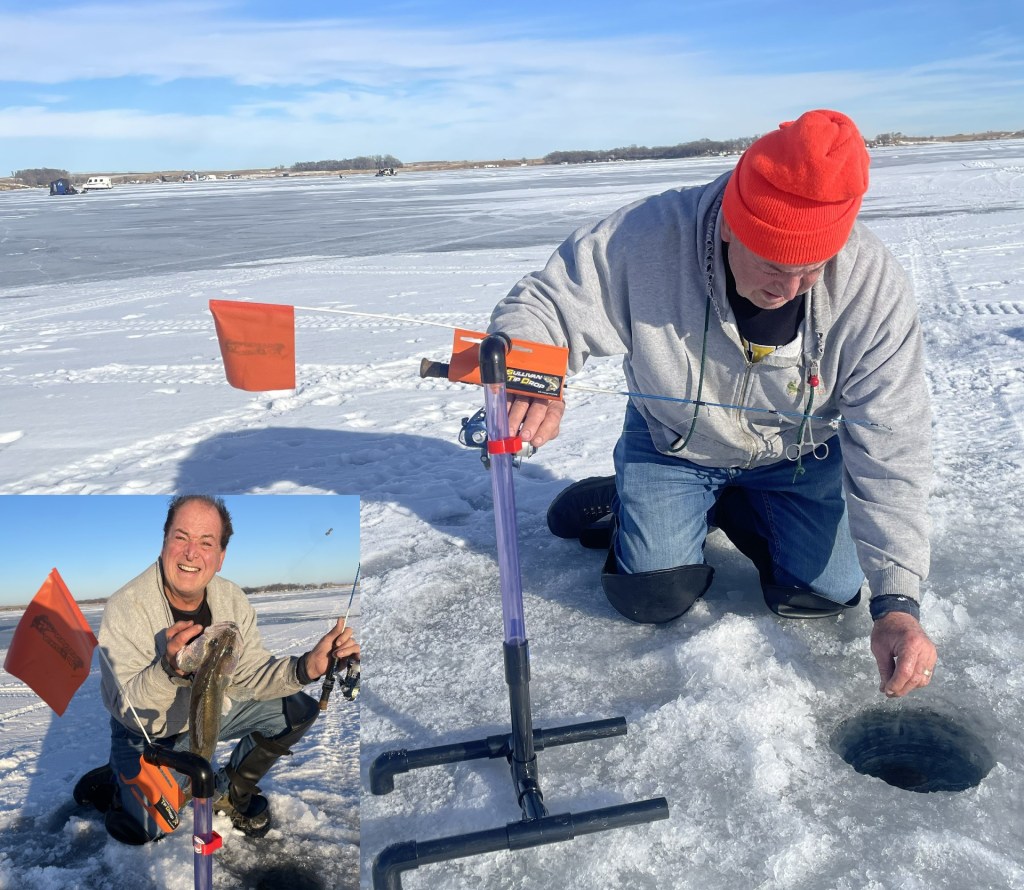
The frame of the Tip Down is made from colorful PVC pipe (allowing it to be disassembled for transport). Once it’s assembled and positioned next to the hole, it’s ready. Just open the reel’s bail and lower the bait down the hole. Now, set the rod in the rod cradle on the Tip Down and adjust the cradle to balance the rod and reel so it’s positioned horizontal to the ice. Loosen the drag on the reel so it’s just tight enough to keep an active minnow from pulling line against the drag. The Tip Down is fishing.

When a fish inhales the bait and swims off, the rod tips down and the flag tips up signaling a bite. Grab the rod, tighten the drag as needed, set the hook and reel in the fish! On the first trip my Tip Downs were used they caught average sized perch and crappies as well as above average sized walleyes.

The Tip Downs are available at www.sullivantipdown.com in several colors. The website lists some add-ons to fit the Tip-Downs. One is an LED light that will light the Tip Down both to be able to detect bites after dark and also to light it up so snowmobilers can see them in the distance. Another allows attaching Tip Downs to the walls of portable or permanent shelters and wheel-houses. Check out the informational videos at this site as well.    

TRAILER ROLLER BY C.E. SMITH

Reviewed by: CAPT. MIKE SCHOONVELD

When I launch my boat solo I attach the bow mooring rope to the winch stand on the trailer so when the boat floats free the connection keeps the boat from floating away. Most places, by the time the boat floats off the trailer, the winch stand is past the water’s edge and I have to pull ahead several feet to be able reach and remove the rope from the winch stand and tie the boat to the dock. 

I quickly learned that using an overly long rope would allow the boat to drift aimlessly until I could get to the rope. That’s very concerning on breezy days. I experimented with several lengths and settled on a bow rope just a couple of feet longer than the trailer. At most ramps, the sides of the center bunks on the trailer keep the bow of the boat from drifting as I pull forward a little. On less steep ramps, or if I pulled ahead an extra foot or so, the keel of my boat would hit the rear crossmember on the trailer. Steel on fiberglass isn’t good.

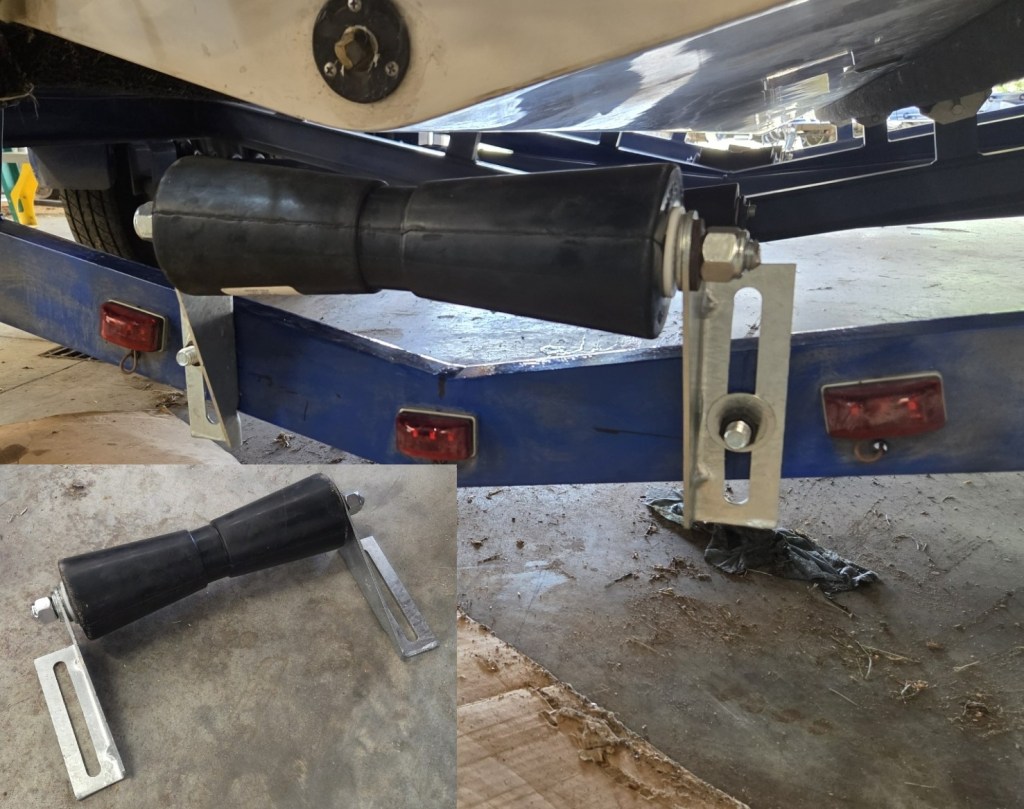
My solution was to purchase an extra keel roller to mount on the back of the trailer frame. It was a simple job. I only had to drill a couple of ½-nch holes in the trailer frame for the mounting bolts. I used a 12” roller with adjustable brackets so I could adjust the height of the roller. No need to mount it so it’s touching the hull when the boat is fully on the trailer. I got the roller and mounting frames from C.E. Smith Company directly from their website: https://store.cesmith.com but you can find C.E. Smith boating and trailer parts at many retailers and online sellers.

FLAMBEAU’S NEXTGEN 4/0 MEDIUM TACKLE BOX

Reviewed by: CAPT. MIKE SCHOONVELD

The day my son was born, I used it as an excuse to buy a new fishing rod. I could imagine in five or six years, I’d have it well broken-in and he’d be standing on the back deck reeling in a coho or two with it. That “dream” did come true.

When my first grandchild was born, I bought her a child’s model, Zebco spincaster. Fishing off a boat dock, Anna reeled in her first bluegill with it when she was just 2 ½ years old. She now has a little brother, but I hadn’t yet bought anything “fishy’ for him when I spotted a NextGen 4/0 Medium Tackle Box made by Flambeau Outdoors. Bingo!

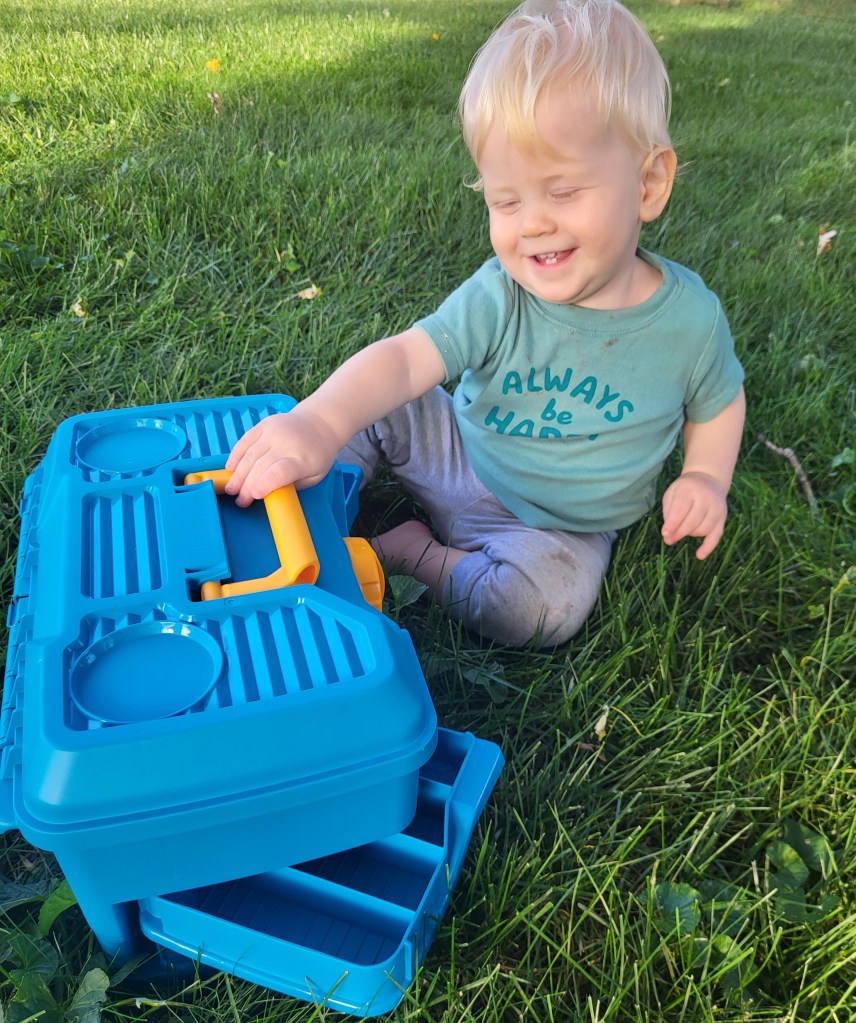
Andrew is way too little to fill the box with hooks, bobbers and other fishing gear, but I knew he’d be attracted to the bright blue color of the box, the bright yellow handle and closure knob and have fun opening and closing the top and swinging out the drawers to fill them with other bright plastic toys. I was right about that.

In a couple years we’ll add a few panfish hooks, some red and white bobbers and other panfish tools then head down to the dock. In the meantime, I’ll work on teaching him words like “tackle, reel, bobber and “here fishy, fishy.” That’s one of the jobs grampas are supposed to do.

Toddlers are going to play with some sort of toys, they might as well be fishing oriented toys. One of the jobs Flambeau Outdoors has taken on is to supply products designed to capture the attention of the next generation of anglers. Check out their NexGen Tackle Boxes, Wild Bite Adventure Kits and the Big Mouth Tackle Box Kits at: http://www.flambeauoutdoors.com. All Flambeau products are available at this website, as well as at hundreds of online sources, retailers and big-box stores. (Flambeau makes products for “big” kids and grampas, too.)

INSHORE ESSENTIALS TOOL KIT BY TOADFISH

Reviews by: CAPT. MIKE SCHOONVELD

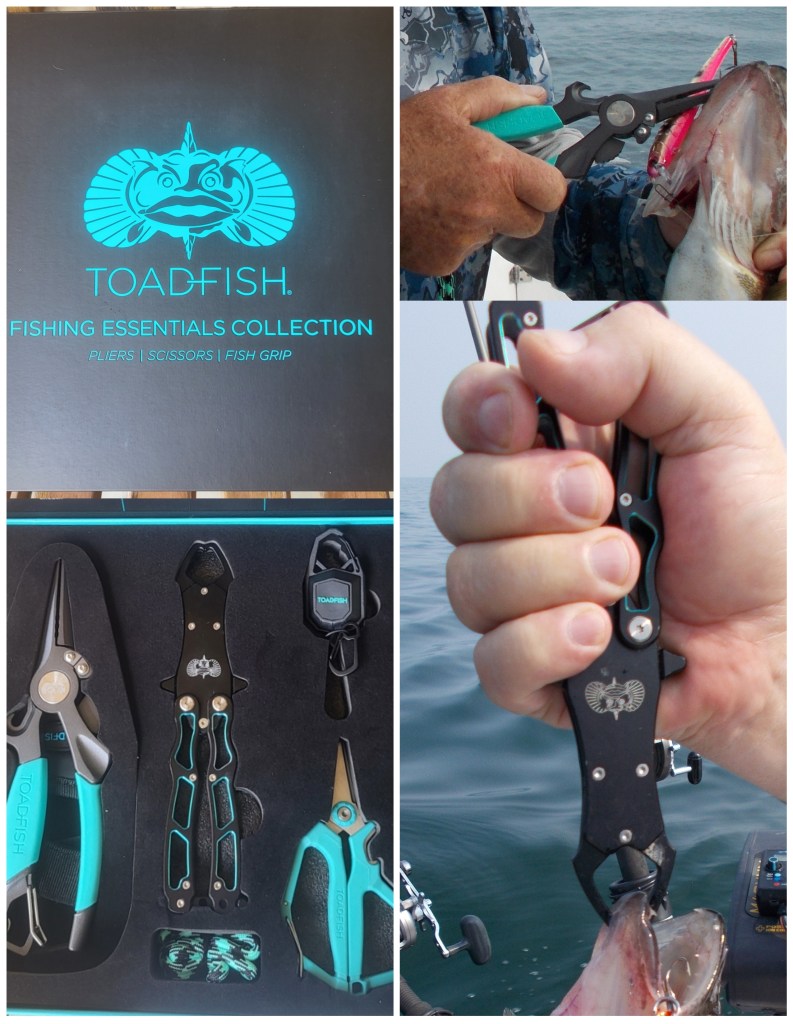
What fisherman doesn’t like getting a fishing related gift for Christmas or other occasion? I do, but my wife and daughter know better than to just wander into a tackle shop or click around the interweb and buy something that they think I would like, need or enjoy. (I probably already have it or don’t need it.) So, I make not-so-subtle “hints” about the “Tackle and Toys” that would brighten my Christmas, birthday or anniversary to help them out. One of the hints I made for my birthday a few months ago, paid off both for me and for my wife – the Inshore Essentials Tool Kit from Toadfish.

The kit includes a “boca grip” style fish gripper, a pair of braid scissors and a pair of long-nose pliers (along with a retractable cord and a lanyard.) “Whoopie do,” you might think, but one feature stands out from the “gifter’s” point of view- they come packed in a stylish case, virtually useless on the boat, but handsome to behold – that scores points for both my wife and daughter. Inside the case, the tools look terrific, as well; sort of like the sausage sticks and foil wrapped cheese in a gift box from Hickory Farms look better than similar items at a food store. The contrasting blackened steel or aluminum frames set off with contrasting stainless steel rivets and hinge-pins give them a “cultured” appearance and the signature, “Toadfish-teal” grips on the pliers and scissor makes them look even better.

More important to me is: “Do they work?” I don’t give a whit if the pliers, cutters or other tools on my boat look good. If they work good, I love ‘em. If they “look good” I just love ‘em more. These tools were designed to work, then appointed to make them handsome. The pliers fit my hand, open and close with zero slop, have a spring-loaded action, important when using them with wet or “fish-slimed” hands. The jaws taper to grip onto perch-sized hooks and are strong enough to dislodge a 2/0 treble from still quivering king salmon. Add a bottle opener and carbide line cutter and it’s a winner.

Most fish grippers are long, heavy tools. The one in the Toadfish kit is petite, in comparison, lightweight and with folding handles allowing them to be stowed in your pocket or in a hand-tool rack if you prefer. Don’t let the small size fool you. The largest size fish I’ve lifted with them so far was a still-struggling 20-pound laker. I love them for walleyes, however, since I can hold the fish easily but the diminutive size doesn’t get in the way of unhooking the trebles even if they have been sucked in way back in the fish’s mouth.

The line cutter clips both mono and braid perfectly. ‘Nuff said, other than the built in carabiner makes it handy for storage whether on a belt loop or other location.

Here’s the exact URL to post on the gift list you present to the person who wants to see your eye’s light up on that special day: https://toadfish.com/products/inshore-essentials-tool-kit. Now available at Amazon as well.

FLAGSHIP TROLLING RODS BY FISHUSA

Reviewed by: CAPT. MIKE SCHOONVELD

Many big box sporting goods retailers produce any number of products with their own label on them. They don’t manufacture the gear – Bass Pro, Dicks Sporting Goods, Sheels and other major retailers including FishUSA don’t own factories. Instead, they contract with companies that do have manufacturing facilities, perhaps Shimano, Daiwa or others to build rods, reels, lures, and dozens of other products for them and then adorn them with the FishUSA or other company’s label.

Don’t expect these private labels to be identical with the name brand models, but that doesn’t mean they are inferior. In many cases they are made to exacting specifications and (at least to most anglers) they perform similarly to the brands from well-known manufacturers. In general, however, they don’t carry the price demanded by the well-known equipment makers. That’s important to value-minded anglers, whether they are newcomers and can’t afford to invest in multiple set-ups all at once or for seasoned charter captains who are often putting their gear in the hands of rank amateurs prone to abusing tackle just due to unfamiliarity with handling any sort of gear.

I was pleasantly surprised by the Flagship Trolling Rod I got from FishUSA in late summer in every aspect. It looks good and performs great. The 802M model I tested has a pleasing metallic steel-blue finish – not so flashy that it looks out of place among the other rods in my array; but even if it was some gaudy color, I’d still like it for how it feels in my hands and how it performs both when I’m trolling or when it’s being bent by a Great Lakes fish.

In hand, its graphite composite blank is noticeably lighter than many of the “well-seasoned” major brands I use daily and the triangular shaped foregrip gives it a firm feel, comfortable in my hands and I’m sure it will be easier to grip for novice customers to handle. The 802M is eight feet long, two-piece construction for easy storage and is rated for 10-to-20-pound line. It will fit well with the rods I use when trolling for cohos on Lake Michigan or walleyes on Lake Erie using planer boards. It would work well with a downrigger for these species, but if I planned to use it when targeting kings, steelhead or lakers, I’d select one of the medium-heavy Flagship versions offered by FishUSA with a bit more backbone.

If you are looking for a mid-priced rod with top-level looks, quality and performance, look no further than the Flagship trolling rods from FishUSA. See them all at http://www.fishusa.com.

THAW RECHARGEABLE HANDWARMERS

Reviewed by: CAPT. MIKE SCHOONVELD

I’ve nearly passed out two different times when my hands got so cold my brain shunted all my blood to my inner organs. I suppose this was to keep them working while I froze to death. One time was when I was duck hunting, once I was ice fishing and both times I was equipped with a hand-warmer that was supposed to keep that from happening.

One of these handwarmers produced heat by burning cigarette lighter fluid – it ran out of fuel. The other warmer had charcoal “stick” inside that was ignited, placed in a flameproof metal box the size of a cell phone. The fire went out.

I didn’t die, and I never relied on handwarmers again to keep my hands warm. Both of these events occurred decades ago, so when I heard of a company called THAW that was producing rechargeable electric hand warmers, I thought, “Perhaps it’s time I revisit handwarmers, now that hi-tech technology has replaced stone age methods to provide a bit of finger-warmth on cold days of fishing.”

What can I say? Charge it up, stick it in your pocket and turn it on when you get to the boat on a frosty morning, have your ice-holes drilled or whenever it’s needed. (If the low heat setting works for you, turn it on and forget it most of the day – it will last 7 hours (they say) and produce 113 degrees (Fahrenheit) of heat. I seldom turn it to the medium or high setting (high is 140 degrees), but I do turn it on and off since there’s no fuel or fuel sticks to ignite. The cell phone sized handwarmer goes from cold to warm in less than a minute. That’s the 5K version. The 10K version produces the same heat but lasts nearly twice as long or provides surplus power to use its other features.

The handwarmer is a multi-tasker since it has a small, but bright, LED flashlight and a port to plug in a power cord to recharge a cell phone or other electronic device needing a boost. I’ve tried the light – it’s bright, similar to the one on my cell phone. I’ve never had to jump-start my phone, but I assume it would work.

Check out the handwarmers and other THAW products at http://www.thaw.acgbrands.com. Purchase them there, at retailers or at Amazon and other online sellers.

DIAL BACK MEMORY ENHANCERS

Reviewed by: CAPT. MIKE SCHOONVELD

You are out fishing with your regular crew, one of which just finished unhooking a walleye that hit one of the planer board lines, or you are trolling on Lake Ontario and your fishing partner just unhooked a king salmon that fell for a lure pulled deep with a Dipsey Diver – or perhaps it’s you and a friend on Lake Superior and the fish being unhooked is a laker that fell for a downrigged lure. Regardless of the place or the fish, soon the familiar question will be heard: How deep was the line set? How far out did you have this Dipsey? How far back was this Flicker Shad?

                Ah…. I think I had it out…. How far is the diver on the other side…? More likely, “I can’t remember.”

                How far? How deep? How much line? All are important questions; and the wrong answer can be the difference in whether that lure or that line is a one-hit-wonder or the hero for the day.

                I’m sure there are “set-up savants” that can remember every lure and every deployment. I was once on a boat where the captain kept an Excel spreadsheet on an iPad showing every lure, every depth, every fish, probably the wind speed and color of each angler’s underwear. That’s not me and it wasn’t a couple of Michigan fishing buddies who were always asking these questions whether they were out for Saginaw Bay walleyes or trolling for Lake Huron salmon.

                But instead of just asking this question over and again, they used their non-fishing talents to invent and produce the Dial Back Precision Trolling Device, or what I call the Dial Back Memory Enhancer. There are two styles, depending on how your boat is set up or how you fish. Both have a small, plastic body with three numbered dials which rotate from zero to nine. Have a Dipsey Diver set at 93 feet, set the dials on the memory enhancer to show 093.  

                The original style is best for boats that always have the same rod in the same rod holder. The device attaches to the rod holder. If you always put the starboard downrigger in a specific rod holder, that’s where to put the Dial Back. Set the lure 88 feet deep, set the rod in the holder, set the dials on the Dial Back to 0-8-8.

                The Dial Back “mini” is for guys who rotate their rods, a common tactic for those who use Big Board Planers with the fishing lines attached to releases that slide down a tether cord. After a fish is caught on the rod and reel in rod holder #1, the rod in the #2 holder gets moved to the #1 position, the #3 moves to #2, etc. The lure that caught the fish gets positioned to rod holder for the lure trolled closest to the boat.

                Dial Back Minis attach to the rod or reel in any position that works for you. Attach it to the reel, to the rod, to the first line guide – where doesn’t matter, the process is the same. Catch a fish. Rotate the other rods, check the Dial Back on the set-up that just caught the fish and put the lure exactly as far as it was previously.

                These are products EVERY trolling boat should have and every troller can afford! The Mini’s are available in black, the originals in a variety of colors so you can color-code your rod holders. “Fish on yellow!” Check them out and purchase them at www.dialbackprecisiontrolling.com.   

GREAT LAKES PRO INSULATED SUIT By Whitewater

GREAT LAKES PRO INSULATED SUIT

Reviewed by Capt. Mike Schoonveld

  Do you get a chill down your spine when the weather people start putting words like frost, snow, wintery mix and wind chill in their forecasts? I used to, but I’d much rather start thinking of words like, fall brawl, early ice, late season fishing and even first ice. Those positive thoughts are now more in my mind than worries about chills down my spine since I got my Great Lakes Pro Insulated Suit.

Great Lake anglers don’t hibernate during the cold months. Certainly, the designers at Whitewater know this and being a Michigan based company where not only is windchill is understood, so are winter forecasts with words like lake effect, blustery and accumulation. They live there and understand the problems inherent in many winter parkas, bibs and other outdoor gear.

There are dozens of hi-tech parka and bibs makers, these days, but few of them seem to offer winter suits that check all the boxes. Some are long on insulation, but so bulky it’s hard to do much more than just stand there. Some are not so bulky, but not so warm. Few of them are waterproof. Many seem to concentrate more on flashy colors and patterns.

When I’m out for walleyes in late November, on the ice or in my boat fishing cohos in early March, looking spiffy is less important than being warm and able to move – whether it’s setting a line or drilling a hole.

Don’t think the Great Lakes Pro suit looks clunky. It doesn’t; but instead of being bright red, blue or other colors, it’s black. Perfect for me. On sunny days, the black color helps keep me warm. More important, after a few trips, it doesn’t look like it’s overdue for a trip through the washing machine. 

Unlike many parkas and bibs I’ve used which use the same amount of insulation top to bottom, Whitewater’s Great Lakes Pro is built around various levels of insulation in different parts of each garment. There’s more insulation in the back of the parka than in the front. The sleeves have even less because it’s more important to have more insulation in the torso than in the hood, arms or in the legs in the bibs. That increases flexibility in the right places while maintaining warmth in others.

The best winter bibs have reinforced knees to keep them from wearing out and an additional bit of waterproofing when kneeling next to a tip up or kneeling on a boat’s floor to unhook a flopping fish. More than just an extra layer of cloth, the GL Pro bibs have reinforced the knee area with a rubberized waterproof fabric. That makes the knee area with totally waterproof while the rest of the suit relies on the a Durable Water Repellant and an internal waterproof/breathable layer sandwiched between the exterior fabric and interior lining. That little patch of waterproofing doesn’t really hurt the garment’s breathability rating (13K) or it’s waterproof rating of 30K. 

I’m a “pocket” person in that I like outerwear with plenty of pockets. Nothing worse than having to dig deep into mid-layers to warm my fingers for a minute or grab my cell phone, key fob, camera, pocket knife or most any other item I might need during the course of the day. The jacket has five pockets, all are zip closed for security rubberized zippers for extra water resistance. The bibs have six pockets, interior and exterior.

Another thing I noticed immediately was the suspenders on the bibs are stretchy which I’ve found to be a great feature since whether I’m wearing several layers under the bibs while ice fishing in the open or just a hoody inside on warmer days, I’ve not had to adjust them. They stretch to fit. I love the silicone grip surface on the underside of the suspenders that keeps them from sliding off my shoulders when I’m in the middle of doing something.

I’m now going into my second season with the Great Lakes Pro suit. It was my top layer, rain or shine when I got it in late winter and through most of the spring. I told my customers, “On southern Lake Michigan, winter lasts to Memorial Day, so bundle up.” They don’t always remember that warning, but I do – and though I relish autumn’s Indian summer, I know by the time the next issue of GLA is out, I’ll be using my Great Lakes Pro parka and bibs nearly every day. 

Whitewater’s Great Lakes Pro tops and bottoms are widely available at retail and online sources. Check them out or purchase them (along with other Whitewater products) at www.whitewaterfish.com.

THE BAIT SHACK

Reviewed by: CAPT. MIKE SCHOONVELD

Whether it’s perch fishing at this time of the year, crappie fishing through the winter months, walleyes in the spring or when or where hungry fish are found, the best bait many times is fresh minnows. Why not? The first rule of the lake is “big fish eat little fish” so minnows are a top choice.

Sure, there’s something to be said about duping a fish with some sort of lure or artificial creation that is usually designed to look like a minnow. Some of them are supposed to smell like a minnow or swim like a minnow or wink it’s eye like a minnow – but real minnows do all this automatically.

Just stop by a bait shop on the way to the lake and pick up a couple dozen, better make that three or four dozen. It’s not that you are going to catch that many perch or crappies, it’s that minnow buckets are notoriously hard on live minnows. By the time you get the boat in the lake, it’s likely to find a floater or two in the container. By the time you are fishing for the last few fish needed to make your limit, you may be hoping to hook that last keeper before the minnows are gone. I’ve been there.

 So was Mathew Davis, owner of Whisker Seeker Tackle – a company with a large collection of tackle designed to meet the needs of catfish anglers. What? Catfish in the Great Lakes? Sure there are, but my guess is far more are caught incidentally than on purpose.

 Yes, catfish anglers do fish with minnows, as well as relying on a variety of other baits, including chicken livers, nightcrawlers. Many of the largest cats become predators as they grow and they eagerly chase down shad, panfish, skipjack and other species. You didn’t think big catfish got big by eating chicken livers or night crawlers, did you?

 These big baits for those fishing for big cats are even harder than shiners or fathead minnows to keep healthy in a minnow bucket. That’s why Davis went to work on his ultimate bait container, the Bait Shack.

Two things cause “bucket death” to baitfish of any species. Oxygen depletion and (at least in the summer months) and excessive heat cause as many minnow deaths as fish hooks and perch, some days.

 Keeping the minnows cool is simple enough, put the minnows in a cooler and keep the lid shut. The better the cooler, the easier it is to beat the heat. So Davis started with the best – one of those roto-molded, heavy-duty brutes designed to keep products chilled for days, not hours. That’s what Davis started with when designing his Bait Shack, but to deliver a steady supply of life-giving oxygen, he incorporated heavy-duty aeration pumps built into the cooler’s lid and powered them with a long-lasting, rechargeable lithium battery. Don’t need that much power – use it to plug in or recharge your phone.

 The coolest thing is the Bait Shack is solar powered. A solar collector on the outside of the lid keeps the battery charged all day (and all night) – and then all day the next day. Don’t worry about changing batteries or plugging it in. If it’s parked where photons from the sun (or a lightbulb) will strike the solar charger, they charge the battery, keeping it in the game. Stick the unit in a closet or your trunk, the battery will stay charged for up to 10 days before the three bubbler tubes cease bubbling. Done with it? Drain it through a convenient drain plug near the bottom on the side.

  This is a brand-new product, unveiled at last summer’s ICAST (2025) where it won the “Best Fishing Accessory” award in the New Products Showcase. Currently, available at www.whiskerseeker.com, it will be showing up at retailers and online outlets across the country and on the internet very soon.

FISHEWEAR THERMAL ¼-ZIP TOP

Reviewed by: CAPT. MIKE SCHOONVELD

Most of the items I feature in this column are products I have personally used so I can evaluate them from my “fisherman’s” point of view. I needed some help with this one, so I enlisted my wife – both to choose the particular item from Fishewear’s line-up of designer outdoor women’s wear and for her to use and offer her impressions.

            She chose the Thermal ¼ Zip top in the Rainbow Ridge pattern. Like all of Fishewear’s patterns, it’s a spectacular mix of colors, this one with a continuum of blue hues from light to dark so vivid the trout, wind, water and waves create a vibrant, eye-catching shirt.

            At first glance the quarter-zip seems to be a summer-weight performance fabric pull-over, worn as much for sun protection as style.  However, there’s a brushed jersey thermal layer inside that provides just enough warmth for crisp mornings in spring or fall, or as a base layer on colder days. The quarter-zip adds extra functionality by having the option of zipping up to provide a windproof collar for extra warmth and wind-blocking comfort when needed; or zip it down to add extra ventilation when hiking, fishing or some other activity that gets one’s blood pumping. Whether worn under another top or jacket, or as an outer shirt, the fabric is breathable so there’s never a clammy feel next to the skin.

            Fishewear was founded a decade ago when Linda Leary stepped away from her partnership in a trucking business in Anchorage, Alaska – think Ice Road Truckers – to produce a line of fishing apparel for women. Her goal was products tailored for women, functioned perfectly and featured bold, art-inspired patterns and designs. I think she was successful in every aspect.

            Check out the ¼ Zip Thermal top and all the other Fishewear gear and garments, styles and color patterns at www.fishewear.com or at their retail outlets in Anchorage and select locations in the Great Lakes region.