
GRUNDENS TRANSMIT X RAINSUIT
Reviewed by: CAPT. MIKE SCHOONVELD
If you ever watch those commercial fishing “reality” shows like Deadliest Catch, Wicked Tuna and others you’ll often see the captains and crews suited up in bright orange or yellow, hi-vis waterproof bibs and jackets when the wind, waves and squalls are pounding them with driving rain from above and saltwater spray from the sea while they are working the decks. Makes for good television.
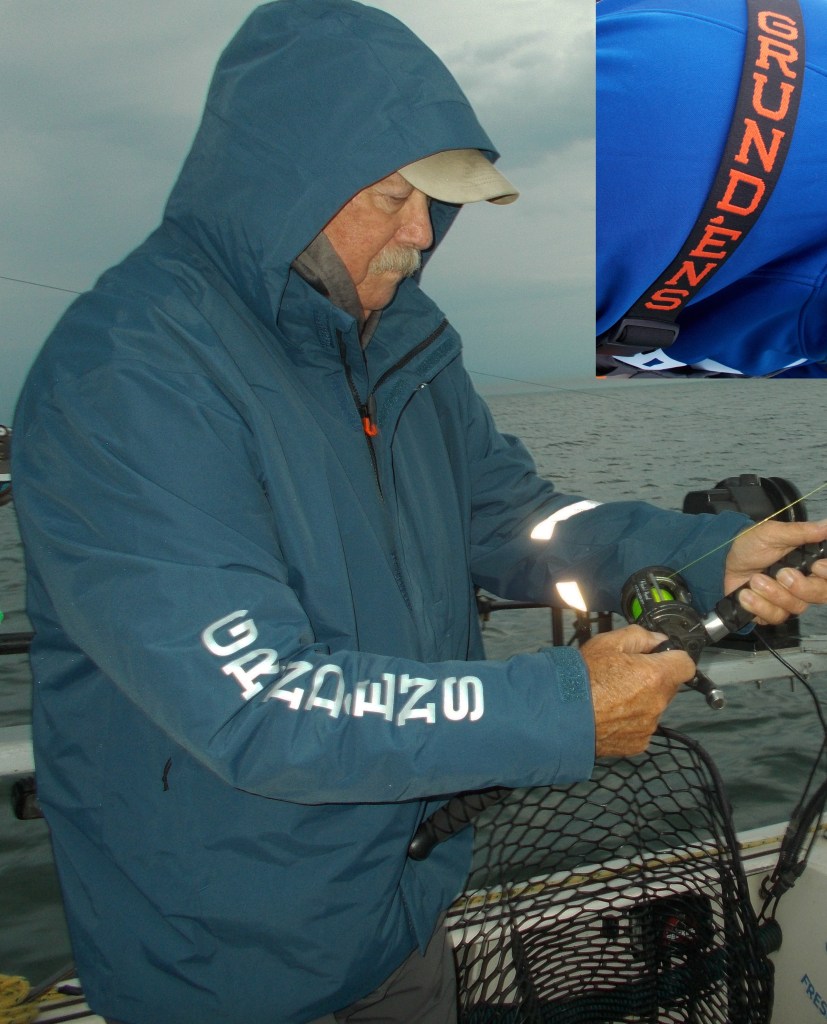
What you don’t often see is the orange letters on the black straps that hold their bibs in place or the small logo on the chest of these that show the rainwear is made by Grundens.
These men aren’t wearing these clothes because of product placement agreements with the producers. Hop on different boat with no TV cameras and you’ll see those crews similarly attired. Grundens is the top choice of weatherwise boating crews because these working men demand the best. They live it. They trust it.
After I got my set of Grundens Transmit X rain wear (jacket and bibs) and experiencing it on my boat in wind, rain and spray, I quickly learned to trust it. It’s not made of the heavy PVC that the deckhands are wearing, rather it’s constructed from rugged, waterproof, breathable (15K/10K) materials suitable for Great Lakes Anglers enjoying days of fishing in less than perfect weather conditions.
I use the Grundens Transmit X as my medium-weight rainwear suitable for those mid-40s to mid-60s days when rain or spray is going to be an issue. When the temperatures are on the colder side, I’ll have layers under for warmth. The Transmit X wind and waterproof outer skin keeps me snug inside and the inner lining makes sliding into the gear or removing it slick and easy.
A problem often encountered with other rainwear is water infiltration at the wrists. Whether setting lines, driving the boat or reeling in a fish, my hands and arms are always moving and the ends of the sleeves are often pointing up where the rain can run down inside a rain jacket. Grundens solved this with snug-fitting neoprene wrist cuffs. They say they are “dunkable.” I’ve not had to plunge my hand into the water, but on the rainy days, not a drop has ever ran up my sleeves.
As the temps rise, I remove inner layers. Often, I remove my Transmit X Jacket but the bibs stay on dock to dock. When fishing, a lot of the moisture (in several forms) that splashes on me is from the waist down. A bit of this gore on my shins or thigh from handling a fresh, floppy fish and I just squirt it clean with the washdown hose.
Check them out or purchase at www.grundens.com. The Transmit X series is also available at many other online and retail outlets.
Though the Transmit X bibs aren’t bright orange like the tough Grundens Herkules bibs commercial watermen have been wearing since the 1950s, they do have the black straps and suspenders with the orange Grundens trademark woven into the material.
COSTA DEL MAR SCHOOLIE SUNGLASSES
Reviewed by: CAPT. MIKE SCHOONVELD
When I learned about Costa Del Mar Sunglasses’ “Schoolie” model – designed for youths or individuals with smaller heads – I knew I had to get a pair. I’ve always kept a couple pairs of good sunglasses on my boat at all times. I have the glasses I personally wear and I have loaner pair for when someone on board says something like, “Crap, I forgotten my sunglasses.” Now, I’ll be keeping another “extra” pair.
The Schoolie sunglasses will also be a loaner pair, but these will be put to use when a youthful angler forgets their sun-shades or shows up with a pair of cheap, plastic-toy-like sunglasses. Bad sunglasses or no sunglasses are almost the same thing. That’s a lesson I learned decades ago.
When out on a Great Lake on a bright, sunny day a quality pair of sunglasses is as important as wearing the right clothes or using the right sunscreen. They provide noticeably better clarity instantly and unexcelled UV protection from direct sunlight and the rays reflected up off the water’s surface. UV blockage isn’t instantly noticeable, but if you’ve ever suffered from photokeratitis (sunburned eyes) you’ll never trust your eyes to “economy” sunglasses again. Why would I want to loan out a cheapo pair to anyone?
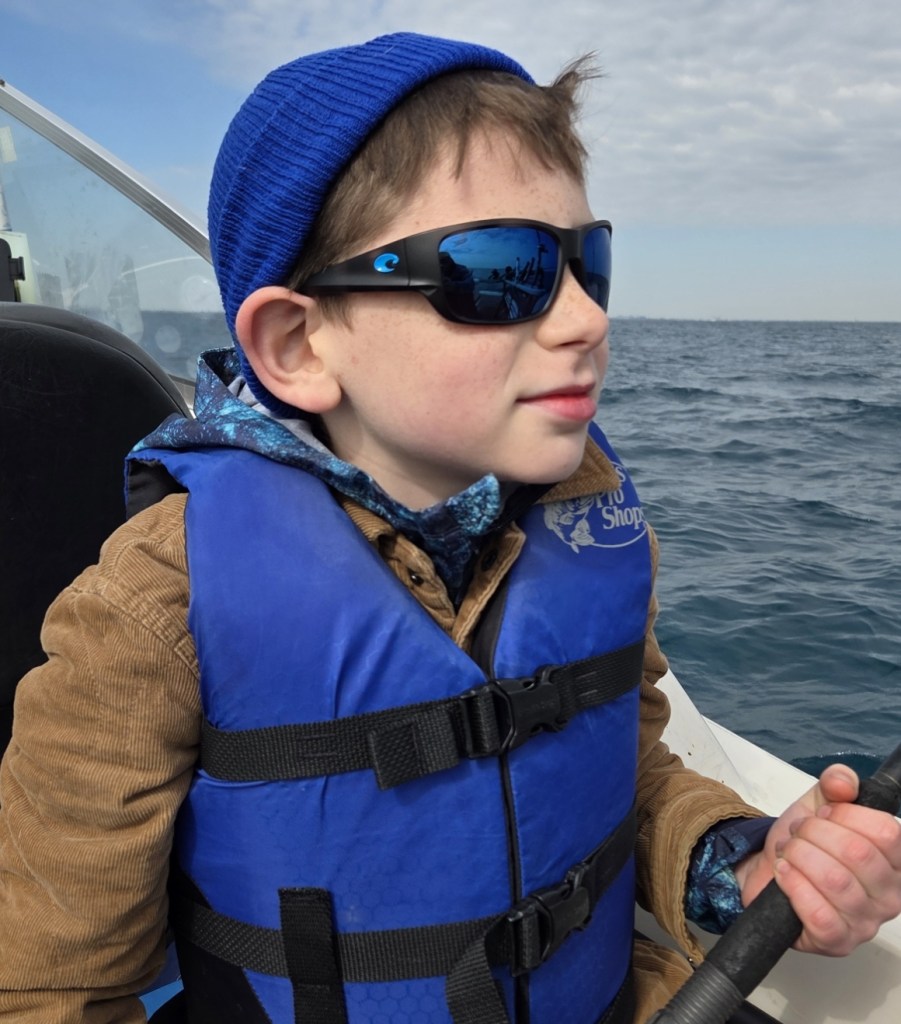
The Schoolie model from Costa features both UVA and UVB protection, as well as wide earpieces to block light from the side. They have lightweight polycarbonate lenses in four different colors. I chose the blue mirror lenses (best for bright days offshore) and black frames.
Working features aside, few sunglasses providers offer frames other than “one size fits most.” “Most” seldom includes youths or petite women. The Schoolies are a smaller sized version of their traditionally-sized “big-boy” models. They’ll fit smaller humans better and more comfortably. The frames come with a holes at the end of the earpieces where I can attach a retainer so if the person I loan them to wants to take them off, he or she won’t put them in an unsecure location.
Check out the Costa Schoolie options and details at www.costadelmar.com. Shop there if you wish and they are available at many other online or retails stores.
SEAKEEPER BOAT STABILIZER
Reviewed by: CAPT. MIKE SCHOONVELD
One of the “magical” toys I played with when I was in grade school was a gyroscope. A metal wheel was mounted in a wire cage. Wind some string around the axle then pull the string to get the wheel spinning. For the next 20 or 30 seconds the gyroscope would balance in most any position and if you held onto the cage and tried to rotate it there was enough force that it felt as though the two-ounce toy weighed a pound or more.
I’m sure a physicist could explain it better than just “magical,” but I doubt I could understand the “principles of angular momentum” in his explanation. Still, it works and gyroscopes are vital components in airplanes, rockets, spacecraft and many other devices and equipment.
Now, that list of gyroscopically controlled devices includes vessels and I was treated to boat ride fitted with a Seakeeper Boat Stabilizer on Lake Michigan. The test-ride was in a 36’ Yellowfin Center Console normally moored at Coco Beach, Florida taking anglers offshore to fish in the Gulf Stream. What did the Seakeeper do?
The Seakeeper’s, is that principle of angular momentum at work. The guts of the machine is a gyroscope wheel spinning up to 9750 RPMs and in the most simplistic explanation, it dampens or eliminates the boat’s side to side rocking and rolling.
The true test of a boat’s side to side stability begins when the boat is at idle or trolling speed and the boat is positioned sideways to the waves – or when some lug speeds past and rocks you with their wake. I’ve been rocked so hard in my boat that the diver rods’ tips splash into the lake on one side, while the other side lifts so hard it trips the Dipsey.
For my test ride the boat’s captain moved far enough offshore to be away from the general boat traffic then cut several tight circles to push up an acre or two of confused seas on top of the wind-driven waves already present. Then, in the middle of the chop and waves, he pulled the shift lever to neutral and pushed the button to turn off the Seakeeper. The screen on his Garmin display showed the boat was rocking 13 to 15 degrees to port and then equally to starboard. That’s almost 30 degrees of roll, total – and not something I’d like to put up with for long. On my boat, I’d either be trolling with or against the wind.
One push of the button and a short few seconds, the roll indicator showed one to three degrees of roll. The waves and chop were still present, but movement of the boat was only straight up or down as the waves, chop and swells passed under the boat.
Interested? Seakeepers are not something that can ordered and installed as a DIY project. You’ll need to contact a licensed dealer, arrange for a technician to personally look at your boat and then decide mounting options. There are several Seakeeper dealers currently available in the Great Lakes region, and more locations planned for the future. The screenshot attached to this review shows the current locations. The exact locations (and other info) can be found at http://www.SEAKEEPER.com.
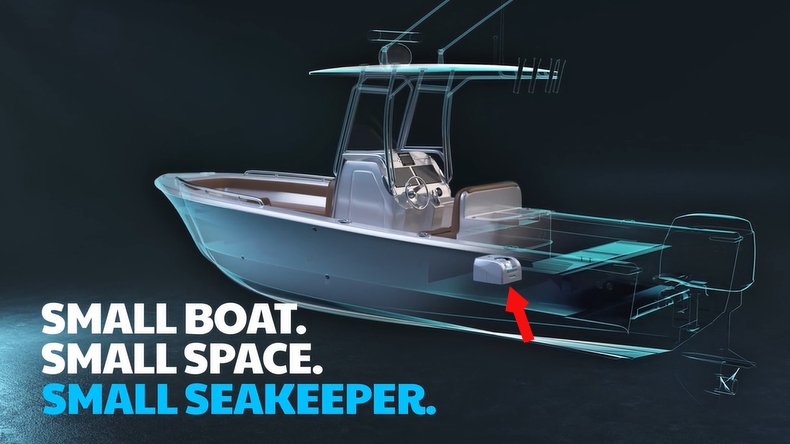
Seakeeper devices come in several sizes, from the Seakeeper 1, recommended for boats 23’ to 30’ to larger units that will smooth the ride of 200’ yachts. (The Seakeeper rep along on my test ride said they could put one in my 21’ fiberglass ProLine.) They can be installed in wood, fiberglass or aluminum boats.
The #1 unit measures roughly 23”X23”X16” – so about the size of a medium cooler. In many installations, the unit is mounted to the boat’s hull through the floor so the height is minimized and often a unit can be installed under a console or seat. The only limitation is the unit has to be somewhere in the rear half of the boat. Every installation will have a sleek, professional custom finish. Many new boat manufacturers are offering a Seakeeper unit as an add-on from the factory. The Seakeepers run on a separate deep-cycle battery (either lithium or traditional) like most boats employ for electronics or bow-mounted trolling motors.
I can imagine Seakeeper equipped boats trolling comfortably crossways to waves that might be keeping owners of non-gyro-stabilized boats off the lake. I can also imagine Lake Erie drift boat anglers equipped with Seakeepers fishing level and comfortably when the “walleye chop” becomes extreme even if everyone is fishing on one side of the boat.
DEXTREME DUAL EDGE 7” FILLET KNIFE
Reviewed by: CAPT. MIKE SCHOONVELD
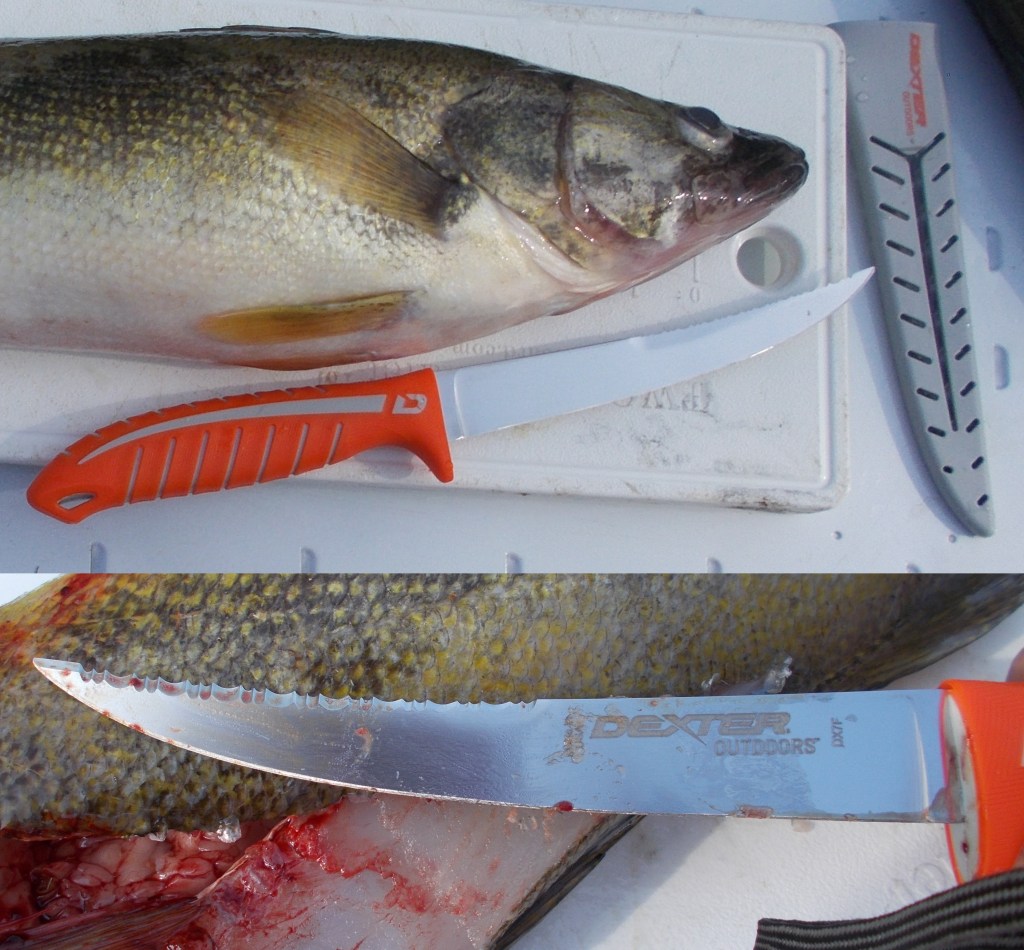
Look in the places where “professionals” are cleaning fish (or avid recreational anglers) you’ll see a Dexter knife in the hands of many of them. Look in my fish cleaning kit and you’ll see a Dexter knife in mine, for sure. I couldn’t guess the number of fish that tool has dissected. Now, look in my kit and you’ll see a second Dexter knife in it – not the familiar white-handled version most use – this one sports a bright orange, comfortable, non-slip handle. The orange handle looks good but that’s not what makes this knife unique.
The blade is made from Dexter’s proprietary (American made) “Dexsteel,” the perfect blend of hardness to allow cleaning a limit of fish without needing sharpened, but not so hard that it takes an expert to put the edge back to factory sharp. Most of Dexter’s fillet knives are made from Dexsteel stainless, each one designed to provide just the right flex to produce perfect fillets. What’s unique on the Dual Edge is the tip-end on top side of the blade has a serrated, ultra sharp edge.
Dexter makes serrated bladed knives with what they call a Tiger Edge to use on frozen fish, extra boney fish or those with tough cartilage. Perfect if that’s kind of fish you encounter regularly, but it’s a specialty tool. The serrations on this dual edge knife isn’t there to be used all the time on most fish found in the Great Lakes, but occasionally, so when it’s needed, it’s there. I’ve used the serrations to cut through the wire-like bones on big walleyes and to cut through backbone on salmon I want to dress out as “steaks” rather than fillets. Mostly, however, if I miss a spot when cutting a fillet, or skinning it off, the top of the blade is sharp and I can finish the job with just a flick of the blade instead of having to change the angle or my grip to hit the spot with the regular sharp side. I selected the 7-inch blade, the perfect size walleyes and coho salmon – the fish that come aboard my boat most of the time. The 7-incher isn’t too long for perch or white bass, and it will handle the biggest kings and lakers we manage to hook when Lady Luck smiles our way.
I can’t say I’ve ever selected a knife just for the sheath that comes with it. Don’t buy this one just because of the sheath, either, but when you get one, you’ll love the fit. It’s plastic (not unusual) but when you slide the blade into the sheath, the handle sort of snaps in place just tight enough to keep the sheath in place as it rattles around in your cleaning kit, boat or the back of your tow vehicle.
Check out all of Dexters Knives and other products at www.dexteroutdoors.com. You can purchase them there, at retailers everywhere or at Amazon.com.
OHERO RUBBER NET REPLACEMENT
Reviewed by: CAPT. MIKE SCHOONVELD
I expect to get years of use from the rubber-mesh nets I use on my boat. They are tough, nearly impervious to UV degradation and plenty strong to lift any fish swimming in the Great Lakes. That doesn’t mean they are indestructible. I once had one that got caught on the knob of a downrigger spool while it was turning and was ripped up pretty good. Most of the other times when I find a hole or broken strand I have no idea what happened. Maybe it was stepped on by someone wearing cowboy boots on board. Maybe it was repeated tiny cuts over time made by sharp hooks or sharp teeth. A black zip tie usually fixes a small hole well-good enough.
Occasionally, it’s time to replace the old with a new and then the search is on to find one sized for Great Lakes net-hoops and Great Lakes fish. There seems to be plenty of panfish or stream trout sizes – larger sizes, not so much. Some of the places that do carry them have outlandish prices.
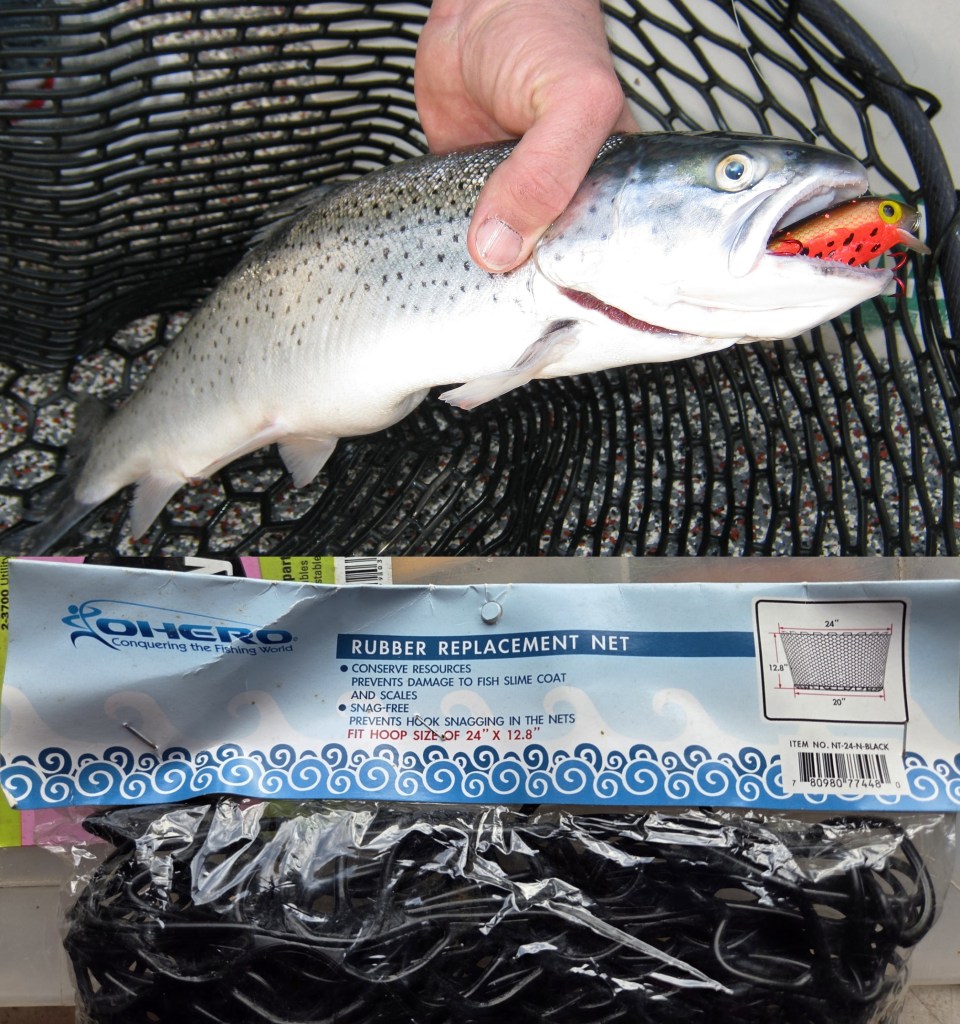
The last replacement net I got was an OHERO brand from Lee Fisher Outdoors. I chose the 26.7″ x 22.2″ size in black. They also have the same nets in white. The hoops on my nets aren’t exactly that diameter, but it’s rubber, it stretches and doesn’t have to fit perfectly. They look and feel just the same as other brands I’ve used, plenty strong and half the price. It’s a good net at an affordable price. ‘Nuff said!
Check them out and purchase them at http://www.leefishersports.com. While you are at that site, check out the other unique items listed.
RAPALA HD SPLIT RING PLIERS
Reviewed by Capt. Mike Schoonveld
I’ve fished on three different boats owned by friends this summer and was amazed that two of them didn’t have a pair of split ring pliers on board and one of them had a pair that were so crummy, it would be just as easy to try to remove a bent hook using a pair of needle nose pliers or my thumbnail.
Both on Lake Michigan and on Lake Erie it’s not unusual to have a bent or mangled hook on a hot lure. The fish don’t bend them so much as unhooking a fish with a barb stuck in a particularly tough cartilage in the fish’s jaw or when coho salmon are twisting in the net. If the hook isn’t bent it’s not uncommon to have a stretched out split ring in need of changing. In any scenario it would be a simple fix with a pair of split ring pliers.
For the most part, a split-ring plier is a single-tasker and maybe that’s the reason many fishing tool makers try to incorporate a “beak” at the end of a pair of needle-nose pliers that is replete with perhaps carbide line cutter or other features to make it a multi-tasking tool. Often the resulting implement is something that doesn’t do anything very well.
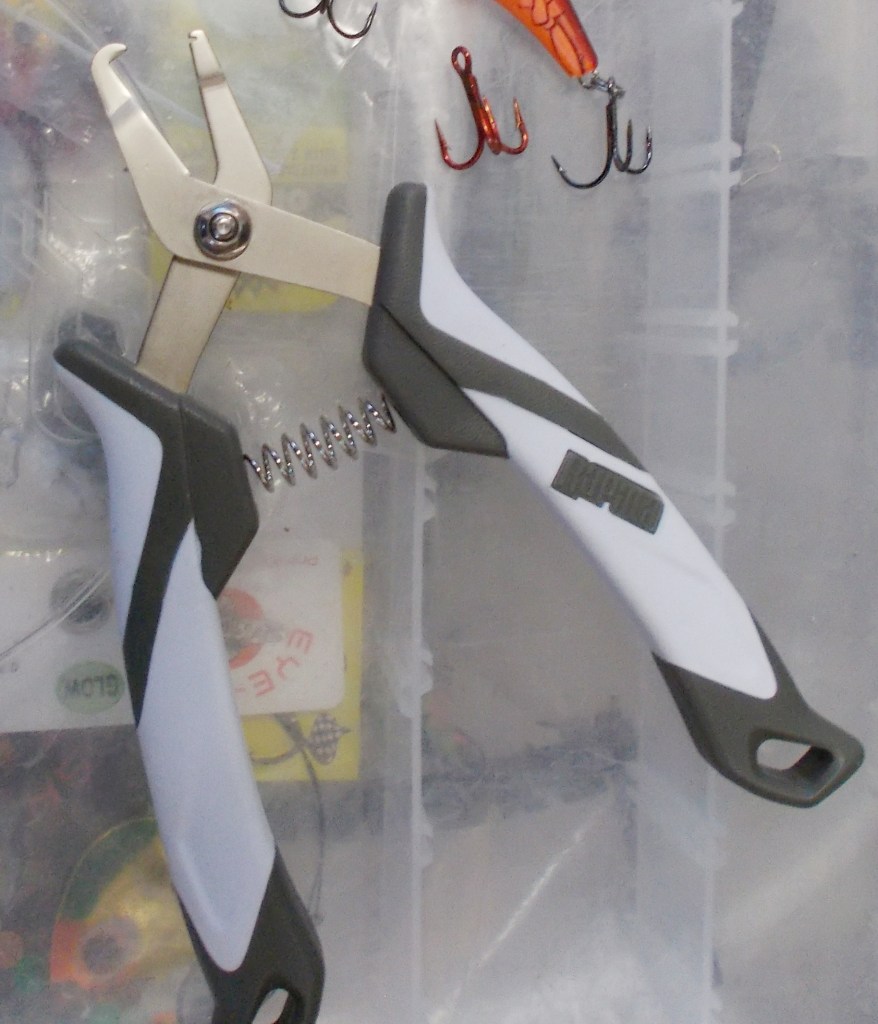
The latest split ring pliers making its way onto my boat are the Angler’s Heavy Duty Split Ring Pliers by made by Rapala. For one, it’s a full-sized tool, not a miniature tool that doesn’t fit my hand adequately. Its handle is spring loaded so I can open or close it as needed without changing my grip and has a rubberized handle just to make it comfortable. I’ve used it on tiny split rings like on #5 Shad Raps and big split rings on magnum spoons. Large split rings are always easier, but this tool handles whatever size ring is being worked.
If you are an angler without a split ring plier in your tool kit, get one. If you are not satisfied with the split ring tool you do have, swap it out for Rapala’s Angler’s Heavy Duty Split Ring Pliers. Priced right, you can purchase them online at www.Rapala.com, or at various other retailers and online sellers. Don’t leave the dock without a pair.
RAPALA ROYAL FLEECE HOODY
Reviewed by: CAPT. MIKE SCHOONVELD
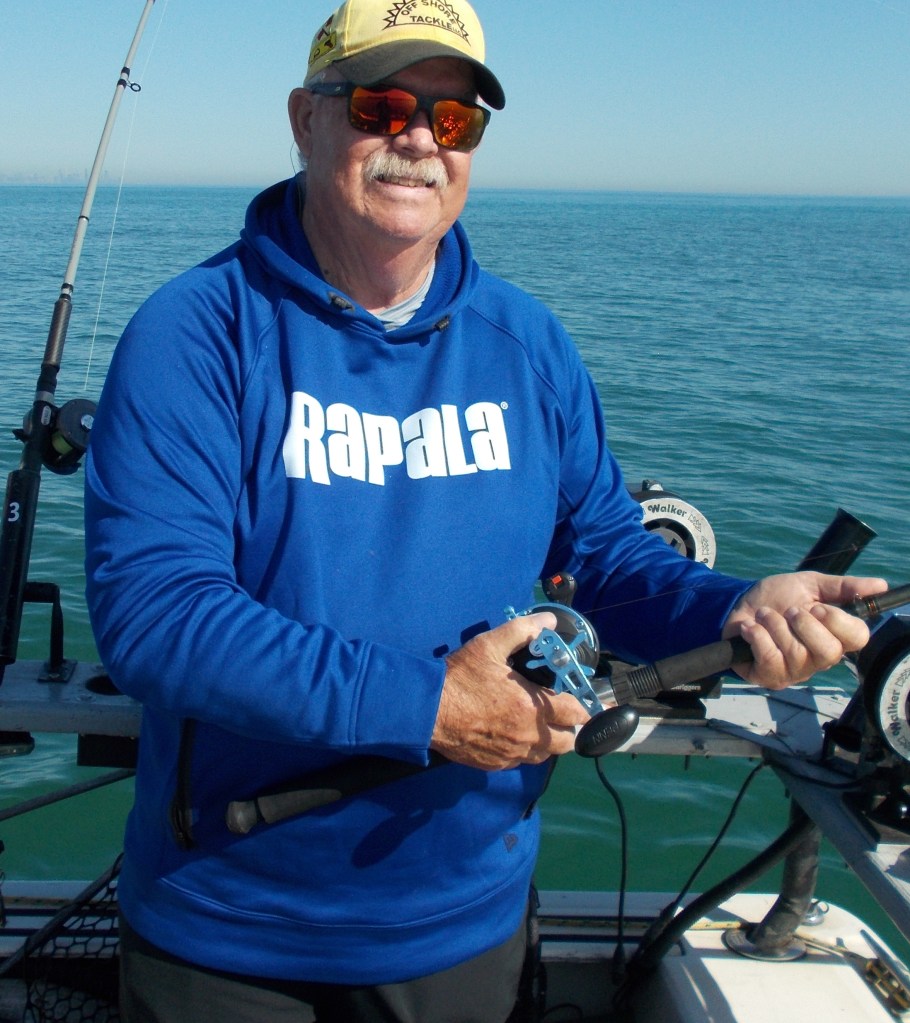
Rapala actually calls it a “Fleece Pullover Hooded Sweatshirt Royal.” Royal refers to the brilliant “royal” blue color and that’s what caught my attention when I first spotted it. What should have caught my attention is the “fleece” in the name indicating it’s not just another cotton hoodie with a company logo printed on the chest.
In keeping with my ABC (Anything But Cotton) mantra when recommending what to wear when fishing, the inside of the sweatshirt is a moisture wicking fleece which moves moisture out through the cloth, keeping the wearer more comfortable all day long. Cotton hoodies (or any garment) tends to get wetter either from moisture from the inside or random spray or splashes from the outside and cotton, once wet, tends to stay wet. Thus, ABC.
The outside is a tight weave polyester soft, slick and slightly stretchy. It’s not waterproof, but the unlike cotton that will absorb any bit of spray, small drops often just bead up and run off. That helps the hoodie ward off fish blood, as well.
Though it’s handsome, I got it as a fishing shirt. I like hoodies for fishing since they are warm and since I use the kangaroo pouch on them as a catch all as well as a tool holder. This one is unique, it’s divided into left and right pockets – each zippered – so I put things like keys, coins, perhaps my cell phone in the left side and zip it shut for security. The right pocket holds clippers, folding knife or other items that I’ll likely use several times.
What more could anyone ask of a sweatshirt? Looks, quality, comfort, stylish and useful. Check them out and purchase them at: www.RAPALA.com.
OKUMA CONVECTOR “B” REEL/DIAMOND ELITE ROD
Reviewed by: CAPT. MIKE SCHOONVELD
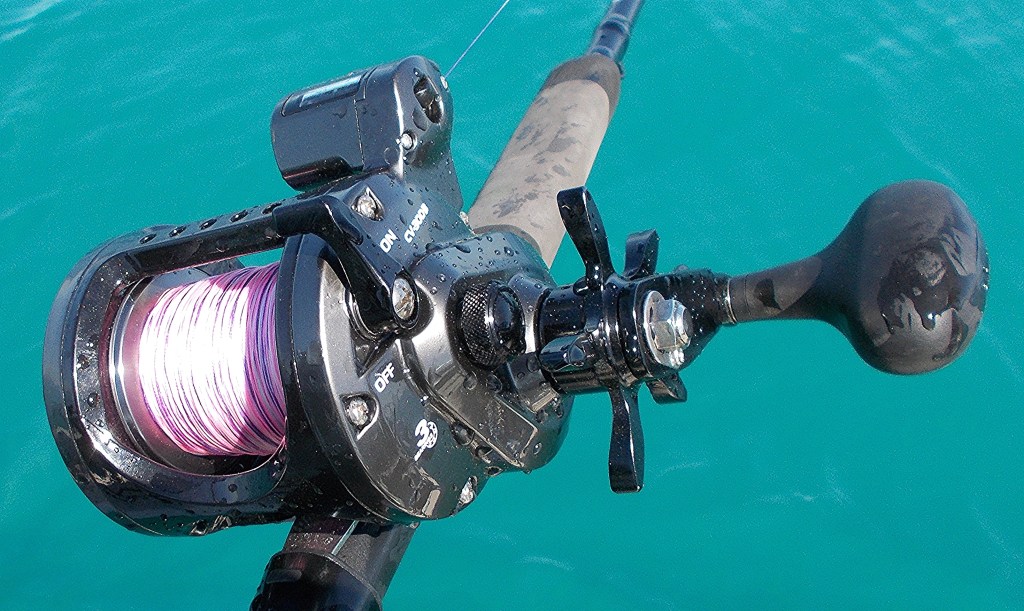
This season I’ve been using the new model of Okuma’s Convector reel – dubbed the Convector “B” Model -and I’ve been blown away by it. The original Convector has a faithful following on the Great Lakes and the redesign now makes it even better.
The improvements include larger, stronger gears, enhanced carbon-fiber drags, an updated line counter mechanism and improved handle-knob – large and easy to grip. All of this in the familiar Convector mid-level price range.
I’ve used it as it was intended on every trip I’ve fished this season (which started on March 2nd for me.) I set it most often as a downrigger line, but I “snuck” it in as a planer board reel several times since those lines were getting most of the action and I wanted to get a “feel” for how it performed. I also used it as a braided line diver reel using the standard #1 Dipsy Divers.
I don’t purposely put the gear I test to extreme conditions but this one I did. On my first offshore excursion I forgot one of my “wire-diver” set-ups I use to get laker rigs down to the shoals where lakers are stacked and gobbling up gobies. I grabbed the Convector “B,” on the Diamond Elite downrigger rod to sub for my forgotten wire-diver. I’d filled the Convector with 30# test Sufix 832 Superline. I attached a #3 Magnum Dipsy Diver pulling a dodger and Spin-N-Glow.
I sent it down, down, down, so it was just scuffing along the bottom made up of sand and pea-gravel. The big Dipsy pulled hard and even harder when it touched the bottom. The Diver’s release had to be set tight enough that just skidding along the bottom wouldn’t trip it. The reel’s drag had to be set tight enough to not slip when the diver did hit the bottom. It’s a system that has to be finely tuned.
Then, when a laker slurps onto the Spin-n-Glow, the rod has to have the backbone to allow the tight release to open and at the same time, the reel has to feed out just enough line – pulling against the drag – to keep something from breaking, losing the fish and the expensive gear. The first fish of the day showed the Convector “B” up to the task and several other trout provided several additional tests. I wouldn’t hesitate to use it with wire line as a wire-diver reel.
I had the reel sitting on a Diamond Elite Downrigger rod (DME-DR-862MHA) This is a medium heavy 8 ½ foot long downrigger rod and it functions perfectly using it in conjunction with a downrigger. It’s not a bad planer board rod, either and I would have no problem using it with medium/large planers pulling deep diving crankbaits, lead core line or copper.
I used the Diamond Elite it as a diver rod with #1 Dipsy Diver for cohos and walleye and it handled that size diver very well. It was slightly over-matched using Magnum Divers, but it got the job done.
The Diamon Elite series are all designed as trolling rods and come in sizes for walleye, up to wire-diver sizes with a roller tip line guide, They are a handsome, steel gray color, and the triangular foregrip gives extra gripping power when reeling in strong, Great Lakes fish. Pair the right Diamond Elite rod with the appropriate size of Convector “B” reel and you have a combo that will serve you well for decades.
EGO TIDEWATER TOOL KIT – FISH CLEANING
Reviewed by: CAPT. MIKE SCHOONVELD
Every angler should have a fish cleaning kit that includes the essentials for cleaning the size and type of fish you plan to catch and keep. For me, a kit that has a couple of different sized fillet knives is important. I’ve cleaned large fish with small knives, small fish with large knives, but cleaning any fish with the appropriately-sized knife makes the job simpler and the finished product better. Each knife should be in a sheath, as well. That protects the user, it keeps the knives from cutting the case in which all the tools are stored and the sheath also protects the knives’ razor edges from clacking together or rubbing on other items inside the case. That could damage the sharp edges.
I’ve learned that keeping a knife sharp is simple. Rather than using (abusing) the knife until it’s dull, simply “steel” the knife, after every fish or two and it will never get dull. I include a honing steel in the fish cleaning kits that I put together. The steel doesn’t have to be large, it has to be used.
When I’m cleaning walleye, I always wear a glove with a tough, rubber palm on my left hand. (I’m right-handed.) The fins on walleye have sharp spines, the gill plates are razor sharp and even the scales on a walleye are abrasive. So there’s a glove for my left hand in my kit.
The only downside to this is when I’m skinning the fillet, the glove makes it tough to grip the end of the fillet when I’m skinning the fillet. That’s why I always have a homemade pick in the kit I take on walleye fishing trips to pin the tail of the fillet in place with my gloved, left hand.
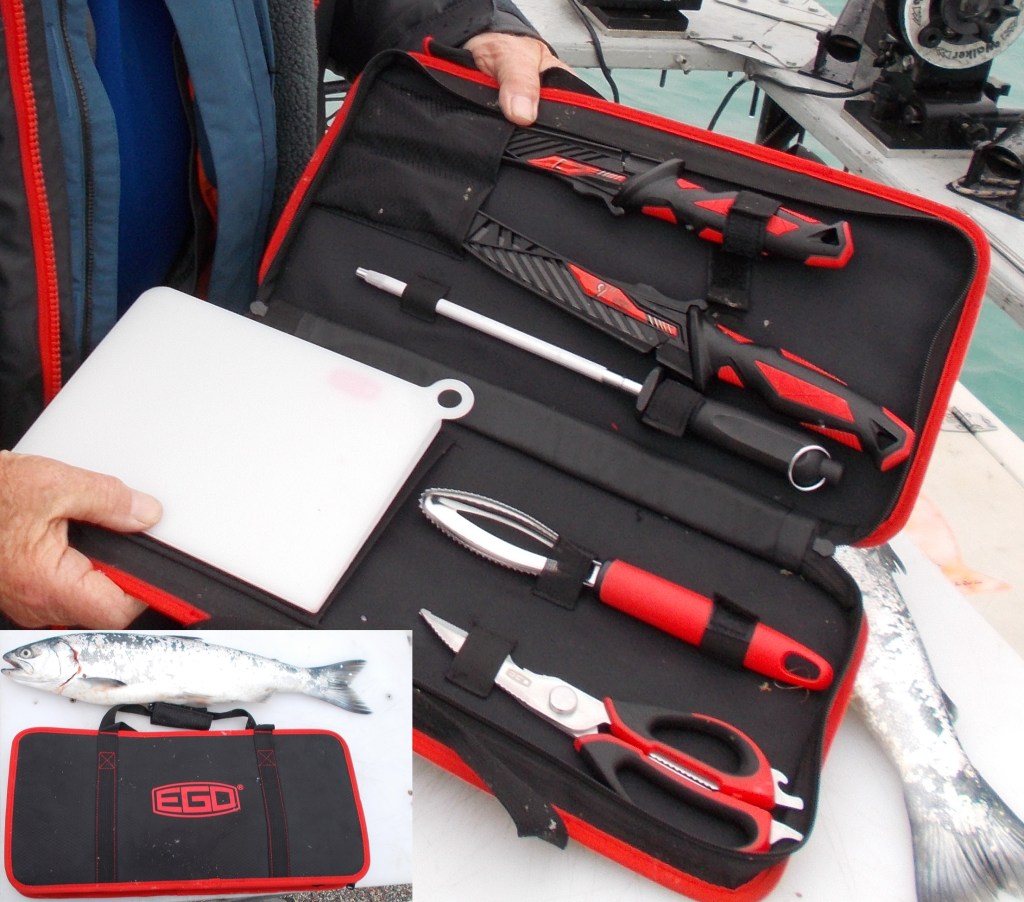
When I saw the Tidewater Tool Kit from EGO, I noticed it had all the tools I consider to be essential – and more! Included in the kit is a folding cutting board measuring 8 ¾”X12 ¾” and a pair of scissors. The cutting board is a bit small, but better than nothing. I don’t often use scissors to clean the fish I catch, but they’d be handy for catfish anglers to cut off the spines. I have been known to pop the top off a longneck when I’m cleaning a fish and there is a bottle opener on the end of the scissors.
There’s also a fish scaler. I actually do scale some of the fish I clean because skin-on fillets have a depth of flavor missing on skinned fillets. The fish scaler easily takes the place of the pick I use to hold the fillet in place when I’m skinning it.
The coolest extra feature is the sheaths for both the seven and nine-inch knives have a locking tab on them so once the knife is sheathed, it stays sheathed. I’ve never seen that on any knife sheath I’ve owned. All this in a convenient carrying case and an extra right-hand glove you can offer to a left-handed fishing partner giving him one less excuse for not helping you to clean the fish. The EGO Tidewater Tool Kit is sold exclusively online at: http://www.egofishing.com.

