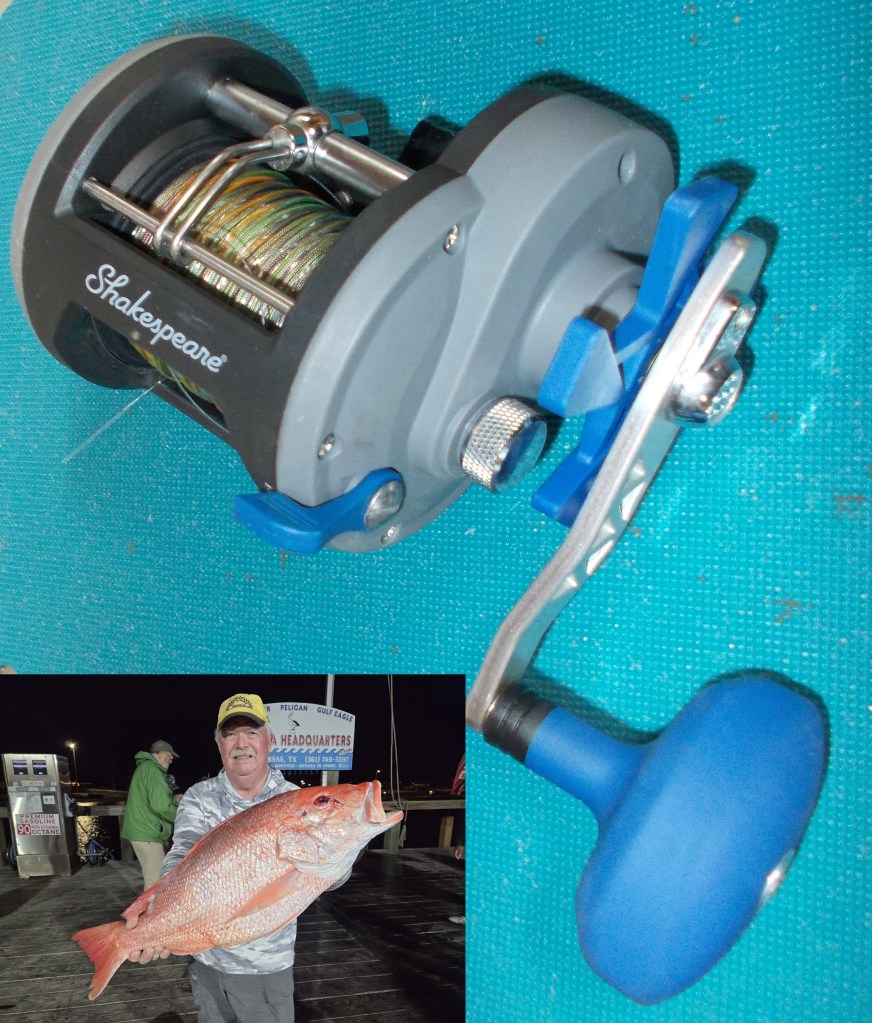
SHAKESPEARE CONTENDER CONVENTIONAL REEL

Reviewed by: CAPT. MIKE SCHOONVELD

The reels needed when fishing for big king salmon, lake trout and Skamania steelhead have to be tough to stand up to the battle, drags that are silky-smooth when a steelhead feels the sting and accelerates to high speed in an instant and have oversized washers to stand up to the heat generated when a king makes a long runs. Then the reel has to be able to stand up to the same things the next trip and the next.

Most reels that meet these criteria are budget breakers for anglers just getting started or on a limited budget who have to balance price with quality. Shakespeare’s new Contender Conventional Reel (currently listed at $74.99 on the Pure Fishing website) tilts that balance in favor of the angler. Available as a “30” size reel, it features a graphite frame, a stainless steel levelwind, brass gears and ball bearings to make the reel run smooth the first time it’s used and will continue to perform years into the future.

“Conventional” is a term often used for reels in the saltwater market – differentiating between a revolving spool – conventional – and spinning reels. Shakespeare used this term because this reel is aimed at the saltwater market primarily, but that certainly doesn’t preclude using it in freshwater. Many of the top-quality reels found on the hardest working Great Lakes charters are “crossover” models equally at home on the lakes or on saltwater.

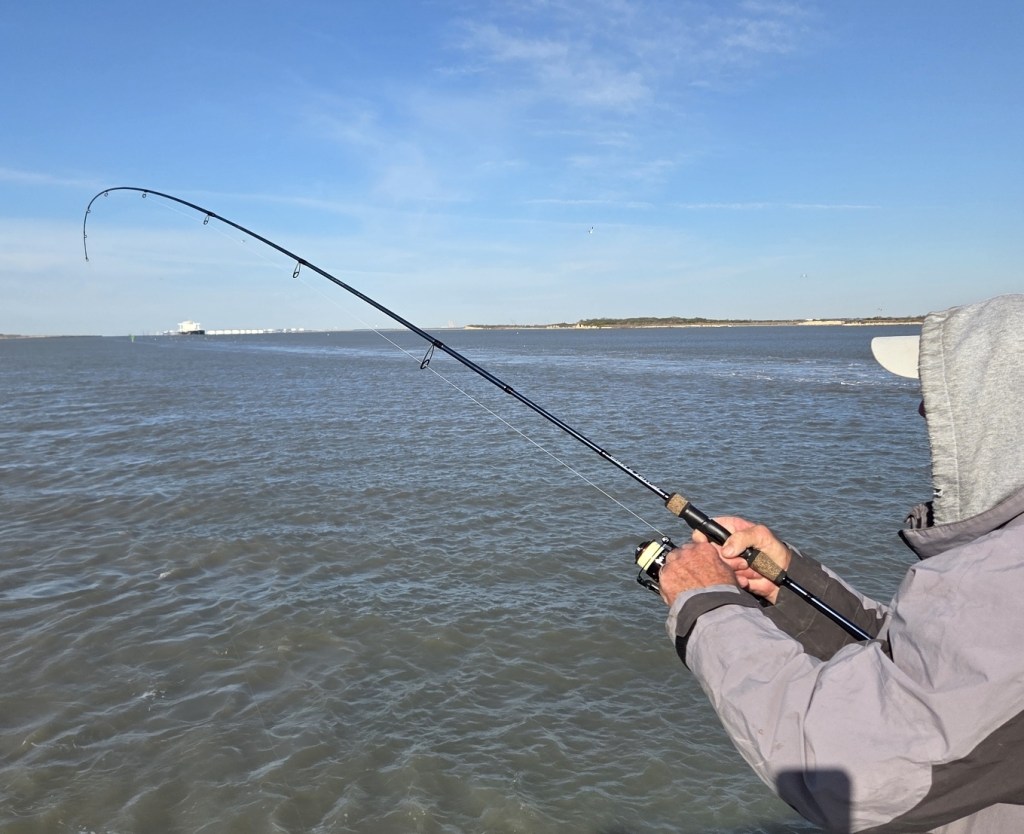
I got the reel during the winter months and wanted to give it a solid test before the 2026 Great Lakes open water season gets going. I took it to the Texas Gulf in February to test it on mammoth red snappers. Snappers are shaped like bass, sized like four-year-old kings and are as stubborn as any fish that swims. I spooled it with 30-pound test braided line with a 50# fluorocarbon leader.

Pulling a 20 pound plus snapper up from the bottom in 100 feet of water isn’t an easy task. Every inch of line is earned and every ten feet or so the fish pulls back and peels off eight or nine feet, even on a drag tighter than I’d ever use on salmon or trout. The reel held up, fish after fish, after fish.

I wanted to put it too the test since I plan to use it as the reel for my “secret weapon rig” – two colors of lead core deployed on the deepest downrigger to present a deep lure far behind and deeper than any of the downrigger weights. Often, the biggest fish of the day come on the “SWR.” My experience with the snappers proved to me it will be up to the task.

The Contenders will likely be available at many retailers this summer and is available now at www.purefishing.com.   
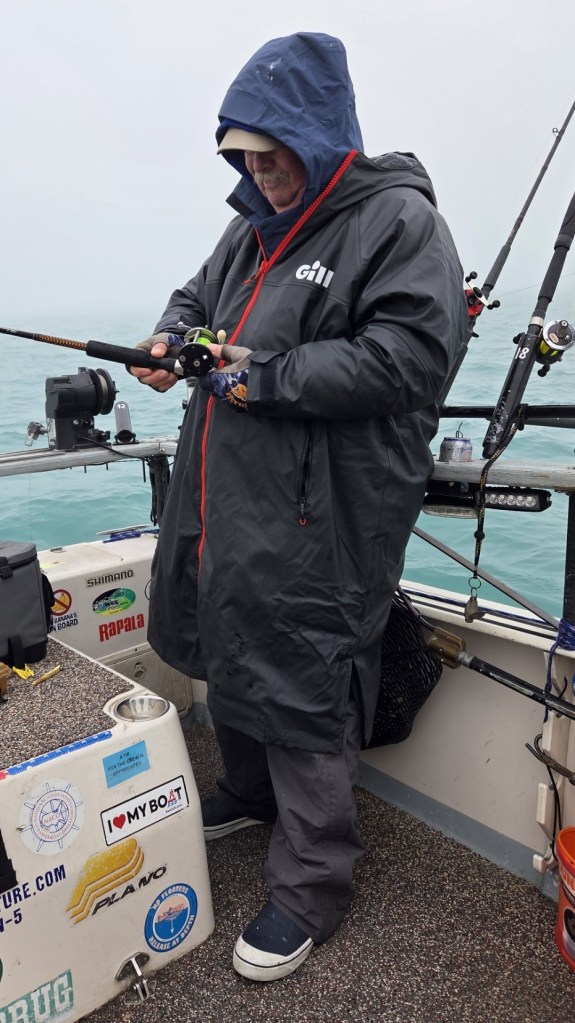
GILL AQUA PARKA

Reviewed by: Capt. Mike Schoonveld

How many times does a quick, passing shower threaten or you realize the choppy water you’re going to run through is going to be enough to send some spray into the boat so you grab the jacket part of your rainsuit because the drizzle or spray probably doesn’t warrant the hassle of putting on the bottoms – either having to take off your boots or try to force them through to where the slit-zipper tops out on the legs. About 87 percent of the time when I only slip into the jacket, I end up with a wet butt and wet legs from the thighs down.

When I saw the news from Gill Marine about their new Aqua Parka I was intrigued enough to order one.

A better name would be the Aqua Trench Coat, I thought when I unrolled the package. On me, at 5-11 the bottom of the parka extends to below my knees.

Standing, any water that runs down to the bottom of the parka, drips to the floor, not to the lower leg. Sitting, the “rubber-like” shell protects my butt on the bottom and covers the top of my thighs over the knee to keep that dry. Try that with a butt-length parka.

The shell features totally welded seams – no stitching – usually the leaky culprit when DWR treated fabric is the outer layer. The outer shell has a totally waterproof  “rubbery” feel to it, but unlike rubber or PVC, it’s breathable and has a 4-way stretch. The inside is lined with a cushy, high-loft fleece for warmth – perfect for cool or cold weather – I’ll stow it away during the summer months.

Besides the working convenience, a stand-out feature is the large – two-way zipper – made of rugged nylon. Zip down from the top to access breast pockets, zip up from the bottom to access the pouch on your hoodie or the pockets on your pants.

 Available in several colors, it’s cut large to fit over sweatshirts or jackets you are wearing. Check them out at: https://www.gillmarine.com/aqua-parka/. If you purchase them from the Gill Fishing website, enter the discount code – CAPTMIKE10 – at checkout for 10% off your order.  

FishUSA FLAGSHIP TRAVEL SPINNING ROD

Reviewed by: CAPT. MIKE SCHOONVELD

I reviewed a FishUSA “store brand” Flagship Trolling Rod in a recent issue of GLA. I was very impressed with it and you can see that review (if you wish) at https://fishgear.reviews/2025/12/08/flagship-trolling-rods-by-fishusa/.

Because of this, I wasn’t so surprised when I put a Flagship Travel Spinning Rod to the test and found it to be an exceptional product. I’ve owned and used a variety of travel rods in the past and the best thing I could say about them was that they could be broken down into three or four sections to make them easy to pack in a large suitcase or to tote them along on other trips where full length or even two-piece rods would be impossible or cumbersome.

A few of the travel rods I’ve previously used were so clunky I could have fished as well with a willow branch. None of the best of them felt or fished like a quality “conventional” rod.

First the “travel” part of this rod. Though it’s a three-piece rod, it comes with four pieces. There are two tip sections, one with a medium action – perfect for walleyes, bass, shore fishing for cohos or browns and similar applications. The other tip turns the rod into a medium light rod, good for stream trout, white bass, bluegills and other panfish.

It comes with a hard sided travel case which will keep the rods secure whether they are being handled by luggage handlers, stowed in an overhead bin or crammed in with other luggage in a car, truck or SUV.

FishUSA says the travel rod is constructed with “a strategic blend of 30 and 36-ton graphite. I’m not sure what that means but I am sure fishing with this rod was a pleasure. At seven-feet long I was able to make long casts if needed to get to the fish and then control fish when I got them close to the boat. I fished with both live bait and lures. Using the medium tip, I could put extra action to the lures on the retrieve. Using live bait, I could detect the lightest bite. There was nothing clunky about the feel, action or look of the rod. Whether fishing on the Detroit River for walleyes, for perch on Lake Michigan or other fish on an inland lake, I wouldn’t hesitate to use this rod whether I needed it as a travel rod or not. Check out the Flagship Travel Spinning Rod and other FishUSA gear at www.fishusa.com.

SCOTTY GIMBLE DOWNRIGGER MOUNT

Reviewed by: CAPT. MIKE SCHOONVELD

A friend of mine fished area inland lakes and trailered his my boat to Florida each winter to spend time fishing for sea trout and redfish. The boat was well equipped for these activities, handled fine in moderate waves so he decided to rig it for Great Lakes fishing, as well to get in on Indiana’s great salmon and steelhead fishing. 

He loved it and soon found himself fishing on Lake Michigan as much or more than on inland lakes. He fished without downriggers, relying on divers and lead core during the summer months, but he was reluctant to add downriggers since he thought that would require drilling holes for the downrigger mounts or installing a track system. He wouldn’t mind doing that but he plannedi to upgrade his boat in another year or two. A boat with tracks or holes in the gunwales would either limit the market for potential buyers or degrade the resale value.

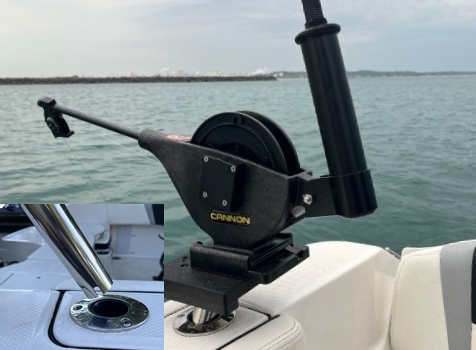
I noticed his boat had flush mounted rod holders built into the gunwales and so I suggested he find downrigger mounts that would slide into these rod holders. After checking around on the Internet, he found some Scotty 1028 Gimbal Mounts at Amazon.com that would fit his rod holders perfectly. I told him Scotty products have been around for decades and always get great reviews. So he bought a pair.

Now he’s set for another season on Lake Michigan and I know the addition of a pair of downriggers will up his game and increase his enjoyment. Perhaps he’ll even learn his current boat will do just fine for more than another year or two.

BAZUKA PRO ROD TUBE BY FLAMBEAU

Reviewed by: Capt. Mike Schoonveld

The Great Lakes covers so much territory it’s often more convenient to travel from one lake to the next – or from one end of one lake to the other end – by plane rather than over surface roads. Or, if you are like me, you have a wanderlust to head for far away fishing adventures where travelling by air is mandatory.

If those flights require travelling with any of your personal fishing gear – in this case, fishing rods – you’ll need some way of ensuring those rods show up on the baggage carousel unscathed by their adventure. Over the years, I’ve seen or used several ploys to get my rods to far off places with me, but these days, the friendly skies aren’t so friendly to most travelers and especially to those that show up at the gate with fish a fishing rod.

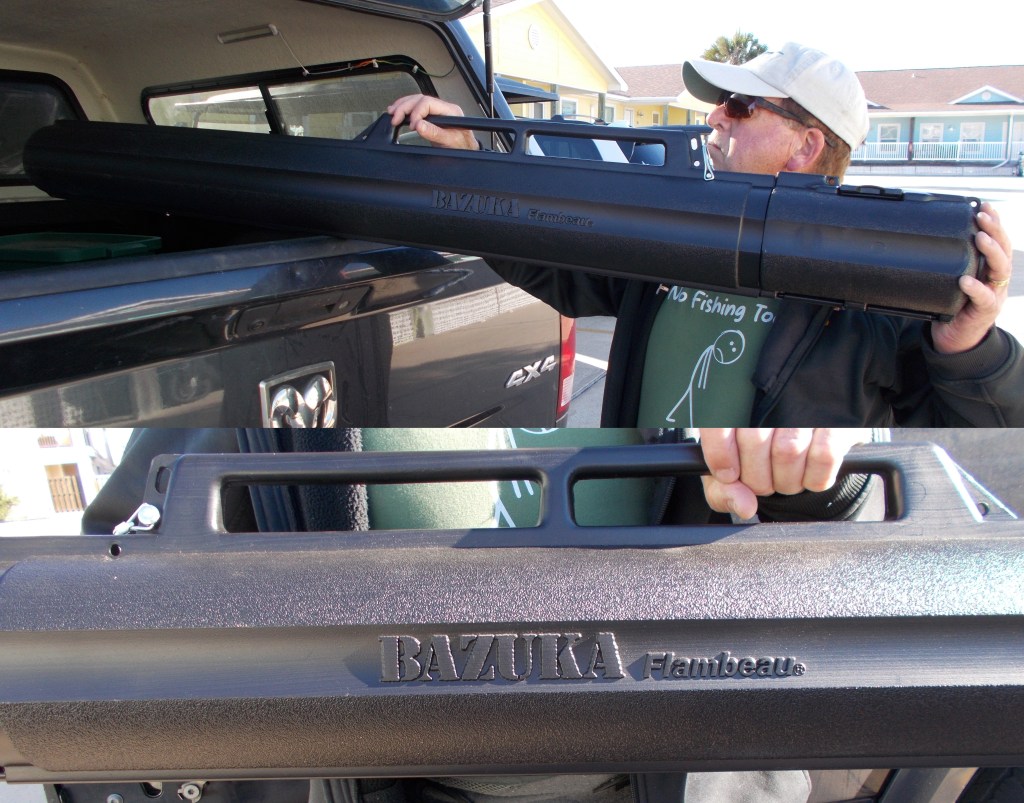
The Bazuka Rod case doesn’t make travelling any friendlier, but it does make it less worrisome.  Made from a tough, rugged plastic, it won’t bend or splinter. If it shows up on the rod carousel crushed or looking like something ran over it, something has run over it. It wasn’t damaged on the plane or when being stowed.

I like the way it telescopes so I can adjust the size to fit the length of the rods I’m toting along with me. Nearly any two-piece rod will fit inside, and it will hold one-piece rods up to 8-feet. I’ve not crammed it full, but the interior diameter will easily hold four or more.

It’s not just for air travel. When I’m heading to a remote location with my boat, I use the in-boat storage. But when I’m not towing a boat, I pack my rods in the Bazuka so I can stow them over, under or beside any of the rest of my gear in the back of the truck or SUV.  Bazukas are widely available at retailers or you can check them out and other Flambeau storage options at www.flambeauoutdoors.com 

TWO TOO-COOL TUMBLERS

Reviewed by: CAPT. MIKE SCHOONVELD   

I’m not sure which manufacturer invented the 20-ounce insulated tumbler, but they are standard on my boat. I load one up with hot coffee knowing that by the time I get to where I plan to fish, get the lines set and maybe have the first fish or two of the day in the cooler, my coffee will still be hot. One of my best friends has a similar cup filled with iced tea that usually still has ice left in the bottom at the end of the trip.

These stainless steel, vacuum-sealed tumblers are now made by several companies and other than different colors and minor variations of lid design, one brand seems nearly identical to the next. Recently, however, I came across a couple that set them apart from most of the rest.

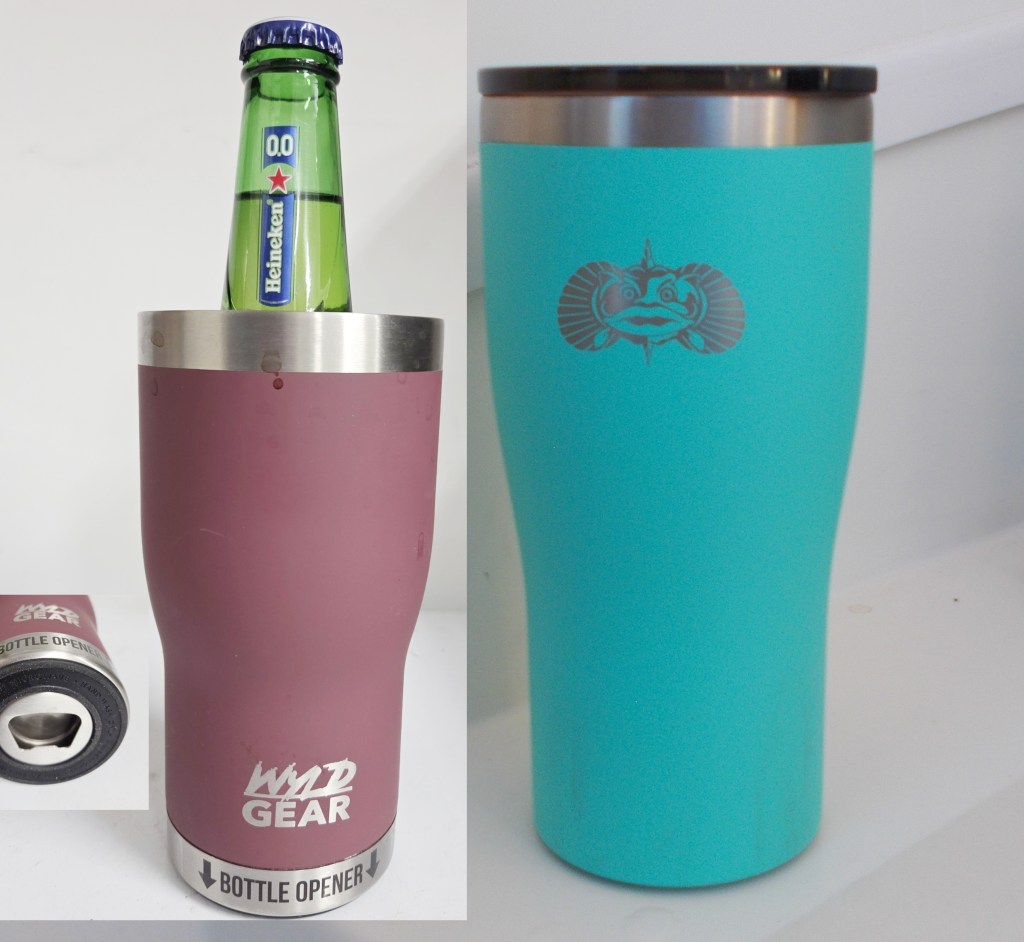
The “coolest” of these has a feature is one available from TOADFISH. It’s the one I always bring along when I’m hopping on someone else’s boat. Many boats are short on cup holders and when I show up with my 20 ounces of hot coffee, the Toadfish Non-Tipping Tumbler solves that problem. Just set the tumbler down on any “slick” surface, like a fiberglass gunwale or a painted aluminum dashboard and its suction cup bottom will stick it there like a lamprey on a laker. It won’t tip over. Want to take a slurp, just lift it straight up and it easily releases. It seems magical more than logical. Available in several colors; I chose the “Toadfish Teal.”  Check it out and other unique Toadfish products at www.ToadFish.com. You can purchase it there, at Amazon.com and other sources.

If you have plenty of drink holders on your boat and the tip-less tumbler isn’t appealing, how about bottle openers? Sure, it’s possible to pop the top on a chilled Corona or Heineken with the same pliers you use to rip hooks out of the fish you catch, but how easy is that? My Wyld Gear 20-ounce tumbler solves that problem.

Look at it from the side or from the top and it looks like most any other steel vacuum drink container but take a look at the bottom, and you’ll see a built-in bottle cap tool. Brilliant! Well, at least it’s novel place to mount a bottle opener. Once you’ve popped the top, slide the bottle inside the tumbler and it becomes a koozie. Check out this multi-tasking tumbler and dozens of other Wyld Gear products at www.wyldgear.com.

BIGEYE BOOT BY STRIKE

Reviewed by: Capt. Mike Schoonveld                

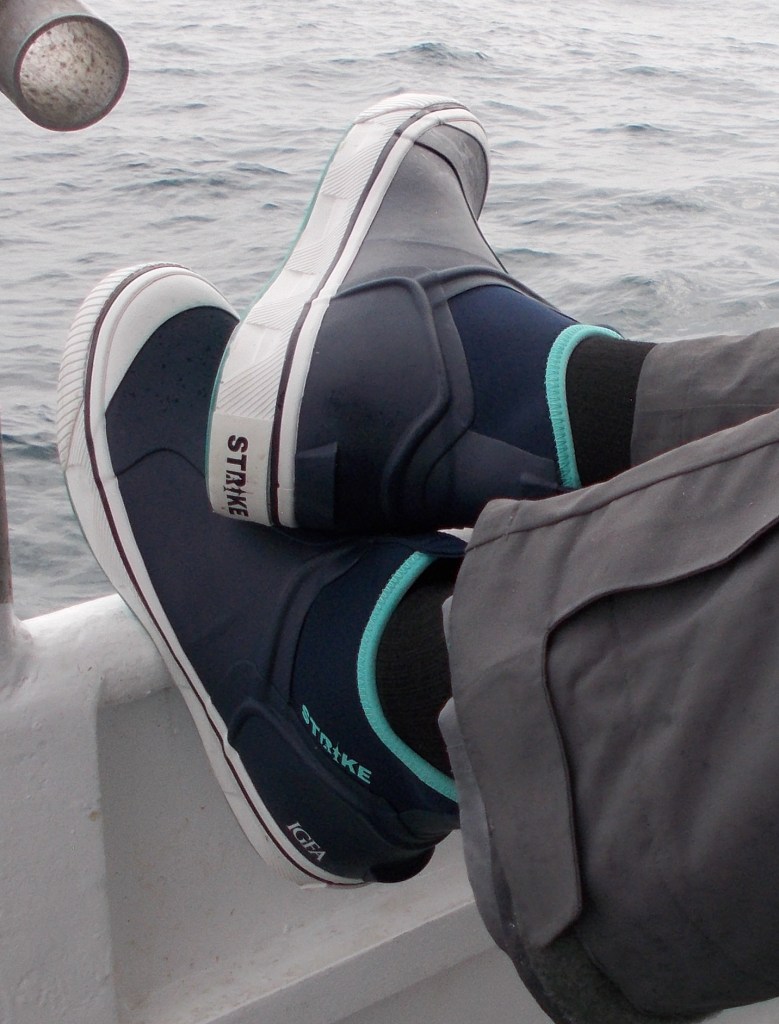
What if you want something that’s more than a deck shoe but not a traditional high-top deck boot? Try a comfy product made by Strike Footwear that is working merger of shoe and boot as well as style and function. 

Deck shoes are built to work on wet decks in warm weather. A bit of slop or spray that overtops the low profile of the shoe makes little difference. It’ll dry and may even feel pleasant. 

But I’m busy on the Great Lakes from early March to late November most years and only about three of these months are warm weather, warm water months. The rest of the season I want my feet in footwear that are warm and dry on the inside and impervious to wet decks and spray on the outside.

In March and April, then again in late fall, I’ll be wearing some sort of hi-top boot. The rest of the “cool” weather/water season I don’t need a full “boot.”  The Bigeye Boot by Strike Footwear isn’t a tall or even a medium tall boot. It covers my feet to just above my ankle.

That’s the perfect height most of the time and the design makes even that much “boot” deceiving. The “rubber” part of the Bigeye is like a shoe. However, the “shoe” part transitions to a stretchy neoprene “upper” that fits over the ankle. The neoprene ankle material extends into the boot as an inner lining so when I’m only wearing a thin sock or no-socks my feet aren’t rubbing on the inside of the rubber shoe. A padded insole cushions the bottom of my foot for “walking on a cloud-like” comfort.

Okay, these boots look good, feel good and work good. They also include interesting extras not often included on other deck boots or shoes. One is a molded on lip at the heel making the shoe easy to slip off and a pair of pull loops – one at the rear, the other ahead of the ankle, to make pulling the Bigeye Boots fast and easy.  

Bigeye Boots are endorsed by the IGFA for Strike’s reliance on eco-friendly materials in their construction. They come in black, white or navy. Look for them and other Strike Footwear at: https://www.strike-footwear.com/.

COBRA BLUE BOUND 150 HANDHELD MARINE RADIO

Reviewed by: CAPT. MIKE SCHOONVELD

I was 11 miles offshore one nearly calm day on Lake Michigan. Suddenly, my motor died and when I tried to restart it, the battery was so weak the starter solenoid would just “click.” I fiddled with the battery connections to no avail so I called the Coast Guard on my marine radio to report my situation.

When I pushed the microphone key, my chart-plotter screen showed a message, “low battery, powering off.” Then the unit shut off. I knew when a battery is weak, at some point, the battery would no longer operate a marine radio – especially transmit – so the first thing I did was tell the USCG dispatcher my GPS position as shown on my cell phone. Though I had zero bars, to make a call, at least that app worked.

All’s well that ends well, but we were lucky. The Coast Guard called BoatUS and they responded, but it took about two hours. By then, the radio wouldn’t even receive messages. My crew and I were concerned but the last transmission we heard was that the tow-boat was underway.

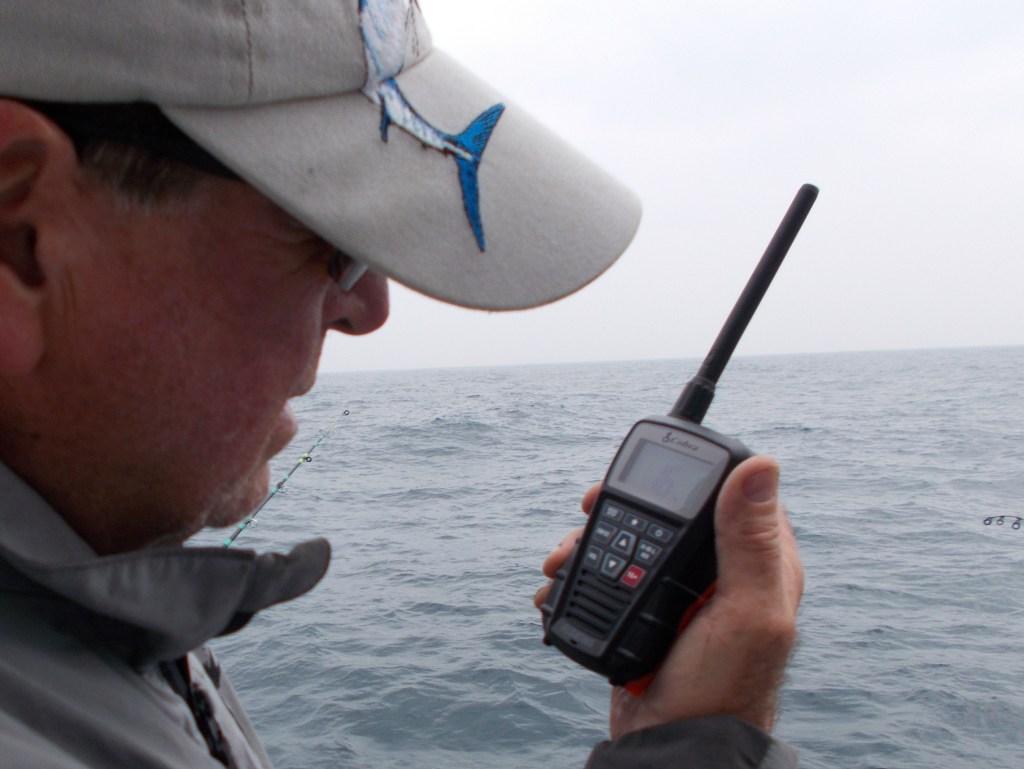
The first thing I did was buy a new alternator to fix the boat and the second thing was to get a Cobra BlueBound 150 handheld marine radio. I chose the Cobra over other brands for several features (including price) and also because my boat’s permanent VHF radio is a Cobra brand and it has given me decades of service.

Other features that sold me on this radio was that it has rechargeable AAA batteries. They charge with the same USB-C plug I use to charge my cell phones. Cobra says a full charge will last up to 11 hours. I’ve put spare AAA lithium batteries in my “necessary” box to use if BlueBound 150’s batteries ever did run down.

One feature I don’t want to test is that it floats. It won’t sink if I were to drop it overboard or off the dock. More important if (God forbid) the boat sinks or someone falls overboard.

The maximum output of this portable radio is 3 watts which isn’t going to blast a signal very far, but the height of the antenna dictates the distance a radio can send or receive more than the power. USCG stations are equipped with very tall antennas capable of reaching out 50 miles.

Since I’ve acquired the radio I’ve used it to monitor a different channel than my main is set on. I’ve carried it with me on other people’s boats – some of them don’t have a marine radio since they think they will usually have cell service. I know my cell phone is usually useless much more than five miles offshore and in some areas service is spotty even nearshore.