SCOTTY GIMBLE DOWNRIGGER MOUNT

Reviewed by: CAPT. MIKE SCHOONVELD

A friend of mine fished area inland lakes and trailered his my boat to Florida each winter to spend time fishing for sea trout and redfish. The boat was well equipped for these activities, handled fine in moderate waves so he decided to rig it for Great Lakes fishing, as well to get in on Indiana’s great salmon and steelhead fishing. 

He loved it and soon found himself fishing on Lake Michigan as much or more than on inland lakes. He fished without downriggers, relying on divers and lead core during the summer months, but he was reluctant to add downriggers since he thought that would require drilling holes for the downrigger mounts or installing a track system. He wouldn’t mind doing that but he plannedi to upgrade his boat in another year or two. A boat with tracks or holes in the gunwales would either limit the market for potential buyers or degrade the resale value.

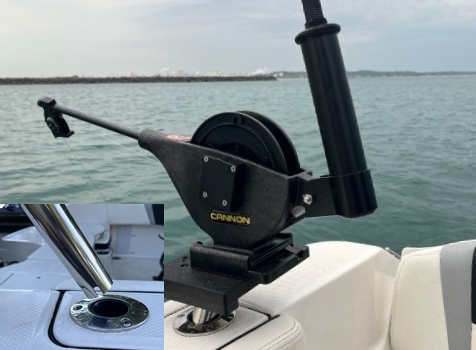
I noticed his boat had flush mounted rod holders built into the gunwales and so I suggested he find downrigger mounts that would slide into these rod holders. After checking around on the Internet, he found some Scotty 1028 Gimbal Mounts at Amazon.com that would fit his rod holders perfectly. I told him Scotty products have been around for decades and always get great reviews. So he bought a pair.

Now he’s set for another season on Lake Michigan and I know the addition of a pair of downriggers will up his game and increase his enjoyment. Perhaps he’ll even learn his current boat will do just fine for more than another year or two.

BAZUKA PRO ROD TUBE BY FLAMBEAU

Reviewed by: Capt. Mike Schoonveld

The Great Lakes covers so much territory it’s often more convenient to travel from one lake to the next – or from one end of one lake to the other end – by plane rather than over surface roads. Or, if you are like me, you have a wanderlust to head for far away fishing adventures where travelling by air is mandatory.

If those flights require travelling with any of your personal fishing gear – in this case, fishing rods – you’ll need some way of ensuring those rods show up on the baggage carousel unscathed by their adventure. Over the years, I’ve seen or used several ploys to get my rods to far off places with me, but these days, the friendly skies aren’t so friendly to most travelers and especially to those that show up at the gate with fish a fishing rod.

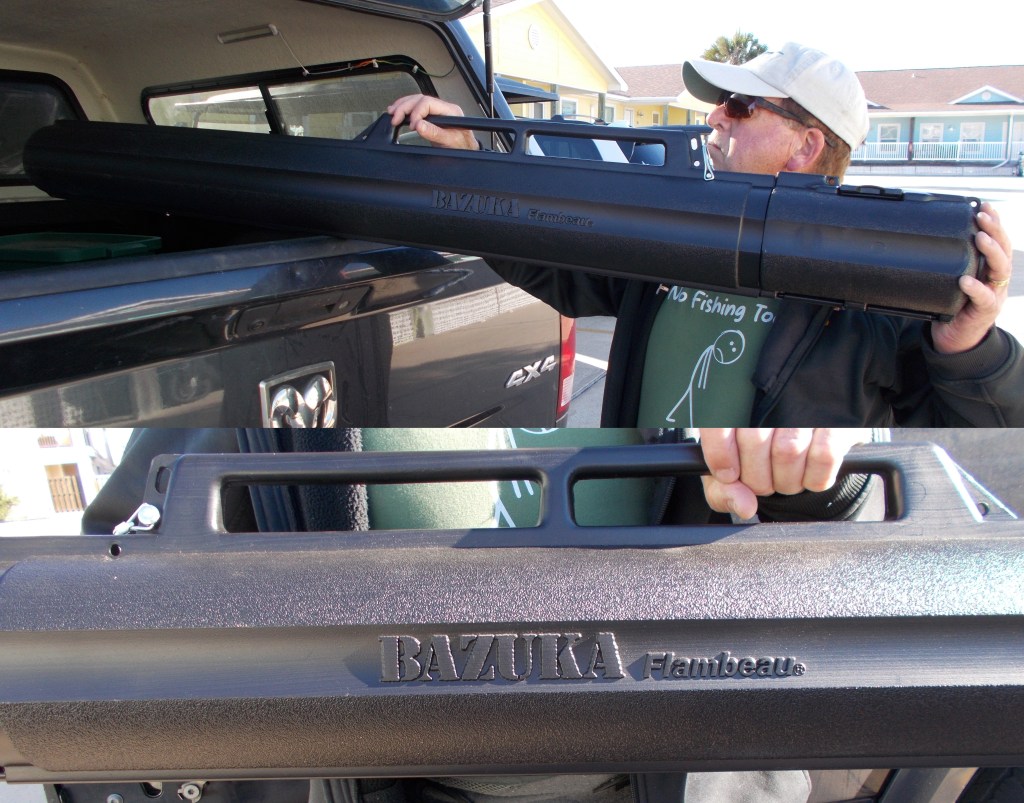
The Bazuka Rod case doesn’t make travelling any friendlier, but it does make it less worrisome.  Made from a tough, rugged plastic, it won’t bend or splinter. If it shows up on the rod carousel crushed or looking like something ran over it, something has run over it. It wasn’t damaged on the plane or when being stowed.

I like the way it telescopes so I can adjust the size to fit the length of the rods I’m toting along with me. Nearly any two-piece rod will fit inside, and it will hold one-piece rods up to 8-feet. I’ve not crammed it full, but the interior diameter will easily hold four or more.

It’s not just for air travel. When I’m heading to a remote location with my boat, I use the in-boat storage. But when I’m not towing a boat, I pack my rods in the Bazuka so I can stow them over, under or beside any of the rest of my gear in the back of the truck or SUV.  Bazukas are widely available at retailers or you can check them out and other Flambeau storage options at www.flambeauoutdoors.com 

TWO TOO-COOL TUMBLERS

Reviewed by: CAPT. MIKE SCHOONVELD   

I’m not sure which manufacturer invented the 20-ounce insulated tumbler, but they are standard on my boat. I load one up with hot coffee knowing that by the time I get to where I plan to fish, get the lines set and maybe have the first fish or two of the day in the cooler, my coffee will still be hot. One of my best friends has a similar cup filled with iced tea that usually still has ice left in the bottom at the end of the trip.

These stainless steel, vacuum-sealed tumblers are now made by several companies and other than different colors and minor variations of lid design, one brand seems nearly identical to the next. Recently, however, I came across a couple that set them apart from most of the rest.

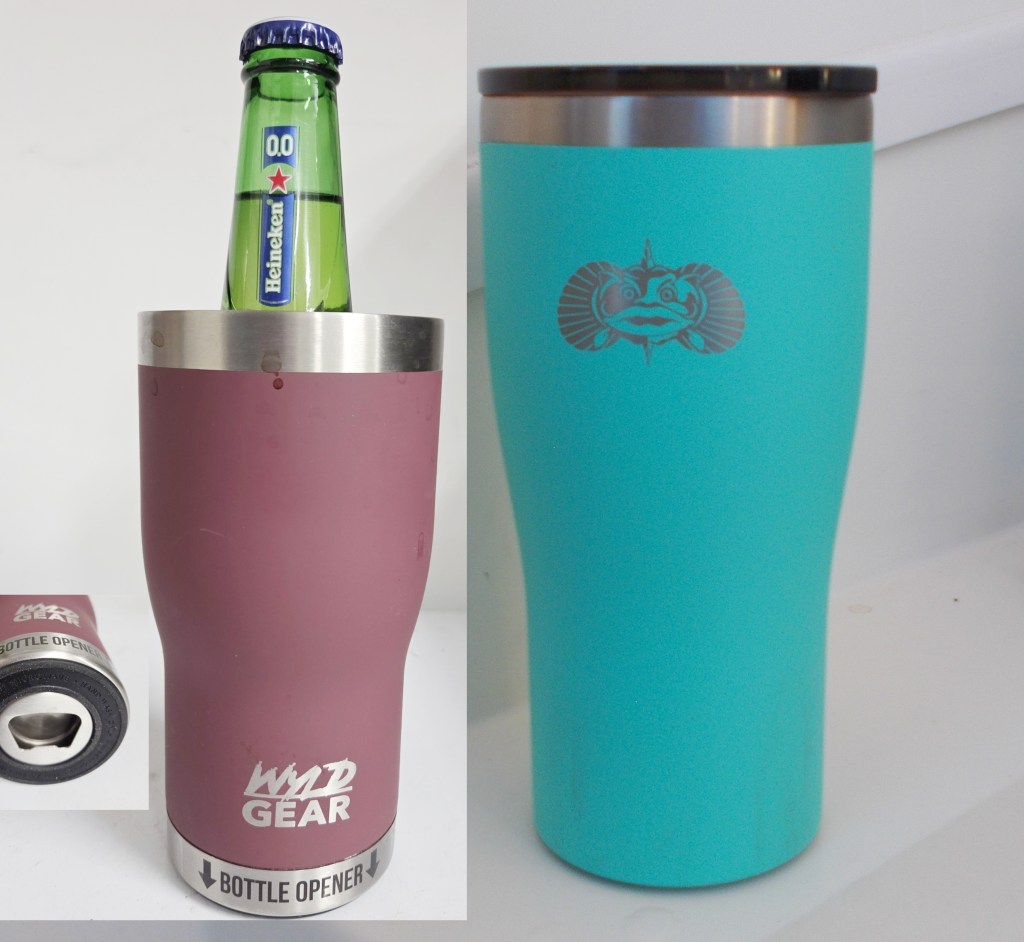
The “coolest” of these has a feature is one available from TOADFISH. It’s the one I always bring along when I’m hopping on someone else’s boat. Many boats are short on cup holders and when I show up with my 20 ounces of hot coffee, the Toadfish Non-Tipping Tumbler solves that problem. Just set the tumbler down on any “slick” surface, like a fiberglass gunwale or a painted aluminum dashboard and its suction cup bottom will stick it there like a lamprey on a laker. It won’t tip over. Want to take a slurp, just lift it straight up and it easily releases. It seems magical more than logical. Available in several colors; I chose the “Toadfish Teal.”  Check it out and other unique Toadfish products at www.ToadFish.com. You can purchase it there, at Amazon.com and other sources.

If you have plenty of drink holders on your boat and the tip-less tumbler isn’t appealing, how about bottle openers? Sure, it’s possible to pop the top on a chilled Corona or Heineken with the same pliers you use to rip hooks out of the fish you catch, but how easy is that? My Wyld Gear 20-ounce tumbler solves that problem.

Look at it from the side or from the top and it looks like most any other steel vacuum drink container but take a look at the bottom, and you’ll see a built-in bottle cap tool. Brilliant! Well, at least it’s novel place to mount a bottle opener. Once you’ve popped the top, slide the bottle inside the tumbler and it becomes a koozie. Check out this multi-tasking tumbler and dozens of other Wyld Gear products at www.wyldgear.com.

BIGEYE BOOT BY STRIKE

Reviewed by: Capt. Mike Schoonveld                

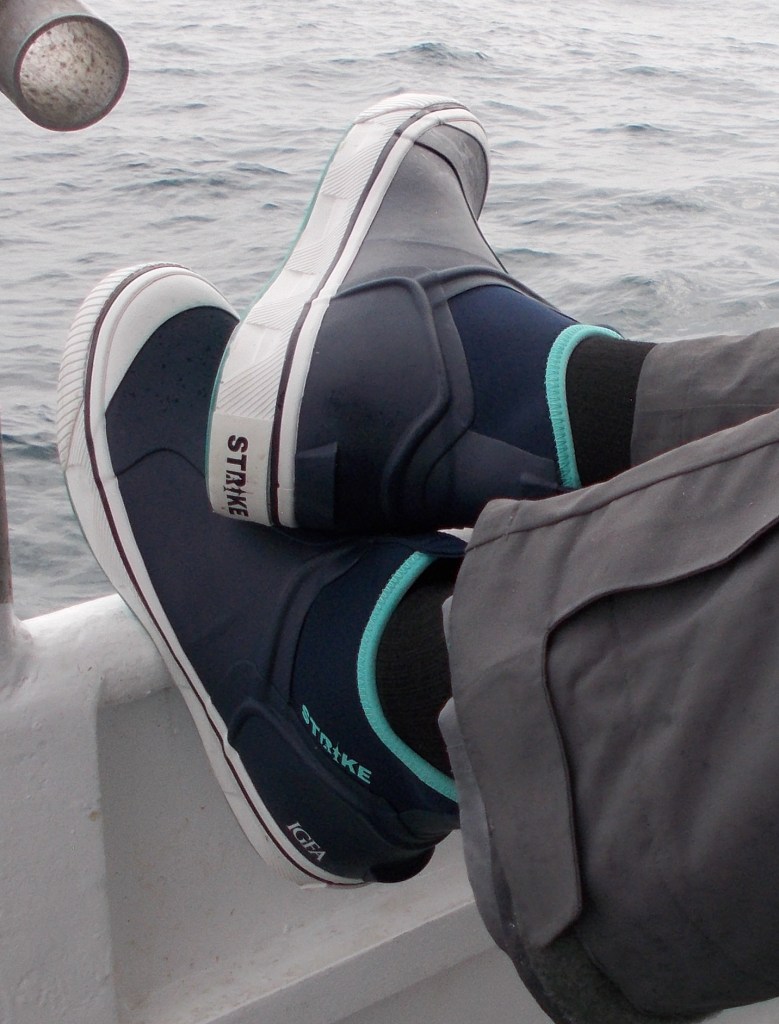
What if you want something that’s more than a deck shoe but not a traditional high-top deck boot? Try a comfy product made by Strike Footwear that is working merger of shoe and boot as well as style and function. 

Deck shoes are built to work on wet decks in warm weather. A bit of slop or spray that overtops the low profile of the shoe makes little difference. It’ll dry and may even feel pleasant. 

But I’m busy on the Great Lakes from early March to late November most years and only about three of these months are warm weather, warm water months. The rest of the season I want my feet in footwear that are warm and dry on the inside and impervious to wet decks and spray on the outside.

In March and April, then again in late fall, I’ll be wearing some sort of hi-top boot. The rest of the “cool” weather/water season I don’t need a full “boot.”  The Bigeye Boot by Strike Footwear isn’t a tall or even a medium tall boot. It covers my feet to just above my ankle.

That’s the perfect height most of the time and the design makes even that much “boot” deceiving. The “rubber” part of the Bigeye is like a shoe. However, the “shoe” part transitions to a stretchy neoprene “upper” that fits over the ankle. The neoprene ankle material extends into the boot as an inner lining so when I’m only wearing a thin sock or no-socks my feet aren’t rubbing on the inside of the rubber shoe. A padded insole cushions the bottom of my foot for “walking on a cloud-like” comfort.

Okay, these boots look good, feel good and work good. They also include interesting extras not often included on other deck boots or shoes. One is a molded on lip at the heel making the shoe easy to slip off and a pair of pull loops – one at the rear, the other ahead of the ankle, to make pulling the Bigeye Boots fast and easy.  

Bigeye Boots are endorsed by the IGFA for Strike’s reliance on eco-friendly materials in their construction. They come in black, white or navy. Look for them and other Strike Footwear at: https://www.strike-footwear.com/.

COBRA BLUE BOUND 150 HANDHELD MARINE RADIO

Reviewed by: CAPT. MIKE SCHOONVELD

I was 11 miles offshore one nearly calm day on Lake Michigan. Suddenly, my motor died and when I tried to restart it, the battery was so weak the starter solenoid would just “click.” I fiddled with the battery connections to no avail so I called the Coast Guard on my marine radio to report my situation.

When I pushed the microphone key, my chart-plotter screen showed a message, “low battery, powering off.” Then the unit shut off. I knew when a battery is weak, at some point, the battery would no longer operate a marine radio – especially transmit – so the first thing I did was tell the USCG dispatcher my GPS position as shown on my cell phone. Though I had zero bars, to make a call, at least that app worked.

All’s well that ends well, but we were lucky. The Coast Guard called BoatUS and they responded, but it took about two hours. By then, the radio wouldn’t even receive messages. My crew and I were concerned but the last transmission we heard was that the tow-boat was underway.

The first thing I did was buy a new alternator to fix the boat and the second thing was to get a Cobra BlueBound 150 handheld marine radio. I chose the Cobra over other brands for several features (including price) and also because my boat’s permanent VHF radio is a Cobra brand and it has given me decades of service.

Other features that sold me on this radio was that it has rechargeable AAA batteries. They charge with the same USB-C plug I use to charge my cell phones. Cobra says a full charge will last up to 11 hours. I’ve put spare AAA lithium batteries in my “necessary” box to use if BlueBound 150’s batteries ever did run down.

One feature I don’t want to test is that it floats. It won’t sink if I were to drop it overboard or off the dock. More important if (God forbid) the boat sinks or someone falls overboard.

The maximum output of this portable radio is 3 watts which isn’t going to blast a signal very far, but the height of the antenna dictates the distance a radio can send or receive more than the power. USCG stations are equipped with very tall antennas capable of reaching out 50 miles.

Since I’ve acquired the radio I’ve used it to monitor a different channel than my main is set on. I’ve carried it with me on other people’s boats – some of them don’t have a marine radio since they think they will usually have cell service. I know my cell phone is usually useless much more than five miles offshore and in some areas service is spotty even nearshore.

DAVINCI 12000 MAG DIAL FLASHLIGHT

Reviewed by: CAPT. MIKE SCHOONVELD

Almost every Great Lakes fishing trip for me starts in the dark. I’ve installed lights in my boat to help me negotiate at the helm or on the back deck when I’m setting lines and I have mounted an LED floodlight on the stern to light up the “action zone” where salmon or walleye are reeled in close enough to net from the otherwise black waters. Those lights take care of what’s going on in the boat and in the immediate vicinity, but what’s happening 10 yards away or 100 yards or more?

I used to keep a Q-Beam spotlight on board I could plug into my boat’s cigarette lighter outlet. It would shoot a brilliant light at distant items, like nav buoys, pierheads or bonehead kayakers with only a dim firefly of a nightlight showing. It would brighten up these or perhaps unknown things 20 yards or perhaps 200 yards ahead. It worked, but it’s an antique these days of flashlights that don’t have to be hardwired or portable lights that eat non-rechargeable batteries.

All the “regular” flashlights I use these days are rechargeable, including the headlight I strap on to give me hands-free lighting down to small “pen” lights that shine brighter and longer than the D cell lights I used to employ.

I own several NEBO lights and their quality and function are top shelf. NEBO is a company that produces rechargeable lights from keychain size up to spotlight models, probably brighter than my old Q-Beam.

The small one I use most is a NEBO SLIM+ 1200. I reviewed it for GLA a couple years ago and you can now see that review at:  www.fishgear.reviews/2022/07/24/nebo-slim-1200-flashlight/

As the name implies, it’s a 1200 lumen model, almost blindingly bright. When I got the news release from NEBO about their Davinci line of “super-bright” flashlights, with models up to 12,000 Lumens, I was intrigued. “If a 1200 lumen is bright, a 12000 lumen must be blazing,” I thought. 

I got one and it instantly retired my old Q-Beam. The Davinci is more compact than the Q-Beam (or other super bright flashlights) and there’s no wired plug-in for power. It’s similar in size to a Maglite 3D that cops often carry as a light and a weapon to bonk the bad guys. I’m sure the Davinci could double as a billy-club in a pinch, weighing two pounds and with a stout, sturdy construction.

More important (at least for fishermen) it turns night into day out to an amazing distance when the adjustable beam is tightened from wide angle to narrow with a twist of the knurled ring just behind the light. A different ring-dial dims the light to five lesser settings all the way down to 300 lumens. Dialing down extends the battery life to 12 hours.

If you would like to check out or purchase the Davinci 12000 light or other models and sizes of rechargeable lights go to:  www.nebo.agcbrands.com.

DEX FINGERLIGHT

Reviewed by: CAPT. MIKE SCHOONVELD

Tom Mitchell, spent a career in the medical device industry and had supplied tiny LED lights to surgeons that could be mounted on their fingers to put additional light in areas where they were working and hard to illuminate with overhead lights. Tom is also a deer hunter and realized there are times before dawn or after sunlight a tiny light would be enough to allow him to climb in or out of his stand, load or unload his gun, knock arrows and not light up the woods, possibly scaring the deer. Putting these thoughts together and into action, the Fingerlight was created – not the stainless, fragile model the doctors require, but a rugged, weather-resistant light that will adjust to nearly every man or woman’s fingers.

It’s great for hunters, I’m sure, but when I saw it, I’d just finished installing a battery in the nether-regions of my boat and realized it would have been perfect for that chore since the compartment was dark, cramped and the light from above wasn’t bright enough to illuminate the battery box. I needed two hands to make some of the connections and a third hand to shine a light so I could see the connections. A small light on one of my fingers would have been perfect answer.

I got one of the Fingerlights and put it to use immediately. The salmon run was on and I started the day long before dawn. I’ve put red interior lights in my boat to help preserve my night vision, but they won’t light up the counters on my downriggers or diver rods. The Fingerlight will. Or it will light up the inside of my glove compartment where small tools work their way to the back. Or it will light-up the oil filter on my tow-vehicle where some auto engineer thought it would be funny to mount it right above the front axle.

I’m sure, over time, I’ll find other nooks and crannies barely big enough to insert a hand, much less shine a light and the rechargeable Fingerlight will be perfect. I’m sure once you get one, you will find your own special uses for it as well. They are available at some retail and online outlets including Amazon.com or directly from www.fingerlight.com

BREAKWATER WATERPROOF GLOVES BY AFTCO

Reviewed by: CAPT. MIKE SCHOONVELD

When it’s “glove weather” in the Great Lakes area you know there’s some fabulous fishing available. Every ice-fishing fan knows that last-of-the-season ice can produce the best action of the season. Every ice-out angler knows those March days can feature hungry walleyes, northerns, cohos, browns and other species in many places. So put on some warm gloves (along with warm clothes) and go fishing! Don’t forget Lake Erie walleye that bite until boats are frozen off the lake.

It seems AFTCO understood this when they designed their Breakwater model gloves with features every cold water/weather angler needs. Though there are many types of waterproof gloves, few are versatile. The rubber or plasticized versions ward off water but most aren’t supple enough to allow fishing maneuvers like gripping a reel handle or grabbing a minnow. Some gloves are warm and flexible, but bulky. None are perfect, but the Breakwater model I used late last fall during late winter-type weather are as close to perfect and all-purpose as I’ve ever used. 

 I couldn’t clip walleye spoons onto snap swivels or tie fishing knots with cold fluorocarbon, but I could deploy the lures on divers or attach the lines to planer boards using the same gloves I used to grip the steering wheel when heading to the fishing area. I didn’t have to peel the gloves off to do most work or sacrifice gripping power due to a slippery, warmth-only glove on the throttle or steering wheel.

 AFTCO started with a quick-drying stretch knit fabric to provide a snug fit and warmth. Inside, there’s a waterproof membrane to prevent water and wetness from getting through to the soft, fleece inner layer that makes the glove extra-warm. I was able to handle wet, slippery fish and grip cold-handled pliers to remove the fishhooks.

 The palm and inside of the fingers have a tough, silicone-like coating to make the gloves more durable and give a non-slip grip. The thumb and first finger have a touchscreen-compatible fingertips that allow me to swipe my cellphone screen and move the cursor around on my sonar/plotter screen. 

 AFTCO Breakwater Gloves are widely available in either black or olive color at retailers and online sources including Amazon. You can also check them out and/or purchase at www.aftco.com along with all the other top-of-the-line fishing products from AFTCO. 

FLAMBEAU GEAR BOX

Reviewed by: CAPT. MIKE SCHOONVELD

Every boat has (or should have) a storage container for “necessary papers.” At the least, it should have the boat’s registration certificate, perhaps the boat’s trailer registration and insurance papers. I keep my BoatUS membership papers, my captain’s license in it. There’s a copy of my fishing licenses (for each Great Lake state I visit each year) and several other licenses and documents dealing with my charter business. Throw in a pen, pencil and Sharpie, a few AA or AAA batteries a roll of electrical tape and a folded-up Approved Day Signal Distress Flag and several zip ties to mount the flag on my VHF antenna. It’s become my “necessary box.”

 The Compact Marine Dry Box by Flambeau is perfect size for me (9.625″ L x 7.5″ W x 4.25″ D) and checks several other boxes. It’s rugged and waterproof due to the rubber gasket that seals out water when the end-hinged (like an ammo box) lid is shut and latched down. It’s bright orange. I keep it in a storage compartment along with other gear – first aid kit, a tool kit, zip lock bags and other items. When I need it, I can locate it at a glance. If I forget to stow it away, it’s heavy enough that it won’t blow out of the boat at highway speeds.

 Check the Compact Marine Dry Box (and larger sizes) along with other Flambeau storage box options at www.flaumeauoutdoors.com. They are available to purchase at the site, at other online sellers and widely available at retailers.

SHALLOW MONEY BADGER

Reviewed by: CAPT. MIKE SCHOONVELD

Berkley’s Money Badger crankbait has been a hit (mostly on the bass fishing scene) for the past couple of years at the times and places where a long-casting, quick diving plug banging off rip-rap or digging along sandy bottoms where either large or smallmouths are present. I captured a couple of them to use on my boat as  trolling lures for fall walleyes on Lake Erie and cohos on Lake Michigan. There’s just a short window when deep diving cranks are right for early-season cohos. To keep the original Money Badgers from diving under the salmon, I got the best results by letting them out only 25 feet and using 20# leaders to keep them from diving too deep. That’s why, when Berkley perfected a Shallow Money Badger, I was intrigued.

Stock up on these and have them in hand when the early season cohos, and spring brown trout invade the shallows. In early March where I fish,the Shallow Money Badgers quickly joined the other shallow-diver crankbaits in the A-Team of lures I fish with utmost confidence. The 6.25 and the slightly larger 7.25 versions both swim right in the zone when browns and cohos are stacked in warm water outflows or swimming just off the beaches and breakwalls seeking warmth and forage fish.

Like most Berkley lures, I expect them to run true right out of the box and stay that way fish after fish. I also expect them to be salmon tough, unlike some small crankbaits that break or get mangled after catching a few fish.  

The action features “an aggressive tail wag and high body roll” according to Berkley, and has a click-like rattle to pull in fish from a distance. High action, ample noise and bright colors are common to all my best-coho cranks. I’m betting the Blaze color (hot red with black squiggles) will be the star on my boat, with the FireTiger a solid option on the days when the fish want something different. I’ll also be including the FireTiger and other, more “walleye” patterns, on late spring trips to Erie to use with Dipsey Divers or downriggers to get them down to the action zone.  

Shallow Money Badgers should be in most well-stocked tackle stores . They can be purchased at many online sites or check out or purchase all of Berkley’s lures and other tackle at www.berkley-fishing.com