When I’m after the biggest fish, I want a big landing net with a basket made of string. For small and mid-sized fish, I’ll take a net with a rubber mesh – easier on the fish and easier on me when untangling the fish and the lure from the net. A big net with a large rubber basket it just too heavy when I extend the net far enough to reach the fish.
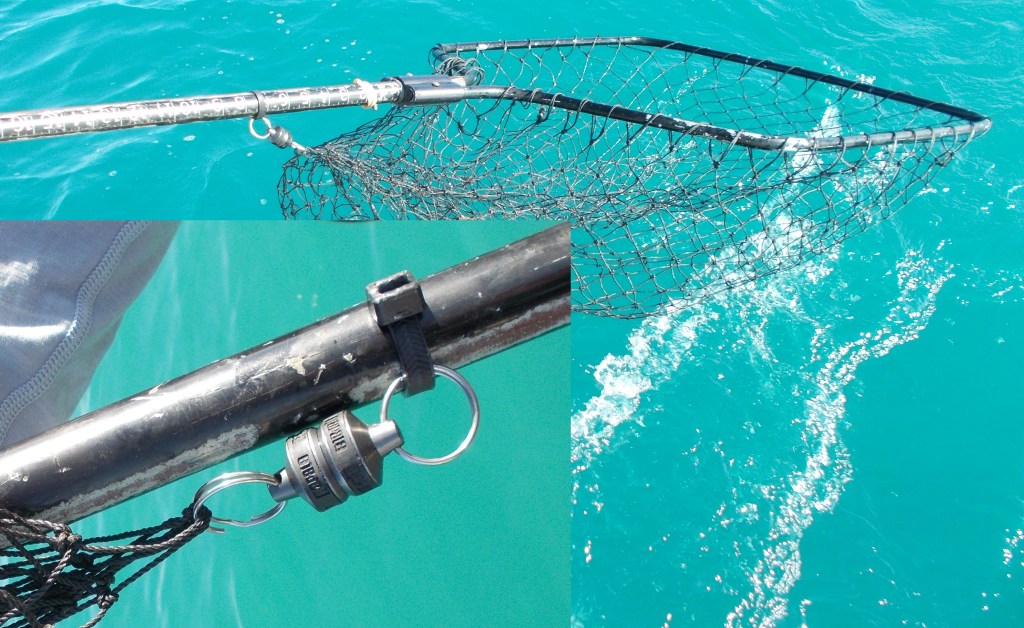
The problem with a “string mesh” net is when the net is readied just above the surface of the water, the lightweight mesh will drag the bag back, past the lip of the net and it’s all too easy for the hook in the fish’s mouth or a second hook on multi-hooked lures to snag on the exposed netting and too often, that’s the end of the fight. Fish on, fish lost.
I’ve tried several methods of preventing “net blow-back” on my string net. All worked to a degree, none were perfect. The Magnetic Release Clip by Rapala is perfect.
I don’ t know for sure how the deep thinkers at Rapala intended for these magnets to be used, but when I saw them, I immediately thought “net release.” The Magnetic Release Clip is basically a pair of rare earth magnets, strong enough to easily hold a net basket in place while a fish is being netted, but not so strong they won’t pull apart when the fish falls into the basket. Using the large split ring that comes on each magnet, I clipped one of them to the bottom of the net basket and used a zip-tie to fasten the other to the handle of the net. They work perfectly!
Available at many online and retail outlets or simply purchase them and other Rapala lures, tools and products at: http://www.RAPALA.com
The reels needed when fishing for big king salmon, lake trout and Skamania steelhead have to be tough to stand up to the battle, drags that are silky-smooth when a steelhead feels the sting and accelerates to high speed in an instant and have oversized washers to stand up to the heat generated when a king makes a long runs. Then the reel has to be able to stand up to the same things the next trip and the next.
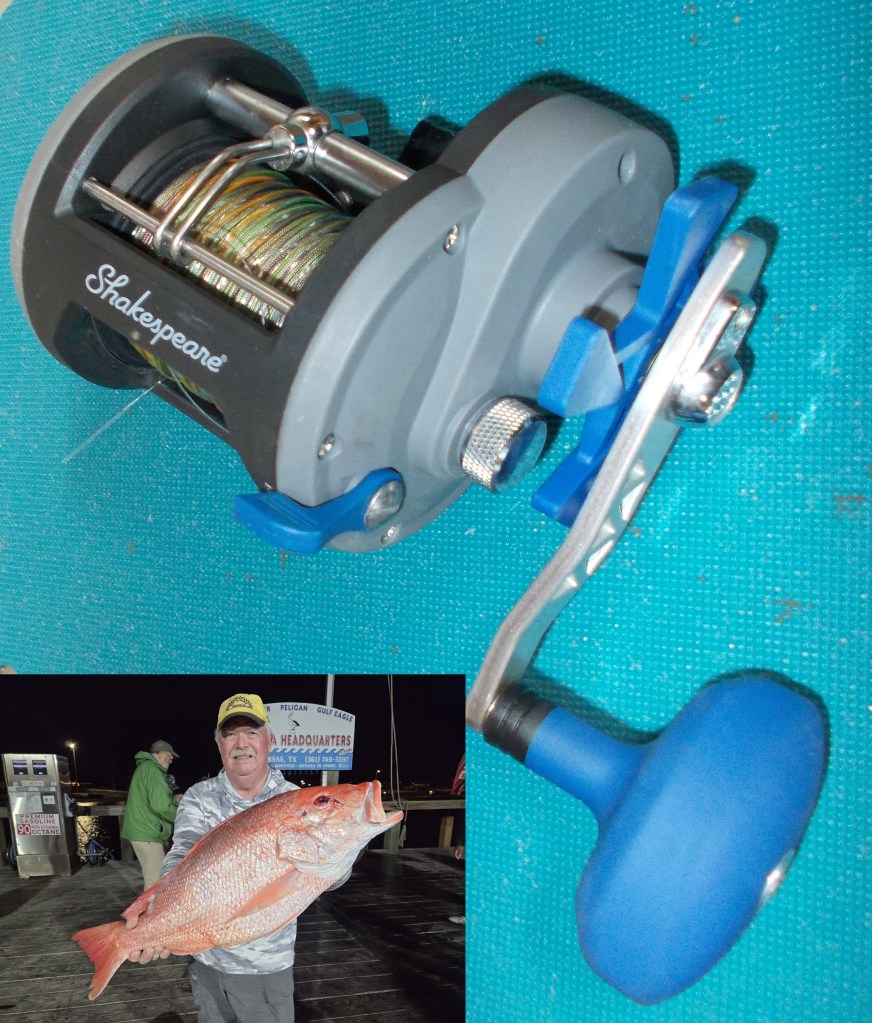
Most reels that meet these criteria are budget breakers for anglers just getting started or on a limited budget who have to balance price with quality. Shakespeare’s new Contender Conventional Reel (currently listed at $74.99 on the Pure Fishing website) tilts that balance in favor of the angler. Available as a “30” size reel, it features a graphite frame, a stainless steel levelwind, brass gears and ball bearings to make the reel run smooth the first time it’s used and will continue to perform years into the future.
“Conventional” is a term often used for reels in the saltwater market – differentiating between a revolving spool – conventional – and spinning reels. Shakespeare used this term because this reel is aimed at the saltwater market primarily, but that certainly doesn’t preclude using it in freshwater. Many of the top-quality reels found on the hardest working Great Lakes charters are “crossover” models equally at home on the lakes or on saltwater.
I got the reel during the winter months and wanted to give it a solid test before the 2026 Great Lakes open water season gets going. I took it to the Texas Gulf in February to test it on mammoth red snappers. Snappers are shaped like bass, sized like four-year-old kings and are as stubborn as any fish that swims. I spooled it with 30-pound test braided line with a 50# fluorocarbon leader.
Pulling a 20 pound plus snapper up from the bottom in 100 feet of water isn’t an easy task. Every inch of line is earned and every ten feet or so the fish pulls back and peels off eight or nine feet, even on a drag tighter than I’d ever use on salmon or trout. The reel held up, fish after fish, after fish.
I wanted to put it too the test since I plan to use it as the reel for my “secret weapon rig” – two colors of lead core deployed on the deepest downrigger to present a deep lure far behind and deeper than any of the downrigger weights. Often, the biggest fish of the day come on the “SWR.” My experience with the snappers proved to me it will be up to the task.
The Contenders will likely be available at many retailers this summer and is available now at www.purefishing.com.
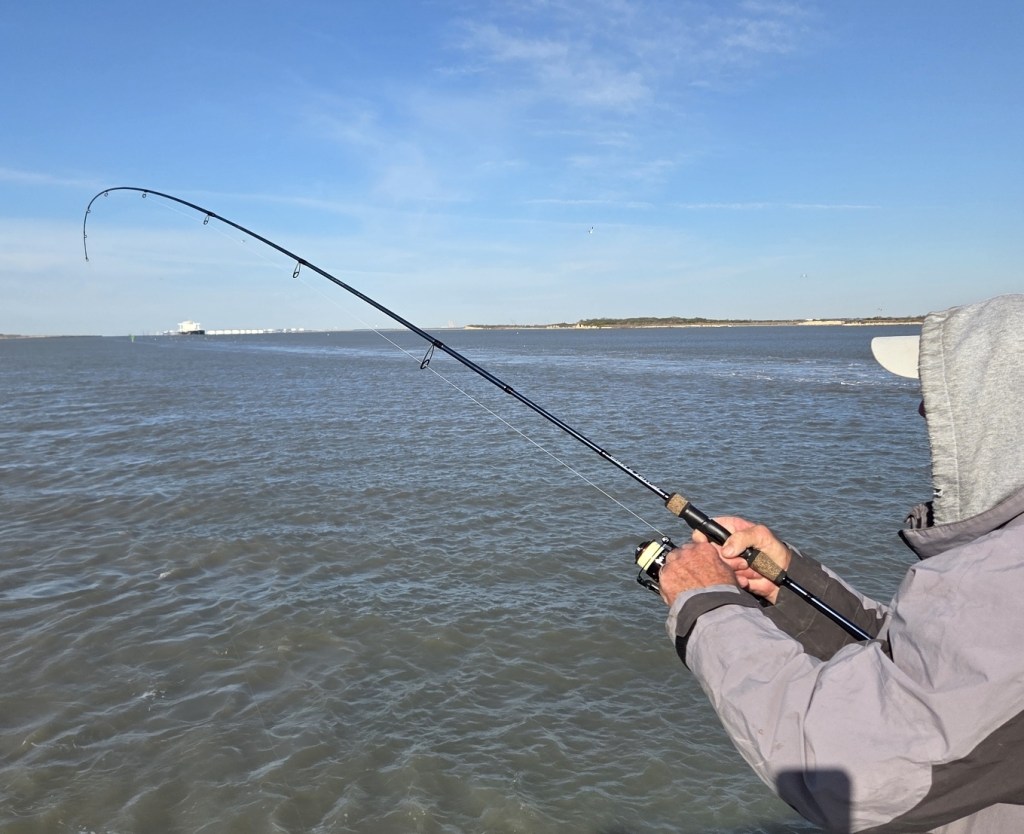
Because of this, I wasn’t so surprised when I put a Flagship Travel Spinning Rod to the test and found it to be an exceptional product. I’ve owned and used a variety of travel rods in the past and the best thing I could say about them was that they could be broken down into three or four sections to make them easy to pack in a large suitcase or to tote them along on other trips where full length or even two-piece rods would be impossible or cumbersome.
A few of the travel rods I’ve previously used were so clunky I could have fished as well with a willow branch. None of the best of them felt or fished like a quality “conventional” rod.
First the “travel” part of this rod. Though it’s a three-piece rod, it comes with four pieces. There are two tip sections, one with a medium action – perfect for walleyes, bass, shore fishing for cohos or browns and similar applications. The other tip turns the rod into a medium light rod, good for stream trout, white bass, bluegills and other panfish.
It comes with a hard sided travel case which will keep the rods secure whether they are being handled by luggage handlers, stowed in an overhead bin or crammed in with other luggage in a car, truck or SUV.
FishUSA says the travel rod is constructed with “a strategic blend of 30 and 36-ton graphite. I’m not sure what that means but I am sure fishing with this rod was a pleasure. At seven-feet long I was able to make long casts if needed to get to the fish and then control fish when I got them close to the boat. I fished with both live bait and lures. Using the medium tip, I could put extra action to the lures on the retrieve. Using live bait, I could detect the lightest bite. There was nothing clunky about the feel, action or look of the rod. Whether fishing on the Detroit River for walleyes, for perch on Lake Michigan or other fish on an inland lake, I wouldn’t hesitate to use this rod whether I needed it as a travel rod or not. Check out the Flagship Travel Spinning Rod and other FishUSA gear at www.fishusa.com.
The Great Lakes covers so much territory it’s often more convenient to travel from one lake to the next – or from one end of one lake to the other end – by plane rather than over surface roads. Or, if you are like me, you have a wanderlust to head for far away fishing adventures where travelling by air is mandatory.
If those flights require travelling with any of your personal fishing gear – in this case, fishing rods – you’ll need some way of ensuring those rods show up on the baggage carousel unscathed by their adventure. Over the years, I’ve seen or used several ploys to get my rods to far off places with me, but these days, the friendly skies aren’t so friendly to most travelers and especially to those that show up at the gate with fish a fishing rod.
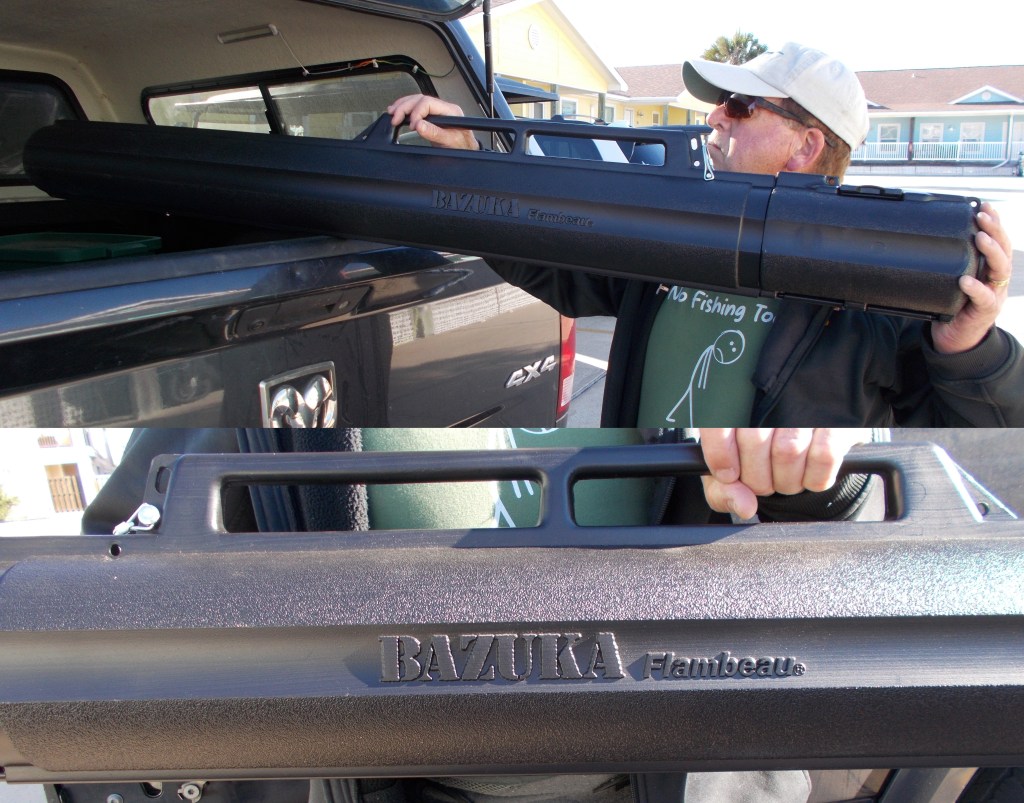
The Bazuka Rod case doesn’t make travelling any friendlier, but it does make it less worrisome. Made from a tough, rugged plastic, it won’t bend or splinter. If it shows up on the rod carousel crushed or looking like something ran over it, something has run over it. It wasn’t damaged on the plane or when being stowed.
I like the way it telescopes so I can adjust the size to fit the length of the rods I’m toting along with me. Nearly any two-piece rod will fit inside, and it will hold one-piece rods up to 8-feet. I’ve not crammed it full, but the interior diameter will easily hold four or more.
It’s not just for air travel. When I’m heading to a remote location with my boat, I use the in-boat storage. But when I’m not towing a boat, I pack my rods in the Bazuka so I can stow them over, under or beside any of the rest of my gear in the back of the truck or SUV. Bazukas are widely available at retailers or you can check them out and other Flambeau storage options at www.flambeauoutdoors.com
You are out fishing with your regular crew, one of which just finished unhooking a walleye that hit one of the planer board lines, or you are trolling on Lake Ontario and your fishing partner just unhooked a king salmon that fell for a lure pulled deep with a Dipsey Diver – or perhaps it’s you and a friend on Lake Superior and the fish being unhooked is a laker that fell for a downrigged lure. Regardless of the place or the fish, soon the familiar question will be heard: How deep was the line set? How far out did you have this Dipsey? How far back was this Flicker Shad?
Ah…. I think I had it out…. How far is the diver on the other side…? More likely, “I can’t remember.”
How far? How deep? How much line? All are important questions; and the wrong answer can be the difference in whether that lure or that line is a one-hit-wonder or the hero for the day.
I’m sure there are “set-up savants” that can remember every lure and every deployment. I was once on a boat where the captain kept an Excel spreadsheet on an iPad showing every lure, every depth, every fish, probably the wind speed and color of each angler’s underwear. That’s not me and it wasn’t a couple of Michigan fishing buddies who were always asking these questions whether they were out for Saginaw Bay walleyes or trolling for Lake Huron salmon.
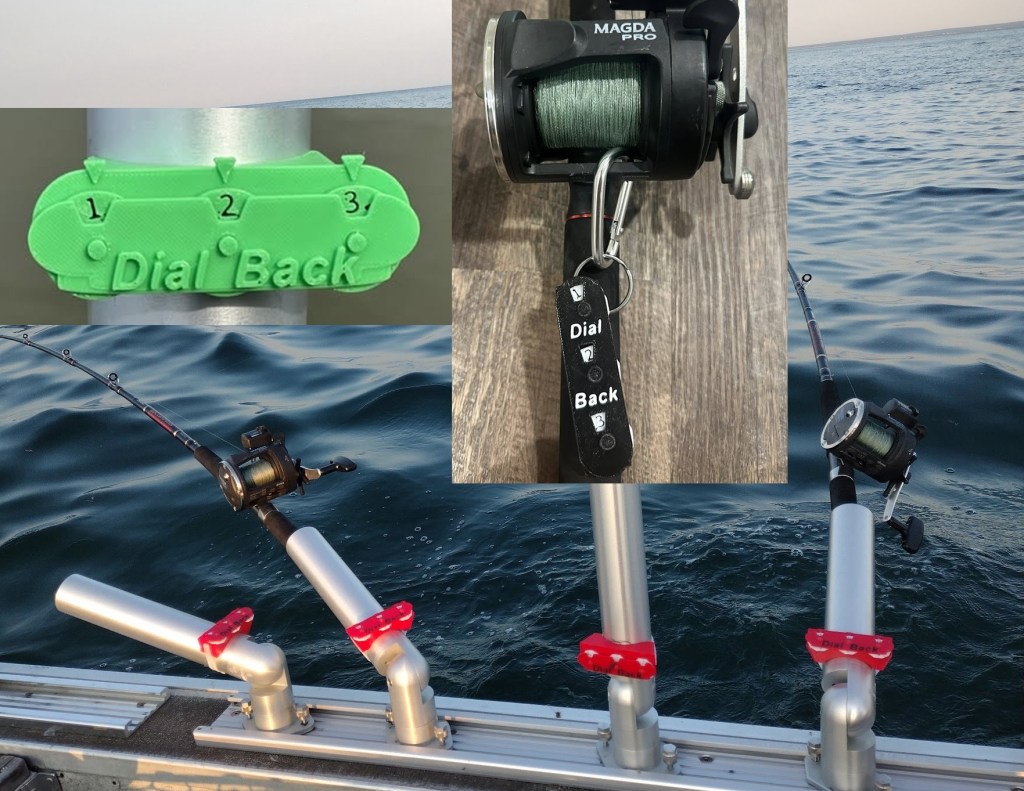
But instead of just asking this question over and again, they used their non-fishing talents to invent and produce the Dial Back Precision Trolling Device, or what I call the Dial Back Memory Enhancer. There are two styles, depending on how your boat is set up or how you fish. Both have a small, plastic body with three numbered dials which rotate from zero to nine. Have a Dipsey Diver set at 93 feet, set the dials on the memory enhancer to show 093.
The original style is best for boats that always have the same rod in the same rod holder. The device attaches to the rod holder. If you always put the starboard downrigger in a specific rod holder, that’s where to put the Dial Back. Set the lure 88 feet deep, set the rod in the holder, set the dials on the Dial Back to 0-8-8.
The Dial Back “mini” is for guys who rotate their rods, a common tactic for those who use Big Board Planers with the fishing lines attached to releases that slide down a tether cord. After a fish is caught on the rod and reel in rod holder #1, the rod in the #2 holder gets moved to the #1 position, the #3 moves to #2, etc. The lure that caught the fish gets positioned to rod holder for the lure trolled closest to the boat.
Dial Back Minis attach to the rod or reel in any position that works for you. Attach it to the reel, to the rod, to the first line guide – where doesn’t matter, the process is the same. Catch a fish. Rotate the other rods, check the Dial Back on the set-up that just caught the fish and put the lure exactly as far as it was previously.
These are products EVERY trolling boat should have and every troller can afford! The Mini’s are available in black, the originals in a variety of colors so you can color-code your rod holders. “Fish on yellow!” Check them out and purchase them at www.dialbackprecisiontrolling.com.
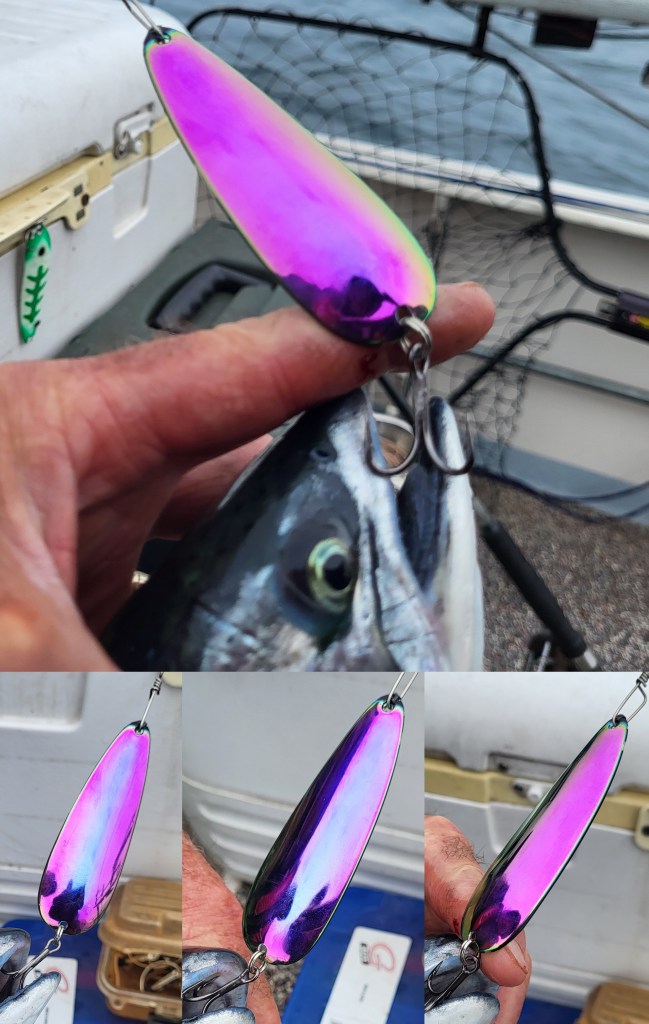
When the guys at RLVNT Sunglasses sent me a pair of sunglasses to try, they slipped in a couple of spoons they thought I’d like to use. This line of tackle is ever-expanding but what they’ve done (and are doing ) is use the light-bending properties of the films and coatings they use in their lenses and apply them to their lures.
Depending on how much and at what angle the light strikes the finish on these lures, the color of the reflected light changes. You see it and the fish see it. So instead of seeing a traditional paint job which only varies whether the lure is in direct sunlight or shade, or a metallic finish that just reflects when sunbeams hit it, the lure changes color continuously.
The one I used shimmered from dark purple to pink to bright blue and regularly caught the attention of passing cohos. I loaned it to a friend to take to Lake Nipigon and he crushed the lake trout using it. Other films produce other hues and excel in conditions from stained or off-colored water to crystal clear. (And don’t think their casting spoon is only for casting. It trolls perfectly with a loose wobble.)
The Mad Scientist lives in Minnesota – often called Walleye-sota – and firmly in the winter ice-belt. They produce a bevy of lures (all with their proprietary finishes) suitable for panfish or pike (salmon or trout) wherever they swim. Made in America, sold online at www.madscientist.technology, in retail stores and other online outlets.
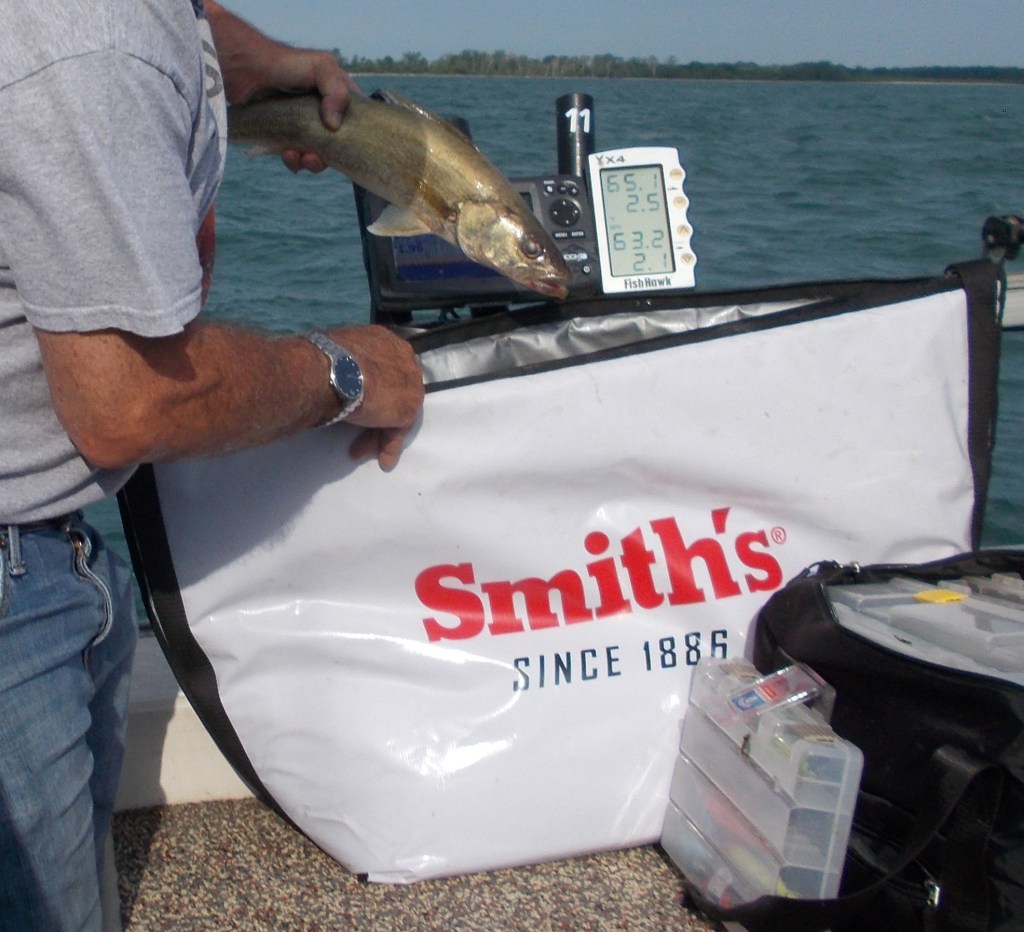
There was something missing on my boat last spring, a fish cooler. Often called a box or the fish box. If you don’t have a fish cooler on your boat, chances are you rely on stuffing the fish you catch and keep into a livewell or into a built-in fish storage compartment. My boat’s livewell must have been designed for perch fishing. It won’t hold a four-person limit of spring cohos and is certainly too small to hold a decent four-person bag of Lake Erie walleye.
So I “bagged” the fish. Actually, the fish went into Smith’s Products Insulated 36” Bait and Fish Kill Bag. Why not use my old IGLOO cooler? It takes up a lot of space.
Formerly, when my cooler was my only choice, I “made” space for it. It was a piece of necessary gear, so I economized on other gear to make everything fit with room left over for the fish box and the fishermen. Not now.
At the beginning of the day, the Kill Bag takes up almost no room. It doesn’t fold perfectly flat, it is insulated – front, back and bottom with closed cell foam, but a cooler is the same size whether it’s full or empty. Before the first fish is caught I add one or two small (7-pound) bags of ice – depending on air temperature. At that point the bag is about 1/3rd the size of my old fish cooler. On a good day, by the time it’s got 18 or 24 walleyes in the bag (or 15 or 20 cohos), it takes up about half the space of my fish cooler – and there’s space left over to hold a king, a big brown trout or several plus-size walleyes if the fishing was extra-good.
I had four concerns when switching from a hard-sided plastic cooler to a soft-sided kill bag. Would it be tough enough? Would it be hard to clean? Would it keep the fish cool and fresh? Would it be large enough?
The Smith’s bag is constructed (inside and out) with a heavy-duty, marine grade tarp-like fabric. I wasn’t overly concerned the sharp fins on the walleyes I put in the bag would perforate the interior lining, but that thought was in the back of my mind. So, after several walleye trips, I took a flashlight, put on my reader glasses and examined the interior closely so see if there were any visible holes. None were found, nor did I ever detect any leakage around the bottom seams from melting ice had dripping through the inner skin and leaking out the bottom. Additionally, the seams are reinforced with strong nylon strapping material made from the same material as the detachable carrying strap. Plenty tough.
Both the interior and exterior is slick-finish allowing fresh blood to just rinse off and even dried-on blood to wash clean with a minimum amount of scrubbing with a soft brush. Once it’s rinsed clean, I just invert it with the zipper open and to let it quickly dry. Cleans up easily.
Cooling ability? One sure indicator of how well it’s insulated is how much ice is left at the end of the trip. If all you have left in your fish cooler is melt water, it’s not doing the job. On my early spring trips when the air temperature and the water temperature (thus the fish temperatures) are in the 40s, that small bag of ice was still more ice than meltwater after a long half-day of fishing. Once the weather and water warmed, the second bag of ice still did the job.
The 36” Bait and Fish Kill Bag is Smith’s middle size offering. It’s perfect for how I used it. Later in the season when king salmon and lake trout figure heavily into the catch where I fish, it wouldn’t be large enough. However, Smith makes a 48” kill bag that is advertised to be larger than my Igloo and there’s a smaller, 30-incher (called Mr. Crappie) that will hold several limits of perch or crappies.
Though the 30 and 36-inch versions are called “bait and fish kill bags,” I don’t think they’d be a good replacement for a bait bucket. Perhaps in a special situation, they’d be ideal – not on my boat. They do come with drain plugs at the bottom, however, to allow melt water from the ice or minnow water if used for bait to flow out the bottom. Available at www.smithsproducts.com at retailers and several online outlets including Amazon.