BIGEYE BOOT BY STRIKE

Reviewed by: Capt. Mike Schoonveld                

What if you want something that’s more than a deck shoe but not a traditional high-top deck boot? Try a comfy product made by Strike Footwear that is working merger of shoe and boot as well as style and function. 

Deck shoes are built to work on wet decks in warm weather. A bit of slop or spray that overtops the low profile of the shoe makes little difference. It’ll dry and may even feel pleasant. 

But I’m busy on the Great Lakes from early March to late November most years and only about three of these months are warm weather, warm water months. The rest of the season I want my feet in footwear that are warm and dry on the inside and impervious to wet decks and spray on the outside.

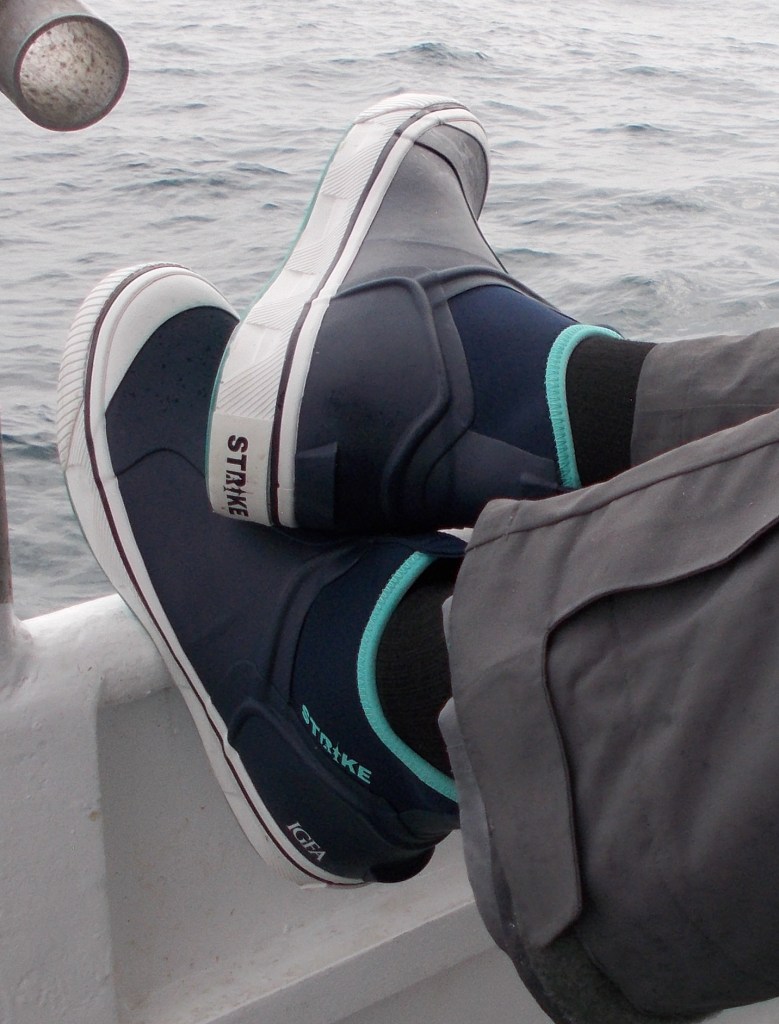
In March and April, then again in late fall, I’ll be wearing some sort of hi-top boot. The rest of the “cool” weather/water season I don’t need a full “boot.”  The Bigeye Boot by Strike Footwear isn’t a tall or even a medium tall boot. It covers my feet to just above my ankle.

That’s the perfect height most of the time and the design makes even that much “boot” deceiving. The “rubber” part of the Bigeye is like a shoe. However, the “shoe” part transitions to a stretchy neoprene “upper” that fits over the ankle. The neoprene ankle material extends into the boot as an inner lining so when I’m only wearing a thin sock or no-socks my feet aren’t rubbing on the inside of the rubber shoe. A padded insole cushions the bottom of my foot for “walking on a cloud-like” comfort.

Okay, these boots look good, feel good and work good. They also include interesting extras not often included on other deck boots or shoes. One is a molded on lip at the heel making the shoe easy to slip off and a pair of pull loops – one at the rear, the other ahead of the ankle, to make pulling the Bigeye Boots fast and easy.  

Bigeye Boots are endorsed by the IGFA for Strike’s reliance on eco-friendly materials in their construction. They come in black, white or navy. Look for them and other Strike Footwear at: https://www.strike-footwear.com/.

COBRA BLUE BOUND 150 HANDHELD MARINE RADIO

Reviewed by: CAPT. MIKE SCHOONVELD

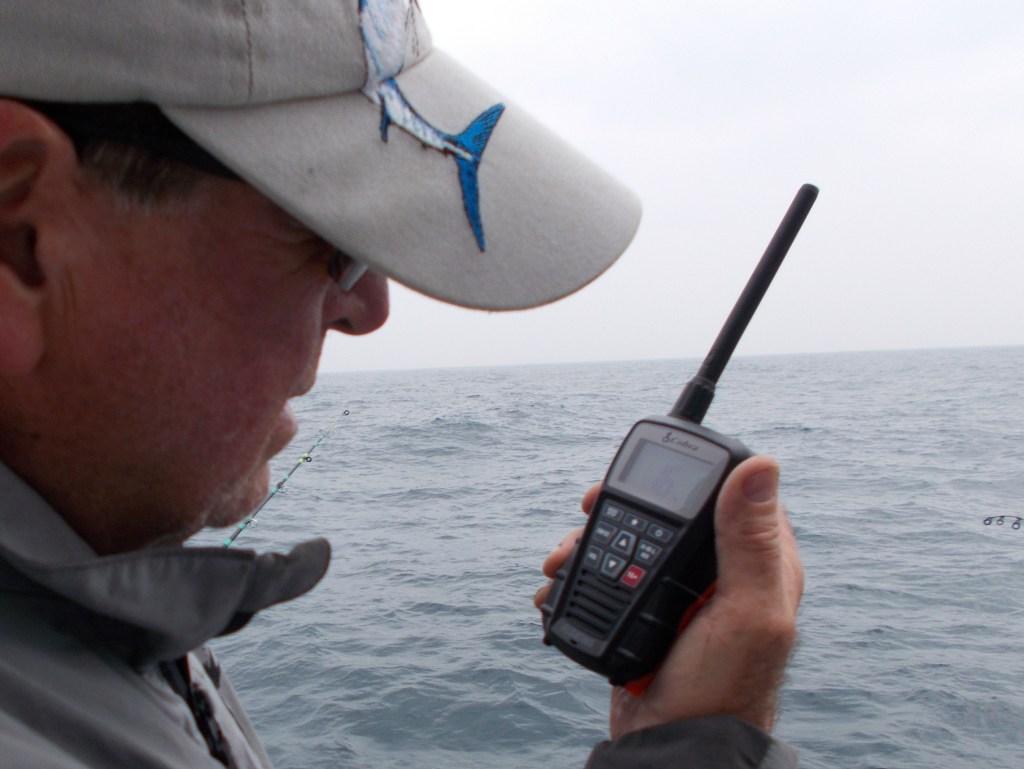
I was 11 miles offshore one nearly calm day on Lake Michigan. Suddenly, my motor died and when I tried to restart it, the battery was so weak the starter solenoid would just “click.” I fiddled with the battery connections to no avail so I called the Coast Guard on my marine radio to report my situation.

When I pushed the microphone key, my chart-plotter screen showed a message, “low battery, powering off.” Then the unit shut off. I knew when a battery is weak, at some point, the battery would no longer operate a marine radio – especially transmit – so the first thing I did was tell the USCG dispatcher my GPS position as shown on my cell phone. Though I had zero bars, to make a call, at least that app worked.

All’s well that ends well, but we were lucky. The Coast Guard called BoatUS and they responded, but it took about two hours. By then, the radio wouldn’t even receive messages. My crew and I were concerned but the last transmission we heard was that the tow-boat was underway.

The first thing I did was buy a new alternator to fix the boat and the second thing was to get a Cobra BlueBound 150 handheld marine radio. I chose the Cobra over other brands for several features (including price) and also because my boat’s permanent VHF radio is a Cobra brand and it has given me decades of service.

Other features that sold me on this radio was that it has rechargeable AAA batteries. They charge with the same USB-C plug I use to charge my cell phones. Cobra says a full charge will last up to 11 hours. I’ve put spare AAA lithium batteries in my “necessary” box to use if BlueBound 150’s batteries ever did run down.

One feature I don’t want to test is that it floats. It won’t sink if I were to drop it overboard or off the dock. More important if (God forbid) the boat sinks or someone falls overboard.

The maximum output of this portable radio is 3 watts which isn’t going to blast a signal very far, but the height of the antenna dictates the distance a radio can send or receive more than the power. USCG stations are equipped with very tall antennas capable of reaching out 50 miles.

Since I’ve acquired the radio I’ve used it to monitor a different channel than my main is set on. I’ve carried it with me on other people’s boats – some of them don’t have a marine radio since they think they will usually have cell service. I know my cell phone is usually useless much more than five miles offshore and in some areas service is spotty even nearshore.

BREAKWATER WATERPROOF GLOVES BY AFTCO

Reviewed by: CAPT. MIKE SCHOONVELD

When it’s “glove weather” in the Great Lakes area you know there’s some fabulous fishing available. Every ice-fishing fan knows that last-of-the-season ice can produce the best action of the season. Every ice-out angler knows those March days can feature hungry walleyes, northerns, cohos, browns and other species in many places. So put on some warm gloves (along with warm clothes) and go fishing! Don’t forget Lake Erie walleye that bite until boats are frozen off the lake.

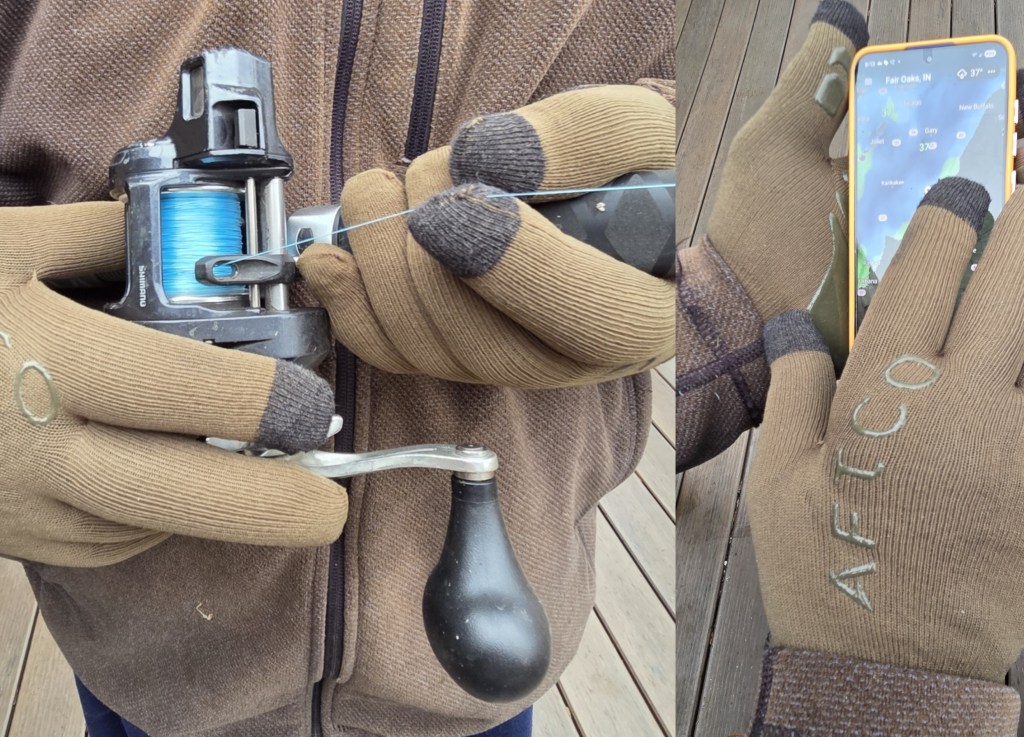
It seems AFTCO understood this when they designed their Breakwater model gloves with features every cold water/weather angler needs. Though there are many types of waterproof gloves, few are versatile. The rubber or plasticized versions ward off water but most aren’t supple enough to allow fishing maneuvers like gripping a reel handle or grabbing a minnow. Some gloves are warm and flexible, but bulky. None are perfect, but the Breakwater model I used late last fall during late winter-type weather are as close to perfect and all-purpose as I’ve ever used. 

 I couldn’t clip walleye spoons onto snap swivels or tie fishing knots with cold fluorocarbon, but I could deploy the lures on divers or attach the lines to planer boards using the same gloves I used to grip the steering wheel when heading to the fishing area. I didn’t have to peel the gloves off to do most work or sacrifice gripping power due to a slippery, warmth-only glove on the throttle or steering wheel.

 AFTCO started with a quick-drying stretch knit fabric to provide a snug fit and warmth. Inside, there’s a waterproof membrane to prevent water and wetness from getting through to the soft, fleece inner layer that makes the glove extra-warm. I was able to handle wet, slippery fish and grip cold-handled pliers to remove the fishhooks.

 The palm and inside of the fingers have a tough, silicone-like coating to make the gloves more durable and give a non-slip grip. The thumb and first finger have a touchscreen-compatible fingertips that allow me to swipe my cellphone screen and move the cursor around on my sonar/plotter screen. 

 AFTCO Breakwater Gloves are widely available in either black or olive color at retailers and online sources including Amazon. You can also check them out and/or purchase at www.aftco.com along with all the other top-of-the-line fishing products from AFTCO. 

DIAL BACK MEMORY ENHANCERS

Reviewed by: CAPT. MIKE SCHOONVELD

You are out fishing with your regular crew, one of which just finished unhooking a walleye that hit one of the planer board lines, or you are trolling on Lake Ontario and your fishing partner just unhooked a king salmon that fell for a lure pulled deep with a Dipsey Diver – or perhaps it’s you and a friend on Lake Superior and the fish being unhooked is a laker that fell for a downrigged lure. Regardless of the place or the fish, soon the familiar question will be heard: How deep was the line set? How far out did you have this Dipsey? How far back was this Flicker Shad?

                Ah…. I think I had it out…. How far is the diver on the other side…? More likely, “I can’t remember.”

                How far? How deep? How much line? All are important questions; and the wrong answer can be the difference in whether that lure or that line is a one-hit-wonder or the hero for the day.

                I’m sure there are “set-up savants” that can remember every lure and every deployment. I was once on a boat where the captain kept an Excel spreadsheet on an iPad showing every lure, every depth, every fish, probably the wind speed and color of each angler’s underwear. That’s not me and it wasn’t a couple of Michigan fishing buddies who were always asking these questions whether they were out for Saginaw Bay walleyes or trolling for Lake Huron salmon.

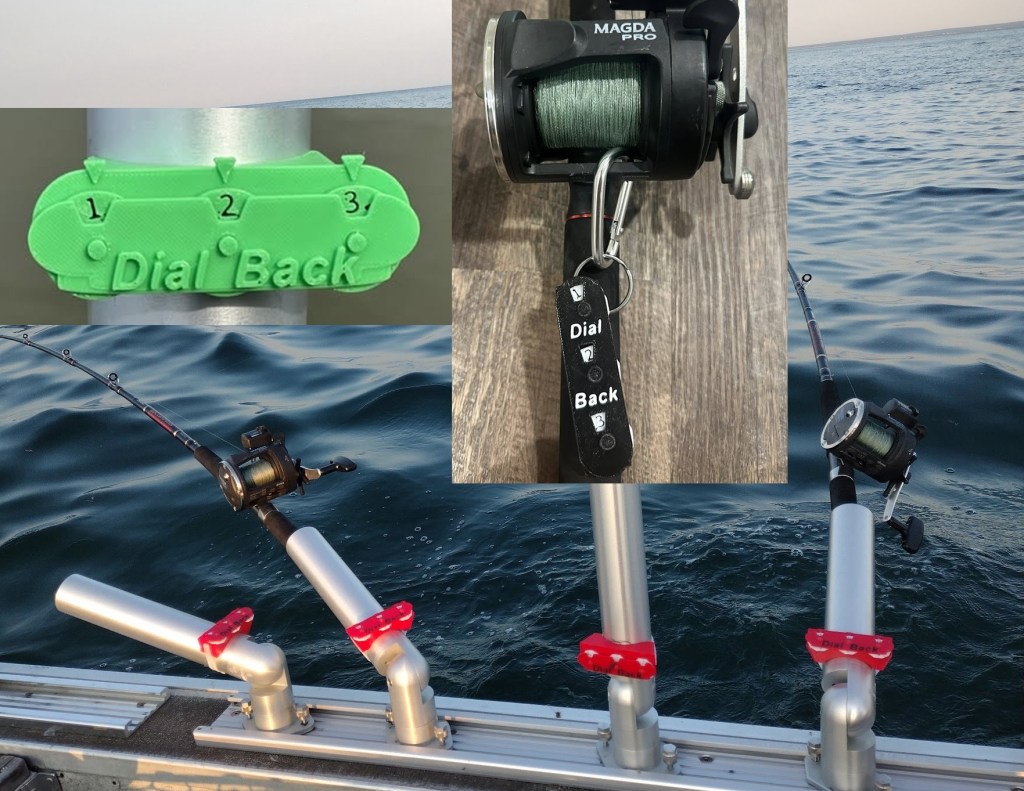
                But instead of just asking this question over and again, they used their non-fishing talents to invent and produce the Dial Back Precision Trolling Device, or what I call the Dial Back Memory Enhancer. There are two styles, depending on how your boat is set up or how you fish. Both have a small, plastic body with three numbered dials which rotate from zero to nine. Have a Dipsey Diver set at 93 feet, set the dials on the memory enhancer to show 093.  

                The original style is best for boats that always have the same rod in the same rod holder. The device attaches to the rod holder. If you always put the starboard downrigger in a specific rod holder, that’s where to put the Dial Back. Set the lure 88 feet deep, set the rod in the holder, set the dials on the Dial Back to 0-8-8.

                The Dial Back “mini” is for guys who rotate their rods, a common tactic for those who use Big Board Planers with the fishing lines attached to releases that slide down a tether cord. After a fish is caught on the rod and reel in rod holder #1, the rod in the #2 holder gets moved to the #1 position, the #3 moves to #2, etc. The lure that caught the fish gets positioned to rod holder for the lure trolled closest to the boat.

                Dial Back Minis attach to the rod or reel in any position that works for you. Attach it to the reel, to the rod, to the first line guide – where doesn’t matter, the process is the same. Catch a fish. Rotate the other rods, check the Dial Back on the set-up that just caught the fish and put the lure exactly as far as it was previously.

                These are products EVERY trolling boat should have and every troller can afford! The Mini’s are available in black, the originals in a variety of colors so you can color-code your rod holders. “Fish on yellow!” Check them out and purchase them at www.dialbackprecisiontrolling.com.   

GREAT LAKES PRO INSULATED SUIT By Whitewater

GREAT LAKES PRO INSULATED SUIT

Reviewed by Capt. Mike Schoonveld

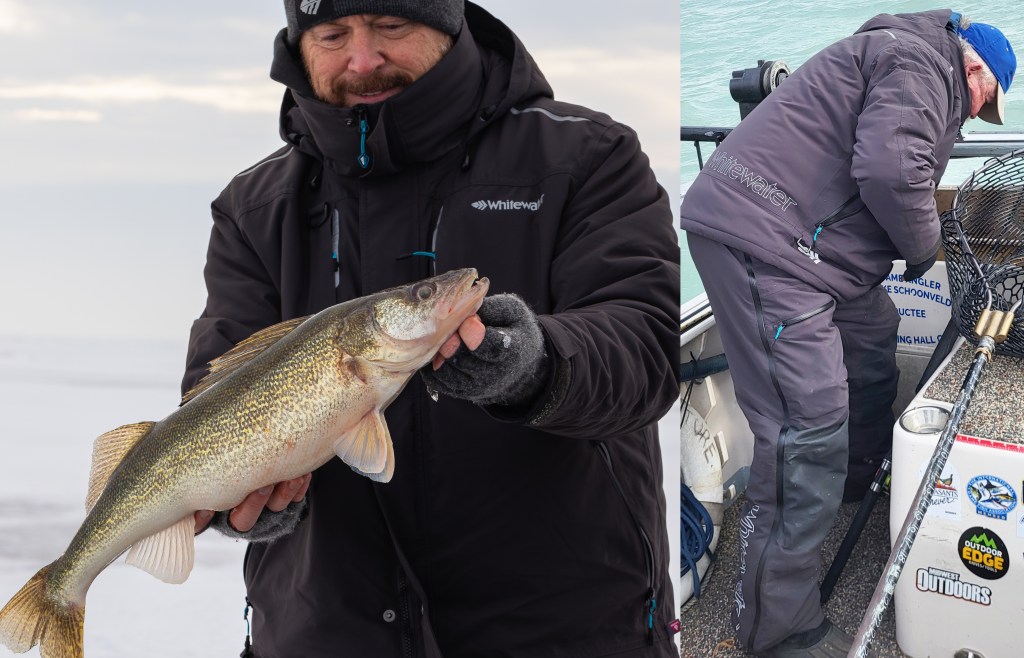
  Do you get a chill down your spine when the weather people start putting words like frost, snow, wintery mix and wind chill in their forecasts? I used to, but I’d much rather start thinking of words like, fall brawl, early ice, late season fishing and even first ice. Those positive thoughts are now more in my mind than worries about chills down my spine since I got my Great Lakes Pro Insulated Suit.

Great Lake anglers don’t hibernate during the cold months. Certainly, the designers at Whitewater know this and being a Michigan based company where not only is windchill is understood, so are winter forecasts with words like lake effect, blustery and accumulation. They live there and understand the problems inherent in many winter parkas, bibs and other outdoor gear.

There are dozens of hi-tech parka and bibs makers, these days, but few of them seem to offer winter suits that check all the boxes. Some are long on insulation, but so bulky it’s hard to do much more than just stand there. Some are not so bulky, but not so warm. Few of them are waterproof. Many seem to concentrate more on flashy colors and patterns.

When I’m out for walleyes in late November, on the ice or in my boat fishing cohos in early March, looking spiffy is less important than being warm and able to move – whether it’s setting a line or drilling a hole.

Don’t think the Great Lakes Pro suit looks clunky. It doesn’t; but instead of being bright red, blue or other colors, it’s black. Perfect for me. On sunny days, the black color helps keep me warm. More important, after a few trips, it doesn’t look like it’s overdue for a trip through the washing machine. 

Unlike many parkas and bibs I’ve used which use the same amount of insulation top to bottom, Whitewater’s Great Lakes Pro is built around various levels of insulation in different parts of each garment. There’s more insulation in the back of the parka than in the front. The sleeves have even less because it’s more important to have more insulation in the torso than in the hood, arms or in the legs in the bibs. That increases flexibility in the right places while maintaining warmth in others.

The best winter bibs have reinforced knees to keep them from wearing out and an additional bit of waterproofing when kneeling next to a tip up or kneeling on a boat’s floor to unhook a flopping fish. More than just an extra layer of cloth, the GL Pro bibs have reinforced the knee area with a rubberized waterproof fabric. That makes the knee area with totally waterproof while the rest of the suit relies on the a Durable Water Repellant and an internal waterproof/breathable layer sandwiched between the exterior fabric and interior lining. That little patch of waterproofing doesn’t really hurt the garment’s breathability rating (13K) or it’s waterproof rating of 30K. 

I’m a “pocket” person in that I like outerwear with plenty of pockets. Nothing worse than having to dig deep into mid-layers to warm my fingers for a minute or grab my cell phone, key fob, camera, pocket knife or most any other item I might need during the course of the day. The jacket has five pockets, all are zip closed for security rubberized zippers for extra water resistance. The bibs have six pockets, interior and exterior.

Another thing I noticed immediately was the suspenders on the bibs are stretchy which I’ve found to be a great feature since whether I’m wearing several layers under the bibs while ice fishing in the open or just a hoody inside on warmer days, I’ve not had to adjust them. They stretch to fit. I love the silicone grip surface on the underside of the suspenders that keeps them from sliding off my shoulders when I’m in the middle of doing something.

I’m now going into my second season with the Great Lakes Pro suit. It was my top layer, rain or shine when I got it in late winter and through most of the spring. I told my customers, “On southern Lake Michigan, winter lasts to Memorial Day, so bundle up.” They don’t always remember that warning, but I do – and though I relish autumn’s Indian summer, I know by the time the next issue of GLA is out, I’ll be using my Great Lakes Pro parka and bibs nearly every day. 

Whitewater’s Great Lakes Pro tops and bottoms are widely available at retail and online sources. Check them out or purchase them (along with other Whitewater products) at www.whitewaterfish.com.

NORTHLAKE TAILGATE BOARD

Reviewed by: CAPT. MIKE SCHOONVELD

There are very few heated fish cleaning stations at marinas or access sites around the Great Lakes. Many marinas and access sites don’t even have a dedicated facility to clean fish.

My fishing season starts long before the cleaning station is open and I’ve seen and used plenty of innovative ways to clean the fish I catch before heading home. Over the winter I got a new one – a tailgate sized cutting board.

I’ve used the tailgate of my pick-up as a work bench many times and as a fish cleaning station a few times. It’s the perfect height, but the downside of using it as a fish cleaning location is the clean-up. Even when laying the largest sized cutting board I owned on the tailgate, there was always some blood or other, slimy fishy-stuff that drips off the board onto the tailgate.

Sure, that can be cleaned up, but doing so without spraying or sloshing water into the truck bed or onto the gear stowed in the bed is tedious. That’s why, when I saw the tailgate sized cutting board from North Lake Outdoors, I realized this two-foot by four-foot cutting board was the perfect answer.

When my fishing partner and I were back at the dock with our limit of cohos (including a bonus brown trout) in early March we lined up our fish on the board for a hero shot and then I went to work. By positioning the board with an inch or so overhanging the open tailgate the blood and slime just dripped off onto the asphalt. When finished, I leaned the board against the open tailgate, dipped a bucket of water from the lake and cleaned the blood, slime and scales off the cutting board, gave it a final rinse with bleach-water I’d brought from home and stowed it in the back of the truck for the next trip.

North Lake makes a slightly smaller 48” X 19” model and a “miniature” 16” X 32” board – all made in America, all made from food-grade polyethylene. Check them out and order one for yourself at www.northlakeoutdoors.com.

GILL VOYAGER DAY PACK

Reviewed by: CAPT. MIKE SCHOONVELD

I don’t leave some of the gear I use just about every trip on or in my boat between excursions. Things like clothes, raingear, sometimes footwear or gloves are removed and either laundered or at least allowed to dry thoroughly between trips. I learned long ago if I pulled out a jacket, hat, camera, or other gear stowed on board, it’s often not as “fresh” as when I stowed it in cubby or compartment.

Anytime I hop onboard someone else’s boat I know I’ll need to take along some of my personal gear. Whether it’s day trips on my boat or on someone else’s, I rely on a roomy day pack to keep my personal gear organized and dry. Last summer my Gill Voyager Day Pack was been my constant companion.

In the early season when days start out more wintery than spring-like, I shed layers as the day warms and when I do, I stuff my morning parka, bibs or other gear into the Day Pack just to keep it out of the way. In the summer, I always have rainsuit in the Day Pack and perhaps a spare sweatshirt along with a boonie hat to keep my ears shaded on sunny days. There may be some homemade cookies, a couple bottles of water or some new lures in the bag when I load it from my truck to the boat.

On away trips I stick my camera, batteries and often my wallet in the zipper-close inner pocket to keep things safe and organized. I bring my own Type V lifejacket, some ziplock baggies and my favorite fillet knife. All this and there’s still room for a couple of 3700 Stowaway lure boxes if I think the extra tackle would be helpful or appreciated.

It all fits – usually – the bag will hold 25 litres (almost seven gallons) worth of gear and I don’t worry about packing it overly tight. The Day Pack is made from a tough, seamless PVC tarpaulin fabric. If I don’t need that much space, I can just give the roll top closure an extra turn or two to shrink the bag and insure it stays perfectly waterproof. I just toss in the bow or stuff it under a seat and don’t worry about it until it’s needed.

It has sturdy, backpack-like carrying straps, handy when carrying it from the parking lot to the docks or even from the ticket counter to the gate in airports. The day pack makes a great carry on for air travel.

Want to try a Gill Day Pack or any other Gill fishing products for yourself? Great! Fishing Toys readers can score a 10% discount by using the Code: CAPTMIKE10 at check out when you purchase at www.gillfishing.com. They are also available at some retailers, at many online sellers and Amazon.com.