
DOUBLE 3 LITER ELECTRIC DEEP FRYER

Reviews by: CAPT. MIKE SCHOONVELD

I don’t often start a product review in which I reveal the downside of a product before I tout the reasons to consider getting one for yourself. The downside of Chard Products’ Double Deep Fryer is it’s too powerful. Actually it’s not too powerful, it just takes a lot of power to make it work.

Unlike most single-basket electric fryers which have a 1200 watt heating element, or double-basket deep fryers that use a single 1800 watt element, each tank in the Chard fryer has a 1500 watt element.

That means on most home electrical circuits, if you plug each side into the same outlet, you’ll blow the fuse or trip the circuit breaker. I’m not an electrician, so I asked one. He said, “A 1500 watt appliance will draw up to 12.5 amps. Most home electrical circuits are 15A, so plug it in anywhere you want as long as there aren’t any or many other things drawing power from the same circuit. But if you plug two 1500 watt (12.5A) deep fryers into the same receptacle, ‘click’ off goes the circuit breaker.

The electrical code requires kitchens to have 20 amp circuits because the toasters, coffee makers and other appliances often require more energy. But even a 20A outlet won’ t handle this much of an amp load.”

I figured this out by trial and error when I set up the “Double Deep” on my deck for an early season fish fry. I solved the problem by plugging one side into the outlet on the deck and used a heavy extension cord to reach an indoor outlet in the house for the other side.

However, and this is however with a capital H, the power of the Chard Fryer is also a selling point. The secret to deep frying anything is to start with hot oil, then maintaining the heat in the oil to keep it hot when the fish, chicken or French fries are lowered into the cooker. Two things will do this, plenty of oil to begin with, and a powerful heating element that will kick in, when the oil temperature drops.

Each oil tank on the Chard unit will hold up to three liters (8/10s of a gallon) and the 1500W, in-tank heater quickly recharges the oil, even when a full basket of frozen fries are lowered into the tank. By the time what’s being cooked is golden brown and delicious, the fryer is ready for the next load and the thermostat will not allow the oil to overheat. The double tank system is great for those who don’t like to cook fries or tots in the same oil that fish has been fried in and it allows both the fish or chicken to finish simultaneously so everything can be plated while it’s still piping hot. 

Clean-up is a snap. I hand wash the removable heater/thermostat units, the tanks and baskets go into the dishwasher and the stainless steel frame wipes clean easily. Go to www.chardproducts.com for more information or to purchase. The Double 3 Liter Deep Fryer is available at other online or in-store locations including Amazon.com.

FISH BILLY BY BOONE

Reviews by: CAPT. MIKE SCHOONVELD

In truth, it sucks to be born a fish. If you are a little fish, something is going to eat you alive. Maybe it will be a quick grab and gulp, as bass would do to a shiner. One minute you are just minding your own business swimming along and the next second everything goes dark and slimy until – ouch – death by stomach acid!  Worse is a fish preyed upon by a toothy fish, like a pike or being cut in two by an even toothier fish like a barracuda.

A tiny percent of the fish in a lake end up being hooked by an angler, pulled from the water and tossed in a cooler of ice to get hypothermia and suffocate; perhaps dunked in a dark livewell for a period of time until removed to be cut into pieces or left to flop around or slowly suffocate while happy fisher-people take photos. Yep, a fish may live a happy life, but few of them have a peaceful end.

I don’t much worry over the plight of a fish, but I do have some empathy for their fate. Their path through this world is tough enough that I can’t blame them for one last attempt at retribution once an angler hauls them out of the water. Many of the fish seem bent on skewering the angler with the same hook that caught them in the first place, while others – the sharp toothed ones, especially – aren’t above inflicting damage to the people who caught them.

Grab a Billy club, people. I have one handy on my boat all the time and lately, I’ve been whacking the fish destined for the cooler with a handy, ball-bat shaped model sold by Boone Bait Company. Depending on the size and toothy-ness of the fish, some get sharp crack on the top of the head even before they are removed from the net. Others are dispatched once I have a “gill-grip” on them just before they are placed into the fish box. Either way, their demise is quicker than most of the other alternatives they faced. 

Though you might find a Boone Fish Billy in a saltwater tackle emporium, most Great Lakes people would do better picking one up from www.boonbait.com or some other online outlet. 

AL’S GOLDFISH FORTY NINER KITS

Reviewed by: CAPT. MIKE SCHOONVELD

If you’ve not used Al’s Forty Niner spoons for walleye trolling, you may be ignoring the most important change-up lure available. The Forty Niner has a unique shape that gives it an action different than any of the flutter-type spoons and that shape also gives these spoons more flash than most others. The multiple flat surfaces give a solid bright look at the finish and colors on these spoons.  A flipper tail on the hook hanger gives the fish one more reason to nab it.

Interested?  I was, but what color?  The base colors of silver, gold or copper are all winners depending on conditions and we all know that various color highlights or combinations are just as important.

What I did was cover as many of the options as possible by picking up a Forty Niner Trolling Kit which comes with spoons in all three metallic finishes and six different assortments of pre-cut prism stickers – all in a tough, Flambeau storage container. If one of the spoons gets hot, it’s easy to doctor one of the others in the kit to match it. 

Check out the kits at http://www.alsgoldfish.com – as well as other, painted Forty Niners and other All-American products including the original Goldfish spoon that’s been catching fish for almost 60 years.

FIN-NOR NORTH DROP SUNGLASSES

Reviewed by: CAPT. MIKE SCHOONVELD

In 1936 Fin-Nor revolutionized the saltwater fishing world by building the first fishing reel that could easily handle the biggest fish in the sea. It was a mix of quality materials, innovative design and attention to details. It’s the same mix that makes the Rolls Royce an automobile of the highest quality or Browning one of the best shotgun brands. These and other companies often add other products lines or allow their name to be affiliated with other products, but the top companies insist these other products measure up to the exacting standards that is their legacy.

So when Fin-Nor started producing sunglasses, I expected nothing less than the exceptional quality and performance I experienced the few times I’ve used Fin-Nor reels. They met my expectations.

I normally don’t get far into the weeds delving into the technology behind the products I review so much as how they perform for me as I use them in real fishing conditions. I study the tech, but I don’t dwell on it, other than how it affects performance. One of the attributes Fin Nor hypes is that the outside layer on both the front and back sides of the lenses are oleophobic and hydrophobic.

I know the word “hydrophobic.” Something that is hydrophobic “hates” or repels water. I expect most sunglasses will repel water. I looked up the definition of “oleophobic” in an online dictionary: Having a lack of affinity for oils. Most of the sunglasses I’ve owned seem to be “oleophilic” – their lenses attract grease and oils – mostly from finger smudges, I’ll admit – perhaps from sunscreen or insect repellent; often it just seems to accumulate from atmospheric oils, if there is such a thing.

I knew this when I put on my Fin Nor sunglasses and my immediate thought was, “I sure hope they live up to the hype.” The picture was crystal clear, almost like I’d cleaned the lenses in my eyes. I chose the green mirrored glass lenses in the grey North Drop frames. The mirrored lenses reflect both the direct sunrays, but also the rays that bounce off the lake’s surface. The green color comes from the mirror finish being applied over copper tinted glass. The copper (also available in non-mirror version) is good for inshore fishing when underwater visibility from the polarized lenses is important. The North Drop frames shield my eyes from light coming in from the sides, without looking like safety glasses. Rubberized nose-bridge and ear pieces help keep the glasses in place.

And they are oleophobic – mostly. Sure, if I grab the glasses by the lens immediately after smearing on some sunscreen, they’ll have an oily smudge. The grease and oil doesn’t just drip off, but in the course of a day, there’s no oily build up as I put on the glasses, take them off repeatedly for a variety of reasons. What’s there wipes off easily without getting out the Windex. There’s no build up of atmospheric “oleo” either.

I used these glasses daily on a late summer trip to the Pacific Northwest fishing out on the ocean. Those of you who have fished saltwater understand most sunglasses need to be cleaned with freshwater several times daily as they haze over from the salt-air. This didn’t happen with the Fin-Nor sunglasses.

Check out all the options and designs at www.fin-nor.com

This site also lists local retail outlets for in person shopping and there are numerous online shopping options. 

DAIWA TATULA COMBO

Reviewed by: CAPT. MIKE SCHOONVELD

I’ve fished all five of the Great Lakes for smallmouth bass, but it’s always been away trips on a friend’s boat or with a guide who furnished me with the rods and reels to use on those excursions.  I was sorting and arranging my “overstock” of fishing rod and reel combos several months ago and it dawned on me my personal selection of bassin’ sticks were “vintage” to put it mildly.

I needed an upgrade. What better place to shake some sticks and wind some handles than at the ICAST show where the top companies come each year to display their wares. It was overwhelming so I headed to the Daiwa booth and contacted a couple of the D-wa guys working there to enlist their help in choosing an outfit that would fit my needs and budget.

They pointed me to the Tatula SV70 reel and paired it with a medium action, Tatula rod. I don’t pretend to be a bass gear historian, but I quickly realized this reel is drastically smaller than even some of my later model “vintage” reels. I mentioned this and the Daiwa rep explained that’s because it’s designed from the bottom up to be spooled with braid. It will hold 90 yards of 10-pound braid or over 50 yards of thirty – plenty for any bass that swims the Great Lakes.

Even though the reel is small, it’s built with the bearings, gearing and other features that makes it easy to cast, smooth as butter to reel and plenty strong to manhandle Great Lakes smallies and more. I selected the reel with the 6.3:1 gear ratio, but faster ratios are available. The one feature that set the reel apart from others I considered is what Daiwa called T-Wing System (TWS) because the level wind line guide is T-shaped instead of round or oval. That adds to the castability for smoothness and distance.

I like relatively long rods so I paired it with a seven footer, the TTU701MRB  Tatula model. It’s light weight but medium in action. Recommended for 8 to 17 pound line, I spooled my reel with 20# braid and have tamed smallies up to 5 pounds with ease.

If you are a bass angler at any level, this Tatula combo will look good in your arsenal and feel good in your hands. Widely available, for more info go to www.daiwa.us

SCOTTY R5 ROD HOLDER

Reviewed by: CAPT. MIKE SCHOONVELD

I’ve been looking for the “perfect” rod holder to use when trolling with Dipsey Divers. Most any will do the chore in the spring or for walleye trolling when I want the diver and lure to only go 20 or 30 feet deep, but in mid-summer, when trying to put a magnum Dipsey or Size 5 Deeper Diver down to the thermocline, what’s needed is a rod holder that will hold up to the strain and almost as important is a rod holder that will allow the rod to easily be pulled out of the holder when a crazed king or lunker laker has latched onto the lure down in the depths.

It’s easy to build a rod holder strong enough to stand up to the strain, but I’ve yet to come across a “pipe-style” holder that passes the ease-of-use test. Few young anglers or inexperienced trollers have the strength or the know-how to pull the rod forward sufficiently to relieve the pressure and then remove the rod so they can actually start fighting the fish. 

A couple of brands I’ve used were easy for youths and newbies, but they didn’t hold the rod securely. I feared an errant bump from a person on the boat or unexpected wave could result in the rod going overboard. That’s why I took a second look and then a third at the Scotty R-5 Rod Holder when I saw it at ICAST.

Unlike most rod holders, the R-5 has a moving part – called a “lock bar” that keeps the rod locked down while it’s being trolled. The lock bar securing the rod in place can’t release until the part of the rod at the front of the holder is manually lifted. That’s the normal/logical way to grab a rod being tortured by a fish at the end of the line. Basically, just lift it free. As the front is lifted the lock bar “unlocks” and the rod is free. 

Early on in my fishing career I used and either broke or discarded various brands of plastic rod holders. They just weren’t tough enough for the Great Lakes and Great Lakes fish. The Scotty R-5 is plastic, but it’s thick, tough plastic and Scotty has reputation for making quality products using quality materials. I’m sure the R-5s on my boat will be there for decades.

I don’t have a track system on my boat so I chose the “290” version of the R-5 which includes a side or deck mount. I was able to just bolt that mount to my rod holder/’rigger support. Scotty does make mounting options for use with most track systems. Check it all out at www.scotty.com.

Available retail at authorized Scotty downrigger outlets. Most Scotty products, including the R-5 can be purchased online at Amazon.com. 

BAFFIN EASTERN MEN’S BOOT

Reviewed by: CAPT. MIKE SCHOONVELD

When it comes to cars, you’ve probably heard of “crossover” vehicles. These are roadsters which do quite well for a multitude of purposes. They aren’t built for hardcore off-roading, but they’ll do fine on snowy roads before the snowplows clear the highways. They aren’t quite mini-vans for hauling families around town or on longer road trips but they aren’t family sedans either.

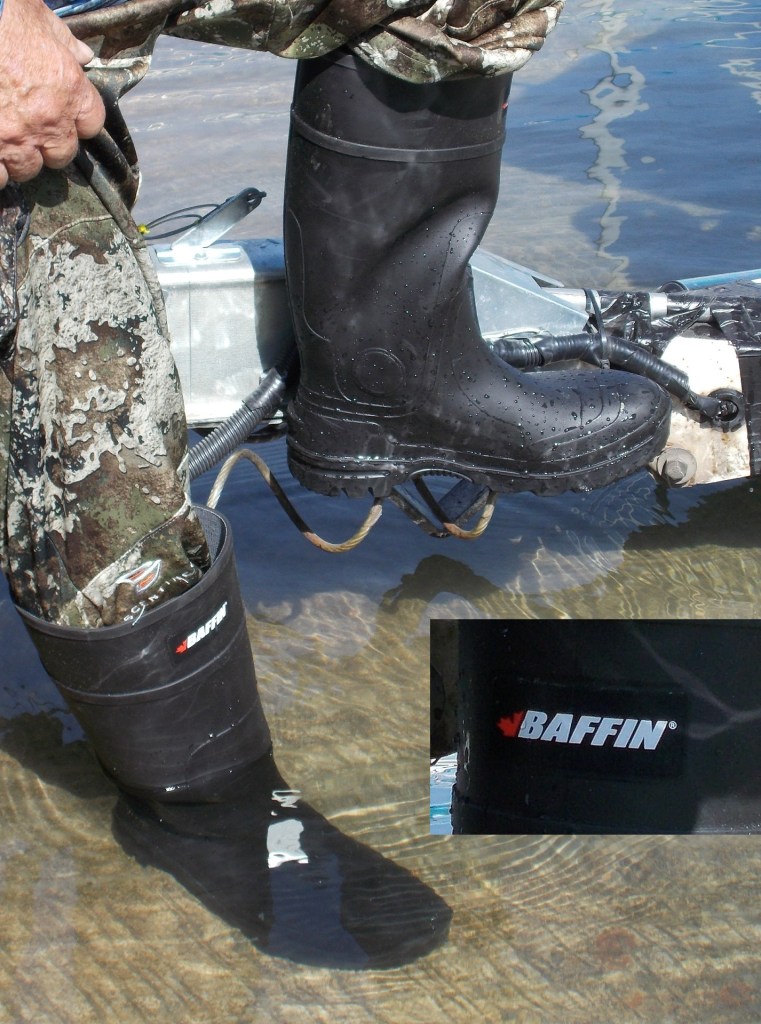
I needed a pair of “crossover” boots. A pair I can put on in the morning and will keep my feet warm, comfortable and protected on those days when my activities take me from home, to office, to running errands, to my boat. I chose a pair of Baffin’s Eastern model of men’s boots..          

Since 1979, the Baffin “footwear” company has been keeping feet warm and comfortable across Canada and the rest of the world. If you are looking for some hardcore footwear for a variety of outdoor activities and over a wide range of temperatures, you’d do well to check them out at www.baffin.com. Many of their boots are built for extreme conditions and activities, but Baffin puts just as much quality in their less demanding footwear.

The Easterns are rated “northern” on the Baffin insulation index, which means they are lightly insulated, not something you’d want to wear all day outdoors on the coldest days. For those, choose something Tundra, Arctic or Polar Rated. “Northern” is perfect for fall and early spring outdoor activities, though I wear mine all winter when I’m only going to be outdoors for short periods. They have an aggressive tread pattern to give traction on sloppy sidewalks. At 7.5 inches tall, they aren’t for deep snow, but are great for sloppy conditions. They are crossovers!  Easterns are both waterproof and breathable to keep my feet dry as I hike across wet marina parking lots or when checking out the action at the fish cleaning station.

Available in brown leather or black, they are perfect for wearing to meetings, trips to the dentist or just on those days when you know your feet might face a variety of unscheduled activities. They are easy on and off, thanks to the stretchy panels over the ankle area and convenient pull loop at the back. The stretchy ankle material also keeps these slip-ons from feeling as though they are also slip offs.

If you are looking for an all-purpose – light duty, but rugged pair of crossover boots/shoes give the Easterns a look. They are widely available at online sources as well select retail outlets. 

FLAMBEAU SPOON TRUNK

Reviewed by: CAPT. MIKE SCHOONVELD

I love it when a spoon gets scratched and scuffed from fish after toothy fish biting down on it. I hate it when I pull a spoon out of my tacklebox and discover scratches and scuffs caused by banging around inside the storage container where rough handling or a rough boat ride caused the other spoons in the box to do the work supposedly reserved for fish teeth.

  I’ve had a few “good” enough spoon storage boxes over the years – none that were perfect. Most worked by having some sort of hanging system which would hold them in place and let them dangle. That’s a good system until the spoon box tips or one of the spoons drops to the bottom of the box. 

The Flambeau Outdoors Spoon Trunk solves the dangling, jingling and tipping wreck problems.  Start with a not-so-basic open box sized to hold up to 63 spoons – from small, walleye sizes to magnum, trout and salmon models. I call the box not so basic because the plastic is made with Flambeau’s proprietary Zerust Technology that eliminates or lessens corrosion on the hooks, hardware and spoons contained inside. An O-Ring gasket makes the lid completely waterproof and that lid locks down tight with a cam-lock closure system.

Inside there’s a thick, closed cell foam layer on the bottom which has the 63 pre-cut slots to insert the front end of the spoons. Next is a thin plastic overlay that outlines each spoon slot to guide pushing them in place when being stored.

It’s simple and effective. The spoons are individually held apart to keep them from scratching or scuffing and it’s easy to see the pattern you need and pull it out.

Spoon Trunks are widely available in retail shops and at numerous online sources. Check out all of Flambeau’s tackle and gear storage options at www.flambeauoutdoors.com

WARTHOG ELITE A4 KNIFE SHARPENER

Reviewed by: CAPT. MIKE SCHOONVELD

Step into my kitchen and look on the top of the refrigerator. What is that contraption?  I had three fishing friends over recently and covering the Warthog Knife Sharpener sticker, I gave them the test. Two of them failed completely. One of them guessed, “Some sort of knife sharpener.”  For one, it was in the kitchen and also, he recognized surface of the sharpening rods as diamond encrusted hones. I knew what it was since I ordered it but it does look to be something of a rather Rube Goldberg mechanism with all the springs, levers and knobs on the tool.

 Does it have to be that complex? After all, experts can sharpen a knife with only a flat whetstone. It can’t get any simpler than that.

 I’m no expert, however, and I’ve tried any number of simple (and not so simple), stone, ceramic, carbide and diamond grit sharpeners. Most of them were manually operated tools but I’ve tried a couple of electric models. My results using these gizmos has been all over the place. A couple basically ruined the blade being sharpened. Most did a fair job, but none, even the most complex gadgets returned the blade to “as good as new” condition.

 Sharpening should be a simple process. Anything that will uniformly remove tiny chips or flakes of steel from the cutting edge of a knife will sharpen it. Various abrasives will do that, diamonds do it best – better than hardened steel files, stone, tungsten carbide or ceramic. Rub the abrasive material and the knife blade against each other at an angle to produce a sharp edge.

There are variables to this simple job. One is the grit-size of the abrasive. Another is amount of force applied during the sharpening process and the last is the angle the blade tapers to the edge and how precise that angle is maintained for each abrasive stroke. 

 The Warthog Elite A4 comes with a 325 grit, diamond impregnated abrasive rods. (In grit parlance, that’s medium-fine.) Rods with finer or more coarse grit are available as options.

 The rods can be adjusted to hone an edge at 15, 20, 25 and 30 degree angles. Fifteen or twenty is good for fillet knives, 25 degrees is good for hunting knives and a 30 degree sharpening angles is about right for a machete.

 The unusual look for the Warthog comes from the knife blade guide and the springs and slides that control the amount of pressure that’s applied as the knife is stroked along the sharpening rods. Place the knife blade flat against the guide, then keeping it flat to the guide, slice downward with a forward and back strokes the length of the blade. The diamond rods will spread outward on the slides as the downward cutting motion is made so the entire length of the sharpening rod is used. The mechanism is spring loaded with the springs chosen to apply the perfect amount of pressure between the blade and sharpening rods.

 A knife doesn’t need frequent sharpenings if a sharpening steel is used frequently. The steel on the reverse side of the A4’s abrasive rods are not encrusted with diamond grit. So just turn the rods around in the mechanism and the A4 becomes a sharpening steel. After every few fish give the knife three or four strokes through the Warthog and the razor edge will be steeled-straight to keep that perfect edge.

 I chose the Elite A4 because I liked the finished wooden base. The mechanics of the V-Sharp A4 Knife Sharpener is identical but without the wooden base. Check them out at www.warthogusa.com.