BPS QUICK CLIP

QC

Reviewed by Capt. Mike Schoonveld


The dodgers and flashers I started using decades ago all came outfitted with a curly-cue swivel thing on the end to quickly attach and detach fly leaders. Whether or not they are the perfect answer, millions of fish have been landed using them.

 
Then some of the “newer” rotating flashers (i.e. Spin Doctors, others) showed up with a ball bearing snap swivel with the snap connected to the flasher and the ring end free. Where do you attach the leader? So you have to take it off, push the loop at the end of the leader through and over and then reattach. The next time I want to put that fly on a different attractor I have to unattach it and it has a kink in the loop maybe weakening it, definitely making it harder to attach a second time.

 
Okay, it’s not all that big of a deal, but compared to the curly-cue on the others, it seems cumbersome. Maybe it’s a left brain, right brain thing.

 
When I spotted the Offshore Brand Quick Clip Snaps at a Bass Pro Shops store, either my left brain or right kicked in and I picked up a pack. Both sides of my brain are now equally happy.

 
Use the clips two different ways. I either substitute a Quick Clip for the loop at the end of the trolling fly leader or put a Quick Clip on the ring end of the snap swivel of each Spin Doctor. Available at most Bass Pro Shops retail stores or on-line at http://www.basspro.com.


REEL GRIPS

FG1

Reviewed by Capt. Mike Schoonveld


It’s not often I get a product to sample that is (or can be) simple, functional, useful, and decorative in any combination. It’s called a Reel Grip which, to be more descriptive should be called a reel handle knob grip. Made of some sort of silicone, spongy rubber material, it’s a sleeve that slips tightly over the reel handle knob on most any reel.

 
That’s simple enough. Just order or pick up the one you need, whether it be for a trolling reel, baitcaster, spinning reel or fly reels. (They make great sense on fly reels since for some reason you can buy a $500 fly reel with a 50 cent reel knob.)

 
On fly reels and others, they make a good reel even better by giving the reel cranker a good, non-slip comfortable handle knob to grab. Reel Grips are softer and more textured than even the handles on my reels which come with rubberized knobs. The factory-installed rubber handles have to last the life of the reel. Slip on a Reel Grip and if the RG gets worn out in a season or two, swap it out for a new one. Have a reel with a hard plastic or wood handle? Try a Reel Grip and you’ll never want to crank that reel again without it.

 
Reel Grips come in a wide range of solid colors or multi-colors. Bears fans might like the Orange and Blue ones, Michigan State backers can go with Green and White. Or color code your gear. Put solid blue grips on your downrigger reels, green ones on your diver rigs and cover the handles on lead core reels with red ones.

 
Reel Grips are carried in many tackle shops and big box sporting goods outlets. Or get the specific colors and kinds you need at http://www.reelgrip.com.

LAKE CLEAR WABBLER

LC1.JPG

Reviewed by Capt. Mike Schoonveld


It’s been a long time since I saw something related to fishing that made me scratch my head a bit and wonder, “What’s that for?” When I opened a package of goodies from Brecks Inc. I recognized most of the samples they sent. Brecks sells items under many brand names probably familiar to you. Their Mooselock brand spoon is shaped like a fish. Their Savant spoons come sized and colored perfectly for Great Lakes walleye. They also brand Williams Wablers, a spoon that’s been around almost 100 years. .


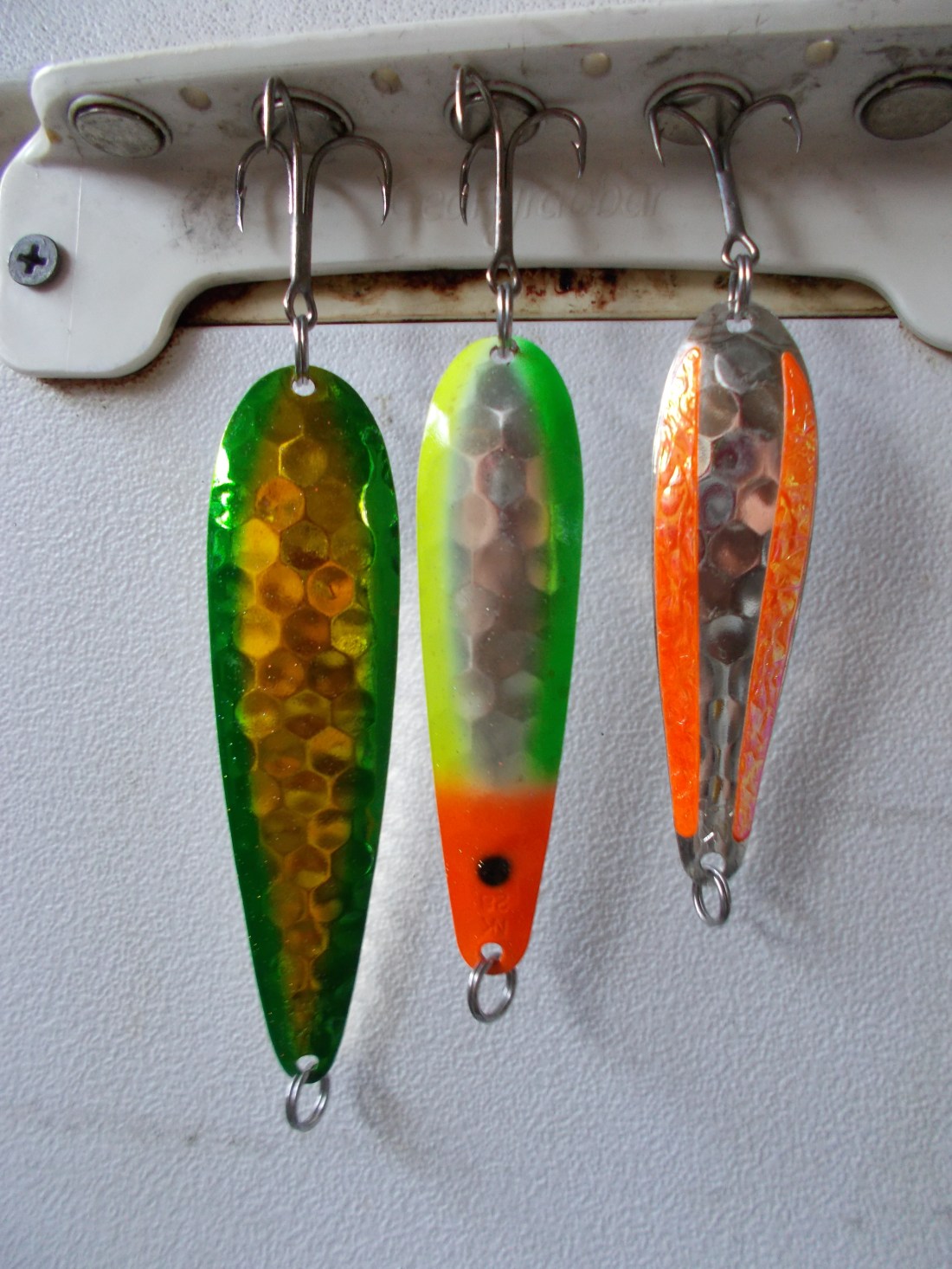
The “mystery” product is a Lake Clear Wabbler from a brand called Lake Clear. It looks like a wide-bodied spoon with no hook on either end – just empty split rings. There’s no swivel on either end, and no markings or other way to determine if there’s a front end or a rear end, even if I wanted to attach a hook.


At a smidge over 3 inches long and about 1 ½ inches wide, the football shaped lure didn’t much look like anything I’ve ever trolled or cast. Before I relegated it to my box of yard sale discards, I did a bit of investigating. The give away was the claim the Wabbler is to be used as an attractor, much the same as putting a dodger or flasher ahead of a squid or trolling fly. The Wabblers are used most often a couple feet up the line from a spoon or body bait.


I’ve no doubt some of the allure (some of the time) of a Dipsey Diver is as attributable to it’s being an attractor as much as a tool to pull lures deep. Why else would they come in an array of colors? Why else do you buy an array of colors?


I tested the two colors I have (yellow orange and fire tiger) with spoons, spinners and stickbaits about two feet behind the Wabbler. All caught fish. One day in particular, I paired the fire tiger Wabbler with one of the above mentioned Flashabou Aglias in fire tiger and it produced one coho after another all morning long.


I’m not saying every lure I’ll be running from now on will have a Wabbler ahead of it, but it’s a trick I’m going to put in my bag of tricks and continue to refine. Check out www. lakeclearwabbler.com


MEPPS AGLIA “MYLAR”

aglia1

Reviewed by Capt. Mike Schoonveld


I was skeptical the first time I saw a “spinner” lure. It was probably in my grandpa’s tackle box and since he was mainly a bullhead fisherman, I don’t know why he had it. I knew the concept “big fish eat little fish” so I understood why a minnow-shaped artificial lure would catch fish. I knew bullheads eat worms, so I understood plastic worms. “What in the world swims through the water looking like a spinner? What sort of pea-brained fish would mistake a spinner for something it ought to eat?” I thought.
I still don’t have the answers, but I do know plenty of pea-brained fish have fallen for the spinners attached to the end of my line since then. Plenty of them have been coho and king salmon, steelhead and brown trout. Plenty of times, especially when fishing in dirty water, storm muddled or silty from tributary effluent dirty, I reach into my arsenal of lures and select a spinner and use them to fool the pea-brains swimming there hunting for something (that looks nothing like a spinner) to bite.
Among my favorite spinners are Mepps Aglias and though they’ve accounted for uncounted numbers of fish in their original versions, they’ve gotten better this year. The better is the hook on the end of them is now dressed with mylar tinsel from Flashabou instead of the traditional squirrel tail hair.
For years Mepps claimed nothing was better than squirrel tails for spinner hook dressing. Maybe for most fish, but the Flashabou dressed #5 Aglias I’ve been using this season are outproducing the squirrel tails seven days to Sunday. In the stained water (and because cohos in particular like to bite hot orange lures) the orange blade with orange/black hook dressing has been my top choice. The fire-tiger with fire-tiger(ish) mylar tail isn’t far behind.
I’ve caught a few fish on a double bladed model – one orange, one black blade, but so far, it’s not any better than its single bladed cousin. I suspect, the added noise may make it a better choice for steelhead.
I use them on both downriggers and behind Dipsey Divers. Be sure to employ a good ball bearing swivel. The Aglia Flashabou spinners may not be widely available this summer but you can always order them on-line at www. mepps .com.


FIELD AND STREAM LINE

FSL

Reviewed by Capt. Mike Schoonveld

When I hear “Field and Stream”, my thoughts go immediately to Field and Stream magazine, the hunting and fishing monthly I’ve been reading since I learned to read. As a kid growing up in a small Indiana farm town, F&S was the vehicle that transported me to hunting adventures and exotic fishing destinations – at least in my mind.

Now, another thing pops to mind at the mention of Field and Stream. Dick’s Sporting Goods now produces a line of outdoor products labelled Field and Stream.  There’s no direct connection with the magazine, but using Field and Stream products still helps me flash back to youthful dreams.

So it is when I spooled up some reels with the three kinds of fishing line available with the Field and Stream label,  braid, traditional monofilament and fluorocarbon monofilament.


I used the braided line as backing on a reel I top-filled with lead core line. I normally choose a bright “hi-vis” colored braided line for this purpose. Field and Stream Angler Braid is only available in a deep dark, almost black, chocolate brown. I actually liked the dark color and found it as easy to see as most of the bright chartreuse or orange colors I usually select. It worked flawlessly in that it has never broke and the normal braid knots I use stayed tied and tight where it was joined to the lead core.

I selected and used 25 pound test F&S Angler Fluorocarbon as the leader material on all my `core, copper and diver sets all summer. Again, it performed flawlessly with no unexplained break-offs or knot failures.
I spooled one of my downrigger reels with 20-pound F&S monofilament for use on staging kings. The mono is only available in clear color and I favor hi-vis but other than that I can’t complain. Many anglers prefer clear mono. Again, flawless performance, no unexplained breaks or knot failures.

If you are at Dick’s Sporting Goods and needing some fishing line, consider Field and Stream Angler Line and expect solid performance. No Dick’s nearby but you’d like a spool of this competitively priced line with the old, familiar name get it on-line at: www. fieldandstreamshop.com.

TROLL MASTER LINE RELEASE


HR

Reviewed by Captain Mike Schoonveld

Pinch pad type releases are the top choice of many Great Lakes fishermen. No other type is so easy to use. Just pinch the line between the rubber pads. No tensioners to adjust or line twists needed. Just pinch the line some where near the middle of the pinch-pad normally, tuck it way back for a tighter grip, out towards the tip if you need a light release.

It’s not rocket science – it’s clothes-pin science. The line release I ever saw put into play was made from a pinch-type clothes pin. The captain wasn’t a penny-pincher. Downriggers were brand new inventions in the early 70s and there were more anglers used homemade ones than factory models. The same went for line releases.

Since then I’ve pinched line in most brands of pinch-pad releases. They all work about the same, they are all reliable. My advice is to buy what’s available and choose the least expensive one if you have a choice.

When I saw the Troll-Master Seahorse Hydrodynamic Line Releases, I asked the Troll-Master guys what made theirs different than the others? “They are hydrodynamic,” I was told.

Indeed they are on closer inspection! Look close at them and you’ll see they are sleek and obviously will pull through the water creating very little turbulence. Is that a big deal?


Most of the time, no. Otherwise, all the other brands would have been “sleeked-up” over the years. Ford’s Model T is now a Mustang. All the other pinch-pad releases are exactly the same as they were decades ago. They are still Model Ts.


Still, decades ago, downrigging lures more than 100 feet deep in the Great Lakes was extreme. Not so much, these days with food web changes and light penetration issues driving fish deeper and downrigger fishermen commonly put lures deeper than anyone ever imagined.


Once you lower a downrigger more than 100 feet, blowback becomes a real issue. Once you speed up your troll a little, blowback becomes an issue. In either case a slight change in hydrodynamics of what’s being trolled through the water does make a significant difference. A release that slides through the water behind a downrigger weight instead of tugging through the water becomes valuable.

As far as holding line and releasing, the Seahorse pinchers work are the equal of any brand I’ve used. The sky blue colored light tension model is perfect for any strength of monofilament/fluorocarbon likely to be used in the Great Lakes at normal depths. The bright red, heavy tension version will grip braided line and hold well all the way down to submarine depths.

Both tension models are competitively priced and widely available at retailers or on-line outlets.

www. troll-master.com


BASS PRO SHOPS STRATAMAXX COMBO

sm

Reviewed by Captain Mike Schoonveld

Are you needing a new diver rod and reel combo? Could you use another rod and reel able to comfortably fit 10 colors of leadcore line or 300 feet of copper wire? Is money the main reason you don’t have these already?

Both leadcore and copper line are thick and require a large size, large capacity reel to accommodate the backing, the heavy line and the leader. Fishing with these long, heavy lines or dangling a diver off the side requires a rod with plenty of backbone just to hold up to the pressure of dragging that stuff around.
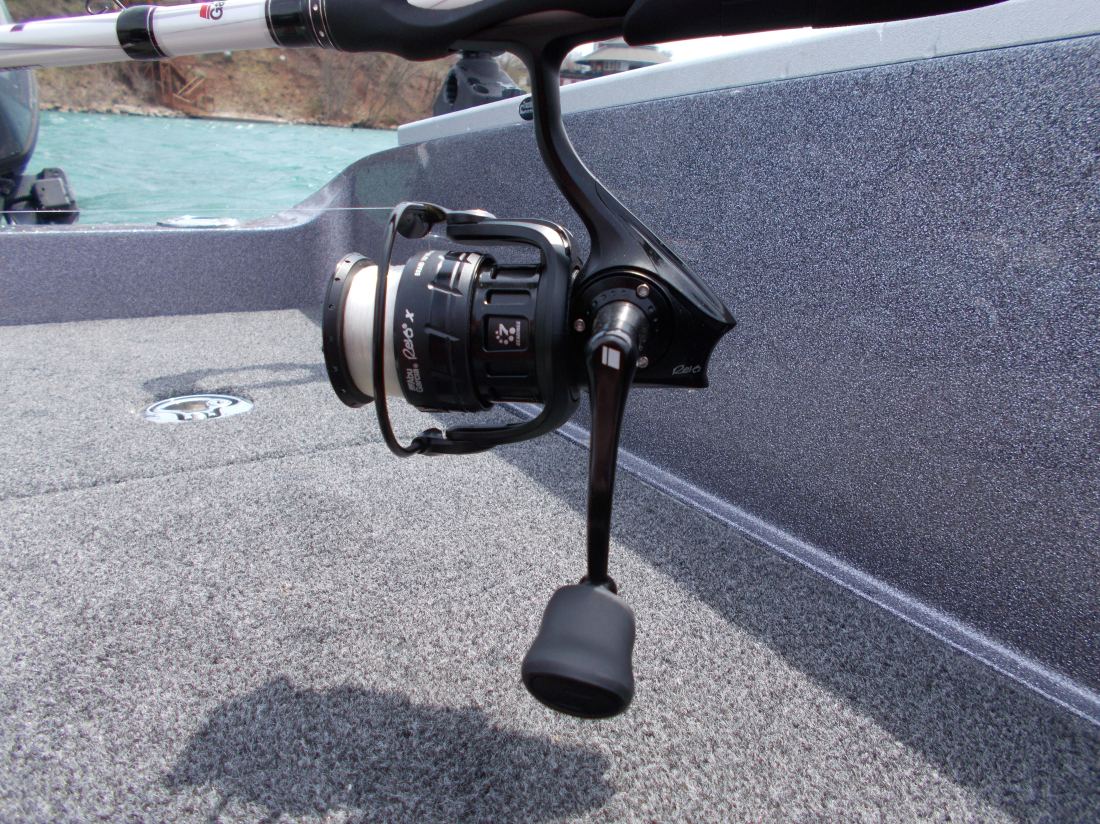
You may want to check out the StrataMaxx Combo from Bass Pro Shops. It features an 8′ 6″ medium heavy rod matched to a solidly built, relatively large, line counter reel. This combo retails for $89.99. I have “name brand” combos on my boat that cost more than twice as much. Do they work twice as good? Will they last twice as long?


The answers are no and only time will tell. I used my StrataMaxx Combo as a 10 color LC set-up in June and later in the summer I switched it to a 300-copper (45 pound). I used 200 yards of 40-pound braid as backing for the heavy lines. Both types of line fit comfortably.


The rod held up nicely to the drag of the long lines trolling at speeds up to 3 knots even when pulling large dodgers or flashers. It also easily handled the kings, cohos and Skamania steelheads that fell for the lures I was pulling.


I often ran this set up straight down the chute behind the boat. No planer board on the line or stretchy rubber band release off the big board planers. When the fish bit, the rod has to absorb the pressure of the strike and the drag has to smoothly start to slip. It’s fun to experiment with new gear, but when I have paying customers on the boat, I don’t play with new stuff that may not be up to the task.


This combo performed time and again all season long and feels as good now as the first day it was put to work.


www. basspro.com

WEEMS-PLATH DISTRESS SIGNAL

wp

Reviewed by Captain Mike Schoonveld


Luckily, I’ve never had to shoot off one of the visual distress signals Coast Guard and state regulations require I carry on my boat when I’m on the Great Lakes. Every time I purchase a replacement set, (they all have an expiration date) I visualize a scenario in which the hand held flares or the meteor shells are all that stands between me and a nasty-fate should something that “only happens to the other guy” happen to me.


Three or four meteors would give me only about 20 seconds of signaling time. Handheld flares might give me 20 minutes – but are visible from a much shorter distance. That’s if they work; that’s if they don’t set the boat on fire.


Weems-Plath noticed a provision in the Coast Guard regs allowing an electronic (battery powered) visual distress signal. This easy-to-use handheld device features a compliantly bright LED bulb programmed to blink three-longs, three shorts, three longs – SOS – for up to 60 hours. There’s no expiration date. Just keep fresh C-cells in the handle.


It comes with a day-signal compliant flag so for less than $100, you are legal. More important, you are more likely to be noticed should you need help. It’s widely available.

www. weems-plath.com

ENGINE COMPARTMENT HEATER

pali

Reviewed by Captain Mike Schoonveld

Compared to the often Arctic-like climate in place over much of the Great Lakes, my home ports at the south end of Lake Michigan are in Banana Zone. Even here, however, weather statistics for my area put the average frost-free date in the spring is May 5th and the average first frost date in autumn is October 5th. Those are averages. I’ve seen plenty of September frosts as well as crispy cold mornings in late May.

There’s a lot of good fishing before and after frost free dates and boat owners, especially those with inboard or inboard/outboard motors, know a dip in the thermometer below the freezing mark can do nasty things inside an engine, bilge or livewell if there is any water present.

Some boats are easier than others to drain dry and freeze proof. Most of the boats I’ve owned over the years weren’t all that easy.
I relied on a heat source placed in the engine compartment to keep my motor and pumps ice free between early or late season fishing trips. Until now, none of my methods were particularly safe or totally worry free.

A common 60 to 100 watt incandescent bulb, will put out enough heat to keep an engine compartment a few degrees warmer than the outside air. I’ve stuck a mechanic’s trouble light inside the engine compartment on nights when the air temperature is predicted to slide only a few degrees sub-freezing. Then I worried all night about the bulb burning out or the temperature to drop just enough the lightbulb didn’t put out enough heat.

On colder nights I’ve put a ceramic space heater in the engine compartment. Often called milk-house heaters they are designed to heat a space much larger than an engine compartment – like a milk house, however big they are. When I use it, I turn the power setting on low (800W) and adjust the thermostat to a minimal setting. Then I crack the engine compartment open to allow some of the heat to escape. Using it I lose sleep worrying as much about meltdown as freeze up.

The Pali 400W Engine Compartment Heater is designed specifically for the job and carries safety certifications from the U.S. Coast Guard and Underwriters Laboratories. There are no power or thermostat settings to adjust. Just set it inside the engine compartment, close the hatch, plug it in and sleep soundly. It has an internal ceramic core heater rated at 400 Watts and a pre-set thermostat which clicks on at 40 degrees and off at 60.
Available at West Marine and other dealers. WWW. caframo.com/marine.

RAPALA’S SHAD RAP DEMON

sr

Reviewed by Captain Mike Schoonveld

Normark’s Shad Rap lure was developed around 1980 and unlike most body baits, was designed for walleyes, not bass or other species. They worked so well it took a half-decade or so for the Norwegian balsa carving machines to keep up with the demand.

I’ve got a good supply of Shad Raps in my arsenal of walleye lures and a few of them have migrated into my boxes of body baits reserved for cohos. It used to be easy to pick them out. The Shad Raps were fire-tiger or chartreuse colored – my favorites for walleyes. Almost all the ThinFins, Hot ‘n Tots and Jointed Rapalas are mostly fluorescent red..

No color pattern on a lure is better for coho salmon (or steelhead) than one predominantly fluorescent red. It’s not uncommon for me to run a 12 rod spread and have a fluorescent red lure at the end of each line. On a particularly slow day, I might pull out a chartreuse Shad Rap to see if that would flip the switch. On a particularly fast day, I might put on a fire-tiger Shad Rap just for variety. They certainly caught fish but seldom compared to the hot red plugs.

A couple seasons ago Normark added the Demon color to their Shad Rap line-up, I guess to lure bass used to eating bright red crawdads. (The only bright red crawdads I’ve ever seen were cooked, but that’s another story.) The body is painted fluorescent red overlain with a black pattern reminiscent of a crawdad’s carapace. In the wild, a cross between a bright red shad and a crayfish would be something of a demon.

Regardless, one morning I tied one on to match it against 11 other tried and true coho lures. It hooked the first fish of the day, then stayed in the mix half the morning. I kept track and it accounted for five of twenty catches that morning, so it more than held it’s own. But I “retired” it after it’s fifth catch because the tail hook broke off. It could have done better.

Remember, the lure has a balsa wood body and was designed for walleye, not salmon. Pound for pound (or most any other measure) salmon fight harder and cohos in particular are predisposed to twist in a landing net.
Since then, I’ve used Demon-Raps that lasted for way more than five fish but the important thing is they only get broken because fish like to eat them. That’s not a bad thing.
They are widely available. The ones I use are Size 06, 2 ½ inches in length.

http://www.rapala.com