
AMISH OUTFITTER’S LURE TUBES

flytubes Reviewed by: CAPT. MIKE SCHOONVELD

Amish Outfitters addressed the problem of lures becoming scratched up and dulled while stored in a tackle box from a unique angle. Their solution is to have an appropriately-sized, plastic cylinder-like bottles in which to put each lure when not in use, and then just having a Stowaway box full of these plastic containers.

When I saw these, three things jumped into my mind. Number one: I would never use these to store my plugs and crankbaits. I’m sure they work perfectly and for persnickety anglers who wouldn’t mind taking the time to insert their lures when storing them and uncorking another lure-tube to pick out its replacement, knock yourself out. I’d end up with a box of un-tubed lures and a bunch of missing or smashed bottles.

Number two: My box of stickbaits has probably three or four dozen in it. If they were all stored in tubes I can only fit 16 inside the same box. (This would be with the 7-inch tubes for big Reef Runners, J-13 Rapalas and most J-Plug type lures.) Sure, when I pull one out of my congested box, two or three come with it, but it takes less time to separate them than it would to put each one individually in it’s own tube.

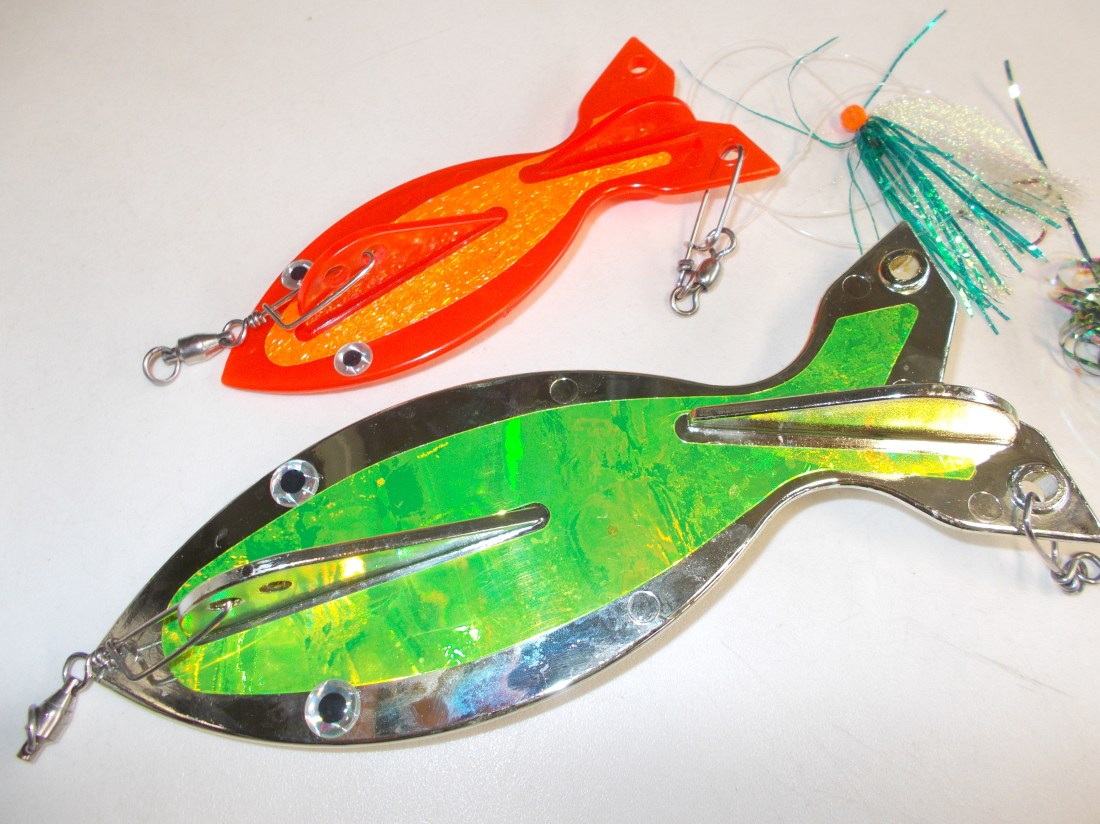
Number three: The half-sized (3 1/2-inch) tubes flashed an entirely different picture in my admittedly left-brained mind. “Those would be perfect for storing trolling flies,” I thought. And I was right. Sure, even the short tubes take up space, but I can put 32 of them in a Plano 3700 Deep Stowaway box. The same box would hold maybe three times as many without the tubes. But with the leaders attached to the flies, even if I fastidiously rolled up the leaders and fastened them with twist-ties or something, when I’d pull out one, I’d pull out all or most of the others.

Need more flies than that? Poke two in each tube. They’ll come out tangled together, but sorting out a two-fly mess is simple compared to untangling a 15-fly disaster.

Sure it takes extra time to poke in a leader and shove the fly down inside the tube. That time is more than redeemed by not having to untangle three or four dozen flies stored in bulk.

Whether you are a right-brained perfectionist or a left-brained fly-piler like me. Amish Outfitters has some lure tubes for you. Each style can be purchased in plastic Stowaway type Caddies or sturdy, canvas zip-close bags with elastic bands inside to hold them in place. Check out http://www.amishoutfitters.com.


LURE LOCK STORAGE BOXES

Tak

Reviewed by:  CAPT. MIKE SCHOONVELD

When you get on my boat, you are going to see most of my lures tucked in Plano, Stowaway boxes. They are the perfect answer for me since I have limited on-board storage areas on my boat. I take the ones I’m likely to need and shelve the one’s I won’t need back home.

When I was at ICAST I noticed a company called Lure Lock had jumped into the tackle organizer business with versions of their own. At first look they appeared to be pretty much clones of Plano Stowaways and other brands.

Perhaps the latches were a bit different but were they better? The dividers you snap apart and insert to divide the inner compartments were green plastic instead of translucent – yippee! They do snap apart cleanly, but I never thought that to be an issue. Lure Lock does have some sturdy racks (they call lockers) to contain and store the boxes, but again, nothing I don’t already own.

I handed my business card to one of the reps at the booth and moved on. Surprisingly, a week or two later they shipped me a couple of their size-large boxes – sized the same as Plano 3700 Stowaways. A few days later I grabbed one of the Lure Lock boxes when I was reorganizing my on-board lures when transitioning from targeting offshore salmon and trout to nearshore, staging kings. This is when I noticed the GIANT difference between the Lure Lock box and all the others.

I dropped a J-13 Rapala into one of the slots then grabbed another lure. Then I reached in to slide the J-13 over to make room for the next and it didn’t move! What?

The bottom of the box is covered with a thin layer of   “Taklogic Technology” tacky-stuff – sort of what you’d expect if you poured a 1/16th inch of maple syrup in the bottom and let it sit out for a couple days. It’s sticky!

It’s not maple syrup. The TT-stuff is sticky, but not stick-to-the-lure sticky. I tried turning the box upside down and the J-13 did release from it’s own weight. I put it back in and pressed it in place and tried again. It stuck – even upside down. That’s not the TT’s purpose, however – to hold lures upside down.

The purpose is to keep lures from sliding around, bouncing around and tangling with neighboring lures under normal use – normal being a bouncing boat, being pulled in and out of a compartment or storage locker and loaded into an out of the boat as needed. I’m confident more of my lures turn from being bright, shiny, perfect looking lures to scuffed, scarred, dull and scratch-finished lures from riding in tackle boxes than get that way by being chewed up by fish. They get that way by being in a bouncing boat, being pulled out of a storage locker or loaded into or out of the boat.

Put it this way. Ever hear the lures in one of your tackle boxes rattling when you are moving it? They are being damaged and you know it.

No, the TT stuff isn’t sticky enough to peel the paint off of lures. No, the TT stuff doesn’t make the lures sticky. No, it doesn’t react to paint or plastic worms. If the TT stuff gets dirty or grimy, the Lure Lock people suggest washing it with soapy water or sticking it in a dishwasher. (Mine isn’t that dirty, yet.)

Nice, you think, but if you are like me and own a mountain of Stowaway boxes crammed with lures, you aren’t ready to junk them all to buy the Lure Lock versions. Just out, you can purchase retrofitting strips of the Taklogic stuff to stick in your existing boxes. These are called Retro Kits – duh! The kits, Lure Boxes and Lure Locker storage totes are available at retailers or online at http://www.lurelock.com.

FREEDOM TACKLE’S VEGAN LURES

cut1

Reviewed by:  CAPT. MIKE SCHOONVELD

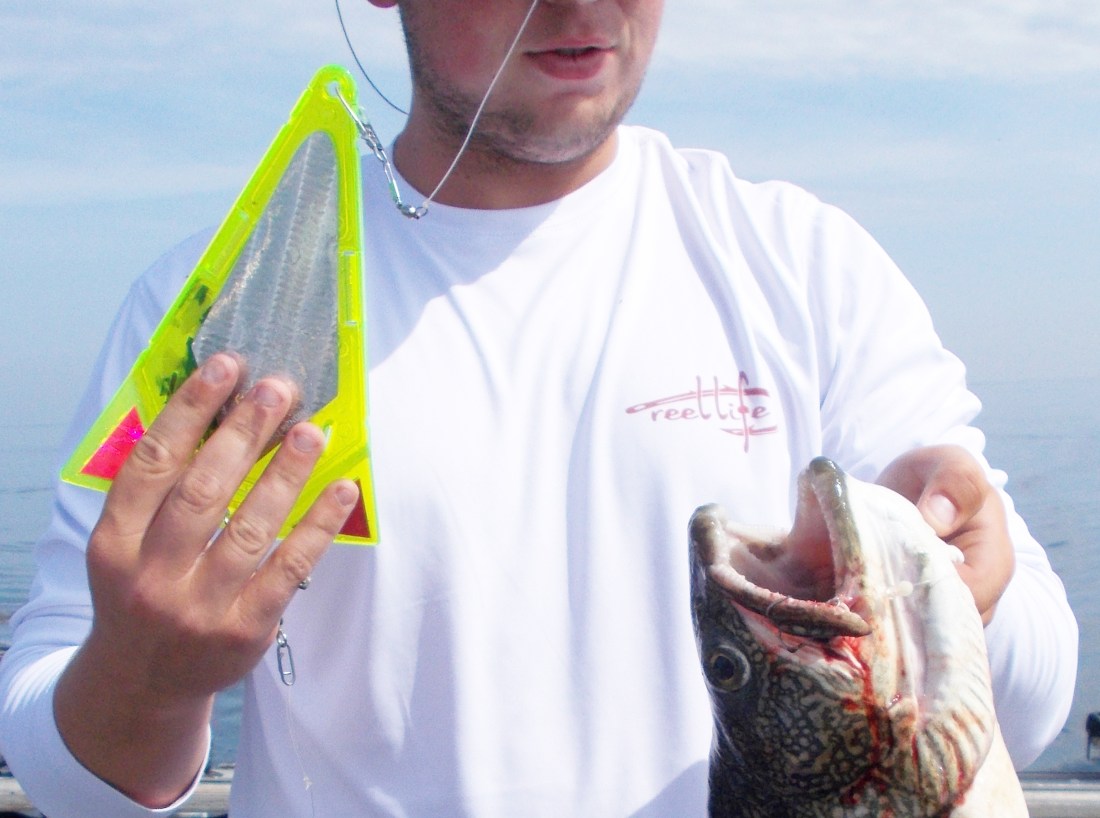
What? Is there now a lure being made to catch vegetarian fish?   No – the Freedom Lures Herring Cutbait Trolling Lure is designed to simulate the spinning action a plastic meat head/herring filet has when it’s trolled – but no herring strips needed.

I would have been somewhat skeptical of this had it not been for a day I spent on Lake Ontario a few years ago. Capt. Danny had thin pieces of plastic cut into an elongated triangle shape in a variety of colors.

He told me, “We were really smacking the salmon on meat rigs one day and ran out of herring strips. I grabbed a strip of plastic, cut it to the shape of a herring strip and pinned it into the meat head. That day, the fish bit the meatless meat rigs just a well as they did the ones with the herring strips. I don’t use them every time, but occasionally, when the fish are keying more on the ‘action’ than the scent, the plastic strips work just as well, once in a while, even better than meatheads with real herring.”

I flashed back to that day on Lake Ontario when I ran into the Freedom Lures guys at the ICAST show last summer. They make a plug, called the Herring Cutbait, which has the same spinning action as a rotating meathead on a meat rig.

By the time I got some on my boat we were targeting bottom hugging lakers and pre-spawn chinooks so I stuck to the 5-inch versions. They are also available in a 3 1/2 inch model which (by the time you are reading this) will be in the game for cohos and steelhead on my boat. Both sizes come in a dozen time-proven chinook and trout colors, including UV and glow patterns. I may have to spice them up with some hot red lure tape accents to give them a boost for the ‘hos and ‘heads.

I ran the lures I sampled “clean,” with no flasher or other attractor ahead of them. The guys at Freedom Tackle said they do it both ways, with or without a flasher ahead of the plug. The Herring Cutbaits are packaged with a 40-pound leader and bead chain swivel. I had no problems just running them with a quality ball bearing swivel but they do spin, so be sure to use one or the other.

The Herring Cutbait Trolling Lures are available in some retail outlets and online. Check them all out at http://www.freedomlures.com.

LOWA BOOTS


LOWAboot

Reviewed by: CAPT. MIKE SCHOONVELD

When my wife retired, I gained a fishing partner. Previously, having her on board either on my boat or with me on trips to other locations was rare. That’s changed and it’s been a personal eye-opener to the Mars and Venus way men and women approach a day on the water when it comes to fishing apparel.

For me (Mars), comfort and function are paramount. A comfortable, tattered sweatshirt is perfect and if I don’t have to be overly concerned about getting fish blood it or other stains, it’s better. I wear a pair of warm, ugly, comfortable boots most days on the water and never give them a second thought.

For her (Venus), style trumps nearly every other factor. I’m confident she’d rather endure cold, wet feet in stylish boots than being caught in a pair of “clumpers” which would be warm and dry. I’m confident because she’s done it – more than once! Mars and Venus.

She spotted and tried on a pair of LOWA Locarno GTX boots at an outdoor writer’s meeting last September and gave them a double thumbs up. LOWA is a manufacturer of high end, climbing, hiking, often technically specific footwear, such as for mountaineering and other extreme sports. Made in Europe, each style is designed for function first, with special tread design and material on the soles, insulation levels, leather and/or fabric uppers and Gore-Tex waterproofing. Each pair is constructed to exacting standards with the highest quality materials available; yet at first glance, you’d guess they were made to look good more than work good.

A pair of Locarno GTX boots arrived on our doorstep a week or so after the meeting, thanks to a collaboration between myself and the LOWA representative. My plans to hide and save them as a Christmas gift were scuttled when Peggy saw the package. By Christmas the boots were already well broken in as well as well traveled. She’s comfortable wearing them when shopping, to social gatherings and they’ve passed muster on boats when we fished together over the winter.

LOWA makes both men’s and women’s boots. Check them out at http://www.lowaboots.com.


PLANO E-SERIES BACKPACK


ESeries

Reviewed by: CAPT. MIKE SCHOONVELD

When I was in school, if I saw someone walking with their gear in a backpack, I’d have guessed the person was in the scouts or perhaps was somehow associated with the military, probably marching home from the Dinosaur Wars. Of course, back then no one had been inventive enough to put wheels on suitcases.

These days, backpacks are the luggage of choice for many people, even replacing briefcases for corporate types. My kids certainly wore them to school everyday – from grade school on. There are probably more people stuffing backpacks into overhead bins on planes, these days than little suitcases with or without wheels.

In a feeble attempt to stay on the cutting edge, on the last flight I made, I left my wheel-less and wheeled carry-on luggage at home and strapped on a Plano E-Series Tackle Pack. It won’t be the last plane trip it makes.

This isn’t a travel magazine, however, it’s a fishing publication. E-Series Backpacks are made for fishermen and women. Though I pressed it into service as a luggage carry-on last winter for a Texas fishing trip; once there, it served as my day-pack when inshore fishing for redfish or offshore fishing for kingfish and red snappers.

It proved to be perfect for both flying and fishing. The pack has multiple compartments with sturdy zippers to organize and store important travel items. My flight info, car reservation documents, ID papers and others were all tucked safely where I could easily access them as needed. My laptop went in a large compartment, my cell phone in a small zipper-safe pocket. There’s space for snacks and mesh pockets on the outside for water or soda containers.

More important, these pockets and compartments did double duty when I was on the water, conveniently storing sunglasses, sunscreen, clippers and other essentials. There’s a handy shelf-like divider inside the main compartment which swings up and velcros in place. Above the shelf is room for a light jacket or other item. Below, up to five Plano 3600 Stowaway Boxes (included) will fit perfectly to organize lures, tackle and other gear. The E-Series is available at many brick or online retailers or at http://www.planomolding.com.

SHIMANO TEKOTA “A” REELS

STA2

REVIEWED BY CAPT. MIKE SCHOONVELD

            When braided line was introduced and became popular with salt water anglers, reel makers adapted. They quickly developed new models specifically for the new, skinny line. These braid-crankers were scaled down in overall size, fitted with relatively massive drag systems and engineered with super-high gear ratios. Size, strictly to increase line capacity, wasn’t needed. Six hundred yards of braid will fit on a reel with only a 200 yard capacity for monofilament.

Just half-filling a reel is a lousy option. A reel with a full spool of line may wind on 24 inches of line with each turn of the handle. The same reel with only a half-filled spool will wind on only 12 inches per handle revolution.

By the same token, a tough fighting fish pulling line off a reel at 10 feet per second, spins the spool against the drag mechanism twice as fast with a half-filled reel. A drag system which may handle 100 rpms may fail completely at 200.

Reels for the Great Lakes market didn’t adapt. Though the use of braid (or equally skinny wire line) increased, almost all braid and wire line guys continued to use the same reels they formerly spooled with mono. To make it work, they wound on enough mono to nearly fill the reel’s spool, then topped off the spool with braid or wire. The line under the braid or wire on top was filler used solely to insure a reasonable amount of line was retrieved with each turn of the handle and to make the drag work efficiently.

I don’t know if Shimano’s newly designed Tekota A models were designed specifically to bridge the gap between braid and mono, but they do and quite nicely. Shimano Tekotas (the original model) are, in the opinion of many, the best Great Lakes trolling reel ever made. I have Shimano Tekotas on my boat, I’ve fished with them on other boats and have nary a complaint about them. So why change?

The change isn’t just cosmetic between the old and new versions. Available (at this writing) in 500 and 600 sizes with the same line capacity as the “non-A” Tekota 500 and 600s, that’s where the comparison ends. The originals had a gear ratio of 4.2:1. The “A-Team” has a gear ratio of 6.3:1. (Rough math comparison, with full spools, the A model winds on 37 inches of line, the original 25 inches with each handle revolution.)

The drag on the originals maxed out at 18 pounds; the Tek-As torque down to 24 pounds. The increased power tells me the drag will perform better, smoother and reliably, however tight it’s set, however full the spool.

My test reels (Tekota 500As in the line counter version) performed flawlessly, one spooled with 30-pound braided line, the other with 40-pound 19-Strand Torpedo Wire. I needed a bit of mono backing to bring 500 feet of wire and 200 yards of braid to “full spool.” The reels were mounted on diver rods and used for diver trolling.

I normally use Tekota 600s for trolling divers because the larger spool diameter gave me an adequate line retrieval per crank. The higher gear ratio more than made up for the smaller diameter spool. In use, the smaller, 500A was noticeably lighter, the drag held nicely against the pressure on the troll and slipped smoothly when a big fish hit the lure. I ran each diver, at times, with as much as 200 feet of line out. I really appreciated the high speed retrieve when reeling in just the diver and lure – no fish – on these longer sets.

Tekota lovers, if you are buying another reel, the Tekota As are as good or better than the original Tekotas and the better means you can easily get by with the smaller 500A if the line capacity suits your needs.


MUSSELHEAD TACKLE MEAT HEADS

musselhead

REVIEWED BY CAPT. MIKE SCHOONVELD

I have a new favorite meat head I use when I’m trolling meat rigs for salmon and trout. I’ve never given much thought to the plastic heads I use to hold the herring strips on a meat rig other than the color. All of them were something of a pain to use what with the toothpicks and rigging the hooks to trail along properly.

No toothpicks needed. Instead, there’s a buckle-like bail with a barbed herring impaler permanently fastened to the head. That’s good reason enough to switch, but the tail of the strip-holder is fitted with a sturdy rubber band to hold the front hook right where it needs to be.

You can buy just the heads or fully rigged set-ups. Check out the Musselhead Tackle website for all the colors available. Order online at www.musselhead.com or look for them at your favorite salmon shop.

SCENTLOK VEHICLE DEODORIZER

SL

REVIEWED BY CAPT. MIKE SCHOONVELD

If you climb into my tow vehicle on Memorial Day, Independence Day, Labor Day or most other days between you’d be subjected to an odor reminiscent of the closet in my college dorm room mixed with not-so-faint fish fumes. Hold your nose.

I may leave for the lake clean, shiny and smelling like Downy Fabric Softener and Old Spice. I drive home smelling like I just finished running a mile on a 90 degree day carrying a dead fish. My personal “scent,” coupled with smells from clammy clothes coupled with damp wipe down towels, coupled with…. Let’s just say, the essence inside the vehicle by the time I’ve driven home tends to linger and it gets worse on day two, three or longer. Now I plug in my Scentlok OZ20 Active Odor Destroyer into the vehicle’s cigarette lighter when I get home and let it run through it’s cycle. The smell disappears!

Odors don’t last forever. Otherwise we’d still be smelling dinosaur poop, exhaust from Henry Ford’s first car, the stench of the skunk he ran over with it and fumes from my dorm room closet. Smells are complex molecules floating around the atmosphere which sooner or later break down into less complex, odorless molecules. I’m sure there are numerous chemicals which can work odor magic on smelly molecules; few of them do it quicker or better than oxygen – or are as abundant.

But atmospheric oxygen is a very stable molecule. Without getting deep in the chemical weeds, over 99% of the oxygen molecules floating around in the air are O-2, basically two oxygen atoms stuck together. Individual, non-partnered, oxygen atoms are never found but occasionally, three oxygen atoms stick together and are called ozone.

In the world of oxygen, three’s a crowd and once ozone is created, the ozone molecule spends it’s fleeting existence looking for someplace to discard one of the three Os. When an ozone molecule bumps into an odor molecule, bam! The third O quickly jumps away from the other two Os and becomes a part of the odor molecule transforming it into something else – and if our nose is lucky, that something else doesn’t stink.

What the ScentLok OZ20 does is electro-chemically transform atmospheric oxygen into ozone and send it out in search of places (such as the stinky seat in my Suburban) to lose its spare oxygen molecule. The OZ20 is for use in unoccupied vehicles only. It cycles on an off every 15 minutes and shuts off completely after 8 hours.

YETI RAMBLER TUMBLER

yetirambler

REVIEWED BY CAPT. MIKE SCHOONVELD

            I’m a coffee drinker but years ago I gave up bringing a Thermos of java along with me when going fishing. I like hot coffee; I don’t particularly like almost hot coffee and I’ll spew cool or cold coffee like a novice sailor spews breakfast in choppy waves.

I’m a hands-on captain on my boat. When there’s a fish on, I’m at the stern. When there’s a fish to be netted, I’m wielding the net. When there’s a line to be set….

Chances are, the hot coffee I poured before the fish bit, the net deployed and the line reset is only spew-worthy swill by the time I get my next coffee break. Not with my Yeti Rambler Tumbler.

Previously, my insulated “go cup” was a promotional item I got at a Pheasant’s Forever banquet. It worked great in my truck on the way to the lake, but only had to do its job for five or 10 minutes in a heated cab.

Tired of my complaining, my wife purchased a stainless steel coffee-on-the-go cup for me as a Christmas gift. Her theory was if my stainless steel Thermos worked great, so would a SS coffee mug. Negatory!

The stainless Thermos is a vacuum bottle. The interior and exterior portions are separated by an airless void and with no air molecules to transfer the heat from the inner container to the outer, the coffee stays warm. The inner container and outer surface on the SS “gift” cup is just air-filled – just as my plastic Pheasants Forever freebie.

The YETI Rambler, however, like my Thermos, is vacuum sealed. The only place heat can escape is out through the lid, but the lid is substantial, fits tight and has a closeable sippy-hole. Will it keep my coffee hot indefinitely? Nope, but I can return to my coffee break after a fish-interruption, take a sip and remain spewless.

The Rambler Tumbler holds 20 ounces, comes in a variety of colors and is available at retail outlets or on-line at http://www.yeti.com. Check out Yeti’s online Custom Shop for products with nifty logos featuring hunting, fishing and other themes.


CHURCH FILET KNIFE

CFknife

REVIEWED BY: Capt. Mike Schoonveld

         I used to be a filet knife knucklehead. I owned only one medium sized (very sharp) filet knife and used it to turn anything from a tiny trout to a wicked tuna into boneless, serving sized fish flesh.

Last year I switched to a two-knife system for most of my fish cutting chores. I used a rechargeable electric knife to cut the filets off of the king salmon, steelhead, lake trout and walleyes I put on the cleaning table, then I switched to a manual blade to complete the boning and skinning process. I wish I’d made that switch years earlier. I was a knucklehead.

If I’d remained a knucklehead, when I saw Church Tackle’s “reinvention” of the filet knife I’d have laughed it off. With my new-found open mindedness about fish cleaning knives, I decided to give the Church Filet Knife a closer look.

Now I realize not only was I a knucklehead, I was a knuckle-dragger. So are you, most likely when you filet small fish or remove the skin from any of your filets unless you move them to the edge of the filet table or cutting board. The Church Filet Knife should be named the Knuckle-Saver.

The handle is molded with an offset so when the blade is against the cutting board the knuckles on my hand aren’t dragging on the surface of the board. That’s different, but even more different is how the blade is turned 90 degrees from the direction every other knife is positioned. When the holding the knife, blade down on the cutting surface, knuckles positioned nicely above the slime and blood on the filet table, the blade is flat on the board. What sort of knucklehead wants that?

The truth is, for skinning a fish, the configuration of this knife is perfect – conventional knives, not so much. Sure, I’ve skinned thousands of perch, walleye, bluegills and other fish over the years with a normal knife by sliding the fish to the edge of the cutting board so I can get the knife blade parallel to the cutting surface, slice off the skin and not be a knuckle-dragger fish skinner. I’ve also cleaned up buckets full of fish garbage from the floor of the fish cleaning station where it dripped off the edge of the table while cutting and skinning my filets.

One more departure from normal is the knuckle-knife is only honed sharp on one side (the top side), much like you should sharpen mower blades. When skinning a fish, that ensures the blade cuts razor close to the skin, less likely to slice through the skin and doesn’t leave any excess meat on the skin.

I did filet a few fish, first cut to last with the knife. Other than feeling a bit weird in my hand, the filets came out just fine. I’ve pounded nails with a rock before and the nails stuck in the wood just fine. If you want to be a knife snob and just use one knife, start to finish, this isn’t the knife for you. However, if like a carpenter, you recognize certain tools are better than others for specific jobs, having the Church “Knuckle-Saver” Filet Knife for skinning your catch makes sense.

The Church Filet Knife is currently available only for right-handers and has an 8-inch blade complete with a snug fitting sheath that won’t slip partially off when bouncing around in a boat or vehicle. Available at retail outlets, online retailers or order from http://www.churchtackle.com