I’ve nearly passed out two different times when my hands got so cold my brain shunted all my blood to my inner organs. I suppose this was to keep them working while I froze to death. One time was when I was duck hunting, once I was ice fishing and both times I was equipped with a hand-warmer that was supposed to keep that from happening.
One of these handwarmers produced heat by burning cigarette lighter fluid – it ran out of fuel. The other warmer had charcoal “stick” inside that was ignited, placed in a flameproof metal box the size of a cell phone. The fire went out.
I didn’t die, and I never relied on handwarmers again to keep my hands warm. Both of these events occurred decades ago, so when I heard of a company called THAW that was producing rechargeable electric hand warmers, I thought, “Perhaps it’s time I revisit handwarmers, now that hi-tech technology has replaced stone age methods to provide a bit of finger-warmth on cold days of fishing.”
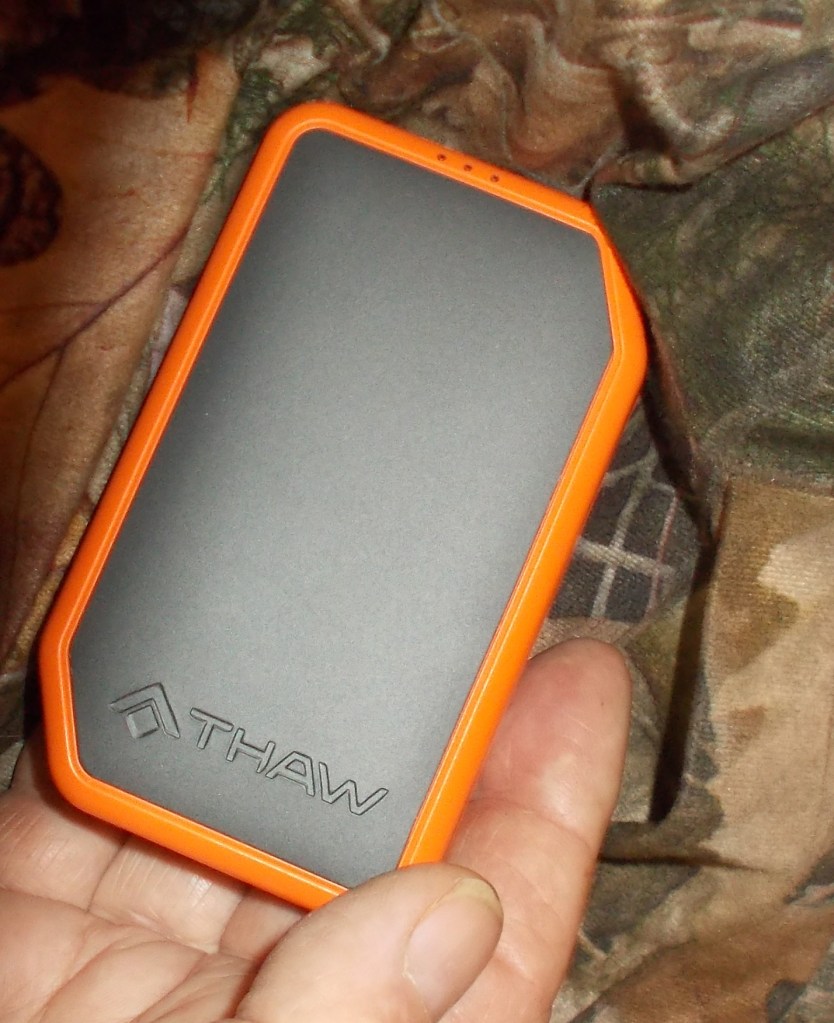
What can I say? Charge it up, stick it in your pocket and turn it on when you get to the boat on a frosty morning, have your ice-holes drilled or whenever it’s needed. (If the low heat setting works for you, turn it on and forget it most of the day – it will last 7 hours (they say) and produce 113 degrees (Fahrenheit) of heat. I seldom turn it to the medium or high setting (high is 140 degrees), but I do turn it on and off since there’s no fuel or fuel sticks to ignite. The cell phone sized handwarmer goes from cold to warm in less than a minute. That’s the 5K version. The 10K version produces the same heat but lasts nearly twice as long or provides surplus power to use its other features.
The handwarmer is a multi-tasker since it has a small, but bright, LED flashlight and a port to plug in a power cord to recharge a cell phone or other electronic device needing a boost. I’ve tried the light – it’s bright, similar to the one on my cell phone. I’ve never had to jump-start my phone, but I assume it would work.
Check out the handwarmers and other THAW products at http://www.thaw.acgbrands.com. Purchase them there, at retailers or at Amazon and other online sellers.
Do you get a chill down your spine when the weather people start putting words like frost, snow, wintery mix and wind chill in their forecasts? I used to, but I’d much rather start thinking of words like, fall brawl, early ice, late season fishing and even first ice. Those positive thoughts are now more in my mind than worries about chills down my spine since I got my Great Lakes Pro Insulated Suit.
Great Lake anglers don’t hibernate during the cold months. Certainly, the designers at Whitewater know this and being a Michigan based company where not only is windchill is understood, so are winter forecasts with words like lake effect, blustery and accumulation. They live there and understand the problems inherent in many winter parkas, bibs and other outdoor gear.
There are dozens of hi-tech parka and bibs makers, these days, but few of them seem to offer winter suits that check all the boxes. Some are long on insulation, but so bulky it’s hard to do much more than just stand there. Some are not so bulky, but not so warm. Few of them are waterproof. Many seem to concentrate more on flashy colors and patterns.
When I’m out for walleyes in late November, on the ice or in my boat fishing cohos in early March, looking spiffy is less important than being warm and able to move – whether it’s setting a line or drilling a hole.
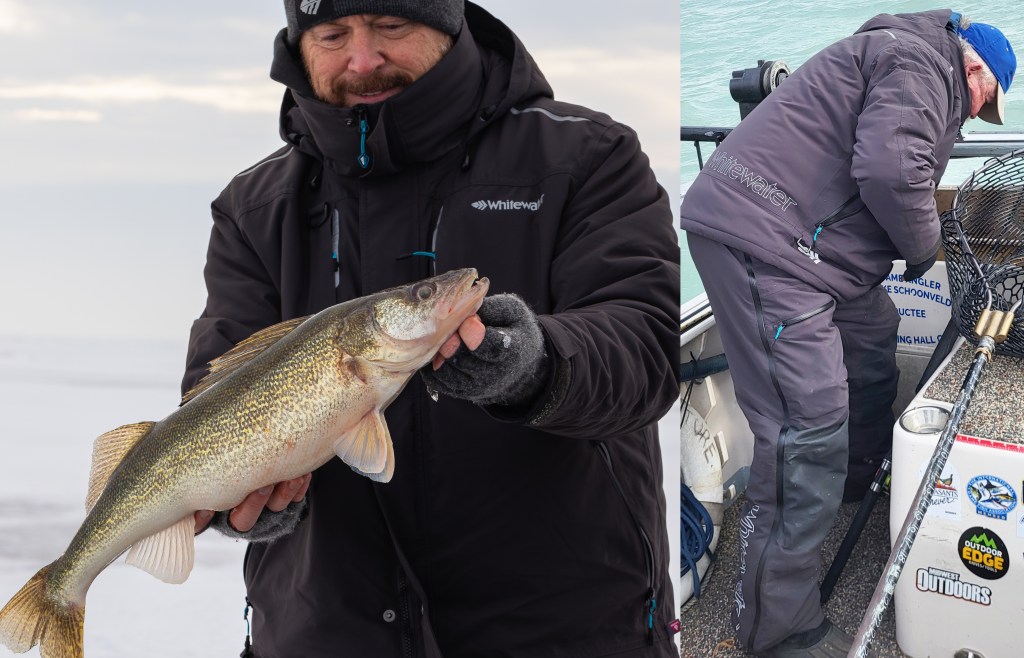
Don’t think the Great Lakes Pro suit looks clunky. It doesn’t; but instead of being bright red, blue or other colors, it’s black. Perfect for me. On sunny days, the black color helps keep me warm. More important, after a few trips, it doesn’t look like it’s overdue for a trip through the washing machine.
Unlike many parkas and bibs I’ve used which use the same amount of insulation top to bottom, Whitewater’s Great Lakes Pro is built around various levels of insulation in different parts of each garment. There’s more insulation in the back of the parka than in the front. The sleeves have even less because it’s more important to have more insulation in the torso than in the hood, arms or in the legs in the bibs. That increases flexibility in the right places while maintaining warmth in others.
The best winter bibs have reinforced knees to keep them from wearing out and an additional bit of waterproofing when kneeling next to a tip up or kneeling on a boat’s floor to unhook a flopping fish. More than just an extra layer of cloth, the GL Pro bibs have reinforced the knee area with a rubberized waterproof fabric. That makes the knee area with totally waterproof while the rest of the suit relies on the a Durable Water Repellant and an internal waterproof/breathable layer sandwiched between the exterior fabric and interior lining. That little patch of waterproofing doesn’t really hurt the garment’s breathability rating (13K) or it’s waterproof rating of 30K.
I’m a “pocket” person in that I like outerwear with plenty of pockets. Nothing worse than having to dig deep into mid-layers to warm my fingers for a minute or grab my cell phone, key fob, camera, pocket knife or most any other item I might need during the course of the day. The jacket has five pockets, all are zip closed for security rubberized zippers for extra water resistance. The bibs have six pockets, interior and exterior.
Another thing I noticed immediately was the suspenders on the bibs are stretchy which I’ve found to be a great feature since whether I’m wearing several layers under the bibs while ice fishing in the open or just a hoody inside on warmer days, I’ve not had to adjust them. They stretch to fit. I love the silicone grip surface on the underside of the suspenders that keeps them from sliding off my shoulders when I’m in the middle of doing something.
I’m now going into my second season with the Great Lakes Pro suit. It was my top layer, rain or shine when I got it in late winter and through most of the spring. I told my customers, “On southern Lake Michigan, winter lasts to Memorial Day, so bundle up.” They don’t always remember that warning, but I do – and though I relish autumn’s Indian summer, I know by the time the next issue of GLA is out, I’ll be using my Great Lakes Pro parka and bibs nearly every day.
Whitewater’s Great Lakes Pro tops and bottoms are widely available at retail and online sources. Check them out or purchase them (along with other Whitewater products) at www.whitewaterfish.com.
Most of the items I feature in this column are products I have personally used so I can evaluate them from my “fisherman’s” point of view. I needed some help with this one, so I enlisted my wife – both to choose the particular item from Fishewear’s line-up of designer outdoor women’s wear and for her to use and offer her impressions.
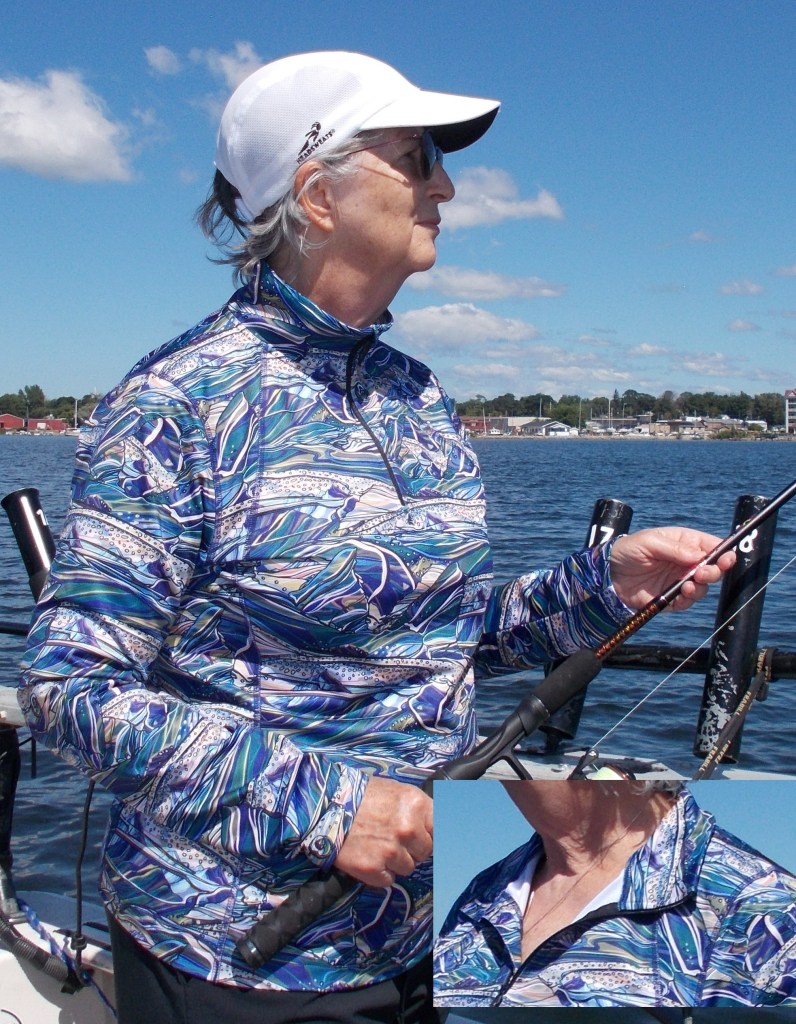
She chose the Thermal ¼ Zip top in the Rainbow Ridge pattern. Like all of Fishewear’s patterns, it’s a spectacular mix of colors, this one with a continuum of blue hues from light to dark so vivid the trout, wind, water and waves create a vibrant, eye-catching shirt.
At first glance the quarter-zip seems to be a summer-weight performance fabric pull-over, worn as much for sun protection as style. However, there’s a brushed jersey thermal layer inside that provides just enough warmth for crisp mornings in spring or fall, or as a base layer on colder days. The quarter-zip adds extra functionality by having the option of zipping up to provide a windproof collar for extra warmth and wind-blocking comfort when needed; or zip it down to add extra ventilation when hiking, fishing or some other activity that gets one’s blood pumping. Whether worn under another top or jacket, or as an outer shirt, the fabric is breathable so there’s never a clammy feel next to the skin.
Fishewear was founded a decade ago when Linda Leary stepped away from her partnership in a trucking business in Anchorage, Alaska – think Ice Road Truckers – to produce a line of fishing apparel for women. Her goal was products tailored for women, functioned perfectly and featured bold, art-inspired patterns and designs. I think she was successful in every aspect.
Check out the ¼ Zip Thermal top and all the other Fishewear gear and garments, styles and color patterns at www.fishewear.com or at their retail outlets in Anchorage and select locations in the Great Lakes region.
When you think of a camo sweatshirt, I bet you think of a cotton or cotton/poly pullover with the logo of your favorite bow or firearm stitched across the front. Forget that when it comes to AFTCO’s Reaper line of hoodies and pullovers. Most important, the Reaper isn’t a cotton or cotton blend, which violates my ABC (Anything But Cotton) rule when it comes to picking fishing clothes. Cotton is comfy, but when I’m out fishing, something is likely to get wet. The weather is likely to be very warm or very cold and I don’t want to be wearing cotton garments in either extreme..
The Reaper Sweatshirt is made from a poly-microfleece material (whatever that is) – what I do know is it’s soft, warm and comfy. The exterior is a decidedly smooth tight weave finish with an inner fleece. That means it more windproof than a cotton sweatshirt and in my opinion, about 50% warmer but the poly material doesn’t absorb water/sweat like cotton would.
So far, it’s been my “outer” layer worn over a performance cloth shirt as my base layer for chilly fall mornings. Later in the fall and for winter work, it will become one of my middle layers over a heavier poly base layer and a heavier coat or parka on top. I’ve worn it on every trip in the ice-out and early spring fishing for Southern Lake Michigan coho as a mid-layer on cold mornings and as a top layer when the spring sun warmed things up midday.
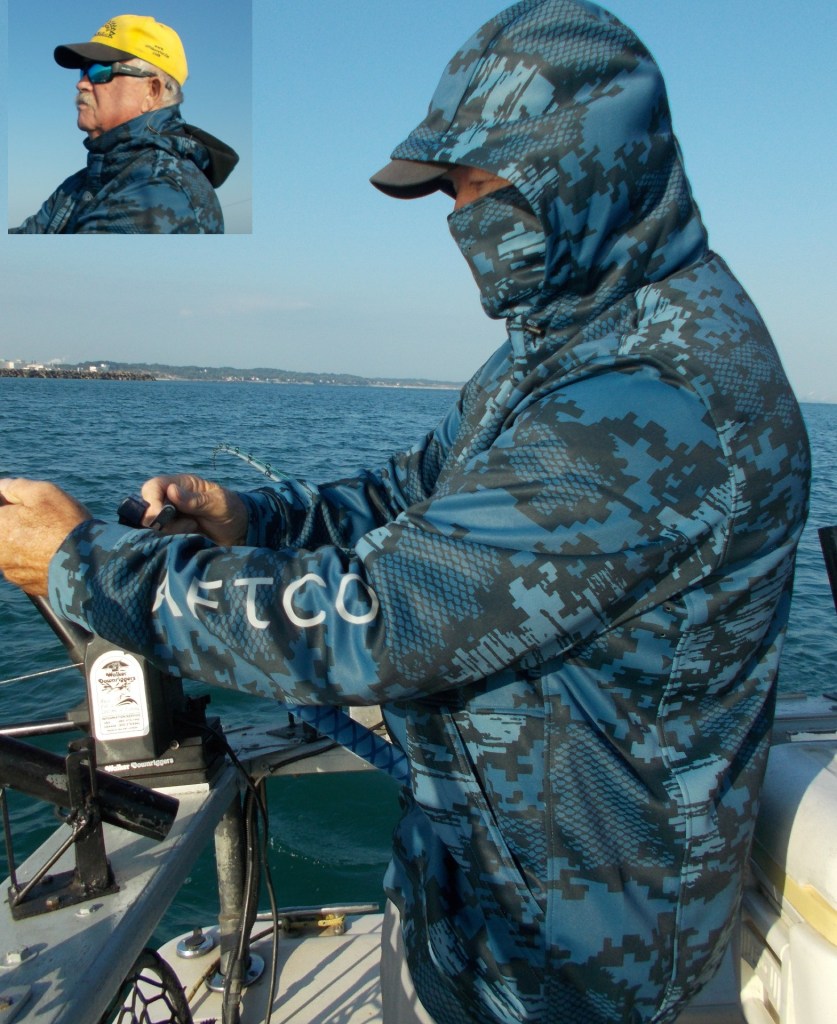
I’m not a fan of “hunting camo” for fishing, though the Reaper Camos are available in a brown camo “Shadowgrass” pattern, green camo OG pattern and a gray/green, “Bottomland” hunting patterns. I am a fan of “fishing” camo patterns however because I’m a “messy” fisherman and by the end of a busy trip, I’ve got (pick one) mud, blood, grease or other dirt on my exterior clothes and the camos help disguise what would be a prominent dirty spot on a solid color garment. There are three dark, fishing/nautical patterns as well. I chose the Navy digital blue pattern. A side benefit is the poly-material is stain-release, so a regular trip through the washer, has it back to looking like new.
A couple of neat features is the built in face mask which is great when I’m speeding to a fishing hotspot on a cold morning. When it’s not in use, the facemask gives the garment a sort of turtle-neck like collar which makes it warmer all day. Anytime I’m wearing a hoodie, I inevitably end up with “stuff” squirreled away in the pouch-pocket on the belly of the shirt – cell phone, keys, spare change, small tools, etc. The Reaper’s pouch has small “hook and loop” tabs that makes the pouch a bit more secure.
The Reaper’s are available at retailers, at numerous online outlets including Amazon.com and of course at www.AFTCO.com.
Do you get a chill down your spine when the weather people start putting words like frost, snow, wintery mix and wind chill in their forecasts? I used to, but I’d much rather start thinking of words like, fall brawl, early ice, late season fishing and even first ice. Those positive thoughts are now more in my mind than worries about chills down my spine since I got my Great Lakes Pro Insulated Suit.
Great Lake anglers don’t hibernate during the cold months. Certainly, the designers at Whitewater know this and being a Michigan based company where not only is windchill is understood, so are winter forecasts with words like lake effect, blustery and accumulation. They live there and understand the problems inherent in many winter parkas, bibs and other outdoor gear.
There are dozens of hi-tech parka and bibs makers, these days, but few of them seem to offer winter suits that check all the boxes. Some are long on insulation, but so bulky it’s hard to do much more than just stand there. Some are not so bulky, but not so warm. Few of them are waterproof. Many seem to concentrate more on flashy colors and patterns.
When I’m out for walleyes in late November, on the ice or in my boat fishing cohos in early March, looking spiffy is less important than being warm and able to move – whether it’s setting a line or drilling a hole.
Don’t think the Great Lakes Pro suit looks clunky. It doesn’t; but instead of being bright red, blue or other colors, it’s black. Perfect for me. On sunny days, the black color helps keep me warm. More important, after a few trips, it doesn’t look like it’s overdue for a trip through the washing machine.
Unlike many parkas and bibs I’ve used which use the same amount of insulation top to bottom, Whitewater’s Great Lakes Pro is built around various levels of insulation in different parts of each garment. There’s more insulation in the back of the parka than in the front. The sleeves have even less because it’s more important to have more insulation in the torso than in the hood, arms or in the legs in the bibs. That increases flexibility in the right places while maintaining warmth in others.
The best winter bibs have reinforced knees to keep them from wearing out and an additional bit of waterproofing when kneeling next to a tip up or kneeling on a boat’s floor to unhook a flopping fish. More than just an extra layer of cloth, the GL Pro bibs have reinforced the knee area with a rubberized waterproof fabric. That makes the knee area with totally waterproof while the rest of the suit relies on the a Durable Water Repellant and an internal waterproof/breathable layer sandwiched between the exterior fabric and interior lining. That little patch of waterproofing doesn’t really hurt the garment’s breathability rating (13K) or it’s waterproof rating of 30K.
I’m a “pocket” person in that I like outerwear with plenty of pockets. Nothing worse than having to dig deep into mid-layers to warm my fingers for a minute or grab my cell phone, key fob, camera, pocket knife or most any other item I might need during the course of the day. The jacket has five pockets, all are zip closed for security rubberized zippers for extra water resistance. The bibs have six pockets, interior and exterior.
Another thing I noticed immediately was the suspenders on the bibs are stretchy which I’ve found to be a great feature since whether I’m wearing several layers under the bibs while ice fishing in the open or just a hoody inside on warmer days, I’ve not had to adjust them. They stretch to fit. I love the silicone grip surface on the underside of the suspenders that keeps them from sliding off my shoulders when I’m in the middle of doing something.
I’m now going into my second season with the Great Lakes Pro suit. It was my top layer, rain or shine when I got it in late winter and through most of the spring. I told my customers, “On southern Lake Michigan, winter lasts to Memorial Day, so bundle up.” They don’t always remember that warning, but I do – and though I relish autumn’s Indian summer, I know by the time the next issue of GLA is out, I’ll be using my Great Lakes Pro parka and bibs nearly every day.
Whitewater’s Great Lakes Pro tops and bottoms are widely available at retail and online sources. Check them out or purchase them (along with other Whitewater products) at www.whitewaterfish.com.
I love the fall and early winter weather in the Great Lakes. That includes the brisk, frosty mornings that often gives way to tee-shirt warmth in the afternoon. Obviously, seasoned anglers know the key to this is layering but it doesn’t have to be a complicated system as is needed in “real” winter on the ice, in deer stands or other cold weather outings. The Fitzroy Jacket from Gill can be your go-to top layer on those Indian summer mornings (and just as useful on middle-spring days.)
My go-to outer layer for the past couple of seasons has been my Gill Winter Jacket and Bibs, which are both heavily insulated and fully waterproof, but the winter-wear is overkill on those days when the frosty morning fades quickly to comfortable temps as soon as the sun brightens the morning sky.
The Fitzroy jacket is very lightweight and packable for when it needs to be stowed, but easily fluffs to a warm, well insulated, good looking coat and hood. For me (so far) the hood is more for style since I’ve never needed it.
Fishing can be a wet sport even on a sunny day, either from errant spray when the boat is under power or when dealing with wet tackle or flopping fish. The Fitzroy will handle spray and wet fish, but it’s a poor choice for a rainy day. It has the same Durable Water Repellant finish on the outer layer that’s the first line of water resistance on all of the best totally waterproof rainwear, but that makes it water resistant, not waterproof. A bit of spray will just bead up and run off or evaporate, a soaking rain will, eventually soak in.
I love the three zip-close pockets – two on the sides for hands, for stowing car keys or other items and one on the upper chest where I often insert my cell phone or camera. The sturdy zips open and close easily and keeps things secure and available.
One observation I’ve noted on this and other Gill products is their sizing. Gill products are designed and engineered in the United Kingdom and sold worldwide where many people are smaller than many of us in the Great Lakes. I choose garments one size larger than I’d normally buy from American producers.
If environmental responsibility is important to you, both the Fitzroy’s shell and insulation is made from recycled materials.
Want to try Gill yourself? The Fitzroy Jacket (and other Gill products) are widely available or order them online straight from the Gill website with a discount:
At checkout, use the discount code- CAPTMIKE10 – for 10% off your order at gillfishing.com