GREAT LAKES PRO INSULATED SUIT By Whitewater

GREAT LAKES PRO INSULATED SUIT

Reviewed by Capt. Mike Schoonveld

  Do you get a chill down your spine when the weather people start putting words like frost, snow, wintery mix and wind chill in their forecasts? I used to, but I’d much rather start thinking of words like, fall brawl, early ice, late season fishing and even first ice. Those positive thoughts are now more in my mind than worries about chills down my spine since I got my Great Lakes Pro Insulated Suit.

Great Lake anglers don’t hibernate during the cold months. Certainly, the designers at Whitewater know this and being a Michigan based company where not only is windchill is understood, so are winter forecasts with words like lake effect, blustery and accumulation. They live there and understand the problems inherent in many winter parkas, bibs and other outdoor gear.

There are dozens of hi-tech parka and bibs makers, these days, but few of them seem to offer winter suits that check all the boxes. Some are long on insulation, but so bulky it’s hard to do much more than just stand there. Some are not so bulky, but not so warm. Few of them are waterproof. Many seem to concentrate more on flashy colors and patterns.

When I’m out for walleyes in late November, on the ice or in my boat fishing cohos in early March, looking spiffy is less important than being warm and able to move – whether it’s setting a line or drilling a hole.

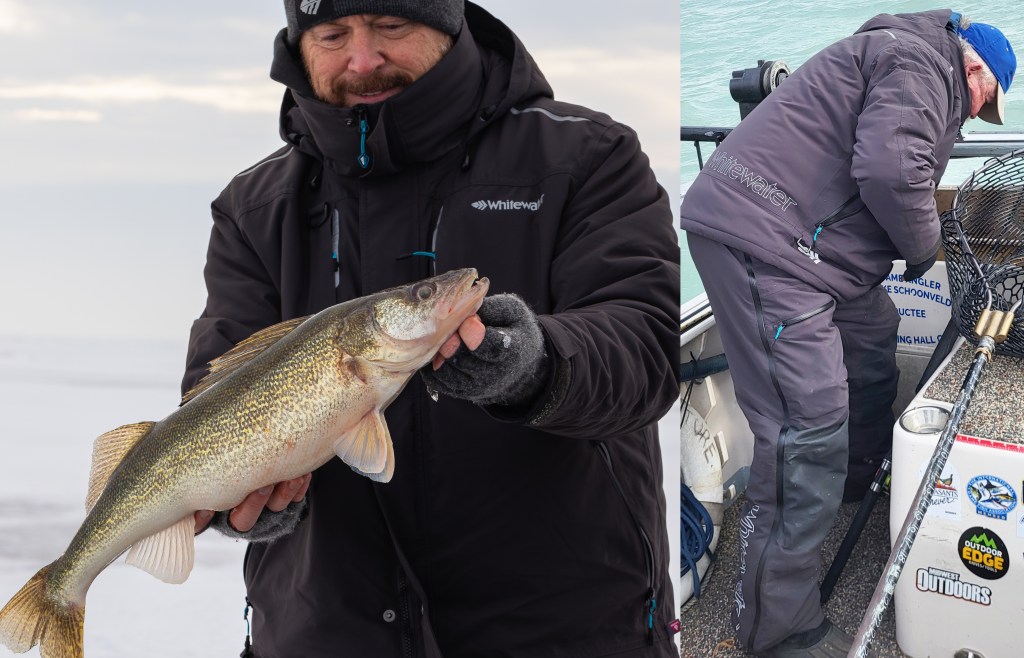
Don’t think the Great Lakes Pro suit looks clunky. It doesn’t; but instead of being bright red, blue or other colors, it’s black. Perfect for me. On sunny days, the black color helps keep me warm. More important, after a few trips, it doesn’t look like it’s overdue for a trip through the washing machine. 

Unlike many parkas and bibs I’ve used which use the same amount of insulation top to bottom, Whitewater’s Great Lakes Pro is built around various levels of insulation in different parts of each garment. There’s more insulation in the back of the parka than in the front. The sleeves have even less because it’s more important to have more insulation in the torso than in the hood, arms or in the legs in the bibs. That increases flexibility in the right places while maintaining warmth in others.

The best winter bibs have reinforced knees to keep them from wearing out and an additional bit of waterproofing when kneeling next to a tip up or kneeling on a boat’s floor to unhook a flopping fish. More than just an extra layer of cloth, the GL Pro bibs have reinforced the knee area with a rubberized waterproof fabric. That makes the knee area with totally waterproof while the rest of the suit relies on the a Durable Water Repellant and an internal waterproof/breathable layer sandwiched between the exterior fabric and interior lining. That little patch of waterproofing doesn’t really hurt the garment’s breathability rating (13K) or it’s waterproof rating of 30K. 

I’m a “pocket” person in that I like outerwear with plenty of pockets. Nothing worse than having to dig deep into mid-layers to warm my fingers for a minute or grab my cell phone, key fob, camera, pocket knife or most any other item I might need during the course of the day. The jacket has five pockets, all are zip closed for security rubberized zippers for extra water resistance. The bibs have six pockets, interior and exterior.

Another thing I noticed immediately was the suspenders on the bibs are stretchy which I’ve found to be a great feature since whether I’m wearing several layers under the bibs while ice fishing in the open or just a hoody inside on warmer days, I’ve not had to adjust them. They stretch to fit. I love the silicone grip surface on the underside of the suspenders that keeps them from sliding off my shoulders when I’m in the middle of doing something.

I’m now going into my second season with the Great Lakes Pro suit. It was my top layer, rain or shine when I got it in late winter and through most of the spring. I told my customers, “On southern Lake Michigan, winter lasts to Memorial Day, so bundle up.” They don’t always remember that warning, but I do – and though I relish autumn’s Indian summer, I know by the time the next issue of GLA is out, I’ll be using my Great Lakes Pro parka and bibs nearly every day. 

Whitewater’s Great Lakes Pro tops and bottoms are widely available at retail and online sources. Check them out or purchase them (along with other Whitewater products) at www.whitewaterfish.com.
AFTCO REAPER CAMO SWEATSHIRT

Reviewed by Capt. Mike Schoonveld

When you think of a camo sweatshirt, I bet you think of a cotton or cotton/poly pullover with the logo of your favorite bow or firearm stitched across the front. Forget that when it comes to AFTCO’s Reaper line of hoodies and pullovers. Most important, the Reaper isn’t a cotton or cotton blend, which violates my ABC (Anything But Cotton) rule when it comes to picking fishing clothes. Cotton is comfy, but when I’m out fishing, something is likely to get wet. The weather is likely to be very warm or very cold and I don’t want to be wearing cotton garments in either extreme..

The Reaper Sweatshirt is made from a poly-microfleece material (whatever that is) – what I do know is it’s soft, warm and comfy. The exterior is a decidedly smooth tight weave finish with an inner fleece. That means it more windproof than a cotton sweatshirt and in my opinion, about 50% warmer but the poly material doesn’t absorb water/sweat like cotton would.

So far, it’s been my “outer” layer worn over a performance cloth shirt as my base layer for chilly fall mornings. Later in the fall and for winter work, it will become one of my middle layers over a heavier poly base layer and a heavier coat or parka on top. I’ve worn it on every trip in the ice-out and early spring fishing for Southern Lake Michigan coho as a mid-layer on cold mornings and as a top layer when the spring sun warmed things up midday.

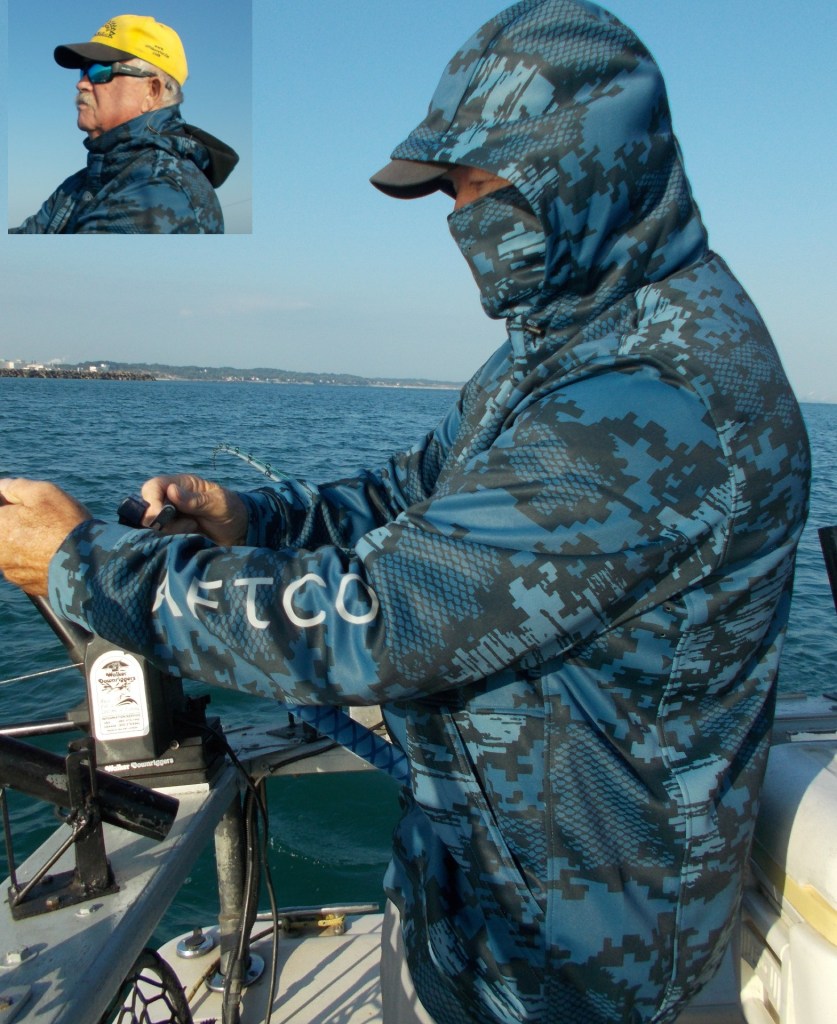
 I’m not a fan of “hunting camo” for fishing, though the Reaper Camos are available in a brown camo “Shadowgrass” pattern, green camo OG pattern and a gray/green, “Bottomland” hunting patterns. I am a fan of “fishing” camo patterns however because I’m a “messy” fisherman and by the end of a busy trip, I’ve got (pick one) mud, blood, grease or other dirt on my exterior clothes and the camos help disguise what would be a prominent dirty spot on a solid color garment. There are three dark, fishing/nautical patterns as well. I chose the Navy digital blue pattern. A side benefit is the poly-material is stain-release, so a regular trip through the washer, has it back to looking like new.

 A couple of neat features is the built in face mask which is great when I’m speeding to a fishing hotspot on a cold morning. When it’s not in use, the facemask gives the garment a sort of turtle-neck like collar which makes it warmer all day. Anytime I’m wearing a hoodie, I inevitably end up with “stuff” squirreled away in the pouch-pocket on the belly of the shirt – cell phone, keys, spare change, small tools, etc. The Reaper’s pouch has small “hook and loop” tabs that makes the pouch a bit more secure. 

 The Reaper’s are available at retailers, at numerous online outlets including Amazon.com and of course at www.AFTCO.com.  

GILL VOYAGER DAY PACK

Reviewed by: CAPT. MIKE SCHOONVELD

I don’t leave some of the gear I use just about every trip on or in my boat between excursions. Things like clothes, raingear, sometimes footwear or gloves are removed and either laundered or at least allowed to dry thoroughly between trips. I learned long ago if I pulled out a jacket, hat, camera, or other gear stowed on board, it’s often not as “fresh” as when I stowed it in cubby or compartment.

Anytime I hop onboard someone else’s boat I know I’ll need to take along some of my personal gear. Whether it’s day trips on my boat or on someone else’s, I rely on a roomy day pack to keep my personal gear organized and dry. Last summer my Gill Voyager Day Pack was been my constant companion.

In the early season when days start out more wintery than spring-like, I shed layers as the day warms and when I do, I stuff my morning parka, bibs or other gear into the Day Pack just to keep it out of the way. In the summer, I always have rainsuit in the Day Pack and perhaps a spare sweatshirt along with a boonie hat to keep my ears shaded on sunny days. There may be some homemade cookies, a couple bottles of water or some new lures in the bag when I load it from my truck to the boat.

On away trips I stick my camera, batteries and often my wallet in the zipper-close inner pocket to keep things safe and organized. I bring my own Type V lifejacket, some ziplock baggies and my favorite fillet knife. All this and there’s still room for a couple of 3700 Stowaway lure boxes if I think the extra tackle would be helpful or appreciated.

It all fits – usually – the bag will hold 25 litres (almost seven gallons) worth of gear and I don’t worry about packing it overly tight. The Day Pack is made from a tough, seamless PVC tarpaulin fabric. If I don’t need that much space, I can just give the roll top closure an extra turn or two to shrink the bag and insure it stays perfectly waterproof. I just toss in the bow or stuff it under a seat and don’t worry about it until it’s needed.

It has sturdy, backpack-like carrying straps, handy when carrying it from the parking lot to the docks or even from the ticket counter to the gate in airports. The day pack makes a great carry on for air travel.

Want to try a Gill Day Pack or any other Gill fishing products for yourself? Great! Fishing Toys readers can score a 10% discount by using the Code: CAPTMIKE10 at check out when you purchase at www.gillfishing.com. They are also available at some retailers, at many online sellers and Amazon.com. 

GREAT LAKES PRO INSULATED SUIT By Whitewater

GREAT LAKES PRO INSULATED SUIT

Reviewed by Capt. Mike Schoonveld

  Do you get a chill down your spine when the weather people start putting words like frost, snow, wintery mix and wind chill in their forecasts? I used to, but I’d much rather start thinking of words like, fall brawl, early ice, late season fishing and even first ice. Those positive thoughts are now more in my mind than worries about chills down my spine since I got my Great Lakes Pro Insulated Suit.

Great Lake anglers don’t hibernate during the cold months. Certainly, the designers at Whitewater know this and being a Michigan based company where not only is windchill is understood, so are winter forecasts with words like lake effect, blustery and accumulation. They live there and understand the problems inherent in many winter parkas, bibs and other outdoor gear.

There are dozens of hi-tech parka and bibs makers, these days, but few of them seem to offer winter suits that check all the boxes. Some are long on insulation, but so bulky it’s hard to do much more than just stand there. Some are not so bulky, but not so warm. Few of them are waterproof. Many seem to concentrate more on flashy colors and patterns.

When I’m out for walleyes in late November, on the ice or in my boat fishing cohos in early March, looking spiffy is less important than being warm and able to move – whether it’s setting a line or drilling a hole.

Don’t think the Great Lakes Pro suit looks clunky. It doesn’t; but instead of being bright red, blue or other colors, it’s black. Perfect for me. On sunny days, the black color helps keep me warm. More important, after a few trips, it doesn’t look like it’s overdue for a trip through the washing machine. 

Unlike many parkas and bibs I’ve used which use the same amount of insulation top to bottom, Whitewater’s Great Lakes Pro is built around various levels of insulation in different parts of each garment. There’s more insulation in the back of the parka than in the front. The sleeves have even less because it’s more important to have more insulation in the torso than in the hood, arms or in the legs in the bibs. That increases flexibility in the right places while maintaining warmth in others.

The best winter bibs have reinforced knees to keep them from wearing out and an additional bit of waterproofing when kneeling next to a tip up or kneeling on a boat’s floor to unhook a flopping fish. More than just an extra layer of cloth, the GL Pro bibs have reinforced the knee area with a rubberized waterproof fabric. That makes the knee area with totally waterproof while the rest of the suit relies on the a Durable Water Repellant and an internal waterproof/breathable layer sandwiched between the exterior fabric and interior lining. That little patch of waterproofing doesn’t really hurt the garment’s breathability rating (13K) or it’s waterproof rating of 30K. 

I’m a “pocket” person in that I like outerwear with plenty of pockets. Nothing worse than having to dig deep into mid-layers to warm my fingers for a minute or grab my cell phone, key fob, camera, pocket knife or most any other item I might need during the course of the day. The jacket has five pockets, all are zip closed for security rubberized zippers for extra water resistance. The bibs have six pockets, interior and exterior.

Another thing I noticed immediately was the suspenders on the bibs are stretchy which I’ve found to be a great feature since whether I’m wearing several layers under the bibs while ice fishing in the open or just a hoody inside on warmer days, I’ve not had to adjust them. They stretch to fit. I love the silicone grip surface on the underside of the suspenders that keeps them from sliding off my shoulders when I’m in the middle of doing something.

I’m now going into my second season with the Great Lakes Pro suit. It was my top layer, rain or shine when I got it in late winter and through most of the spring. I told my customers, “On southern Lake Michigan, winter lasts to Memorial Day, so bundle up.” They don’t always remember that warning, but I do – and though I relish autumn’s Indian summer, I know by the time the next issue of GLA is out, I’ll be using my Great Lakes Pro parka and bibs nearly every day. 

Whitewater’s Great Lakes Pro tops and bottoms are widely available at retail and online sources. Check them out or purchase them (along with other Whitewater products) at www.whitewaterfish.com.
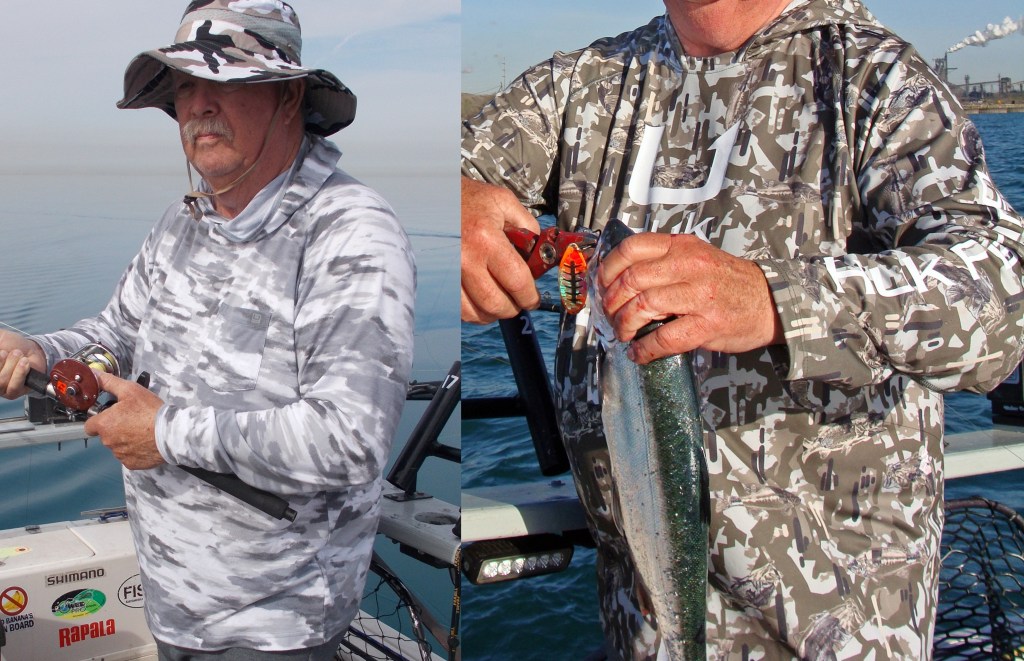
HUK PERFORMANCE SHIRTS – APEX VERT ICON and WAYPOINT

Reviewed by: CAPT. MIKE SCHOONVELD

Other than when I’m ice fishing in extreme conditions, when I’m fishing I always have a long sleeve shirt or hoody made of what has become known as performance cloth as my base layer – or only layer. In the summer, these shirts keep me cooler than if I were wearing a short sleeve shirt and give me 50 UPF sun protection against UV radiation. In the earliest part of thefishing season and late fall fishing, these same shirts are a part of my layering system that allows me to add or subtract coats, vests or jackets as the conditions change from morning chill to midday levels. It all has to do with the moisture and water vapor wicking properties of performance cloth.

Basically, the fibers of performance cloth is woven from is made of some sort of plastic. The HUK Waypoint shirts I own are actually made from recycled water bottles. Others, like the Apex Vert ICON are made from other forms of plastic, but the fact the base material is poly-something or other means it can’t get wet. Each thread can get wet on the outside, but unlike cotton, woolor other blends of natural threads, the base materials won’t soak up wetness. Instead, because of the tight weave, when moisture is produced from perspiration or from the natural production of water vapor escaping from a person’s skin, none of that wetness is captured by the material. Instead, through capillary action, it’s pulled into the cloth next to the skin and wicked outward. In the summer, it evaporates, cooling the cloth and cooling the wearer better than just sweaty skin or wet tee-shirt material will do. In cold weather, as a base layer, it still wicks moisture away from the skin and passes the moisture on to the next layer – hopefully all the way through each layer, where it leaves the wearer warm and cozy inside.

I’ve had the Waypoint shirt for over a year and it’s still one of my favorites. This shirt looks and feels more cottony-soft and I like this, especially in the morning chill. Once the temperature climbs, the fabric still performs with moisture wicking and cooling effects. Many of these performance fabric shirts are slick-feeling, more like silk or satin than familiar feel of cotton.

Most of HUK’s performance shirts come emblazoned with the HUK logo on the front, back or sleeves. Some people don’t like wearing shirts with logos or emblems.If that’s you, take a look at HUK’s Waypoint line.

One of HUK’s newest versions of the performance cloth shirts is the Apex Vert ICON is an upgrade to their popular ICON shirt line. It is one of those “slick” feeling materials which I think enhances the “cooling” feel on hot summer days and the AVI has special panels on the sides and backs that accelerates the moisture-wicking and the cooling feel. I prefer the hoody versions of these shirts since it gives me more neck protection from the sun and eliminates the need for me to wear neck gaitors most days.

I used to shy away from “hunter” pattern camoshirts, but I now embrace the gray and blue shaded nautical camos. I’m not trying to hide from the fish, but I’m a sloppy angler. It’s not uncommon for meto end up with fish slime, fish blood and other stains by the end of a day onthe lake – stains that show up like a blood trail in new fallen snow on pastel, solid-colored fabric. I still get the stains, but I don’t look like a serial killer by the end of a fishing trip.

Both of these HUK performance shirt lines are available in both solid colors and camo versions. HUK performance wear is widely available at many retailers and online sources including Amazon.com. See all the choices or purchase directly at www.hukgear.com


SCOTTY 452 GEAR CADDY

Reviewed by: CAPT. MIKE SCHOONVELD

If you ever watch a professional at work you’ll see that he or she usually has all the usual tools organized and close at hand. That goes for heart surgeons to electricians. The doctor probably has the scalpels, clamps and other tools arranged on a tray next to the operating table, the electrician often has a tool belt holding the screwdrivers, wire pliers and the needed tools for the job at hand.

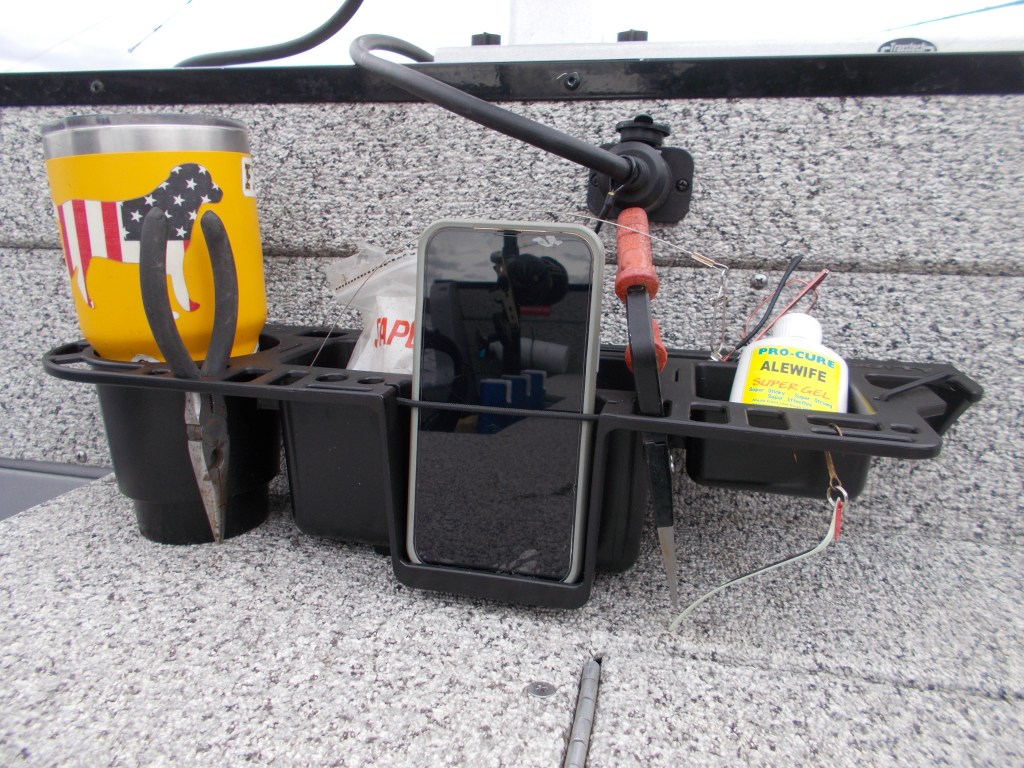
It’s equally important for anglers to have the tools they will or might need close at hand and considering the excitement and uncertainty of fishing on the Great Lakes, it’s also important to not have pliers, lures, line snippers and other cluttering the working area. “Scotty” as in Scotty Downriggers understands this and has added a variety of products to their line of ‘riggers and rod holders to help with the clutter. Newest of these is the 452 Gear Caddy.

It’s an organizer that attaches solidly into tracks or Scotty rod holder mounts, or it can be fastened in a convenient location with mounting screws. It can be a permanent fixture or can be repositioned depending on the style of fishing happening.

It has three recessed cavities, one is obviously a cup or beverage container holder, the other two are rectangular to hold any number of necessities, from bug spray to scent products. Add to this is multiple slots to hold knives, pliers, screwdrivers and other tools, or use the slots as lure hangers to keep the lures probably going to be needed or the ones just pulled at bay to allow them to dry or at least stay in one place before they are stowed away in the tackle box. A part of the caddy is magnetized, a great place to temporarily set hooks or swivels and keep them from disappearing onto the floor or elsewhere until they are needed.  

If you want to fish like a pro, be organized like a pro. Pick up a 452 Gear Caddy at retailers handling Scotty Downrigger products, at Amazon.com or at a variety or other online outlets.  Check out the Gear Caddy and other Scotty products at http://www.scotty.com.

KASTKING KALIBRATE

Reviewed by: CAPT. MIKE SCHOONVELD

Most anglers know they need to change their line on a regular basis and most fishermen know quality fishing line is expensive. The two things that can help cut those costs is to purchase line in bulk spools instead of reel-filler amounts and don’t remove all the line on each reel every time it’s time to swap it out. 

 Few anglers use all the line spooled on a reel. If that happens you probably need a bigger reel. That line at the bottom of the spool may not be as good as new, but since it is never subjected to the subtle degradation by UV light and it’s never brutalized by being stretched, cast and other normal wear and tear of just being used, why change it?

 If you buy a bulk spool, how do you know when you have removed enough line? If you buy a 300 yard spool and you want to split it between two or three reels, how do you split it equally? The only way to do it with precision is to measure the line. There are tools to do this.

 One of the tools is not a line-counter reel. LC reels only measure the number of revolutions the reel’s spool makes and the changing numbers on counter are approximations – at best! A revolution of a half empty spool will only hold a small amount of line compared to a nearly full spool.

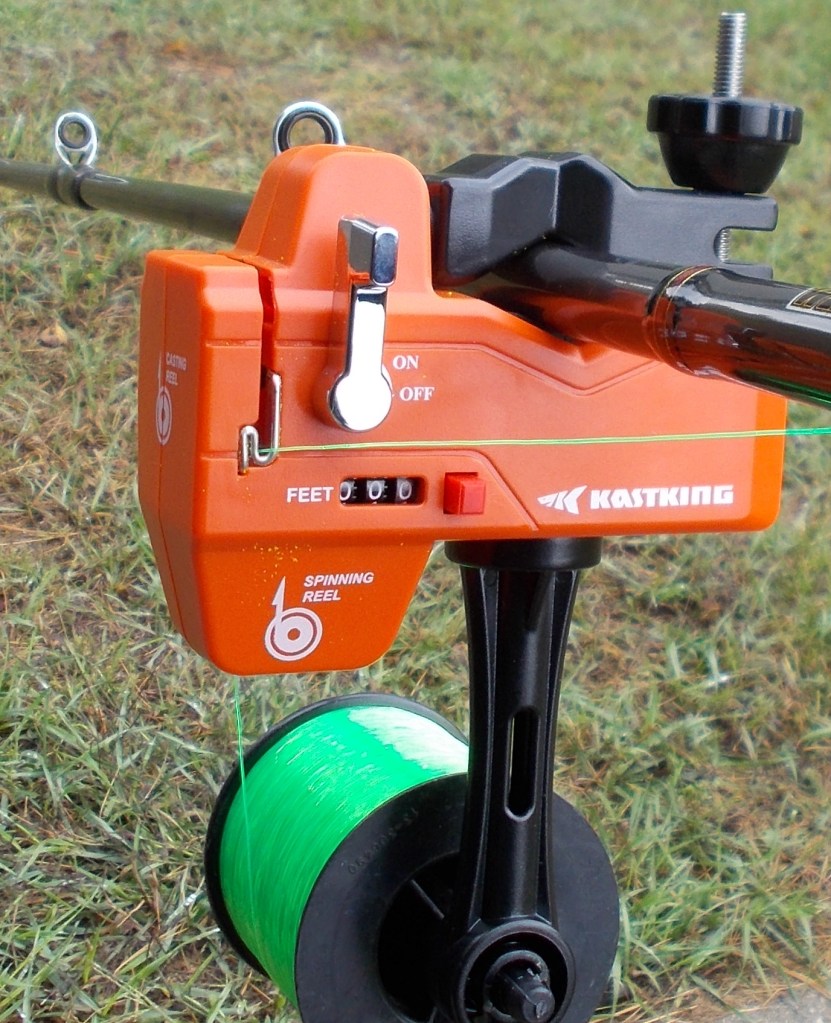
 One of the tools that will accurately measure the line spooling on or peeling off a reel is KastKing’s Kalibrate Line Spooler. (It’s designed to measure line being spooled on, but can easily be reversed to measure outgoing line.)  There are a lot of moving parts on this tool allowing it to be used for spooling with both spinning reels as well as revolving spool reels and on rods from heavy trolling to light carbon-fiber models – but it’s not complicated.

There are lots of line spooling tools available. Before I got the Kalibrate, I normally used a screwdriver punched through the arbor of a spool of line and clamped between my knees. There are a few line-counter tools that clamp onto a rod as well but the ones I’ve tried ranged from horrible to barely okay at best, for both ease of use and accuracy. The Kalibrate is the only model I’ve found that does both things and does both of them well.

The KastKing Kalibrate Tool is available at www.amazon.com or visit http://www.KastKing.com to see this tool and other KastKing products.