DIAL BACK MEMORY ENHANCERS

Reviewed by: CAPT. MIKE SCHOONVELD

You are out fishing with your regular crew, one of which just finished unhooking a walleye that hit one of the planer board lines, or you are trolling on Lake Ontario and your fishing partner just unhooked a king salmon that fell for a lure pulled deep with a Dipsey Diver – or perhaps it’s you and a friend on Lake Superior and the fish being unhooked is a laker that fell for a downrigged lure. Regardless of the place or the fish, soon the familiar question will be heard: How deep was the line set? How far out did you have this Dipsey? How far back was this Flicker Shad?

                Ah…. I think I had it out…. How far is the diver on the other side…? More likely, “I can’t remember.”

                How far? How deep? How much line? All are important questions; and the wrong answer can be the difference in whether that lure or that line is a one-hit-wonder or the hero for the day.

                I’m sure there are “set-up savants” that can remember every lure and every deployment. I was once on a boat where the captain kept an Excel spreadsheet on an iPad showing every lure, every depth, every fish, probably the wind speed and color of each angler’s underwear. That’s not me and it wasn’t a couple of Michigan fishing buddies who were always asking these questions whether they were out for Saginaw Bay walleyes or trolling for Lake Huron salmon.

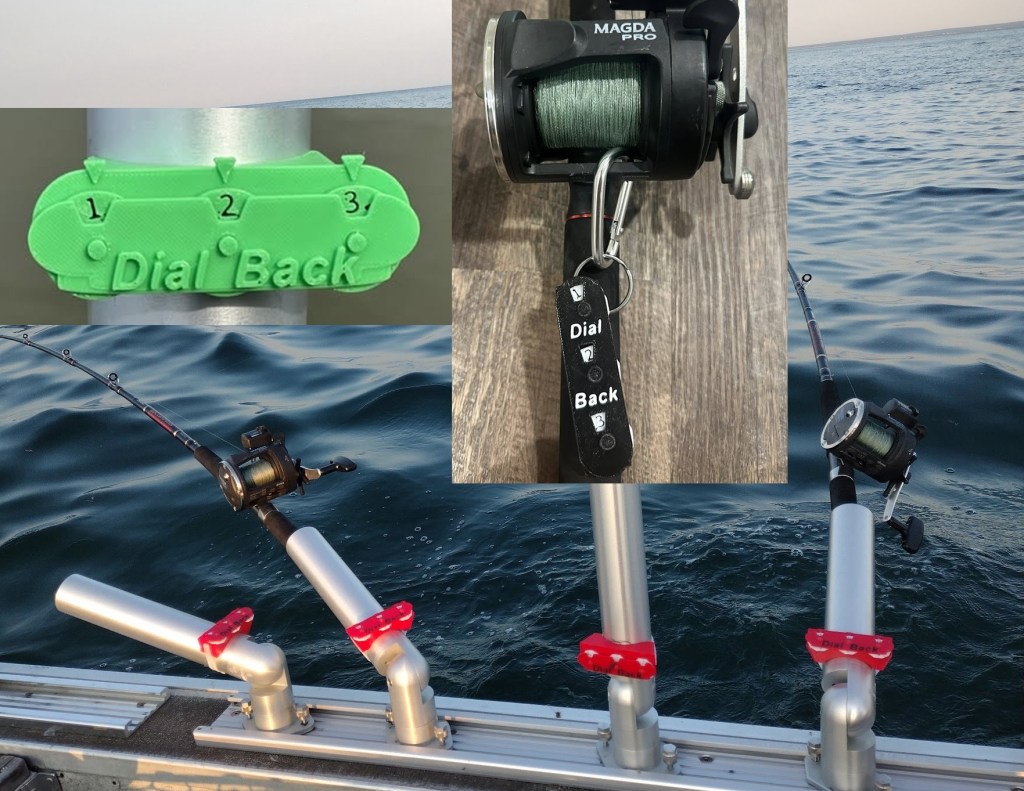
                But instead of just asking this question over and again, they used their non-fishing talents to invent and produce the Dial Back Precision Trolling Device, or what I call the Dial Back Memory Enhancer. There are two styles, depending on how your boat is set up or how you fish. Both have a small, plastic body with three numbered dials which rotate from zero to nine. Have a Dipsey Diver set at 93 feet, set the dials on the memory enhancer to show 093.  

                The original style is best for boats that always have the same rod in the same rod holder. The device attaches to the rod holder. If you always put the starboard downrigger in a specific rod holder, that’s where to put the Dial Back. Set the lure 88 feet deep, set the rod in the holder, set the dials on the Dial Back to 0-8-8.

                The Dial Back “mini” is for guys who rotate their rods, a common tactic for those who use Big Board Planers with the fishing lines attached to releases that slide down a tether cord. After a fish is caught on the rod and reel in rod holder #1, the rod in the #2 holder gets moved to the #1 position, the #3 moves to #2, etc. The lure that caught the fish gets positioned to rod holder for the lure trolled closest to the boat.

                Dial Back Minis attach to the rod or reel in any position that works for you. Attach it to the reel, to the rod, to the first line guide – where doesn’t matter, the process is the same. Catch a fish. Rotate the other rods, check the Dial Back on the set-up that just caught the fish and put the lure exactly as far as it was previously.

                These are products EVERY trolling boat should have and every troller can afford! The Mini’s are available in black, the originals in a variety of colors so you can color-code your rod holders. “Fish on yellow!” Check them out and purchase them at www.dialbackprecisiontrolling.com.   
MAD SCIENTIST TACKLE


Reviewed by: CAPT. MIKE SCHOONVELD              

When the guys at RLVNT Sunglasses sent me a pair of sunglasses to try, they slipped in a couple of spoons they thought I’d like to use. This line of tackle is ever-expanding but what they’ve done (and are doing ) is use the light-bending properties of the films and coatings they use in their lenses and apply them to their lures.

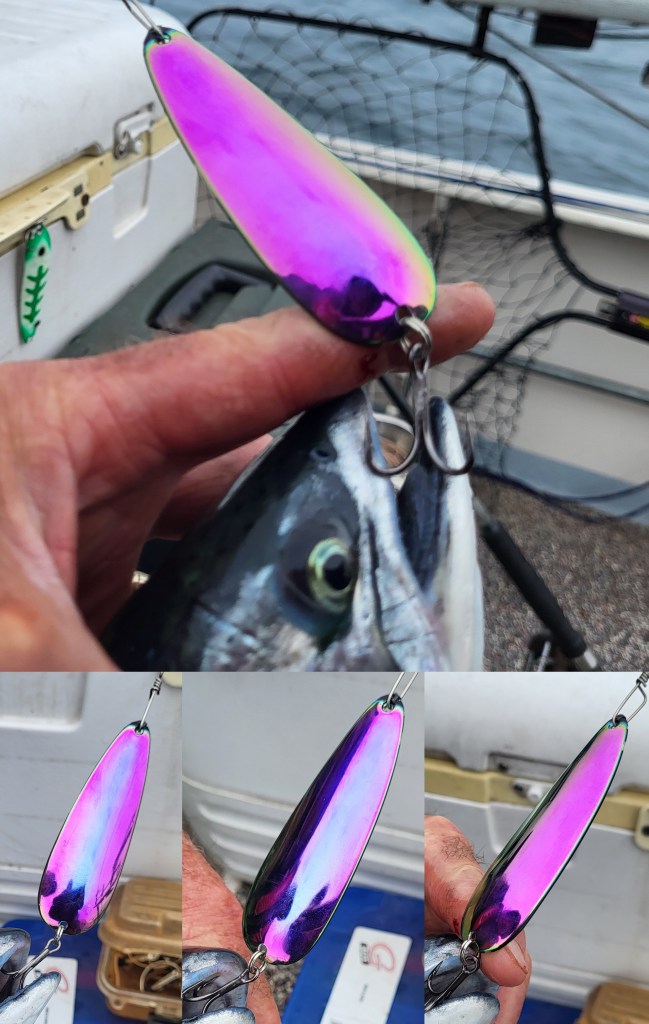
                Depending on how much and at what angle the light strikes the finish on these lures, the color of the reflected light changes. You see it and the fish see it. So instead of seeing a traditional paint job which only varies whether the lure is in direct sunlight or shade, or a metallic finish that just reflects when sunbeams hit it, the lure changes color continuously.

                The one I used shimmered from dark purple to pink to bright blue and regularly caught the attention of passing cohos. I loaned it to a friend to take to Lake Nipigon and he crushed the lake trout using it. Other films produce other hues and excel in conditions from stained or off-colored water to crystal clear. (And don’t think their casting spoon is only for casting. It trolls perfectly with a loose wobble.)

                The Mad Scientist lives in Minnesota – often called Walleye-sota – and firmly in the winter ice-belt. They produce a bevy of lures (all with their proprietary finishes) suitable for panfish or pike (salmon or trout) wherever they swim. Made in America, sold online at www.madscientist.technology, in retail stores and other online outlets. 

SMITH’S BAIT AND FISH KILL BAG

Reviewed by: CAPT. MIKE SCHOONVELD

There was something missing on my boat last spring, a fish cooler. Often called a box or the fish box. If you don’t have a fish cooler on your boat, chances are you rely on stuffing the fish you catch and keep into a livewell or into a built-in fish storage compartment. My boat’s livewell must have been designed for perch fishing. It won’t hold a four-person limit of spring cohos and is certainly too small to hold a decent four-person bag of Lake Erie walleye.

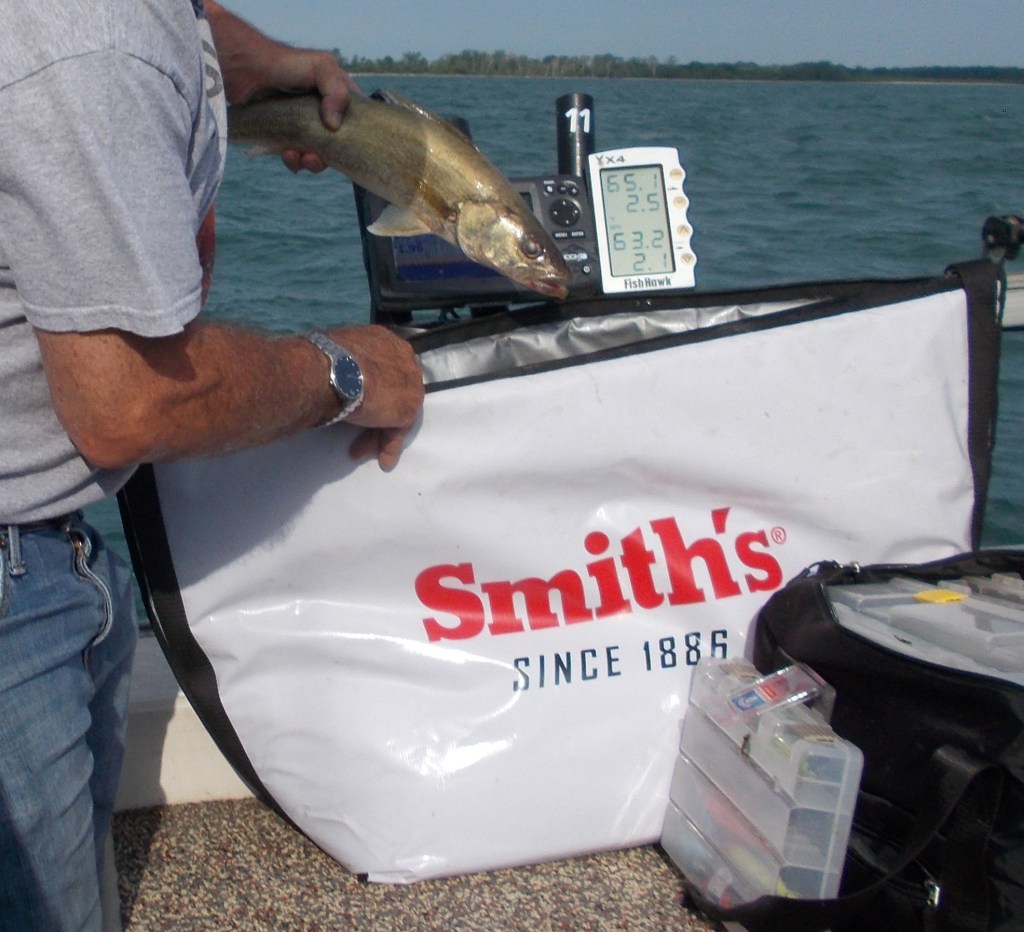
 So I “bagged” the fish.  Actually, the fish went into Smith’s Products Insulated 36” Bait and Fish Kill Bag. Why not use my old IGLOO cooler? It takes up a lot of space.

Formerly, when my cooler was my only choice, I “made” space for it. It was a piece of necessary gear, so I economized on other gear to make everything fit with room left over for the fish box and the fishermen. Not now.

At the beginning of the day, the Kill Bag takes up almost no room. It doesn’t fold perfectly flat, it is insulated – front, back and bottom with closed cell foam, but a cooler is the same size whether it’s full or empty. Before the first fish is caught I add one or two small (7-pound) bags of ice – depending on air temperature. At that point the bag is about 1/3rd the size of my old fish cooler. On a good day, by the time it’s got 18 or 24 walleyes in the bag (or 15 or 20 cohos), it takes up about half the space of my fish cooler – and there’s space left over to hold a king, a big brown trout or several plus-size walleyes if the fishing was extra-good.

I had four concerns when switching from a hard-sided plastic cooler to a soft-sided kill bag. Would it be tough enough? Would it be hard to clean? Would it keep the fish cool and fresh? Would it be large enough?

The Smith’s bag is constructed (inside and out) with a heavy-duty, marine grade tarp-like fabric. I wasn’t overly concerned the sharp fins on the walleyes I put in the bag would perforate the interior lining, but that thought was in the back of my mind. So, after several walleye trips, I took a flashlight, put on my reader glasses and examined the interior closely so see if there were any visible holes. None were found, nor did I ever detect any leakage around the bottom seams from melting ice had dripping through the inner skin and leaking out the bottom. Additionally, the seams are reinforced with strong nylon strapping material made from the same material as the detachable carrying strap. Plenty tough.

Both the interior and exterior is slick-finish allowing fresh blood to just rinse off and even dried-on blood to wash clean with a minimum amount of scrubbing with a soft brush. Once it’s rinsed clean, I just invert it with the zipper open and to let it quickly dry. Cleans up easily.

Cooling ability? One sure indicator of how well it’s insulated is how much ice is left at the end of the trip. If all you have left in your fish cooler is melt water, it’s not doing the job. On my early spring trips when the air temperature and the water temperature (thus the fish temperatures) are in the 40s, that small bag of ice was still more ice than meltwater after a long half-day of fishing. Once the weather and water warmed, the second bag of ice still did the job. 

The 36” Bait and Fish Kill Bag is Smith’s middle size offering. It’s perfect for how I used it. Later in the season when king salmon and lake trout figure heavily into the catch where I fish, it wouldn’t be large enough. However, Smith makes a 48” kill bag that is advertised to be larger than my Igloo and there’s a smaller, 30-incher (called Mr. Crappie) that will hold several limits of perch or crappies.

Though the 30 and 36-inch versions are called “bait and fish kill bags,” I don’t think they’d be a good replacement for a bait bucket. Perhaps in a special situation, they’d be ideal – not on my boat. They do come with drain plugs at the bottom, however, to allow melt water from the ice or minnow water if used for bait to flow out the bottom. Available at www.smithsproducts.com at retailers and several online outlets including Amazon.