RAPALA CORDLESS ELECTRIC KNIFE

rap

REVIEWED BY CAPT. MIKE SCHOONVELD

Electric knife? I used to be a manual knife purest and viewed fish cleaners who used electric knives to be people who didn’t know how to sharpen (and keep sharp) their conventional knives. Besides, I always questioned the sanity of someone who would stand on a wet floor and plug a hand-held appliance into a 120V electrical outlet. An additional “besides” is I often clean fish in locations where there’s no electrical outlet.

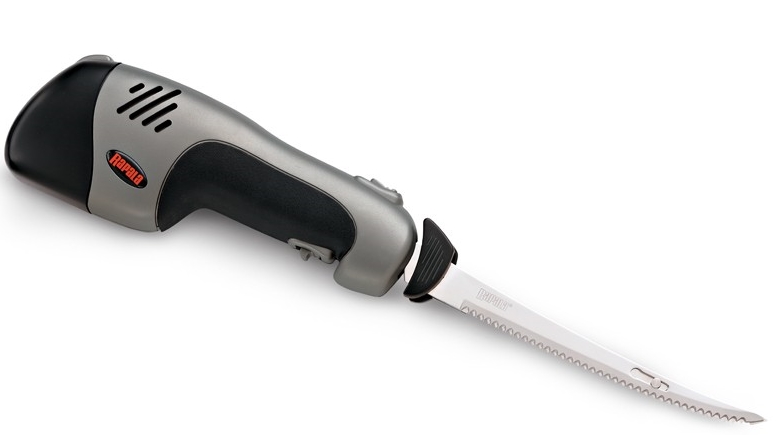
I still think the above is partially true. However, I’m no longer a purest. I now own a Rapala Lithiom Ion Cordless Fillet Knife.

There are two methods of cutting a filet off a fish. One involves cutting over the ribcage, but not through the ribs, then carefully cutting around the ribs until the boneless filet is freed from the fish. The second method (the one I normally use) is to cut through the rib bones, free the filet, then trim the rib bones from the filet.

This works terrific on the kinds of fish with relatively easy to cut rib bones like salmon or pike. A sharp filet knife will slice through salmon ribs with very little resistance. Other species, like walleye, steelhead, lake trout and others – not so much.

The changing fishery on Lake Michigan has made lake trout an increasingly important part of my catch and for a longer period during the season. “It may be time to give up those puritan knife opinions,” I thought – and then added, “if there’s a battery powered option.”

There are several brands of rechargeable knives and after looking at on-line reviews of popular choices, I chose the Rapala Lithium-Ion Cordless model. My experience with rechargeable drills and other tools taught me those li-ion batteries are much superior to nickel-cadmium rechargeable power-packs of a few years ago. They are more powerful and last much longer.

I love it! I (mostly) have given up my electric fillet knife bias. There’s still great satisfaction in producing a perfect filet with a good sharp knife and that’s still all I use for salmon and or other easy-to-cut fish. When I have a load of lakers to cut up – or a whack of walleyes – out comes the electric.

The battery is supposed to last 80 minutes. I’ve never run it down enough to even notice a power drop though I only recharge the Li-Ion power pack every four or five outings.

I really appreciate the trigger comes with a shotgun-like safety button and I always use it when I’m attaching or removing the blades.

These knives are widely available at retail and on-line sellers or buy direct from http://www.rapala.com.

OUTDOOR EDGE FILET KNIVES

RFkit

REVIEWED BY CAPT. MIKE SCHOONVELD

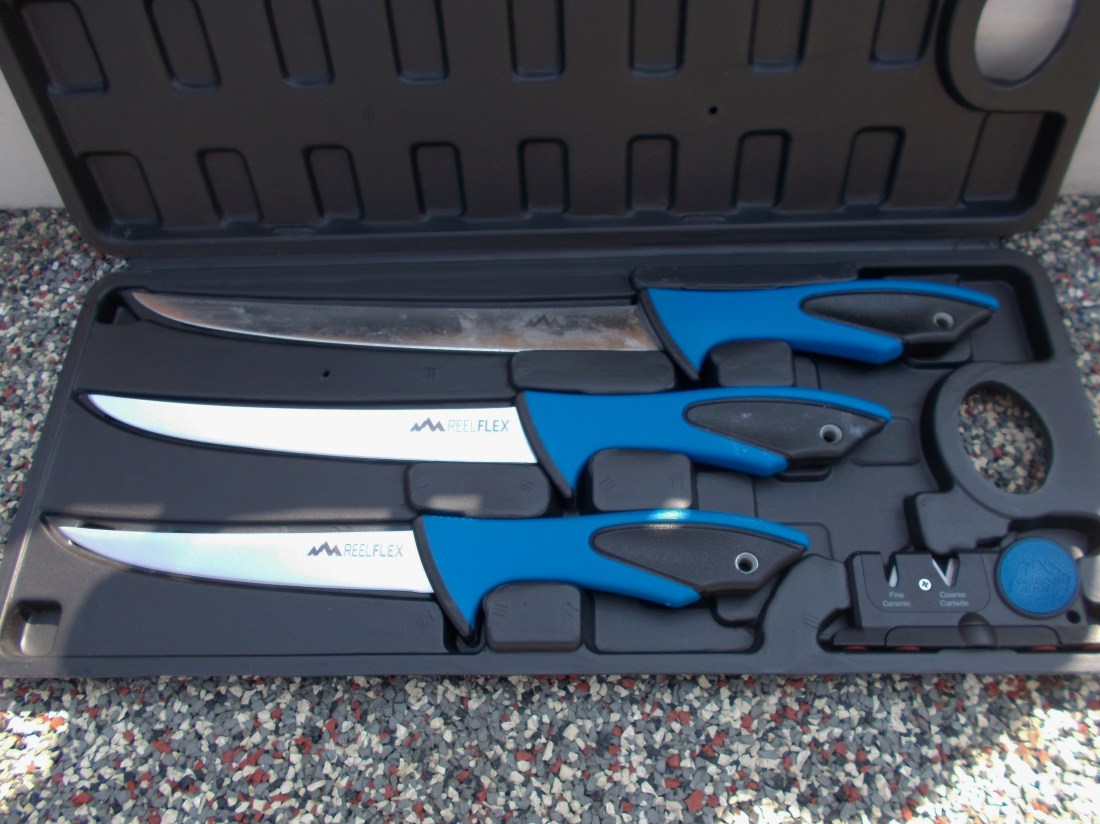
I have a new set of filet knives on my boat, thanks to Outdoor Edge. The handy carrying case contains one knife sporting a six-inch blade, a mid-sized, 7.5-incher and the Mac-Daddy has a 9.5 inch blade. The set is called the ReelFlex Pak and includes a simple, ceramic sharpening tool. Individual knives can be purchased separately.

The one I use the most is the 9.5-incher both because I am normally cutting up fairly good sized fish salmon, steelhead and lake trout and I prefer a longer knife rather than shorter. When I’m filleting panfish or smaller fish like walleyes or pike, I do use the smaller knives. If I could only select one I’d opt for the big-boy. I’d rather clean an 8-inch bluegill with a 9-inch knife than face a 20+ salmon with a 6-inch blade.

Reel-Flex knives have a rubber-like TPE handle for a secure grip and as their brand name suggests, the blades on these knives are more flexible than many other brands I’ve been used. How much flex a person needs in a filet knife blade is a combination of personal preference and what the person gets used to using.

Flex in a fillet knife is important. Try butchering a fish with a non-flexible butcher knife sometime and you’ll understand why better than I can describe. The flex helps the fish cleaner guide the knife up, down, in and out along the backbone and around fins – getting the maximum amount of meat off the skeleton. In my hand, the flexible blade really shines when skinning the filets, allowing the knife to slide easily between the meat and skin along the full length of the slab.

Individual knives and/or kits are available at retailers or on-line at http://www.outdooredge.com or amazon.com.

CASE TRIBAL LOCK KNIFE

CTL

REVIEWED BY CAPT. MIKE SCHOONVELD

Unless I’m flying on an airplane and subject to a TSA search, there will be a folding knife – a pocket knife – in my right hand pants pocket. Some people are wedded to their cell phone; I’m wedded to my pocket knife and have been since long before it became illegal to fly the friendly skies carrying a Barlow knife.

     I’ve actually owned several Barlow-style knives, a folding knife which dates back to the 1700s. George Washington carried one. Why not? It fit almost all the criteria I deem important.

     A pocket knife should be medium in size. A tiny penknife may fit the pocket more unobtrusively, but it’s going to be too small for many of the jobs I’ll ask it to perform. A big folding lock-back hunting knife will certainly fit in a pocket, but there’s a reason most come with a belt sheath. They are too big and may be oversized for delicate tasks.

      A pocket knife should have a pointy tip. These are “jack of all trades” tool and depending on the task at hand, a dagger-like tip may be as important as a sharp blade.
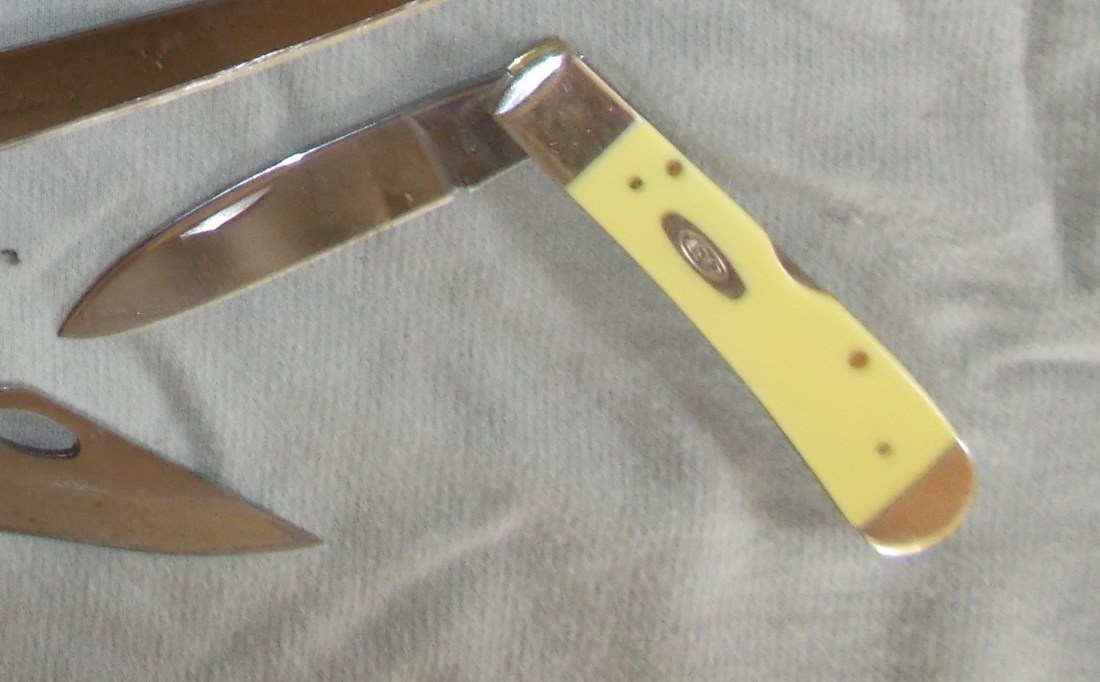
The knife in my pocket right now is a Case Tribal Lock. I chose it because of the above criteria and others. First, you can’t beat the quality. Case knives date back to 1889 and there are knives they made over a century ago, still in every day use.

     The CTL is a bit longer than other pocket knives I’ve used but it makes up for it by being thinner and less bulky since it’s a single blade model. I don’t notice it’s in my pocket unless I stick my hand in there to check for it.

     On my boat, the 3 plus inch blade is more appropriate for most of the chores it’s called to do. An example is the time I managed to snap the blade off the filet knife I was using and finished filleting a 20-pound king salmon with the pocket knife.

     The Tribal Lock is available in several handle types and colors. I chose the yellow synthetic handle for only one reason. It’s easily visible. Most of my past pocket knives became knives of the past because I used them, laid them down and walked away. Then they walked away (or were helped.)

      I do like the fact the Tribal Lock has a blade that locks open. I like more the “unlocking” procedure is simple and easy. I’ve used non-locking folding knives hundreds of times with scant few incidents or close calls, but with a blade as sharp as this knife has, the locking feature is welcome.

LUCAS HUB OIL

huboil

REVIEWED BY CAPT. MIKE SCHOONVELD

      It’s 55 miles from my house to the marina’s I normally fish. That’s 110 miles each time I go fishing and I average 100 days on the lake every year. Do the math. That’s 11,000 miles put on my boat trailer every year, not counting one or two “road” trips to far distant ports or even other Great Lakes.

That also means dunking my trailer’s wheel hubs into the lake 200 times per season as I launch and load. By most measures, that’s significant use. By some measures, that’s a decade or even lifetime of use.

I’m no stranger to burned-out wheel bearings. Usually, I find them in routine checks at home or in the marina parking lot. I have found them on the road when a driver pulls up next to me, honking and pointing back to where smoke is rolling out of a failing hub.
I’ve tried any number of bearing protectors, lubrication systems, types of grease and maintenance schedules. Most worked to a degree, but rising above the rest in both reliability and ease of maintenance is oil bath hubs, often used on long haul trailers that put as many miles in a month as I do in a year.

The first oil bath hubs I used on my trailer used 80/90 weight gear lube, the same weight of oil used in marine lower units and outdrives. Now I use Lucas Hub Oil, a heavy weight, somewhat sticky oil specifically formulated for use in oil bath wheel hubs.

Knock on wood, my wheel bearing problems have dropped to zero since I switched to Lucas Hub Oil two years ago. It works! That’s all I ask.

PLANO TACKLE BAG

planobag2

REVIEWED BY CAPT. MIKE SCHOONVELD

        I’m envious when I get on a Great Lake fishing boat with plenty of storage space. My boat doesn’t have it. Once I get past the mandatory items such as PFDs, emergency gear and standard tools, I have to be choosy about what lures and other tackle I tote along for each trip.

I’ve tried bringing huge tackle boxes, I’ve tried bunches of smaller boxes and used other schemes to make sure I have the things I need each day without overly cluttering up the boat or overtaxing the storage compartments I do have. Nothing has come close to being a perfect system so much as putting my lures, terminal tackle and other items in Plano 3700 Series Stowaway containers.

I have one box with coho baits, another with spoons, another with deep divers for when I’m trolling at Lake Erie. There are other with stick-baits, J-Plugs, trolling flies, saltwater jigs; one with hot orange spoons and plugs used when the steelhead are stacked just offshore and…. Just say, I’ve got a lot of them – even one loaded with bobbers and small hooks I grab when I need to take a youngster to a nearby farm pond.

So now all I need is pick the appropriate boxes of lures or supplies I’ll need on any particular day and take just them, not the whole collection. I have what I need, the rest wait at home for next time.

Instead of organizing and sorting through entire boxes of gear, all I need to do is contain the few Stowaway boxes I choose for the particular day. That’s easy? The Plano Guide Series Tackle Bag (3700) is the mack-daddy of these Stowaway box totes.

I can slide five of the standard thickness 3700 Stowaways inside the bag. Need one more? A sixth one nestles perfectly onto the plastic top lid and there’s a stretchy cord you can pull across it to hold it in place.

The outside of the bag has a both open and zipper-close pouches for tools, cameras, glasses, Kleenex (when my wife it along) and other necessary items, either packed loose or in smaller Stowaway boxes. With the adjustable shoulder strap, it’s the perfect grab and go container for a day or week on the water. The canvas and leather bag is widely available in retail stores. http://www.planomolding.com.

ACURITE WEATHER INSTRUMENT

weather3

REVIEWED BY CAPT. MIKE SCHOONVELD

     How fast is the wind blowing? How much rain fell last night or in the past several days? Is the barometer rising or falling? What’s the temperature or wind chill? These and other questions are all things I often need to know before heading out on the lake. Each one can determine where, how or even if I can get out to fish.

It’s all information I can pull up on my computer or smartphone, but how local is it? The information posted on weather sites is seldom taken from readings on or near the lake front. Most of the reporting stations are located a few miles (or even dozens of miles) away from the lake and any Great Lake angler knows conditions are usually different at the lake than inland.

On the theory any job worth doing is worth doing yourself, Bass Pro Shops has licensed a 5 in 1 Weather Center from AcuRite. (I don’t know why they call it 5 in 1 since it reports and displays over a dozen weather details.)

Rather than just reading and recording info gathered in some far off location, it has it’s own weather instrument apparatus you mount outdoors, up to 100 yards away from the receiver. On site details such as wind-speed, direction, temperature, rainfall amounts, barometer and others – the details I need to know at the lake – all show up on the bright, colorful display. The indoor display also reads some “indoor” weather, such as temperature and humidity. (www.basspro.com)

PIRANHA PROPELLER

piranha1REVIEWED BY CAPT. MIKE SCHOONVELD

      This is an idea which is either really revolutionary or completely useless. Which side you fall on depends on how and where you use your boat.

      Most outboards and sterndrive boats come factory equipped with an aluminum propeller. They work pretty good and aren’t priced as though they are gold plated when compared to stainless steel propellers. Aluminum props have one side benefit or drawback (again depending on how and where you use the boat). Aluminum is a much softer metal than the stainless steel from which propeller shafts are made.

      The drawback? Hit a rock, a good hard tree stump or the concrete on a boat ramp with an aluminum prop and the propeller will show it. If you are lucky, one or more of the blades will be slightly bent; less lucky, one or more of the blades will be chipped; even less lucky and there will be chunks missing from the blades and the prop so out of balance you’ll be lucky to be able to run the boat at much more than idle speed.

     The good news is it’s highly unlikely the prop-shaft on your lower unit will be broken. The relative soft aluminum will chip or bend  long before the shaft will be damaged.  An aluminum propeller can be repaired or replaced for much less than the cost of replacing the propeller shaft.

     A popular alternative for people who operate in areas where whanging a boat’s propellor into a rock, stump or other obstruction is commonplace is to swap the aluminum propeller for a stainless steel model. These don’t come cheap but the stainless blades will definitely stand up to much more abuse than those on an aluminum prop.

     Being tough and strong is fine until the blade impacts something so hard (or so often) the propeller shaft gets twisted or breaks – or perhaps some other gear explodes up inside that mystical box called the lower unit. I ruined many aluminum props until I switched to stainless and have broken broken prop shafts and gears since switching to a stainless steel propeller. Here comes the Piranha Propellor.

     The Piranha looks as though it’s made of black plastic, but it’s actually made of a a hard, composite material, so only partially plastic, partially resin, partially who knows? The hub part of the propeller is actually made of an aluminum core, over molded with their resin/plastic/ composite material. The hub guaranteed for life.

      The hub is guaranteed to never break because the blades will. Whang into a stump, floating log, submerged rock or some other hard object and the composite blades will break off. Here’s the deal, however. The composite blades are easily replaceable and only cost $10 each, give or take a buck depending on the size. Hit something hard? Tilt up the motor and in a couple minutes, the damaged/broken blade or blades can be swapped out and everything down there is good as new.

      I installed one on my boat and took it out for a test. I noticed no difference in performance between the Piranha Prop and the stainless steel propeller I normally use. Available in three and four blade models for motors from six to 280 horsepower. Check out http://www.piranha.com for prices, dealers and on-line retailers.

NORTHERN KING SPOONS

nk


REVIEWED BY CAPT. MIKE SCHOONVELD

They are back – almost from the grave. In the middle 1980s, primarily on Lake Ontario but with a solid presence on the other Great Lakes, Northern King spoons were solid producers, if not the overwhelming favorite of many salmon and trout anglers. When owner/creator of Northern King Spoons, Patsy Distaffen died, the company faded to near non-existence. Now they are coming back – solidly so on the north of the border portions of the Great Lakes, but increasingly, here on the U.S. side as well.

     The venerable Len Thompson Company, a maker of “Canadian” pike spoons since the 1930s, purchased the Northern King company – most importantly, they now own the Northern King dies used to stamp out the spoon blanks. Many believe Patsy’s dies produce a spoon with just enough realism to make just enough difference in the eyes of a hungry salmon or steelhead to get them to bite when they would pass on other brands.

     Many other fans of Northern Kings say it’s the genuine silver finish on the spoons that makes the difference. To humans, in direct sunlight, there’s not much difference between the flash off a polished chrome or nickel spoon and a polished silver spoon. Underwater, there is a difference and the fish can see that difference as easily as a woman can tell the difference between a real diamond and one made of cubic zirconium.

     They are available in three sizes, the NK 28 is a standard 3 3/4 inches, the NK 4-D is just under 4 inches (a great size for steelhead) but thinner and with a different action completely. The NK MAG is the 4 3/4 inch “king-killer.”

They are not (yet) available in an amazing array of color patterns, but I don’t detract from them for that. Many companies produce a dizzying number of patterns and anyone who thinks a fish cares much about whether or not the spots on the lure are round or oval or if the orange highlight stripe is 1/4 inch wide or 3/16s pays more attention to those details than I do (and most fish, I believe).

They do come in nice selection of standard and UV as well as extended glow patterns. The first fish I caught on my “new” NKs was on an orange-monkey-puke, NK 28, the venerable double orange crush proved as deadly on steelhead as ever and the UV Mixed Veggies gets bit by any species that comes close to it.

     Northern King is becoming increasingly available in Great Lakes tackle shops here stateside. The biggest on-line seller when this review was written was http://www.fishusa.com. Take a peek at all their colors at http://www.nklures.com.

ABU GARCIA REVO X

revo

REVIEWED BY CAPT. MIKE SCHOONVELD

     Are you looking for a medium light spinning reel perfect for bass, walleye or most any other species you’d normally fish with 8 or 10 pound line? Do you want the reel to last forever, and man-up when a fish you would normally fish for with 17 or 20 pound line mistakenly bites your bass or walleye lure? Do you want one that handles like a reel twice the price and is comfortable to fish all day with braid, mono or fluorocarbon line.
That’s exactly what I was handed one of the days I spent fishing the lower Niagara River earlier this year. Using the medium sized Revo X, we were targeting smallmouth, but the smelt run was on and lake trout were on the prowl in the river at the same time.

When my rod slammed down with noticeably more force than the smallies normally made, the importance of a reel capable of manning-up became paramount. The matching Abu Veritas rod added little to the fight once the rod bent double. It was 90% reel, 5% rod and 5% just hanging on long enough to winch those middle teen trout close enough to swoop a net under them in the tricky currents of the big river.

If you fish a place where something far larger than your target species could occasionally end up on your line – perhaps a sturgeon in the Rainy River, a musky in Sturgeon Bay, a 20 pound sheephead in Lake Erie and you need a reel perfectly suited to the species you are after and reserve toughness to handle any unexpected job, the Revo X (available in three sizes) will be up to the task.

FISH FIGHTER DOWNRIGGER WEIGHT


weight

REVIEWED BY CAPTAIN MIKE SCHOONVELD


    Would you pay $85 for a downrigger weight? Not me. That’s about twice the price DRWs cost at most retail outlets. But the $85 price point isn’t that out of line for a Fish Fighter weight when you consider the big-bucks “canon ball” does the work of two or more weights and comes with unique features not found on most other weights.

    When I used manual crank downriggers on my boat, I had ‘rigger weights of various sizes to use, depending on how deep I needed to fish. No sense in hand-winching up a 12-pounder if I was only lowering it 15 to 25 feet. An eight-pound weight would work at that depth without having an excessive blow-back. Even now, with a set of electric ‘riggers at the back of my boat, I use smaller weights when I’m fishing shallower and heavyweights when I’d putting ‘em down, way down.

The Fish Fighters work on the same principle as a set of adjustable weight barbells. The “weight” part of the weight are thin, steel plates a downrigger user can add or subtract to the sides of the devise to vary the total poundage, like adding additional weight disks on a barbell. The one I sampled could bulk-up in incremental steps from one to 14 pounds.

    The individual side plate weights bolt to the sides of a thin, stainless steel center plate. Each weight comes with two detachable tail fins, one is straight for the riggers on the stern to keep the weights tracking straight, the other is bent ten-degrees to become a rudder which sways the weight to the left or right adding a few feet (or several feet on deep sets) of spread to the lures positioned on the out-downs.

    When changing the weight, leave the polished steel outer side plate in place if you like a flashy ‘rigger weight. Take it off if you just want a black, stealthy weight. http://www.fishfighterproducts.com.