CHURCH TACKLE REVELATORS

Revelators

Reviewed by:  CAPTAIN MIKE SCHOONVELD

No one knows for sure what’s going through the mind of a salmon when it sees a fly, hootchy or other lure trailing along through the water behind a dodger or flasher. My guess is they see the flash and color of the attractor and think it’s the flash reflecting off the flank of another fish as it is feeding. If there’s food for one, maybe there’s food for two. Then the fish spots the lure behind the flash and nabs it, thinking it’s the baitfish the other fish missed or another baitfish in the school.

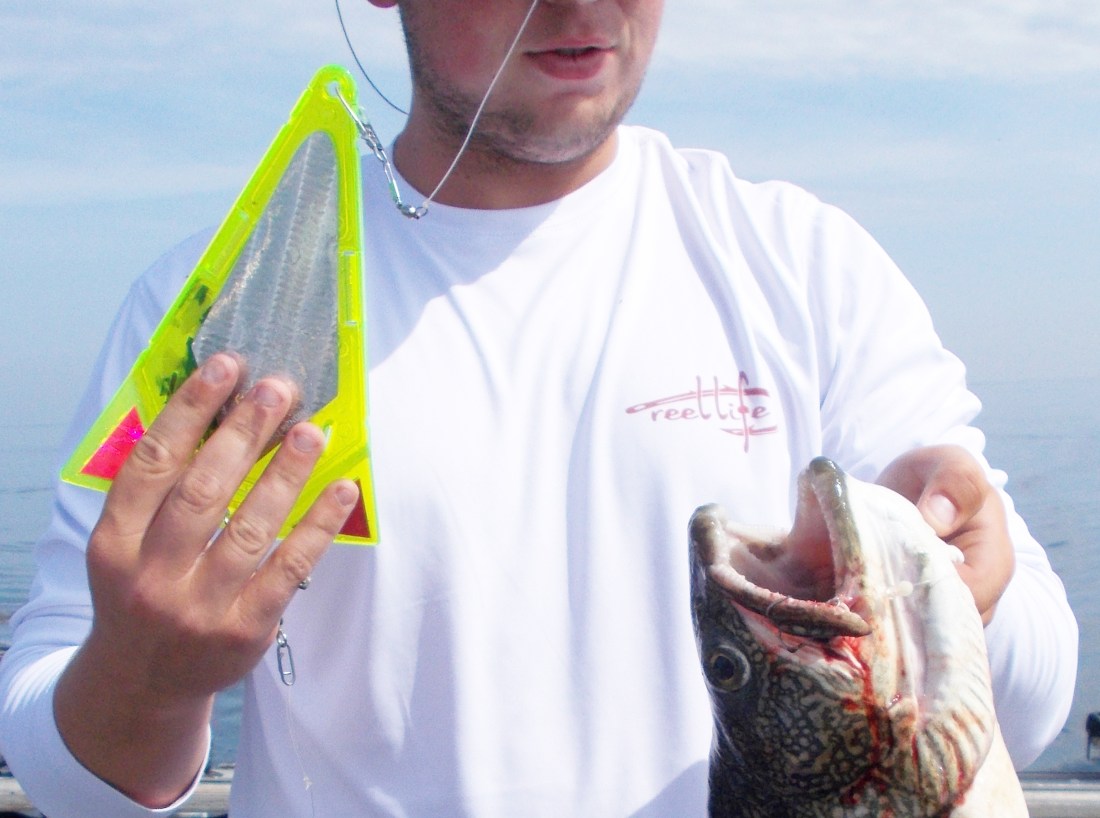
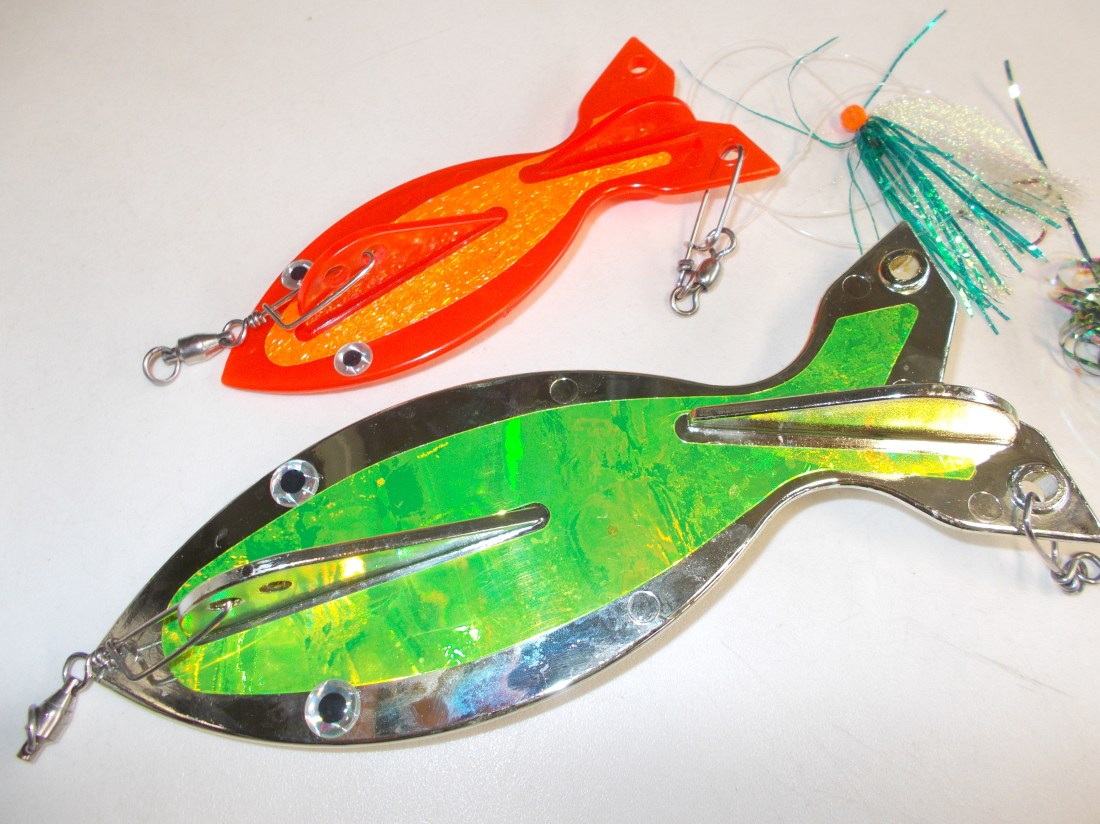
I’m probably over-thinking the ability of a salmon or trout to think, but if there’s a modicum of truth in my theory, I guess there was a modicum of reason when Dreamweaver decided to make their version of the plastic flasher (the Spin Doctor) into a cartoonish-looking fish shape. Cartoon or not, the Spin Doctor was a winner and soon other lure makers doctored up their own versions of the plastic rotating flasher.

Among those are the Revelators from Church Tackle. I had the chance to try out a few Revelators earlier this summer. (Actually, I’m still “trying” them as they’ve remained a solid choice the rest of the summer. )

The Revelators come in two lengths – 5 3/4 and 8-inchers. As with most flashers there’s a choice of plastic color for the blade – red, white, blue, chartreuse, black, chrome, gold, purple, copper and green. Of course each color of blade can be ordered with a dizzying number of reflective tape choices applied to each side. You’ll have to go to their website, http://www.churchtackle.com to see all the combinations.

I had no doubt the 8-inchers would match up well with other brands of flashers when I used them to pull full-sized flies for summer salmon and the occasional suspended laker. I was right. They performed flawlessly and many days I put one out at the beginning of the trip and it did it’s thing right on to quitting time. My best were chartreuse blades with silver tape patterns. Go with what works in your area.

When it came to testing the 5 3/4-nchers, I was a skeptic. Tens of thousands of cohos are caught using 6-inch metal dodgers trailing mini-sized flies every summer in southern Lake Michigan. Most of these are caught on the fluorescent red/orange models so I got the red shorty Reveleators with orange tape. At least I had the right color.

The 5 3/4-inch Revelators produced right along side my regular dodgers and flies each time I tied one on. I usually ran it behind a Dipsey Diver. The fun thing about lure testing comes when “further testing is needed.” The only thing more fun than testing lures is reeling in the fish they catch.

If anything, the Revelators shape is closer to the shape of a real fish than the other fishy-looking flashers available. If you think that makes a difference, you may or may not be over-thinking what’s going through the fish’s head when it strikes.

Available a many retailers and online sources or buy direct at: http://www.churchtackle.com

TROPHY HAUL LANDING NET by FRABILL

FraNet


Reviewed by: CAPTAIN MIKE SCHOONVELD

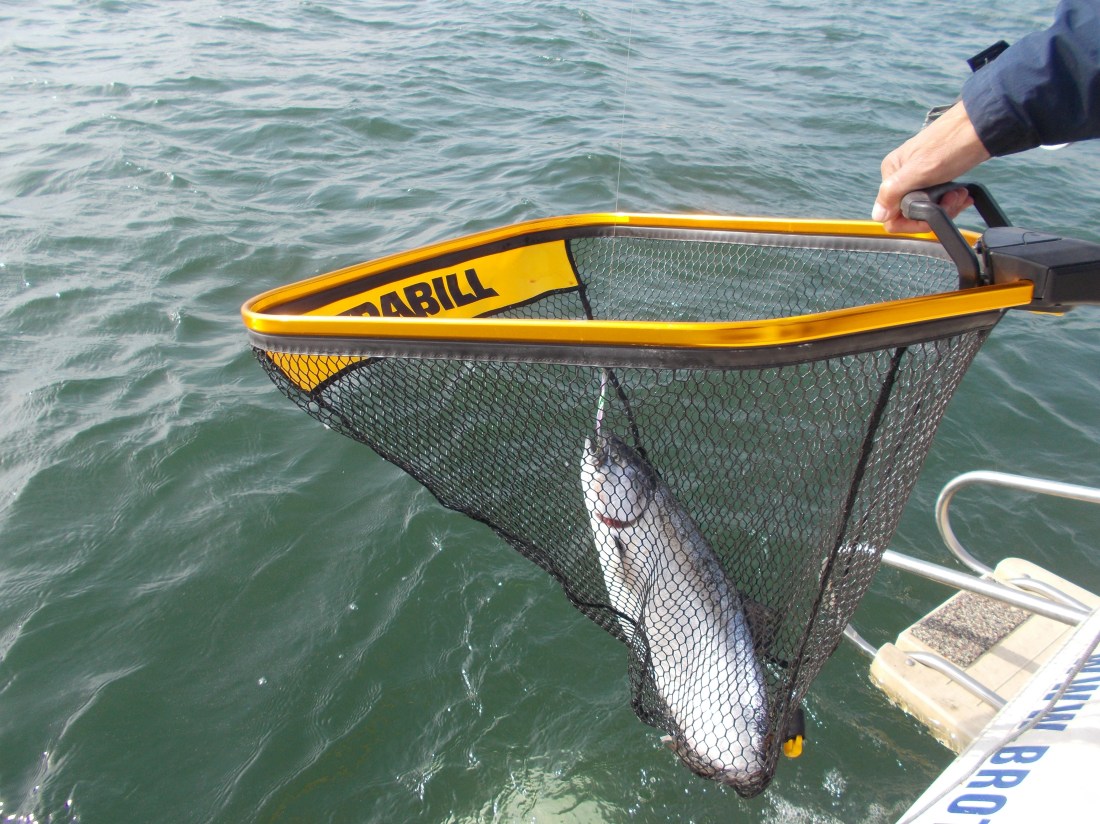
Fishing nets are one of the most underrated and overlooked pieces of gear in an angler’s arsenal. A net can make or break a day and be the difference between winning and losing a big tournament. Frabill’s new line of Trophy Haul nets, help anglers get the job done, get the fish in the net, get both fish and net into the boat and then get the fish and lure out of the net.

Frabill’s new advanced series of nets come in three variants, the Standard Trophy Haul, the Power Extend, and the Bear Claw. Constructed from anodized stainless steel each variation is built tough and made to withstand use in both fresh and saltwater. I had the chance to try out the Power Extend model with the large-enough-for-Great Lakes 24″ X 27″ hoop size.

More and more Great Lakers are heading out in smaller version, trailerable boats. Net size matters when your boat has limited space for people and gear. One way these guys cope is by having a net with an extendable handle. Shrink it down to a few feet in length when not in use, slide the handle out to full length when needed.

If you can do it. Most have a little round button to push which often requires a tool of some sort to push far enough to allow the telescoping action to work. The worst ones have a round handle and trying to line up the hole in which the little buttons have to nestle is nearly impossible.

Power Extend means just that. Push a button (a man-sized, no-tool-needed button) and the spring loaded handle extends to full length from three to six feet. That’s long enough to get the net way back there to scoop out the biggest laker, salmon or walleye.

If that’s the fish you just scooped, perhaps you need two hands to lift it up over the transom and inside the boat. If so, you’ll appreciate the yoke handle built into the rear of the hoop which gives a convenient grab-with-both-hands gripping spot to hoist the beast up and over rod holders, ‘riggers or across the outboard motor.

Conventional net baskets are simply a long round bag made of string or rubber. Millions of fish have been scooped with these so why change? Because thousands of fish have made last second escapes when the deep net, trailing behind the rim of the net grabbed a hook and pulled it free before the fish was over the rim. The Frabill net isn’t just a deep round bag.

It’s made of Frabill’s patented conservation netting, as much a rubberized fabric as netting material. It’s designed to minimize the amount of slime removal and scratching of the fish’s skin a knotted net can inflict – very important if the fish is destined to be released. More important for Great Lakers is the shape of the bag, while deep, is only deep at the rear of the basket so when the net-weilder is reaching out for the fish, the bag isn’t trailing out past the rear hoop. The rubberized fabric makes hook removal from the net an easy chore, as well.

The net is widely available at retail and online merchandisers or check out: http://www.frabill.com.

SEAQUEST GLOW SPOONS

sq1

Reviewed by: CAPTAIN MIKE SCHOONVELD

Seaquest has been a popular brand of spoons mostly found on boats in southern Lake Michigan for more than a decade. Richard Holm makes each one individually and sells them online (www.seaquestlures.com) and at winter sports expos in Illinois, Indiana and Michigan. A few area tackle shops stock them, as well.

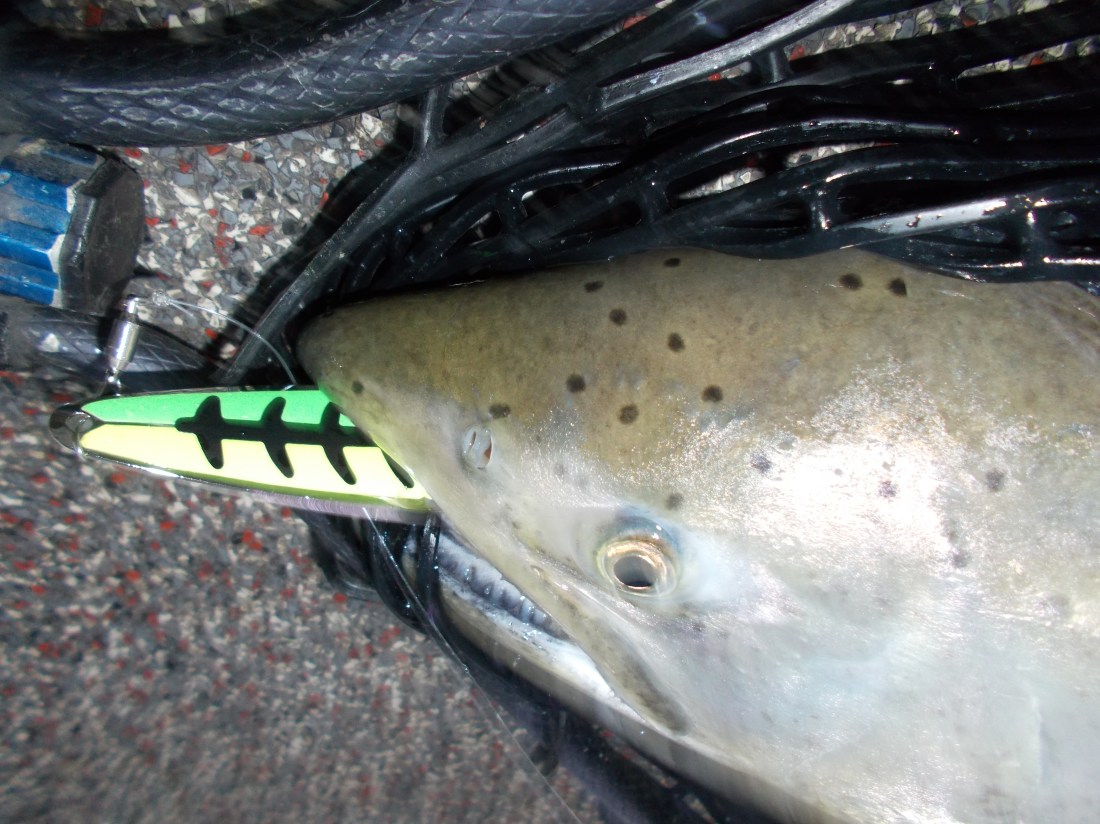
He’s always had a few models of standard and magnum-sized spoons with either glow-in the dark paint or scallop tape highlights. Now he has produced a line with extended glow body tape, adorned with either ladder backs or scallop diagonal highlights.

 
I like them because they catch fish and since Holm is a fisherman and no stranger to big fish, I know the hooks and rings are made of the finest quality. I keep telling him he needs to call them XTs for extra tough!

 
The new extended glow models were solid producers for me in the summer, offshore deepwater fishing where I usually fish, as well as near shore when fishing in the dark or dawn’s early light for staging kings. Check the Seaquest website for all the colors and patterns available.

TROLLBUDDY TROLLING PLATE

trollbuddy

Reviewed by CAPT. MIKE SCHOONVELD

When Brad Dupuie showed up with his 2019 826 Angler Qwest demo boat to fish my home waters a few days last April he had the new ‘toon outfitted with a few new options not available on the previous version. (See “‘Toon in to Great Lakes Fishing” in the last December/January issue of GLA). Among the new details was a 300 HP Suzuki four-stroke fitted with a TrollBuddy Electronic Trolling Plate.

As a long time trolling plate user, I was interested. Each of my last three boats were fitted with Happy Trollers to enable me to throttle down slow enough to fish sub 2MPH should I wish. Without the HT plate (and no other boat-slowing aid) these boats would only back down to about 2.5 MPH on a calm, windless day.

HT’s and other brands of trolling plates used on other boats I’ve been on, aren’t perfect. Most important, they have only two positions. They are up or down. When they flop down over the prop, baffling the forward thrust, the boat slows but then you have to adjust the throttle faster or slower to hit that perfect speed. Sometimes, depending on the boat, the throttle linkage, wind and waves, even that is a tough chore.

The TrollBuddy works the same, but different. It can certainly be positioned fully down or all the way up like any other troller, but it can also be positioned anywhere in between up and down, as well.

Here’s how we used it while fishing that morning. Our wind conditions were gentle, less than 10 MPH. Slow troll with the 300 HP at dead idle into the wind was an impressive 2.4 MPH with the TB all the way up. We found our best speed was about 2.7 so Brad nudged the throttle a little on our upwind troll. Once we turned back, the speed increased to over 3 MPH but instead of throttling back, Brad simply lowered the Trolling Buddy plate about a quarter of the way until the pontoon settled back to the trolling speed we needed.

Instead of the simple mechanical up or down most plates use, the Trolling Buddy has an electrically actuated piston (similar to what are on most trim tabs) which raises or lowers the flap. (The manufacturer has been in the trim tab business since 1997).

The Troll Buddy looks to be built tough as nails strong and has a one year warranty. The plate is heavier gauge metal than on my Happy Trollers.

The controller is designed to be mounted on the dash and operates with a simple on/off button, then by operating a rocker switch to move it up or down. There are two grades of switches, one has LED indicator lights showing the position of the plate. The other just has a simple up-down rocker switch.

As a final test we wanted to simulate how the TrollBuddy would work with a radically “too fast” boat such as happens with small boats with big engines which require a kicker motor or deploying trolling bags to hit reasonably low speeds. With the Trolling Buddy fully up, we nudged the throttle until we were moving at 3.8 MPH. That’s a fast troll anywhere on the Great Lakes. Then Brad gradually lowered the plate a quarter of the way, we slowed to 3 MPH, then moved it to half and we were down to 2.4. At full down, no change in engine RPM, we were putting along at 1.6.

There are certainly situations both walleye trollers and salmon chasers need precise trolling speeds for success. If that’s you, check out http://www.trollbuddy.com

BASS PRO SHOPS 100 MPH RAINSUIT

1004

Reviewed by: Capt. Mike Schoonveld

For almost two decades the Bass Pro 100 MPH rain parka and bibs have been the rain wear against which other brands of waterproof, breathable rain suits were compared. You’d never hear the PR people from Brand X or Y raincoat company say, “just as good as” or “better than,” but at boat ramps and weigh-ins on rainy days, you can often hear comments by rain-drenched anglers like “Thank goodness I had my 100 MPH suit” or more often, “I wish I’d paid a bit more and gotten a 100 MPH suit.”

Almost 20 years ago when BPS first put the 100 MPH logo on their top-of-the-line raingear, Great Lakes Angler magazine was a start-up publication and I started the Tackle and Toys column. One of the first items I featured was a Bass Pro 100 MPH Parka and Bibs.

This is the first time I’ve ever written a repeat review of the same product. But after almost 20 years of service, it was time to retire my original parka and bibs and get a replacement. Both my first bruised and abused 100-miler and my new, still shiny parka and bibs are constructed using genuine Gore-Tex membrane, the first-ever waterproof, breathable material. Liquid water won’t penetrate it, it’s porous to water vapor.

When Gore-Tex was invented, the W.L. Gore Corporation made the marketing decision to only supply their revolutionary membrane to manufacturers who would use it in combination with top-shelf products. You won’t find Gore-Tex membrane in a pair of twenty-dollar boots or a $19.95 rain jacket or even a $99 jacket. Just having a product with Gore-Tex in it is a testament of quality. Bass Pro’s 100 MPH Rain Parka and Bibs are quality.

I’ve proven it for myself. I’m not a few times a year user. I fish on rainy days, I fish many other days when there’s a chance of showers and you’ll find me on the lake wearing my 100 MPH gear every time I’m out in March, April and May – even on sunny days. When it rains, they keep me dry, when it’s not raining, I wear them as a top layer wind breaker. The Gore-Tex ensures I won’t feel clammy underneath.

I often wear them while ice fishing and they’ve been my top layer in Alaska, on all five Great Lakes and on both the Pacific Ocean and the Atlantic.

My originals are frayed around the cuffs and have some stains that will never come out. That’s not age, that’s patina. I expect my new 100 MPH version will look similar 20 years from now.

AMISH OUTFITTER’S LURE TUBES

flytubes Reviewed by: CAPT. MIKE SCHOONVELD

Amish Outfitters addressed the problem of lures becoming scratched up and dulled while stored in a tackle box from a unique angle. Their solution is to have an appropriately-sized, plastic cylinder-like bottles in which to put each lure when not in use, and then just having a Stowaway box full of these plastic containers.

When I saw these, three things jumped into my mind. Number one: I would never use these to store my plugs and crankbaits. I’m sure they work perfectly and for persnickety anglers who wouldn’t mind taking the time to insert their lures when storing them and uncorking another lure-tube to pick out its replacement, knock yourself out. I’d end up with a box of un-tubed lures and a bunch of missing or smashed bottles.

Number two: My box of stickbaits has probably three or four dozen in it. If they were all stored in tubes I can only fit 16 inside the same box. (This would be with the 7-inch tubes for big Reef Runners, J-13 Rapalas and most J-Plug type lures.) Sure, when I pull one out of my congested box, two or three come with it, but it takes less time to separate them than it would to put each one individually in it’s own tube.

Number three: The half-sized (3 1/2-inch) tubes flashed an entirely different picture in my admittedly left-brained mind. “Those would be perfect for storing trolling flies,” I thought. And I was right. Sure, even the short tubes take up space, but I can put 32 of them in a Plano 3700 Deep Stowaway box. The same box would hold maybe three times as many without the tubes. But with the leaders attached to the flies, even if I fastidiously rolled up the leaders and fastened them with twist-ties or something, when I’d pull out one, I’d pull out all or most of the others.

Need more flies than that? Poke two in each tube. They’ll come out tangled together, but sorting out a two-fly mess is simple compared to untangling a 15-fly disaster.

Sure it takes extra time to poke in a leader and shove the fly down inside the tube. That time is more than redeemed by not having to untangle three or four dozen flies stored in bulk.

Whether you are a right-brained perfectionist or a left-brained fly-piler like me. Amish Outfitters has some lure tubes for you. Each style can be purchased in plastic Stowaway type Caddies or sturdy, canvas zip-close bags with elastic bands inside to hold them in place. Check out http://www.amishoutfitters.com.


LURE LOCK STORAGE BOXES

Tak

Reviewed by:  CAPT. MIKE SCHOONVELD

When you get on my boat, you are going to see most of my lures tucked in Plano, Stowaway boxes. They are the perfect answer for me since I have limited on-board storage areas on my boat. I take the ones I’m likely to need and shelve the one’s I won’t need back home.

When I was at ICAST I noticed a company called Lure Lock had jumped into the tackle organizer business with versions of their own. At first look they appeared to be pretty much clones of Plano Stowaways and other brands.

Perhaps the latches were a bit different but were they better? The dividers you snap apart and insert to divide the inner compartments were green plastic instead of translucent – yippee! They do snap apart cleanly, but I never thought that to be an issue. Lure Lock does have some sturdy racks (they call lockers) to contain and store the boxes, but again, nothing I don’t already own.

I handed my business card to one of the reps at the booth and moved on. Surprisingly, a week or two later they shipped me a couple of their size-large boxes – sized the same as Plano 3700 Stowaways. A few days later I grabbed one of the Lure Lock boxes when I was reorganizing my on-board lures when transitioning from targeting offshore salmon and trout to nearshore, staging kings. This is when I noticed the GIANT difference between the Lure Lock box and all the others.

I dropped a J-13 Rapala into one of the slots then grabbed another lure. Then I reached in to slide the J-13 over to make room for the next and it didn’t move! What?

The bottom of the box is covered with a thin layer of   “Taklogic Technology” tacky-stuff – sort of what you’d expect if you poured a 1/16th inch of maple syrup in the bottom and let it sit out for a couple days. It’s sticky!

It’s not maple syrup. The TT-stuff is sticky, but not stick-to-the-lure sticky. I tried turning the box upside down and the J-13 did release from it’s own weight. I put it back in and pressed it in place and tried again. It stuck – even upside down. That’s not the TT’s purpose, however – to hold lures upside down.

The purpose is to keep lures from sliding around, bouncing around and tangling with neighboring lures under normal use – normal being a bouncing boat, being pulled in and out of a compartment or storage locker and loaded into an out of the boat as needed. I’m confident more of my lures turn from being bright, shiny, perfect looking lures to scuffed, scarred, dull and scratch-finished lures from riding in tackle boxes than get that way by being chewed up by fish. They get that way by being in a bouncing boat, being pulled out of a storage locker or loaded into or out of the boat.

Put it this way. Ever hear the lures in one of your tackle boxes rattling when you are moving it? They are being damaged and you know it.

No, the TT stuff isn’t sticky enough to peel the paint off of lures. No, the TT stuff doesn’t make the lures sticky. No, it doesn’t react to paint or plastic worms. If the TT stuff gets dirty or grimy, the Lure Lock people suggest washing it with soapy water or sticking it in a dishwasher. (Mine isn’t that dirty, yet.)

Nice, you think, but if you are like me and own a mountain of Stowaway boxes crammed with lures, you aren’t ready to junk them all to buy the Lure Lock versions. Just out, you can purchase retrofitting strips of the Taklogic stuff to stick in your existing boxes. These are called Retro Kits – duh! The kits, Lure Boxes and Lure Locker storage totes are available at retailers or online at http://www.lurelock.com.

FREEDOM TACKLE’S VEGAN LURES

cut1

Reviewed by:  CAPT. MIKE SCHOONVELD

What? Is there now a lure being made to catch vegetarian fish?   No – the Freedom Lures Herring Cutbait Trolling Lure is designed to simulate the spinning action a plastic meat head/herring filet has when it’s trolled – but no herring strips needed.

I would have been somewhat skeptical of this had it not been for a day I spent on Lake Ontario a few years ago. Capt. Danny had thin pieces of plastic cut into an elongated triangle shape in a variety of colors.

He told me, “We were really smacking the salmon on meat rigs one day and ran out of herring strips. I grabbed a strip of plastic, cut it to the shape of a herring strip and pinned it into the meat head. That day, the fish bit the meatless meat rigs just a well as they did the ones with the herring strips. I don’t use them every time, but occasionally, when the fish are keying more on the ‘action’ than the scent, the plastic strips work just as well, once in a while, even better than meatheads with real herring.”

I flashed back to that day on Lake Ontario when I ran into the Freedom Lures guys at the ICAST show last summer. They make a plug, called the Herring Cutbait, which has the same spinning action as a rotating meathead on a meat rig.

By the time I got some on my boat we were targeting bottom hugging lakers and pre-spawn chinooks so I stuck to the 5-inch versions. They are also available in a 3 1/2 inch model which (by the time you are reading this) will be in the game for cohos and steelhead on my boat. Both sizes come in a dozen time-proven chinook and trout colors, including UV and glow patterns. I may have to spice them up with some hot red lure tape accents to give them a boost for the ‘hos and ‘heads.

I ran the lures I sampled “clean,” with no flasher or other attractor ahead of them. The guys at Freedom Tackle said they do it both ways, with or without a flasher ahead of the plug. The Herring Cutbaits are packaged with a 40-pound leader and bead chain swivel. I had no problems just running them with a quality ball bearing swivel but they do spin, so be sure to use one or the other.

The Herring Cutbait Trolling Lures are available in some retail outlets and online. Check them all out at http://www.freedomlures.com.

LOWA BOOTS


LOWAboot

Reviewed by: CAPT. MIKE SCHOONVELD

When my wife retired, I gained a fishing partner. Previously, having her on board either on my boat or with me on trips to other locations was rare. That’s changed and it’s been a personal eye-opener to the Mars and Venus way men and women approach a day on the water when it comes to fishing apparel.

For me (Mars), comfort and function are paramount. A comfortable, tattered sweatshirt is perfect and if I don’t have to be overly concerned about getting fish blood it or other stains, it’s better. I wear a pair of warm, ugly, comfortable boots most days on the water and never give them a second thought.

For her (Venus), style trumps nearly every other factor. I’m confident she’d rather endure cold, wet feet in stylish boots than being caught in a pair of “clumpers” which would be warm and dry. I’m confident because she’s done it – more than once! Mars and Venus.

She spotted and tried on a pair of LOWA Locarno GTX boots at an outdoor writer’s meeting last September and gave them a double thumbs up. LOWA is a manufacturer of high end, climbing, hiking, often technically specific footwear, such as for mountaineering and other extreme sports. Made in Europe, each style is designed for function first, with special tread design and material on the soles, insulation levels, leather and/or fabric uppers and Gore-Tex waterproofing. Each pair is constructed to exacting standards with the highest quality materials available; yet at first glance, you’d guess they were made to look good more than work good.

A pair of Locarno GTX boots arrived on our doorstep a week or so after the meeting, thanks to a collaboration between myself and the LOWA representative. My plans to hide and save them as a Christmas gift were scuttled when Peggy saw the package. By Christmas the boots were already well broken in as well as well traveled. She’s comfortable wearing them when shopping, to social gatherings and they’ve passed muster on boats when we fished together over the winter.

LOWA makes both men’s and women’s boots. Check them out at http://www.lowaboots.com.


PLANO E-SERIES BACKPACK


ESeries

Reviewed by: CAPT. MIKE SCHOONVELD

When I was in school, if I saw someone walking with their gear in a backpack, I’d have guessed the person was in the scouts or perhaps was somehow associated with the military, probably marching home from the Dinosaur Wars. Of course, back then no one had been inventive enough to put wheels on suitcases.

These days, backpacks are the luggage of choice for many people, even replacing briefcases for corporate types. My kids certainly wore them to school everyday – from grade school on. There are probably more people stuffing backpacks into overhead bins on planes, these days than little suitcases with or without wheels.

In a feeble attempt to stay on the cutting edge, on the last flight I made, I left my wheel-less and wheeled carry-on luggage at home and strapped on a Plano E-Series Tackle Pack. It won’t be the last plane trip it makes.

This isn’t a travel magazine, however, it’s a fishing publication. E-Series Backpacks are made for fishermen and women. Though I pressed it into service as a luggage carry-on last winter for a Texas fishing trip; once there, it served as my day-pack when inshore fishing for redfish or offshore fishing for kingfish and red snappers.

It proved to be perfect for both flying and fishing. The pack has multiple compartments with sturdy zippers to organize and store important travel items. My flight info, car reservation documents, ID papers and others were all tucked safely where I could easily access them as needed. My laptop went in a large compartment, my cell phone in a small zipper-safe pocket. There’s space for snacks and mesh pockets on the outside for water or soda containers.

More important, these pockets and compartments did double duty when I was on the water, conveniently storing sunglasses, sunscreen, clippers and other essentials. There’s a handy shelf-like divider inside the main compartment which swings up and velcros in place. Above the shelf is room for a light jacket or other item. Below, up to five Plano 3600 Stowaway Boxes (included) will fit perfectly to organize lures, tackle and other gear. The E-Series is available at many brick or online retailers or at http://www.planomolding.com.