NORTHERN KING’S NEW COLORS

Reviewed by: CAPT. MIKE SCHOONVELD

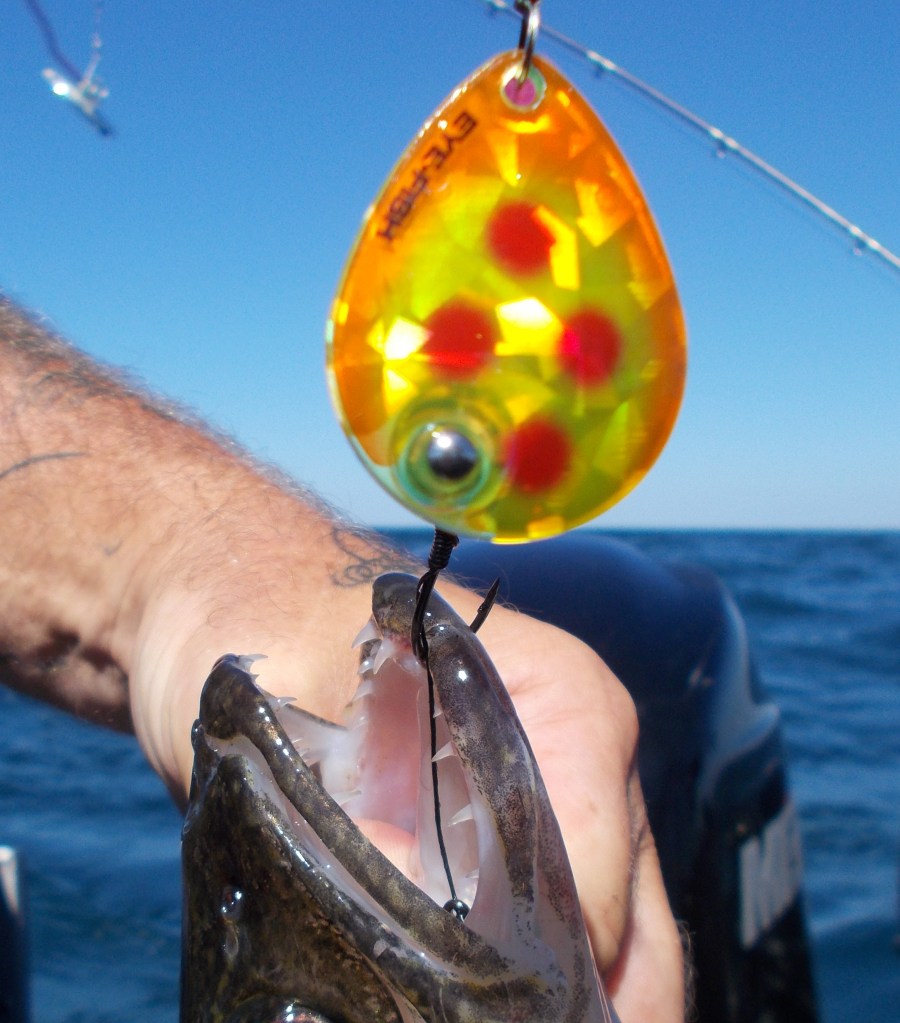
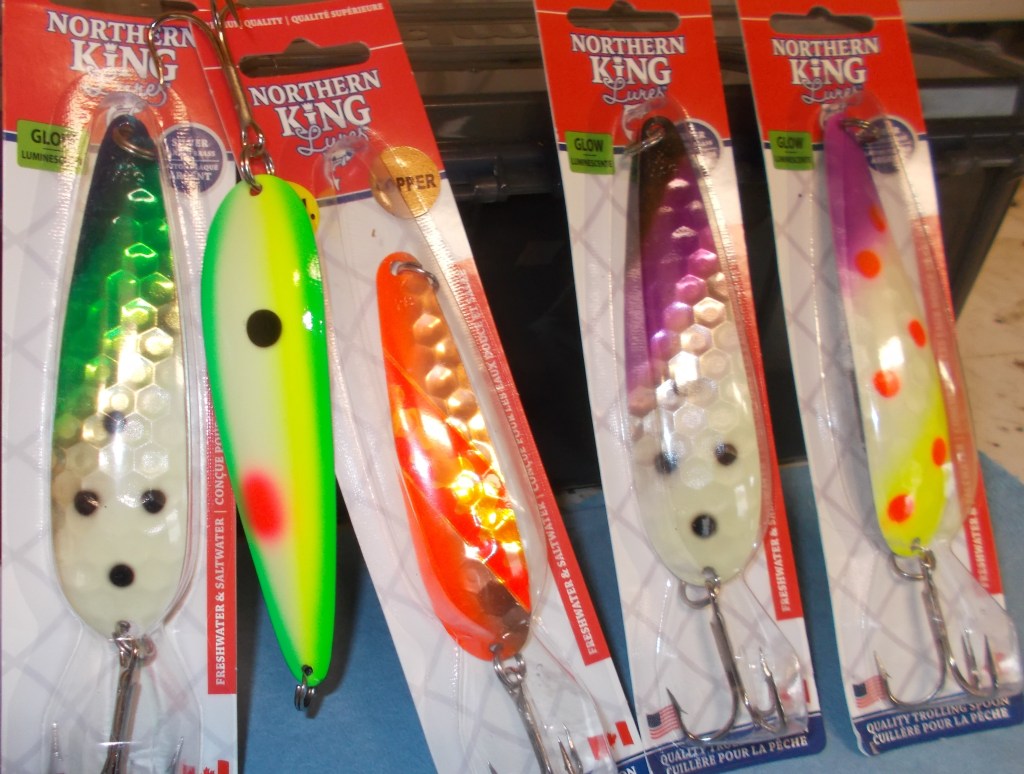
I’ve been using Northern King Spoons for salmon and trout as long as I can remember for one reason – when the fish are slurping spoons, my NK Magnums and NK 28s standard sizes – whack and stack with the best of them. I got some “advance copies of some of the “new for ’23 patterns” late last season and put them to use at the tag end of the season and for my early season fishing here in Indiana. Most of the newbies are either new super-glow patterns, UV – or both.

So far – the NK 28 Jerry Lee Copper has been a stud both for late ’22 steelheads and early ’23 cohos. I’m sure as the season progresses both sizes and all of the new patterns will have their share of winning days. 

Check them out at www.NKLures.com – and order some from their “USA store” on the website. Northern Kings are made in Canada so using the USA store eliminates delays in shipping when crossing the border. Many US online and retail outlets sell Northern Kings, as well. 

FROGG TOGGS APRON

Reviewed by: CAPT. MIKE SCHOONVELD

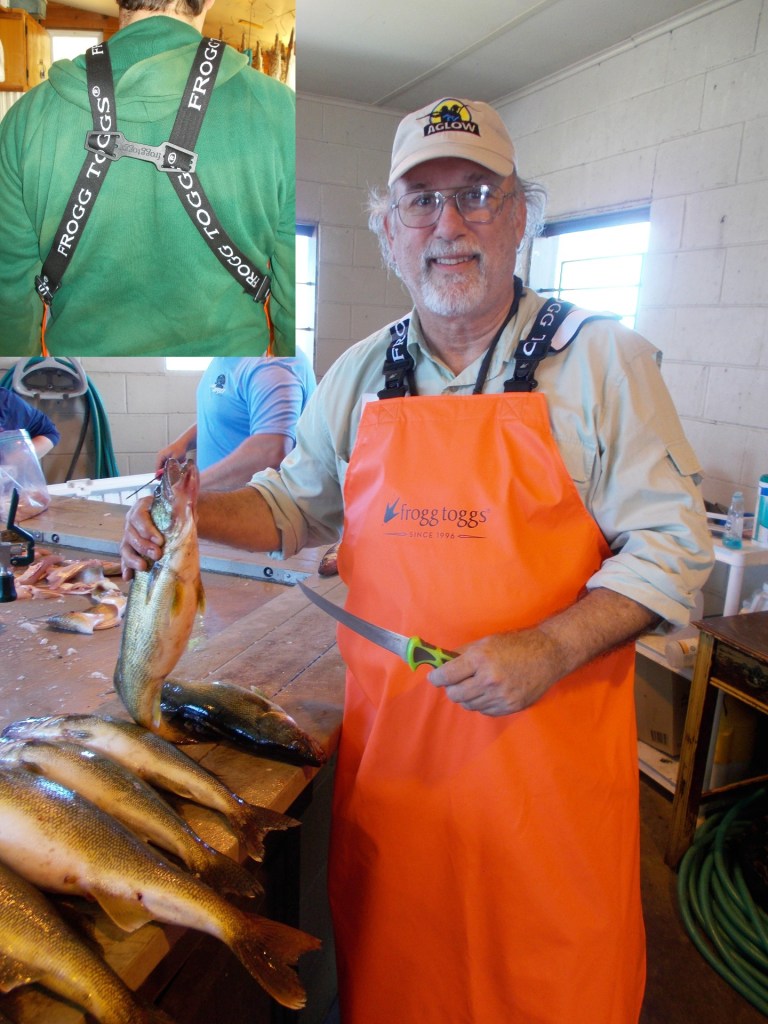
When it comes to rain gear, there’s no better choice than Frogg Toggs. They make wet-weather garb in quality and price points for every outdoor person. So when I spotted a Frogg Toggs Apron on a mannequin at the Frogg Toggs booth at last summer’s ICAST show, I flashed on all the miscellaneous slime and fish blood slopped on my “fishing” togs when I show up at home after a successful fishing trip.

I examined them closer. First, the apron is made from a thin, tough-feeling vinyl, not from any of the modern fabrics that go into most Frogg Toggs raingear, or from the paper-like material associated with the original FT rainwear. That’s good. The vinyl material is perfectly waterproof (and thus fish blood and slime proof) and nearly stainproof – at least fish blood won’t stain it. Just rinse it clean after being used.

Plastic or rubber aprons are widely available, but two things that separate the Frogg Toggs Apron from others I’ve used. The apron is long. When I’m cleaning fish, I’m as likely to slop blood and slime from the knees down as on my belly. I also like the “harness” system that supports the apron when it’s being worn. Most aprons have only a a non-adjustable string or strap that goes around the user’s neck and a tie-strap around the waist. The harness is more comfortable and, at least for me, snugs the apron where it needs to be snug while I’m using it.  

It’s available only in bright orange color (not a problem for me) at www.froggtoggs.com as well as other online and retail outlets.

LIVINGSTON LURES NEW COLORS

Reviewed by: CAPT. MIKE SCHOONVELD

A few years ago I took some of Livingston Lure’s “Walleye” models on a trip to Lake Erie and they almost instantly found a place in my “A-Team” line-up. The A-Team being the baits I tie on first and only reluctantly remove when the bite gets slow.

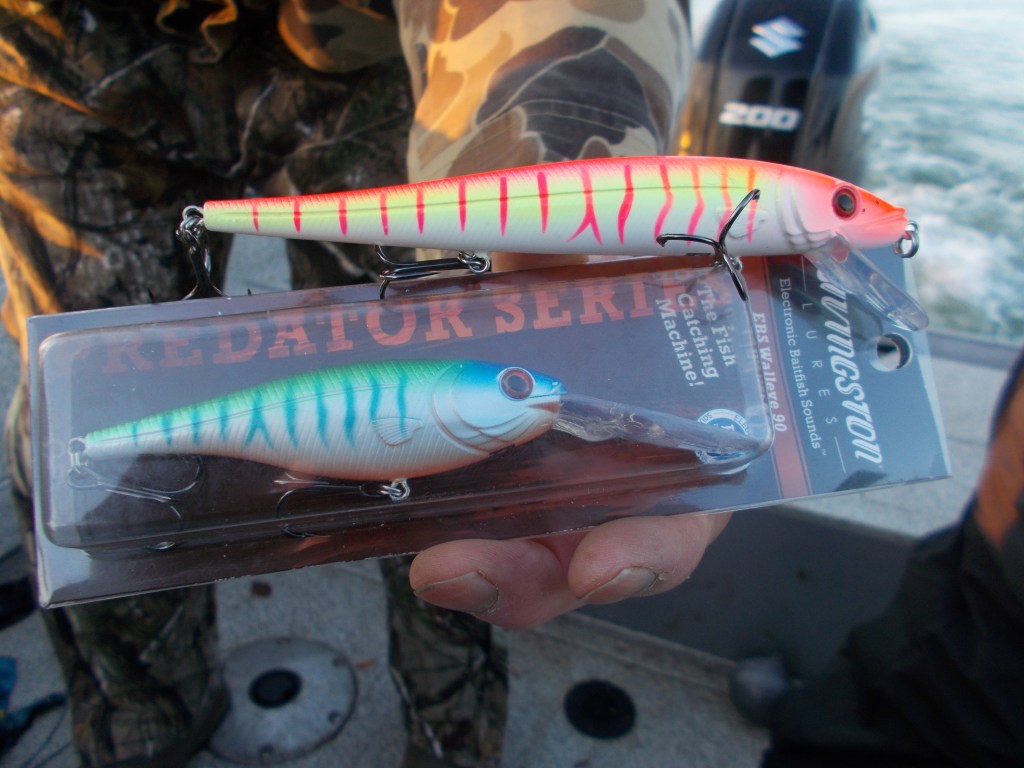
                Livingstons are well made, well balanced and well-sized for walleye trolling but have one main difference. Instead of weights or rattles inside the lure body to add a sound feature to the lure, they have what is called EBS technology and acronym for electric baitfish sound. It’s basically a tiny devise implanted inside the lure that emits sounds that mimic the “screams” of fleeing baitfish. Since then, my fishing friends and I just call those lures, the “screamers.”

                At last summer’s ICAST show Livingston showcased some new colors in their walleye series – Voyager 15 Walleye, EBS Walleye 111, EBS Walleye 90 and EBS Walleye 136. I had the chance to show some of these new colors to Lake Erie walleyes on late season trips last season.  The Pink Crush and the Blue Tiger colors were top producers on these trips. Check out these and all the great colors in Livingston’s walleye plugs at www.livingstonlures.com then give them a try. You’ll be screaming for more!   

ABU-GARCIA ROD RACK

Reviewed by: CAPT. MIKE SCHOONVELD

As the “producer” of the Basics and Beyond column in this magazine, one trend I’ve noticed is the number of tips about innovative ways GLA readers have concocted to store their rods when not in use. I doubt there is any type of angler who owns more fishing outfits than Great Lakes fishermen. Trollers often use a dozen or more at a time. If they switch from salmon/trout to walleyes and back, no doubt they don’t use many of the same combos for both. Add in some perch, maybe some jigging on the Detroit River or other Great Lakes tributaries with walleye runs, throw in a few spares, oldies, ice fishing outfits and pretty soon your garage will look like mine. No wonder I get tips from readers showing how to store rods on walls, garage doors, in stairwells, behind the refrigerator and elsewhere – the result of  DIY projects.

The rod array in my garage is one of those DIY builds. But let’s face it, not everyone has the time, tools or skills to complete one of these projects. If that’s you and your pile of on-deck rods is getting out of hand, consider the Rod or Combo Floor Rack made by Abu Garcia. Basically it’s a sturdy aluminum rack engineered to hold as many as 44 individual rods or a dozen or more rod and reel combos depending on the size and type of reels on the rods. With a bit of strategic positioning, I was able to stack 18 salmon/steelhead rod and reel outfits on the rack I put to the test. That’s pretty good in a rack about 30 inches long.             

The rods are easy to position – no straps or latches are needed to lock the rods in place. The individual slots that secure the rods are foam plastic lined so it holds them better but won’t scratch the rods. The upper and lower supports can be repositioned, say for ice fishing rods or ultra-light combos. My planer-board, downrigger and diver rods all fit nicely with the bottom support in the lowest position and the upper support in the highest. 

Check them out or purchase them at www.abugarcia.com  They are also available at some retail outlets or at other online sellers. 

(Actually, I’ve not gotten a tip about storing fishing rods behind the ‘fridge. If you do that or have an idea about doing it, send it to me at captain@bronature.com and get a one-year GLA subscription renewal.

WHITEWATER PACKABLE RAIN JACKET

Reviewed by: CAPT. MIKE SCHOONVELD

I always have a waterproof, breathable rainsuit on my boat. In the early, early spring, they are insulated and I’m probably wearing them as much as a windbreaker as for wet weather protection. Even on a warm day on the land, when water temperatures are only in the 40s, it’s going to be chilly on board, at best.

         Later in the season I may not leave the dock, suited up, but I still have a good set of raingear on board – either for unexpected showers or somedays for an outer windproof layer. Most days in the summer when the water is warm and the air temperature is unbearable, those multi-layer waterproof/breathable rainsuits are just plain too heavy to wear as a windbreaker or even when an unexpected shower happens to show up.

That’s when my Whitewater Packable Rain Jacket and Pants comes to the rescue. When it’s not rainy, the jacket and pants each pack into a small, grapefruit sized pouch – easy to store out of sight, out of mind. When needed, unstuff the packs and slip into the lightest-weight waterproof/breathable rainwear I’ve ever encountered.

 Check out (or purchase) the Packables and other Whitewater products at www.whitewaterfish.com. They are also available at Amazon, other online stores and in some retail outlets.

DOUBLE 3 LITER ELECTRIC DEEP FRYER

Reviews by: CAPT. MIKE SCHOONVELD

I don’t often start a product review in which I reveal the downside of a product before I tout the reasons to consider getting one for yourself. The downside of Chard Products’ Double Deep Fryer is it’s too powerful. Actually it’s not too powerful, it just takes a lot of power to make it work.

Unlike most single-basket electric fryers which have a 1200 watt heating element, or double-basket deep fryers that use a single 1800 watt element, each tank in the Chard fryer has a 1500 watt element.

That means on most home electrical circuits, if you plug each side into the same outlet, you’ll blow the fuse or trip the circuit breaker. I’m not an electrician, so I asked one. He said, “A 1500 watt appliance will draw up to 12.5 amps. Most home electrical circuits are 15A, so plug it in anywhere you want as long as there aren’t any or many other things drawing power from the same circuit. But if you plug two 1500 watt (12.5A) deep fryers into the same receptacle, ‘click’ off goes the circuit breaker.

The electrical code requires kitchens to have 20 amp circuits because the toasters, coffee makers and other appliances often require more energy. But even a 20A outlet won’ t handle this much of an amp load.”

I figured this out by trial and error when I set up the “Double Deep” on my deck for an early season fish fry. I solved the problem by plugging one side into the outlet on the deck and used a heavy extension cord to reach an indoor outlet in the house for the other side.

However, and this is however with a capital H, the power of the Chard Fryer is also a selling point. The secret to deep frying anything is to start with hot oil, then maintaining the heat in the oil to keep it hot when the fish, chicken or French fries are lowered into the cooker. Two things will do this, plenty of oil to begin with, and a powerful heating element that will kick in, when the oil temperature drops.

Each oil tank on the Chard unit will hold up to three liters (8/10s of a gallon) and the 1500W, in-tank heater quickly recharges the oil, even when a full basket of frozen fries are lowered into the tank. By the time what’s being cooked is golden brown and delicious, the fryer is ready for the next load and the thermostat will not allow the oil to overheat. The double tank system is great for those who don’t like to cook fries or tots in the same oil that fish has been fried in and it allows both the fish or chicken to finish simultaneously so everything can be plated while it’s still piping hot. 

Clean-up is a snap. I hand wash the removable heater/thermostat units, the tanks and baskets go into the dishwasher and the stainless steel frame wipes clean easily. Go to www.chardproducts.com for more information or to purchase. The Double 3 Liter Deep Fryer is available at other online or in-store locations including Amazon.com.

FISH BILLY BY BOONE

Reviews by: CAPT. MIKE SCHOONVELD

In truth, it sucks to be born a fish. If you are a little fish, something is going to eat you alive. Maybe it will be a quick grab and gulp, as bass would do to a shiner. One minute you are just minding your own business swimming along and the next second everything goes dark and slimy until – ouch – death by stomach acid!  Worse is a fish preyed upon by a toothy fish, like a pike or being cut in two by an even toothier fish like a barracuda.

A tiny percent of the fish in a lake end up being hooked by an angler, pulled from the water and tossed in a cooler of ice to get hypothermia and suffocate; perhaps dunked in a dark livewell for a period of time until removed to be cut into pieces or left to flop around or slowly suffocate while happy fisher-people take photos. Yep, a fish may live a happy life, but few of them have a peaceful end.

I don’t much worry over the plight of a fish, but I do have some empathy for their fate. Their path through this world is tough enough that I can’t blame them for one last attempt at retribution once an angler hauls them out of the water. Many of the fish seem bent on skewering the angler with the same hook that caught them in the first place, while others – the sharp toothed ones, especially – aren’t above inflicting damage to the people who caught them.

Grab a Billy club, people. I have one handy on my boat all the time and lately, I’ve been whacking the fish destined for the cooler with a handy, ball-bat shaped model sold by Boone Bait Company. Depending on the size and toothy-ness of the fish, some get sharp crack on the top of the head even before they are removed from the net. Others are dispatched once I have a “gill-grip” on them just before they are placed into the fish box. Either way, their demise is quicker than most of the other alternatives they faced. 

Though you might find a Boone Fish Billy in a saltwater tackle emporium, most Great Lakes people would do better picking one up from www.boonbait.com or some other online outlet. 

AL’S GOLDFISH FORTY NINER KITS

Reviewed by: CAPT. MIKE SCHOONVELD

If you’ve not used Al’s Forty Niner spoons for walleye trolling, you may be ignoring the most important change-up lure available. The Forty Niner has a unique shape that gives it an action different than any of the flutter-type spoons and that shape also gives these spoons more flash than most others. The multiple flat surfaces give a solid bright look at the finish and colors on these spoons.  A flipper tail on the hook hanger gives the fish one more reason to nab it.

Interested?  I was, but what color?  The base colors of silver, gold or copper are all winners depending on conditions and we all know that various color highlights or combinations are just as important.

What I did was cover as many of the options as possible by picking up a Forty Niner Trolling Kit which comes with spoons in all three metallic finishes and six different assortments of pre-cut prism stickers – all in a tough, Flambeau storage container. If one of the spoons gets hot, it’s easy to doctor one of the others in the kit to match it. 

Check out the kits at http://www.alsgoldfish.com – as well as other, painted Forty Niners and other All-American products including the original Goldfish spoon that’s been catching fish for almost 60 years.

FIN-NOR NORTH DROP SUNGLASSES

Reviewed by: CAPT. MIKE SCHOONVELD

In 1936 Fin-Nor revolutionized the saltwater fishing world by building the first fishing reel that could easily handle the biggest fish in the sea. It was a mix of quality materials, innovative design and attention to details. It’s the same mix that makes the Rolls Royce an automobile of the highest quality or Browning one of the best shotgun brands. These and other companies often add other products lines or allow their name to be affiliated with other products, but the top companies insist these other products measure up to the exacting standards that is their legacy.

So when Fin-Nor started producing sunglasses, I expected nothing less than the exceptional quality and performance I experienced the few times I’ve used Fin-Nor reels. They met my expectations.

I normally don’t get far into the weeds delving into the technology behind the products I review so much as how they perform for me as I use them in real fishing conditions. I study the tech, but I don’t dwell on it, other than how it affects performance. One of the attributes Fin Nor hypes is that the outside layer on both the front and back sides of the lenses are oleophobic and hydrophobic.

I know the word “hydrophobic.” Something that is hydrophobic “hates” or repels water. I expect most sunglasses will repel water. I looked up the definition of “oleophobic” in an online dictionary: Having a lack of affinity for oils. Most of the sunglasses I’ve owned seem to be “oleophilic” – their lenses attract grease and oils – mostly from finger smudges, I’ll admit – perhaps from sunscreen or insect repellent; often it just seems to accumulate from atmospheric oils, if there is such a thing.

I knew this when I put on my Fin Nor sunglasses and my immediate thought was, “I sure hope they live up to the hype.” The picture was crystal clear, almost like I’d cleaned the lenses in my eyes. I chose the green mirrored glass lenses in the grey North Drop frames. The mirrored lenses reflect both the direct sunrays, but also the rays that bounce off the lake’s surface. The green color comes from the mirror finish being applied over copper tinted glass. The copper (also available in non-mirror version) is good for inshore fishing when underwater visibility from the polarized lenses is important. The North Drop frames shield my eyes from light coming in from the sides, without looking like safety glasses. Rubberized nose-bridge and ear pieces help keep the glasses in place.

And they are oleophobic – mostly. Sure, if I grab the glasses by the lens immediately after smearing on some sunscreen, they’ll have an oily smudge. The grease and oil doesn’t just drip off, but in the course of a day, there’s no oily build up as I put on the glasses, take them off repeatedly for a variety of reasons. What’s there wipes off easily without getting out the Windex. There’s no build up of atmospheric “oleo” either.

I used these glasses daily on a late summer trip to the Pacific Northwest fishing out on the ocean. Those of you who have fished saltwater understand most sunglasses need to be cleaned with freshwater several times daily as they haze over from the salt-air. This didn’t happen with the Fin-Nor sunglasses.

Check out all the options and designs at www.fin-nor.com

This site also lists local retail outlets for in person shopping and there are numerous online shopping options.