YETI RAMBLER TUMBLER

yetirambler

REVIEWED BY CAPT. MIKE SCHOONVELD

            I’m a coffee drinker but years ago I gave up bringing a Thermos of java along with me when going fishing. I like hot coffee; I don’t particularly like almost hot coffee and I’ll spew cool or cold coffee like a novice sailor spews breakfast in choppy waves.

I’m a hands-on captain on my boat. When there’s a fish on, I’m at the stern. When there’s a fish to be netted, I’m wielding the net. When there’s a line to be set….

Chances are, the hot coffee I poured before the fish bit, the net deployed and the line reset is only spew-worthy swill by the time I get my next coffee break. Not with my Yeti Rambler Tumbler.

Previously, my insulated “go cup” was a promotional item I got at a Pheasant’s Forever banquet. It worked great in my truck on the way to the lake, but only had to do its job for five or 10 minutes in a heated cab.

Tired of my complaining, my wife purchased a stainless steel coffee-on-the-go cup for me as a Christmas gift. Her theory was if my stainless steel Thermos worked great, so would a SS coffee mug. Negatory!

The stainless Thermos is a vacuum bottle. The interior and exterior portions are separated by an airless void and with no air molecules to transfer the heat from the inner container to the outer, the coffee stays warm. The inner container and outer surface on the SS “gift” cup is just air-filled – just as my plastic Pheasants Forever freebie.

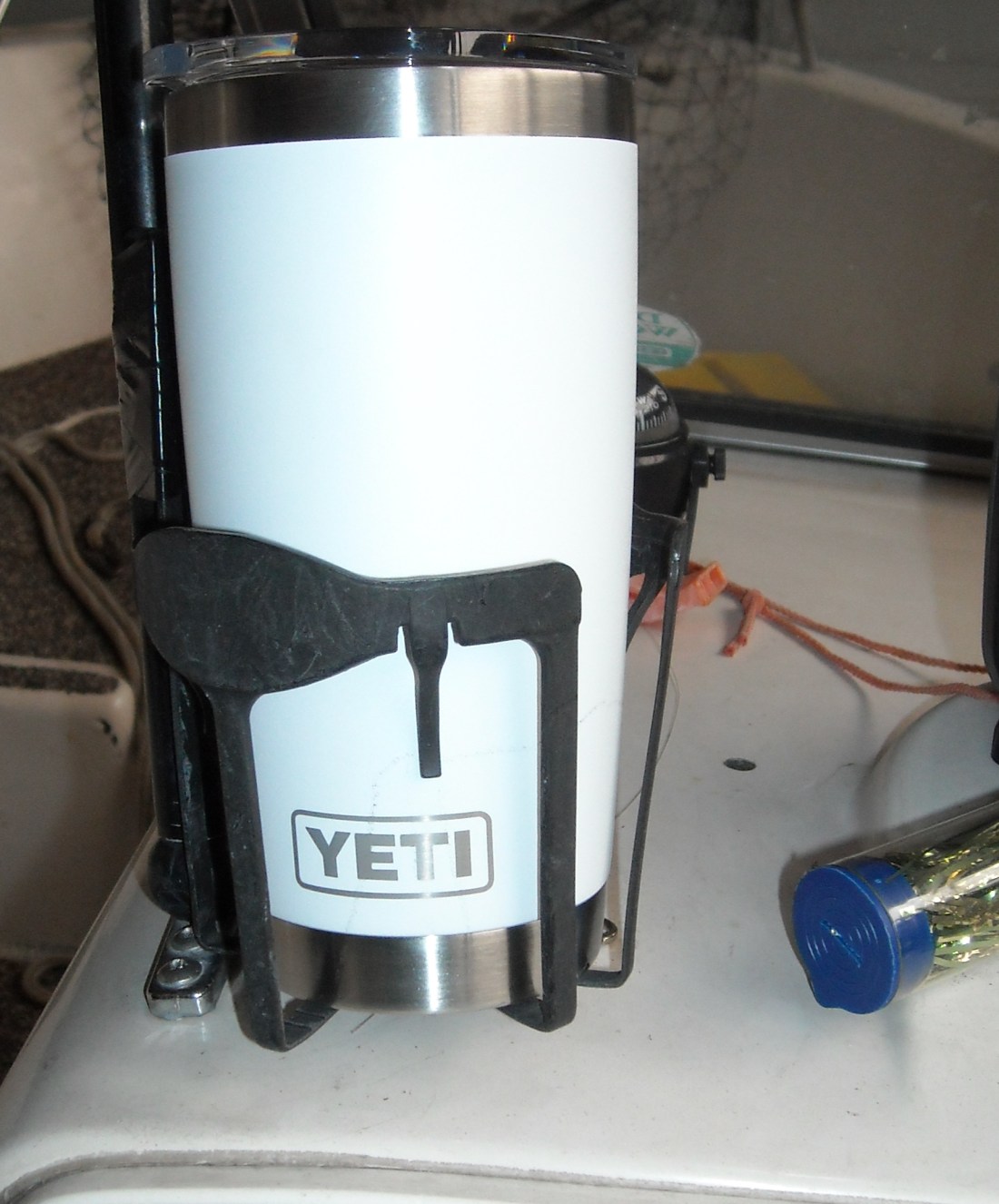
The YETI Rambler, however, like my Thermos, is vacuum sealed. The only place heat can escape is out through the lid, but the lid is substantial, fits tight and has a closeable sippy-hole. Will it keep my coffee hot indefinitely? Nope, but I can return to my coffee break after a fish-interruption, take a sip and remain spewless.

The Rambler Tumbler holds 20 ounces, comes in a variety of colors and is available at retail outlets or on-line at http://www.yeti.com. Check out Yeti’s online Custom Shop for products with nifty logos featuring hunting, fishing and other themes.
 

CHURCH FILET KNIFE

CFknife

REVIEWED BY: Capt. Mike Schoonveld

         I used to be a filet knife knucklehead. I owned only one medium sized (very sharp) filet knife and used it to turn anything from a tiny trout to a wicked tuna into boneless, serving sized fish flesh.

Last year I switched to a two-knife system for most of my fish cutting chores. I used a rechargeable electric knife to cut the filets off of the king salmon, steelhead, lake trout and walleyes I put on the cleaning table, then I switched to a manual blade to complete the boning and skinning process. I wish I’d made that switch years earlier. I was a knucklehead.

If I’d remained a knucklehead, when I saw Church Tackle’s “reinvention” of the filet knife I’d have laughed it off. With my new-found open mindedness about fish cleaning knives, I decided to give the Church Filet Knife a closer look.

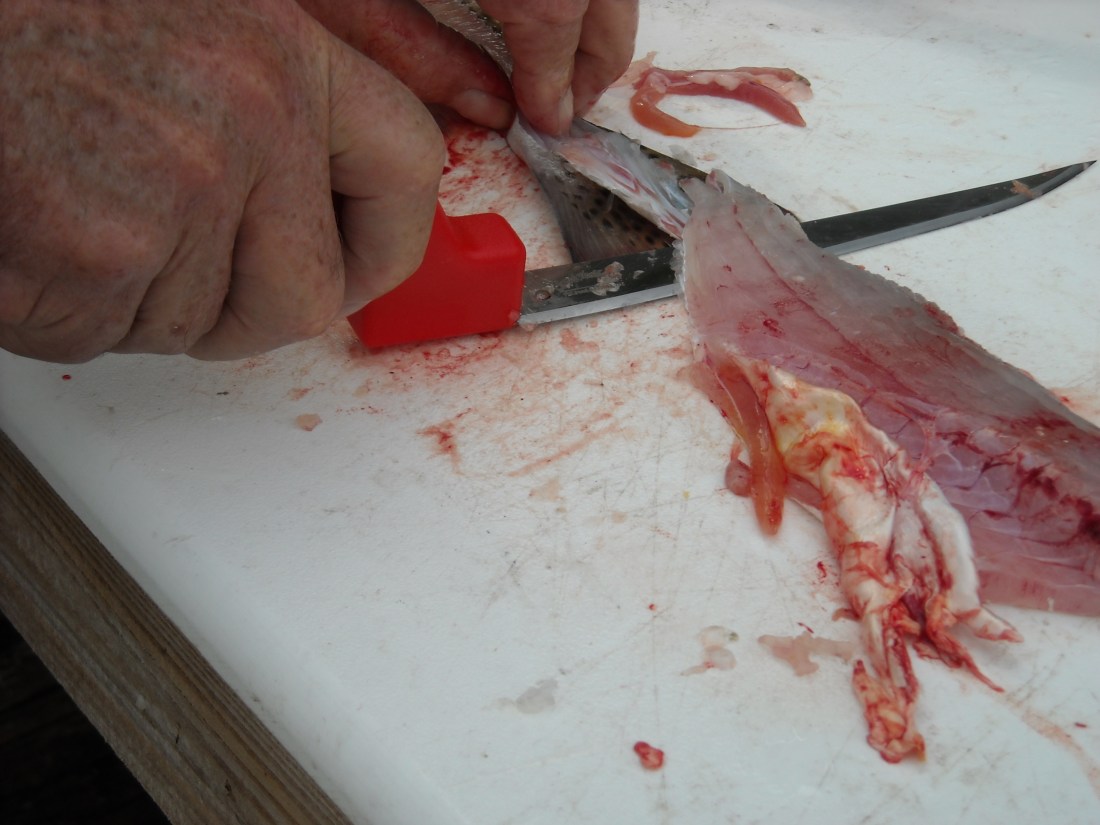
Now I realize not only was I a knucklehead, I was a knuckle-dragger. So are you, most likely when you filet small fish or remove the skin from any of your filets unless you move them to the edge of the filet table or cutting board. The Church Filet Knife should be named the Knuckle-Saver.

The handle is molded with an offset so when the blade is against the cutting board the knuckles on my hand aren’t dragging on the surface of the board. That’s different, but even more different is how the blade is turned 90 degrees from the direction every other knife is positioned. When the holding the knife, blade down on the cutting surface, knuckles positioned nicely above the slime and blood on the filet table, the blade is flat on the board. What sort of knucklehead wants that?

The truth is, for skinning a fish, the configuration of this knife is perfect – conventional knives, not so much. Sure, I’ve skinned thousands of perch, walleye, bluegills and other fish over the years with a normal knife by sliding the fish to the edge of the cutting board so I can get the knife blade parallel to the cutting surface, slice off the skin and not be a knuckle-dragger fish skinner. I’ve also cleaned up buckets full of fish garbage from the floor of the fish cleaning station where it dripped off the edge of the table while cutting and skinning my filets.

One more departure from normal is the knuckle-knife is only honed sharp on one side (the top side), much like you should sharpen mower blades. When skinning a fish, that ensures the blade cuts razor close to the skin, less likely to slice through the skin and doesn’t leave any excess meat on the skin.

I did filet a few fish, first cut to last with the knife. Other than feeling a bit weird in my hand, the filets came out just fine. I’ve pounded nails with a rock before and the nails stuck in the wood just fine. If you want to be a knife snob and just use one knife, start to finish, this isn’t the knife for you. However, if like a carpenter, you recognize certain tools are better than others for specific jobs, having the Church “Knuckle-Saver” Filet Knife for skinning your catch makes sense.

The Church Filet Knife is currently available only for right-handers and has an 8-inch blade complete with a snug fitting sheath that won’t slip partially off when bouncing around in a boat or vehicle. Available at retail outlets, online retailers or order from http://www.churchtackle.com

THROW RAFT

TR1

Reviewed by CAPT. MIKE SCHOONVELD

Until recently, there were only two types of throwables meeting USCG standards. One type is a relatively large buoy type, either ring-shaped or horseshoe shaped. The other type is a floating seat cushion.

By far, the better of these for the guy in the drink or rescuer in the boat is the buoy type. By far, due to ignorance, space consideration or cost, most boaters rely on the seat cushion type – if they rely on anything at all.

Though legal, a floatable boat cushion makes a very poor throwable float. I tested one in my yard. In perfect conditions (on land, no wind) I was able toss one almost 20 yards with a mighty, Frisbee-like throw, though with very little accuracy. I could toss it 10 yards, pretty much on-target.

Into the wind? Not so great. At wind speeds of 10 to15 mph, a mighty heave could result in the cushion going any direction – even backwards! Is that what you want as your first emergency response tool? Should you spend the money and sacrifice the space to get a USCG bouy type throwable? Perhaps.

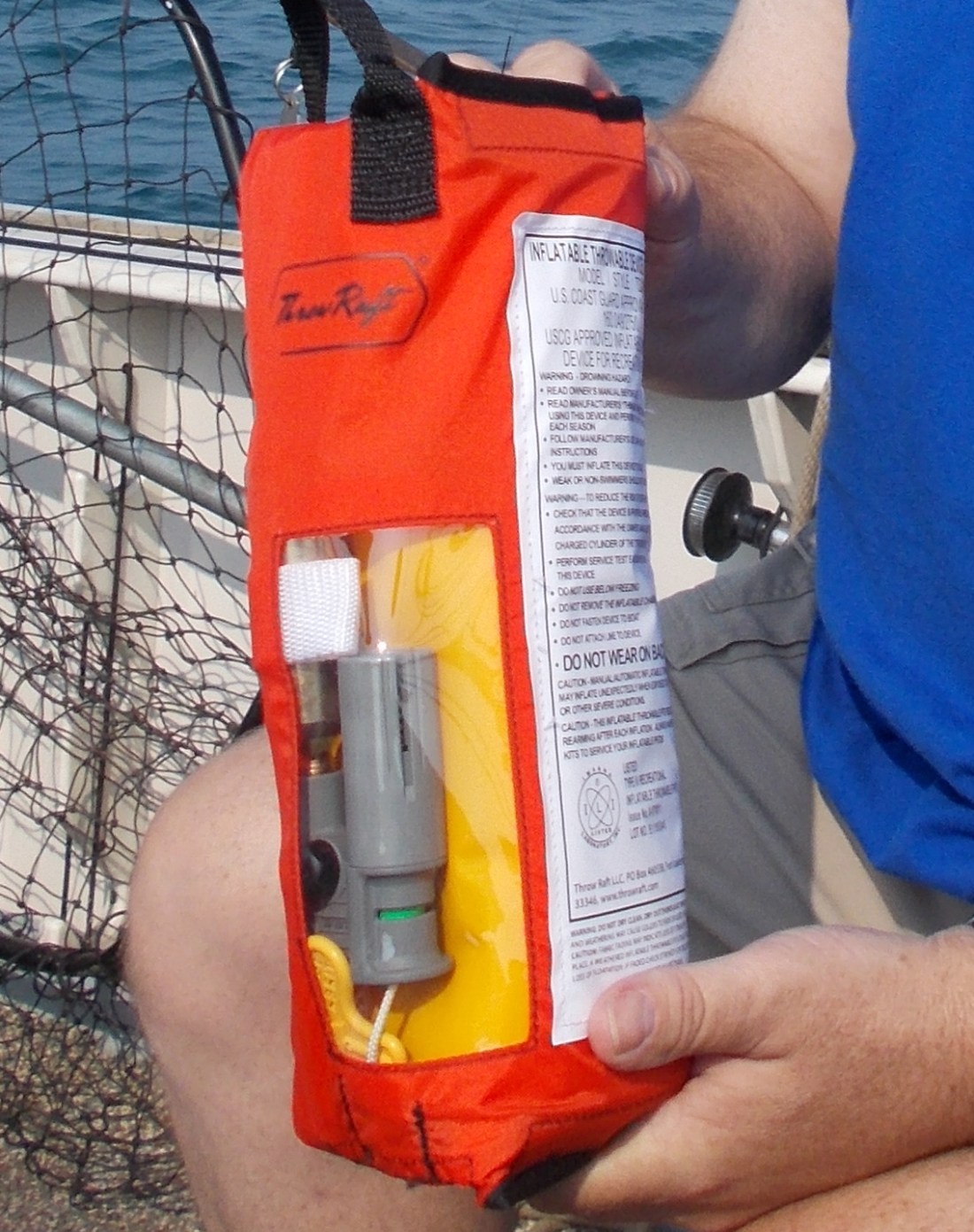
Or, look into a recently USCG certified inflatable throwable called a Throw Raft. Using similar technology to what’s used in CG approved inflatable PFDs, these pack into a small, dense container – roughly the size and weight of a football – which, like a football, can be thrown accurately for a fairly long distance.

Once the throwable splashes down in the water and the swimmer grabs on, it will either self-inflate or the user can pull the rip-cord to inflate it. It initially inflates using a compressed CO2 cylinder. There’s also a manual blow-up tube for double emergency use. It can be repacked, rearmed with a new CO2 Cylinder and reused.

Once inflated, the floatation is a square raft measuring 22 by 24 inches which provides more buoyancy than non-inflatable throwables meeting minimum USCG standards.

Since this is a device 99 percent of boaters will never use (other than for being legal), the above stats and specifications have little importance. What is important is the fact the throwable Type IV is only one-fifth the size of a seat cushion type and a tenth the size of a ring buoy.

A boater can stow or mount it in a handy location without it taking up valuable space. Being dense, it won’t blow out of the boat while underway or at normal trailering speeds on the highway. Throw Rafts are available in some retail outlets, on-line at www. throwraft.com or at Amazon.com.

KEELSHIELD

kgReviewed by CAPT. MIKE SCHOONVELD

With normal use, the “pointy” end of your boat is the location on the outside of the hull most likely to be subject to normal wear and tear as well as abnormal distress. Until I found a healthy chip in the gelcoat of my boat close to the water line, right at the bow, I hadn’t given this much thought. I have no idea of whether the ding was caused by running into one object one single time while running at speed or hitting dozens, maybe hundreds of miscellaneous chunks of flotsam or jetsam.

Regardless, I fixed it, but the repair left me wondering how long it would be until I’d need to fix it again. I found the answer at the ICAST show a week or so later at the Gator Guards’ booth. Never!

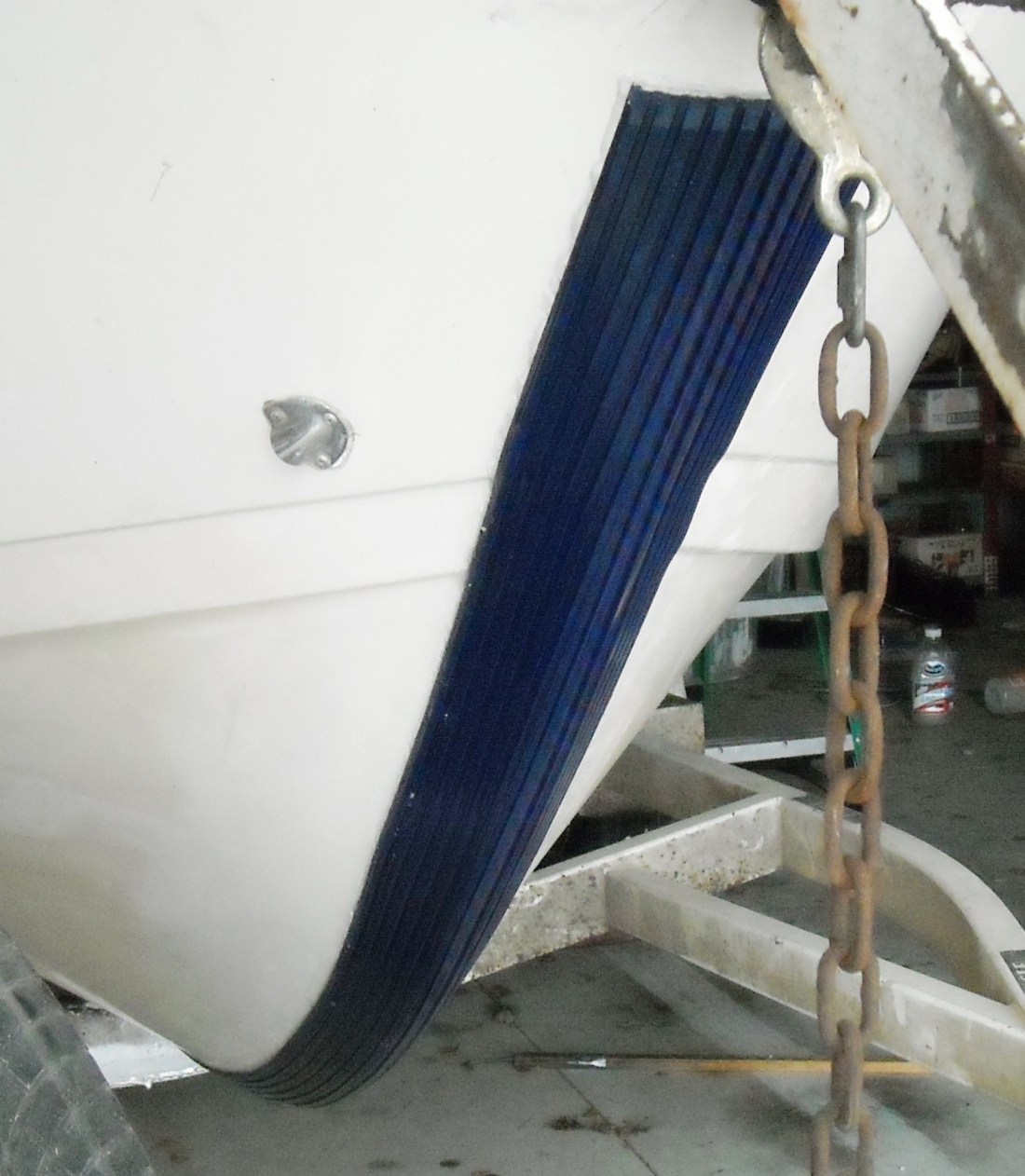
Among the Gator Guard products on display was KeelShield. KeelShield is a six-inch wide, roughly quarter-inch thick, incredibly tough, flexible polymer strip which bonds to the boat’s pointy-end to protect it from impact with floating items – as well as docks, boat trailers, concrete ramps or rocky shorelines.

KeelShield will adhere to aluminum boats from most manufacturers and all fiberglass hulls. Following the detailed instructions, I was able to install a KeelShield on my boat in about an hour. Surface prep is simply cleaning the area with a scrubby pad (included) with isopropyl alcohol (not included). Once the keel is ready, just follow the steps to carefully remove a thin backing to expose the 3-M bonding surface as the KeelShield is pressed in place. If you can stick packing tape on a box, you can stick a KeelShield on your boat.

The product is exceedingly tough and if you manage to wear it out (doubtful), it comes with a lifetime warrantee. I chose a navy blue color that matches the accent stripes already on the hull of my boat. KeelShields come in nine colors to mix or match, and various lengths depending on the size and slope of your boat’s bow. Get KeelShields online at http://www.gator-guard.com or amazon.com. It’s also sold at marine retailers and big-box outdoor outlets.

STERN PLANER

SPReviewed by CAPT. MIKE SCHOONVELD

Perhaps this fishing tool would have a better following if Church Tackle could come up with a more descriptive name. The Stern Planer doesn’t plane. It just drags along back behind the boat. Perhaps the name is just a marketing ploy. Would you buy a Stern Dragger?”

Regardless of the name, what does it do? You attach a planer to keep trolled lines from simply dragging straight behind the boat’s stern. If a troller wants a lure to troll straight behind the boat, why not just let it out and stick the rod in a rod holder? What advantage does the Stern Planer offer? More than you might guess.

I didn’t understand the concept of a Stern Planer until I fished with a walleye-guy who used a measured amount of line between his in-line planer boards and the lures he was trolling. The measured length of line kept his lures swimming at specific depths.

Bingo! The light bulb in my mind clicked bright.

There are charts which will show the trolling depth various lures will achieve with more or less line is deployed (measured from where the line enters the water to the lure.) Say you want your lure to troll 12 feet deep. The chart shows you need 50 feet of line in the water. Let out 50 feet of line, attach a side planer (or the Stern Planer) and it’s set perfectly.

Let out 50 feet of line without the SP, then put the rod in a stern-mounted rod holder and 20, 25 or 30 feet of the line will be out of the water. So let out more line but how much more? There’s no chart for this. The depth of the lure on the stern line is little more than a guess.

On my boat, I don’t often run an unweighted stern line, but I do often put a six to ten color lead core line “right down the chute.” Right down the chute often means “right in the way” when a fish bites one of my other lines and it’s being reeled into net range.

            The Stern Planer comes in two sizes (TX-005 is small, TX-007 is large). The TX-005 will tow any sort of crankbait or other lightweight lure. The large size will pull 10 colors of lead core line. When I have a chute line out, the Stern Planer not only makes it easy to spot where the  chute line enters the water, but makes it possible to just let out 25 or 30 more yards of line when a fish bites some other line. The stern cone slides back so the fish being caught on other lines can be fought under the stern line, not along side it.

FISHGRIP

FG

Reviewed by CAPT. MIKE SCHOONVELD

Many people fishing the Great Lakes for the first time catch the biggest fish of their lives. Often, that fish is the first one they’ve ever caught with teeth. Almost always as soon as the fish is in the net or on the deck, out comes the cameras or cell phones to record the catch for posterity.

Usually, the next thing that happens is the just-caught, just-lifted fish wiggles, flops and drops back onto the deck as the proud angler gets a finger poked by a sharp tooth or simply fails to get a good, solid grip. That’s if the proud angler even attempts to pick it up in the first place.

Many youngsters, women and a surprising number of men-folk are happy to reel in a fish; not so happy to actually touch one. Actually, I don’t want a person of any age or gender with that mindset trying to do a grip and grin with their fish on my boat. At best they are going to drop the fish. At worst they are going to get cut by a gill or scraped by a sharp tooth, then drop it.

I’ve used several brands of fish-holding tools and have used both boca-grips and spike-handle types on my boat. The spike style relies on poking the spike up through the gills and then gravity takes over. They actually work pretty well until you skewer on a big trout or salmon and then hand it over to the nine-year old who just caught it. His or her arm will soon sway like a palm tree in a hurricane and then down goes the fish.

The boca-grips allow a two-handed grip and straight up lift, but (and I have three brands), I’ve watched dozens of twisty active cohos manage to come un-boca gripped when lifted. Down goes the fish. These fish grabbers were all sidelined once I got a pair of Fish Grip, vice-plier type fish holding tools last summer.

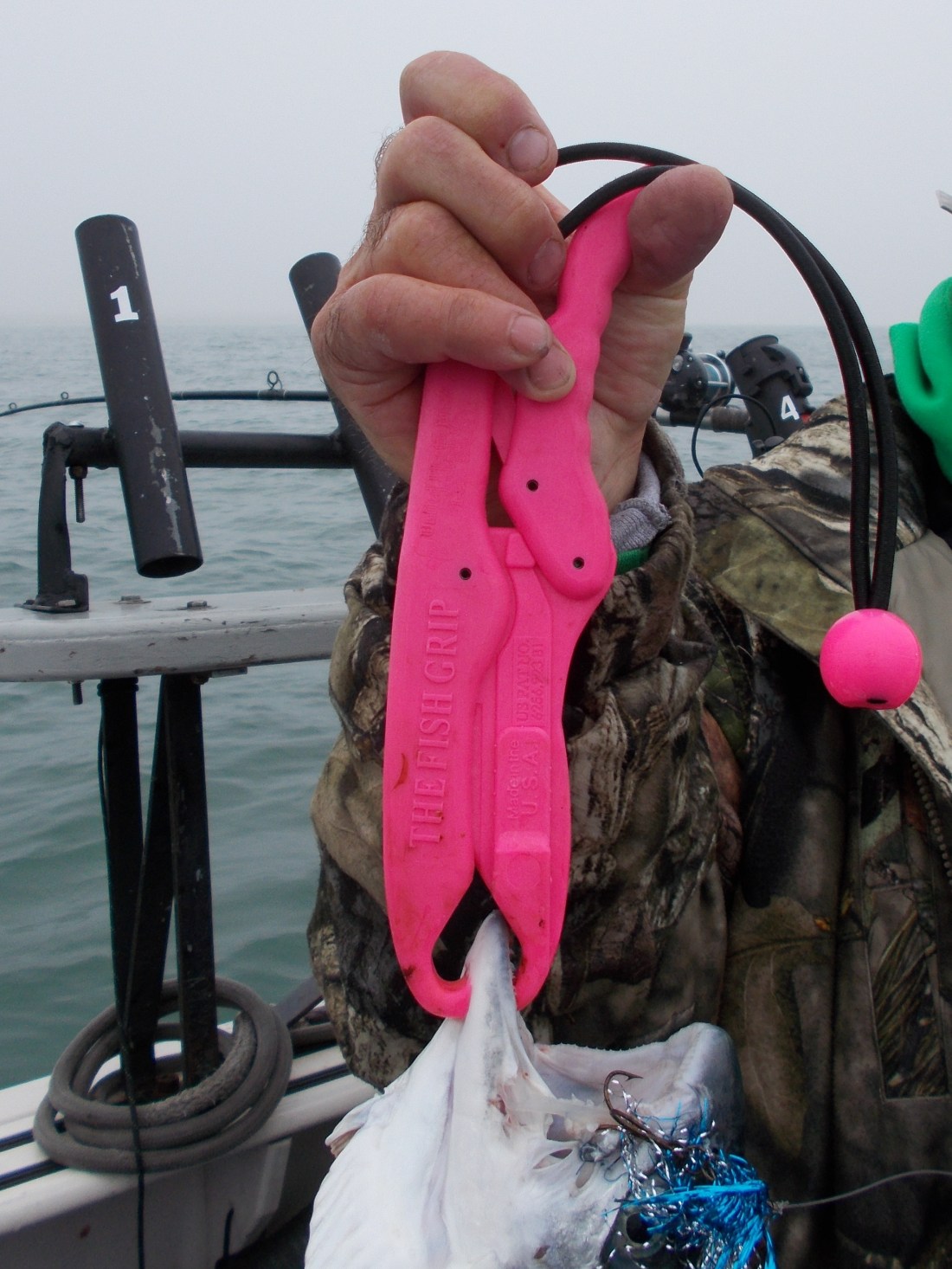
Fish Grips are modeled after Vise Grip locking pliers (except no adjustment is needed.) Just get one of the jaws of the Fish Grips fish lifter into the mouth of the fish and squeeze the handles to pinch the other jaw shut. It will stay put until the handles are pulled apart to pop open the jaws. No further instructions needed.

They do come with a cord you can put around your wrist if using them to grip pike or muskies over the side of the boat. (Don’t worry about not strapping them on – they will float.) More importantly, I’ve never seen a person drop a fish once the tool is pinched in place, either because the tool slipped loose or the fish ripped it out of the lifter’s hands.

Fish Grips, made in the USA, are widely available at retailers or online at www. TheFishGrip.net. They come in two sizes (original and junior) and in a variety of colors. I have two sets. I chose bright pink for the fisher-ladies who come on my boat and a bright red pair, easy to locate in the compartment where I stow them.


PEG FLUTTER SPOONS

peg

Reviewed by CAPT. MIKE SCHOONVELD

There’s probably not an ice fisherman in North America who doesn’t use products manufactured by the Clam Corporation. So when I approached Clam’s new product display at an outdoor writer’s meeting I was surprised to see a line of salmon/steelhead trolling spoons on display.

I asked the Clam rep at the booth if they are starting to branch out into the Great Lakes lure business. He looked at me as if I’d just asked if they planned to start selling designer coffee products. I quickly grabbed one of the Peg Spoons being displayed and simply asked, “What’s up with these?”

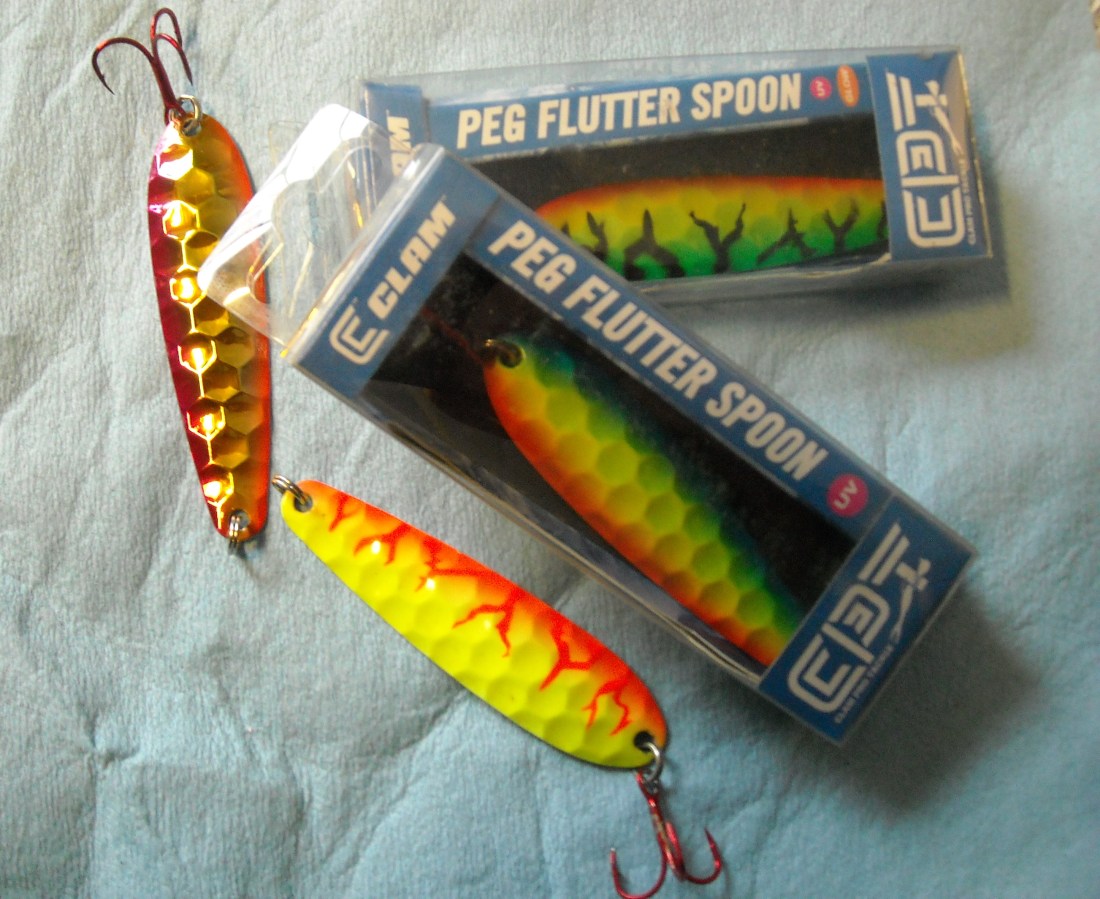
Back on a familiar topic, the Clam-guy said, “These are our new Peg Spoons, the name “Peg” being short for Lake Winnipeg where they use this sort of spoon regularly when ice fishing for walleye.”

I’m far from being up on the latest ice fishing tactics, especially at Lake Winnipeg, but I’ve attached similar-looking flutter spoons to my salmon and steelhead trolling lines thousands of times. Maybe walleyes will gobble them eagerly in Winnipeg or elsewhere; I was sure early season coho on Lake Michigan and browns and steelheads in all the lakes would find them equally attractive.

I was right – at least about the Great Lakes cohos, browns and steelies where I tested the spoons. Available in eight colors, I used the Rusty Craw (orange/gold/pink) and the Orange Tiger (chartreuse/orange) with good success in the chalky, churned-up water I fish at the beginning of the season when bright colors always do better. I know the other colors would be equally successful in areas where clearer water conditions prevail.

At 3 1/4 inches, the Peg is stamped from a zinc alloy which makes it slightly lighter than steel or brass spoons. I couldn’t detect much difference in the action from the similarly sized spoons of other brands but humans don’t view spoons and other lures the same way as fish.

The next time you are in the ice fishing aisle at your favorite tackle shop (or heading for Lake Winnipeg) check out Clam’s Peg Spoons in your favorite salmon and trout colors. Or see them at http://www.clamoutdoors.com.


ARACHNET

ArachnetReviewed by CAPT. MIKE SCHOONVELD

            I trailer my boat every time I go to the lake. While things like jackets, fish towels, empty coolers and other items which could blow out as I travel are stowed in the tow vehicle, most of my gear stays in the boat. That leaves a whole bunch of stuff that stays in the boat – and about 200 other things, if I took an inventory.

Some of the cargo rides in built in storage areas, quite a bit, like rods, reels, tackle boxes, planer boards are just positioned on the floor where they won’t bounce out along the highway. The only lockable storage on the boat is the glove compartment at the helm. If a thief were to climb in the boat, the crook could clean it out in a minute and help himself to most of the electronics in a few minutes more. It would take a bit more time to unbolt the downriggers and rod holders, but with the right tools, who knows?

That’s why 95 percent of the time when I’m away from home either myself or someone else is physically with the boat and when I’m at home, it’s locked securely in my pole barn. The five percent occurs only when I am traveling and stopped for fuel, lunch or rest stops or when at the destination and parked at a hotel or VRBO (few of which include secure boat and trailer parking spaces.)

In those situations, I used to remove all the rods, boxes and other gear when the boat was left unattended. No more – I have an Arachnet Security System.

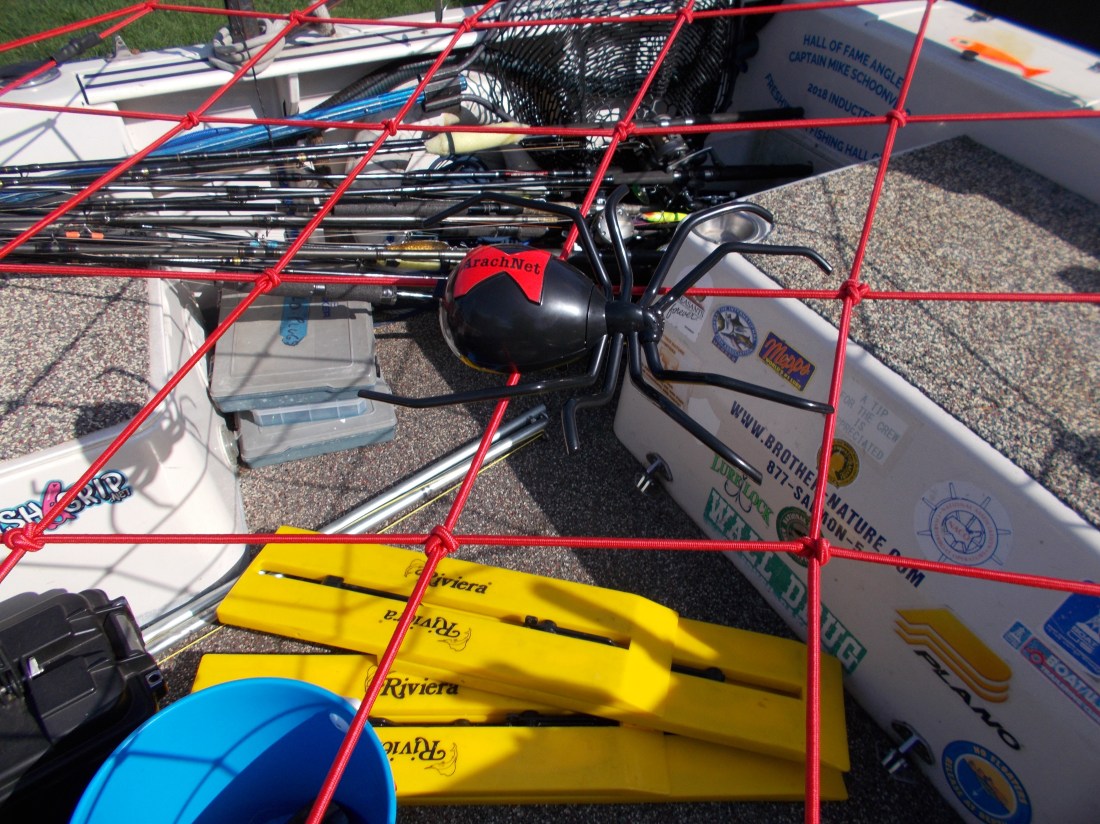
It’s a simple two part system – three if you include the key fob thing that activates it or turns it off. Part one is a stretchy-cord cargo net large enough to cover my boat from the helm to the stern. It hooks in place solidly using large plastic S-hooks. While on the road, it works as any cargo net would and will keep items from bouncing out and will catch a sweatshirt or lifejacket I forgot to stow or remove to the tow vehicle.

The cargo net takes about a minute to deploy and hook across the boat securely and less time to remove and stuff in it’s carrying bag. If that’s all you want, cargo nets can be purchased lots of places.

Part two of the system is large plastic spider which clips securely onto the net. Why a spider? The net is reminiscent of a spider web stretched over the back of the boat, the toy-looking spider looks cute and clever sitting there, perhaps just daring a thief to sneak on board.

The electronics inside the spider is what is really clever. Once the trailer is parked, the net installed and the spider locked onto the net, turn it on with a click of the key fob. Now, the spider is a sensitive motion detector. It just sits there looking cute until the thief shows up but when the spider or it’s web is jiggled or moved, it electronically screams out a high pitched, 120 decibel alarm – loud enough you’ll hear it from inside the restaurant or inside your motel room. By the time you get outside to turn it off, the thief will be gone.

There are certainly higher priced security alarms, some of which connect up with cell phones to alert you or the police of security breaches. Those may be what you need in some locations. I only need some kind of security system five percent of the time and the Arachnet handles that five percent need about 95 percent of the time.

It will work on open pick-up truck beds, campers, motorcycles or just leave the spider laying on the driver’s seat of your car and turn it on when you park in an insecure area. Check them out at http://www.arachnet.net.

POPTICALS SUNGLASSES

popticalsReviewed by CAPT. MIKE SCHOONVELD

It would be hard to argue there’s any item more important for comfortable day on the water for Great Lakes anglers than a good pair of sunglasses. Sunny skies and glare off the water on a bright day can be almost blinding. It hurts and can cause headaches.

Sun and glare can also be dangerous as UVA and UVB rays from the sun can cause immediate “sunburned” retinas as well as long-term eye damage. A good pair of shades shields the wearer’s eyes from almost all harmful UV rays.

There’s more. For those who like being stylish, sunglasses can be a fashion statement. For situations where seeing down into the water is important, polarized lenses make a world of difference. For anyone who has had a lure or sinker spring out of a fish’s mouth and face-smack them faster than he or she could duck knows they provide eye protection from unexpected accidents. Sunglass buyers can choose from dozens of brands and models that check every one of these boxes. So why choose Popticals?

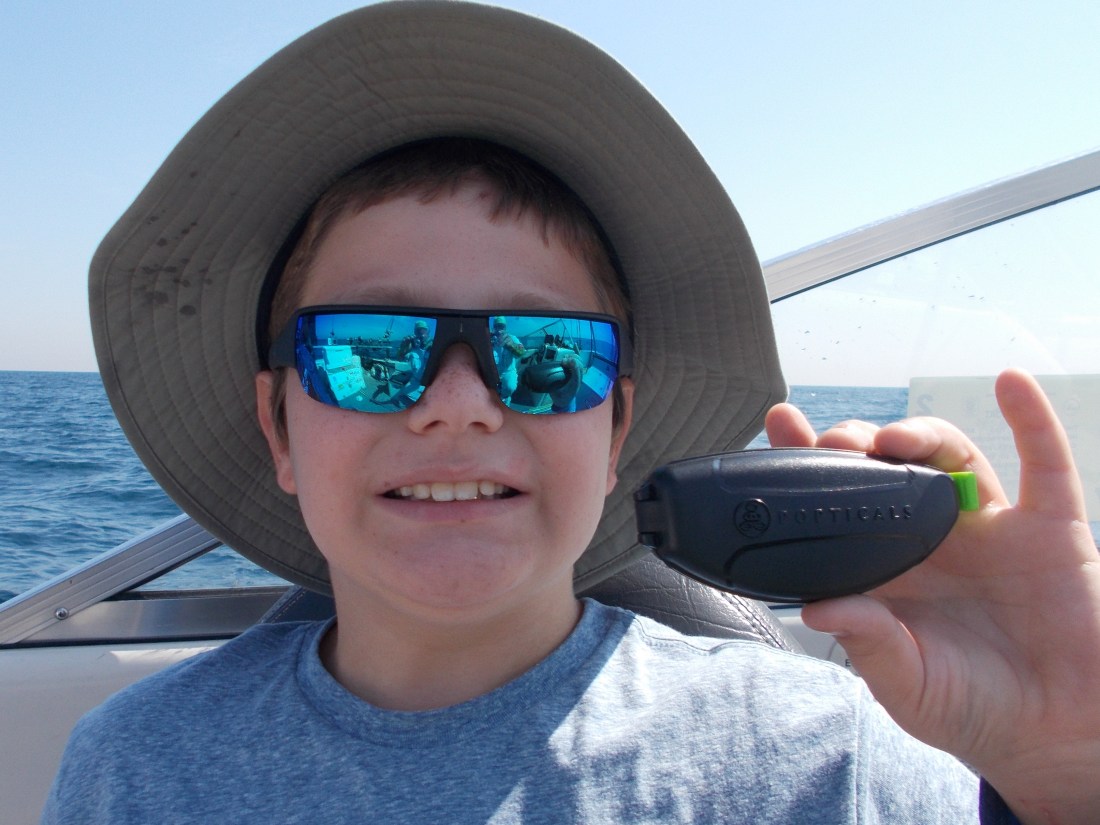
Popticals fold down into a carrying case as small as a bar of soap. That may not be an issue for a pair of “boat shades” that will either be in a glove compartment or on the boater’s face, but for people who keep their fishing glasses in their tackle box or tote them along in their pocket or day-pack, having a good set of sunglasses which will fold down into a carrying case half or a third the size of non-foldable shades can make a big difference.

If that’s you, check out the available styles at: http://www.popticals.com. They are available for purchase on-line and at many retail outlets.

CHEEKY WINGO BELT

belt


Reviewed by Capt. Mike Schoonveld

            I’m not shaped correctly to wear a pair of fishing pants without strapping on a belt to keep the waist snug around my midsection. If I’m beltless anything could happen in the middle of a fight with a big salmon. Okay, only one thing could happen, but it wouldn’t be pretty.

So I wear a belt – a simple clothing accessory good for only one purpose. Or is it?

A length of nylon rope could do the same job, but if for nothing but gaining style points, few people go the rope belt route. A rope just doesn’t look good and if looking good is one of the ancillary reasons to have a belt, you may just want to check out the fishing oriented belts from Cheeky Fishing.

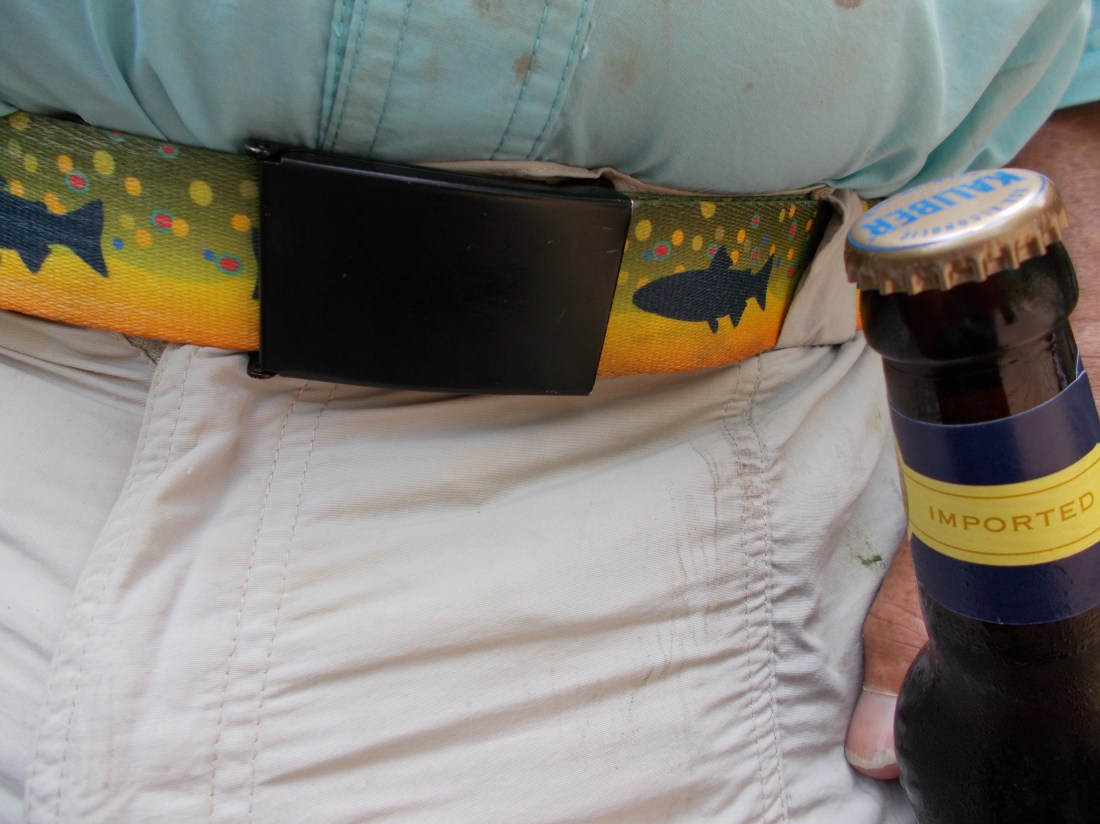
With dozens of “fishy” patterns from which to choose, patterns to look like various trout, tarpon scales, redfish spots and others, the Cheeky Wingo belts are long on style points. If, like me, you need a belt to hold up your fishing trousers, it might as well be a “fishing belt.”

When designing these belts, the Cheeky guys kept three things in mind. It has to look good and perform well. The one I’ve been using all summer fills both of those bills.

The other thing they considered was at sometime during the course of the fishing day, there could be a bottle in the fisherman’s hand in need of having its cap removed. Proving a fishing belt can be a multi-tasker, pop open the belt buckle and it becomes a handy bottle opener!   Check them out at www. cheekyfishing.com.