CAPTAIN’S PACKS FROM GREAT LAKES TACKLE

Reviewed by: CAPT. MIKE SCHOONVELD  

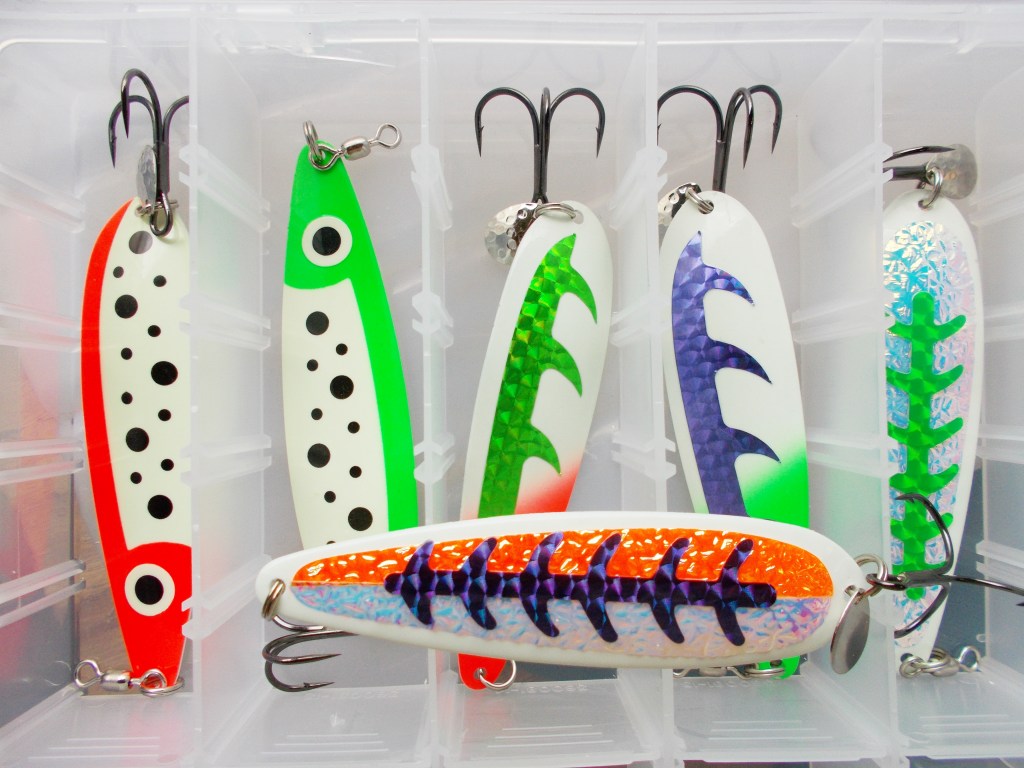
What’s better than having a high quality spoon with a “fish-popping” color scheme?  Having six of them – and that’s what you get with a Captain’s Pack of spoons from Great Lakes Tackle like GLT’s Hot Mag Mix shown here. The Hot Mag Pack is a mix of their most popular individually-sold patterns and more. It includes a pair of their Zombie Apocalypse SuperGlows, another pair of the Head Hunter SuperGlows and includes a pair of ladder-back patterns only available in the Captain’s Pack. The spoons come packed in a six compartment Plano box.

 If I were designing the “perfect” salmon/trout spoon for the Great Lakes I’d start with a super glow blank, then I’d add some bright color highlight colors – my favorites are fluorescent green and hot red – then finish with some Mylar or painted-on patterns. I’m going to make sure my spoons are UV “activated.”  I’ve seen non-UV patterns fail, when the same pattern with a UV coating is the top producer.  Tom Schultz’s spoons check all the boxes.

 Lots of spoon builders end it there. Not GLT. First, put a top quality, name brand hook on the fishy end – none are better than Owner. Hang a small, hammered “flipper” spinner blade on the hook-hanger as well. Most of the time, that flipper doesn’t do squat, but every once in a while that tiny bit of flash might be just what gets a skeptical fish to chomp the blade, or perhaps the minor amount of clatter the spinner creates when it ticks on the hook shank attracts the attention of a big salmon which otherwise might ignore it.

There’s a nose swivel at the angler-end of these spoons. Again, it may or may not be a deal breaker most days, but when the few extra strikes it may produce come on one of your lines – success! 

More important, in my mind is the back side of the spoon. Many spoon builders go all out on the face of the spoon – to catch the fisherman – and leave the back of the spoon bare. Fish see both sides as a spoon trolls through the water and the backsides of these spoons all have something other than just plain metal.  You’ll like them and the fish are proven to like them.            

Check out the available “Captain’s Packs” and order one for yourself or for your favorite captain at https://www.gl-tackle.com.  

SPOON BOX FROM SPOONCRANK

Reviewed by: CAPT. MIKE SCHOONVELD

Decades ago I won a spinner-bait tackle box in a raffle. I am not an avid bass angler so I didn’t need a special box just for the few spinner baits I owned but I did have dozens and dozens of trolling spoons I needed to keep under control. The spinner bait box did the job well enough it’s been on my boat ever since, despite my trying numerous versions of spoon storage “options” from several companies.

The spinner-bait box wasn’t perfect, however, just better than the others. So when frequent Basics and Beyond contributor, Doug Morash, mentioned he had started a new business producing and selling tackle boxes specifically for the Great Lakes market, I wondered if he was on to something or being overly optimistic. Competing with the established lure storage “big dogs” with an American made product is like opening a general store next to a Walmart.

Morash had first hand knowledge that Great Lakes trollers’ tackle storage needs are much different than what works for inland lake guys fishing for bass, pike or panfish, especially when it comes to trolling spoons and those super long diving crankbaits popular with walleye trollers. He developed two sizes of boxes, the shorter one converts to a crankbait and/or spoon box, the taller one is perfect for walleye trollers using extra long, “deeper-diver” models.

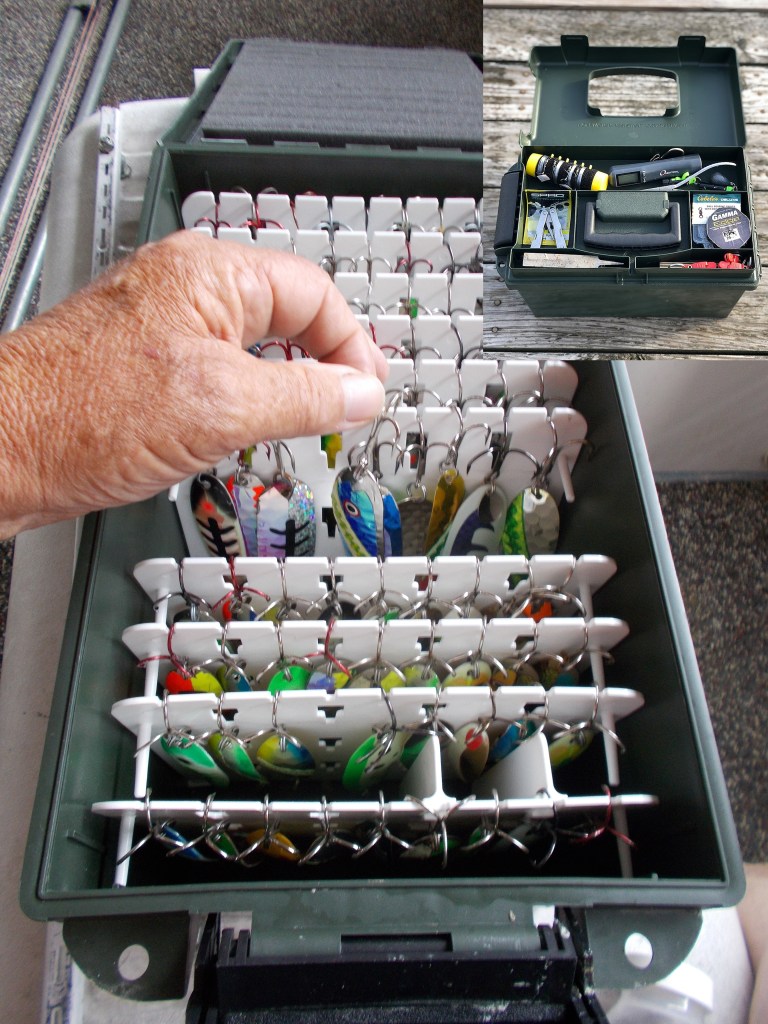
Both are built on the “ammo” box design with the hinge on one end and a secure closure on the other. Inside are 10, hinged-at-the-bottom dividers – each divider with nine hook slots so you can dangle 90 spoons inside (more if you want to double up). The hinged dividers allow the user to flip through the selections like flipping through folders in a file cabinet and easily remove a selected spoon. Genius! 

Add five bucks more to the bill and get a stack of partitions which snap firmly on the dividers creating individual cubicles to hang up to 50 crankbaits and never tangle hooks or end up with the lures getting more scratched from being stored than from catching fish. Many people will be able to use the partitions on some of the dividers, leave them off of others and put all of their trolling lures in one container.

The original Spoon/Crank box will hold magnum (five-inch) spoons and/or cranks and stickbaits to 6.75 inches. The Deeper Diver box has the same footprint but is deep enough to hold lures like the Reef Runner 800s, deep running Bandits and other, similar lures to 9 1/2 inches.

I tested the smaller box and ended up using it just for my spoons assortment. It passed all the my tests.

Test one: It held 90 spoons and made them easy to find – easily beating my old spinner-bait box.

Test two: One of the knuckleheads fishing with me managed to drop the full box of spoons upside down onto the deck. On my old box, that would have resulted in a mess requiring a half hour and several curse words to fix. When the Spoon Box was righted and opened, all of the spoons were still in place. The foam lined lid pushes down on the top of the divider keeping the lures in place.

Test three: My old spinner-bait box is now permanently retired.

“But wait, there’s more!” as any infomercial salesman would say. The lid opens to reveal an additional storage area to hold tools, terminal tackle or other items. That’s where I keep a Tackle Tamer with pre-tied slider leaders and other supplies. 

To see more about or purchase Morash’s Spoon, Crankbait or Deeper Diver Boxes go to www.spooncrankbox.com.

SPRO 9″ SPORTSMAN SCISSORS


Reviewed by: CAPT. MIKE SCHOONVELD

Do you have a pair of scissors on your boat?  I never did even though they do a terrific job of cutting braided line. I had traditional nail-clipper style line cutters on board and I used them to “gnaw” through braid when needed. Line clippers are basically, single task tools – perhaps dual task if you find yourself in need of an emergency manicure while fishing.

I don’t like single-task tools – especially on the boat. I imagined including a pair of scissors just for when I needed to cut braided line would be just another single tasker.

But when I saw the SPRO 9″ Sportsman Scissors at the mid-summer ICAST show, it caught my eye. Not only are they top notch “braid cutters,” they are decidedly a multi-use tool.

 So I got a 9″ Sportsman Scissors to add to my fishing tool assortment and used it the last half of the 2021 fishing season. I was worried about the size – a nine-inch scissor is a rather robust tool, especially compared to a fingernail snipper. However, what I found is it’s easier to do “micro” jobs with a large scissor than to tackle a “macro” chore with a mini-set of clips or snips.

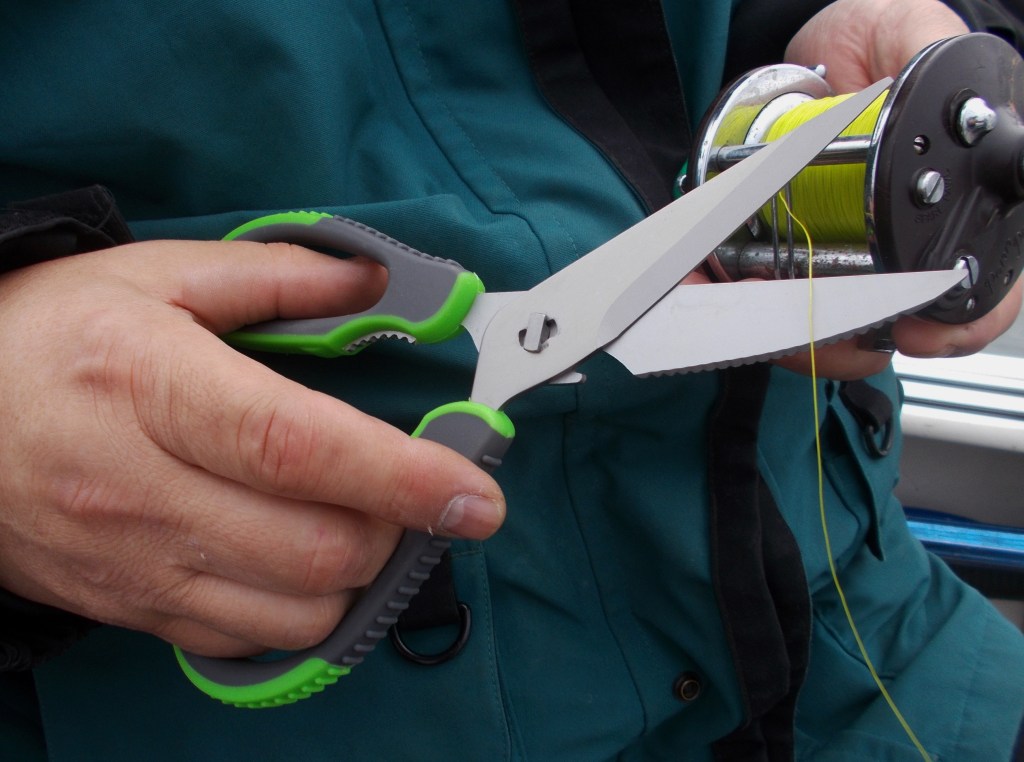
 A few of the details about the scissors: they are stainless steel, naturally; have a serrated edge (necessary to cut braid) and a non-slip, man-sized, rubberized grip. Inside the grip is what SPRO calls a nut (as in walnuts) and claw cracker (as in crab claws). I’ve not cracked any walnuts or crab legs with them, but I have grabbed the scissors several times to use the crab-cracker as pliers when I needed a better grip on a stubborn something. When the blades are opened fully, the two blades of the tool will pop apart allowing the fish-scaler and bottle opener to be used.

Besides cutting braided line, I’ve used the scissors to open new blister-packed lures, clipping fins, trimming flies and other chores. Maybe they are a multi-tasker.

There are some brands of fishing products that are recognized as being the highest quality. SPRO is one of those. From snaps and swivels to tackle storage to tools, if it’s a SPRO I know it’s well made and isn’t going to let me down. I’ve used the SPRO scissors for half a season now and I wish I’d had them for the last half of my life (or longer.) If you don’t have a pair of scissors on board your boat, you need a pair and the SPRO nine-inchers will do the multiple jobs you’ll find for them.

To check out the SPRO scissors, go to http://www.SPRO.com.

FRABILL RUBBER REPLACEMENT NET

Reviewed by: CAPT. MIKE SCHOONVELD

Over 90 percent of the fish that come aboard my boat are hauled aboard using rubber mesh landing nets, simply because they are about 10 times less prone to tangling with hooks than nets made of other materials.  I’ve tried “string” nets, plastic coated nets – both “store-bought” and DIY versions covered with spray-on products like Flex Seal. The coated nets are slightly better than non-coated versions but can’t compete with rubber nets.

Some net manufacturers offer rubber mesh models, some don’t and some of those that do don’t offer them in versions large enough for good-sized Great Lakes salmon and trout or with handle lengths suitable for most trolling boats. That’s why both of the “rubber” nets I use on my boat are hybrids. 

I retro-fitted replacement rubber nets from Frabill (model number 3070) onto net frames with suitably-sized handles and adequate hoop sizes made by other manufacturers. The 3070 is Frabill’s largest rubber replacement net, said to fit hoops 23 X 26 inches. One of my hoops is several inches larger, the other slightly smaller than this, but the basket is rubber. It stretches and will work just fine.

When I have fish approaching 20 pounds or larger, I drag out a bigger, string-basket net, but I regularly and easily scoop up fifteen pounders or larger with the 3070 hybrid. The largest fish ever boated with this net was a 26-pound king. 

If you can’t find them anywhere else, they can be ordered direct from http://www.frabill.com.

NORTHLAND RUMBLE LURES

Reviewed by: CAPT. MIKE SCHOONVELD

Sometimes the old saw about everything old becoming new again makes sense. Before the first molds were made to make lures from plastic, various types of wood were carved to make fishing “plugs.” Once lure makers sprouted in the plastics industry and many existing brands “reimagined” their baits as plastic, lures crafted from wood, except in a few cases, became endangered species.

Millions of fish have fallen for plastic lures, but that doesn’t mean they were necessarily better. Plenty of fish still fall for the few brands of wooden lures still out there. Balsa ShadRaps and Rapala Jointed Minnows will be in my tackle box forever.

The fact is, the switch from wood to plastic wasn’t made to make lures more appealing to fish; it was an economic decision. The fish don’t care, in fact, my choice of balsa ShadRaps over say, plastic Flicker Shads is because the fish like them better – some of the time – maybe most of the time. So in the competitive fishing lure business, it’s no surprise that a few lure makers are going retro and producing lures made of balsa or other wood – to catch more fish as well as more fishermen.

Few companies know walleyes better than Northland Tackle so when this north woods company based in Bemidji, Minnesota rolled out their balsa wood Rumble Shads and Rumble Sticks last spring, I got some and put them to use and abuse on my early June trip to Lake Erie. My friends and I used them, the walleyes abused them.             My favorite color in the dirtier than usual water was the “Sneeze” color – yellow with green/black spots. We did well with the Rumble Shad in the Bubble Gum Tiger color, as well. Check these and other “Rumbles” out at retailers, big box outlets or on-line at http://www.northlandtackle.com 

MUDPAW SHOES – ROMEO

Reviewed by: CAPT. MIKE SCHOONVELD

There are few things more uncomfortable than having wet feet whether you are walking, driving or sitting in a boat. That’s why boots were invented.

Much of the time, however, boots aren’t needed or wanted. You wouldn’t put on a pair of boots just to walk across a dew-laden grassy lawn to get in your car.  You wouldn’t carry a pair of boots with you just because you know the floor at the fish cleaning station is going to be wet. It’s easier to just be careful when walking through a parking lot if the asphalt is puddled with rainwater than to put on a pair of boots.

 All these places and more have had me enduring wet feet because I was too lazy to slip off my Chuck Taylors and put on something a bit more waterproof – whether it was a quick hike through the “danger zone” or a morning on the boat in damp weather. 

Irish Setter Mudpaws to the rescue. These are rubber shoes built to Irish Setter’s strict standards for quality footwear that made them the favorites of outdoorsmen for over 70 years.

They’ve kept my feet dry in each of the situations above and others. At first glance (and feel) I thought the Romeo model might be more “pull on” than “slip on.” I wasn’t able to insert my foot like I would in a Crocs or other clog-type rubberized shoe, but the stretchy neoprene upper and the handy finger pull tab at the heel makes donning the “paws” more of a tug-on operation.

Once on, the removable foot bed provides the underfoot comfort which has made Irish Setter boots an American favorite and what Irish Setter calls “TempSens” technology helps keep feet from becoming sweat-wet on the inside. Top it off by looking at the bottom. The soles have a relative aggressive tread to provide firm footing in wet conditions. See them or buy them online at http://www.irishsetterboots.com, Amazon as well as many big-box outdoor stores.      

MINI-KEEP KOOL WORM CONTAINER

Reviewed by: CAPT. MIKE SCHOONVELD    

        It’s a problem I discovered over 50 years ago when a digging a soup can full of garden worms was a precursor to every fishing trip. There was no problem catching the worms, the problem was keeping them alive and squirming.

            Soup cans had no insulation. I eventually graduated to insulated worm containers that were better, but even in a special cooler, a hot summer sun can easily kill more worms than you feed to the fish.

            The folks at Hagen’s Fishing have come up with a worm container that will keep worms cool and comfortable all day or all weekend. The concept is simple. Start with a specially shaped, reusable, ice-pack which can be used over and again. The ice-pack slides into a soft, insulated jacket to slow the thawing and warming of the frozen liquid inside and a special container, slides into a special recess in the freezer block. The worms go into the container and stay comfortably cool all day. At the end of the day, the worm container can be slid into a cooler or fridge; the ice-pack can be refrozen in a freezer in a few hours. 

            First, let me say the thing worked. I spent five sunny, summer days on Lake Erie in an open boat with this container protecting our nightcrawlers. The crawlers were just as healthy on Friday as they were on Monday when they were put in it.

            I questioned the wisdom of making the jacket white in color when I first saw it, but then I realized the white color extended the length of time the container will keep the worms cool. I’d rather have a dirty worm box than a dead nightcrawler.

              They are available in two sizes. The largest will hold twelve dozen crawlers, the smaller will hold six dozen. Check them out and purchase these at http://www.hagensfish.com. But plan on spending some time on Hagen’s website. Hagen’s has literally thousands of SKUs of fishing products. I doubt the worm box will be the only thing in your order.

RENO GLOW STICKS

Reviewed by: CAPT. MIKE SCHOONVELD

Joe Reno, owner and lure designer at the Reno Bait Company, has some of the most imaginative paint patterns and finishes on his lures of any available anywhere. Now he’s added patterns that overlay a glow-in-the-dark body in his Shallow Diver stickbait line-up. Glow lures are a staple for salmon and trout in the Great Lakes, but somewhat unique in the walleye world.

I question why. I gave these “glow sticks” a workout on my annual foray to Lake Erie for the same reasons I use glow-lures back home for salmon and trout. We started our days early and were setting lines by the time the sun cracked the horizon.  We hit the glow-stick with a dose of UV light from a special flashlight and sent it out. It never stayed out for long.

 it stayed out most of the morning, even after the sun was high enough to light up the depths. We were there soon after the Memorial Weekend blow had muddied the Western Basin waters. The fish didn’t have to dive deep to avoid the bright sun. We ran the Reno Shallow Diver with no weight or diving aides early, then moved it to run a bit deeper using downriggers, Dipsey Divers or lead core where it remained a top producer under these cloudy-water conditions.  Check them out where ever Reno Baits are sold or at http://www.renobaitcompany.com.  

CME TROLLING – EYED BULLET HEADS

Reviewed by: CAPT. MIKE SCHOONVELD

You wouldn’t buy a J-Plug or other crankbait that didn’t have eyes painted on them, would you?  Many popular trolling spoons come with eyespots; I often tape aftermarket spots on the spoons I purchase that don’t come with eyes.

How many of the trolling flies you use have eyes?  Not many, but still, they catch fish. Is there a reason other lures need eyes but trolling flies don’t?  I can’t answer that for sure, but I’m sure an eye on the head of the fly would never hurt and just might get an extra bite or two from super-wary fish.            

CME, maker of my favorite bullet heads to use when making my own trolling flies, now make bullet heads with prominent eyes. I like them!  Here are the first couple flies I made with the Eyed Bullet Heads.  If you make your own flies and like the idea of making some with eyes, check out http://www.cmetrolling.com 

SMART TROLL II – DEPTH/SPEED/TEMP PROBE(S)

Reviewed by: CAPT. MIKE SCHOONVELD            

Much of the time, fishing without a “probe” to measure the temperature of the water at the depth the lure is being trolled and/or the speed of the lure is like star gazing at night while wearing sunglasses. Salmon, trout, walleyes and other fish often relate to water temperature and down deep, where the cool water is located, lake currents make relying on GPS or other speed readings imprecise. 

In short, knowing the speed and water temperature down where your lures are positioned is far more important than the speed and temperature at the lake’s surface. You’ll see more stars when you take off your sunglasses. You’ll catch more fish when you use a “probe” device. 

“Probes” are all two-part products. Part one for most of them is a about the size of a D Cell flashlight that connects to a downrigger cable just above the weight probe to measure the speed and temp. Part two is a unit on the boat to display the readings being measured in the depths. I’ve used all of the popular brands; I currently have a Fish Hawk X4 on my boat. So why was I willing – even excited – to put the Smart Troll II on my boat?

Because the size and drag caused by the X4’s (and others I’ve used) big probes creates a significantly greater amount of blowback on the ‘rigger with the probe on it. This makes setting a lure at a specific depth somewhat imprecise and occasionally causes tangles with adjacent downrigged lines. The Smart Troll II probe is about 80 percent smaller than the probe on my X4; and in addition, the display registers the true depth of the probe in along with the speed and temp.

Since the ST probe is small, it just clips to the downrigger wire with an Offshore OR-16 pinch pad. If the downrigger ball is lost, the probe will still be on the cable.

Or just don’t run the Smart Troll probe on your downrigger at all. The speed measuring part of the probe can be removed and without it, the temperature and depth measuring part of the probe is the size of an AA battery.

“Many guys don’t worry about the speed so much, and put the temperature and depth probe just ahead of or behind their Dipsey Divers,” said Darrell Huff, owner of Smart Troll. “They let out line on their diver gradually, not as much worrying about the amount of line as watching the temperature readout as the diver goes deeper. Once the temperature shows the diver is in or under the temperature break, the Smart Troll will show it’s exact depth. From there, the fisherman can set his downriggers and by checking the line counter on the diver reel, use that reading to position other divers.”

Or, put one of the probes on each diver. Or put temp probe(s) on the divers and one with the speed attachment on a downrigger to monitor the boat’s trolling speed.  Probes are sold separately or in kits with two to six probes.

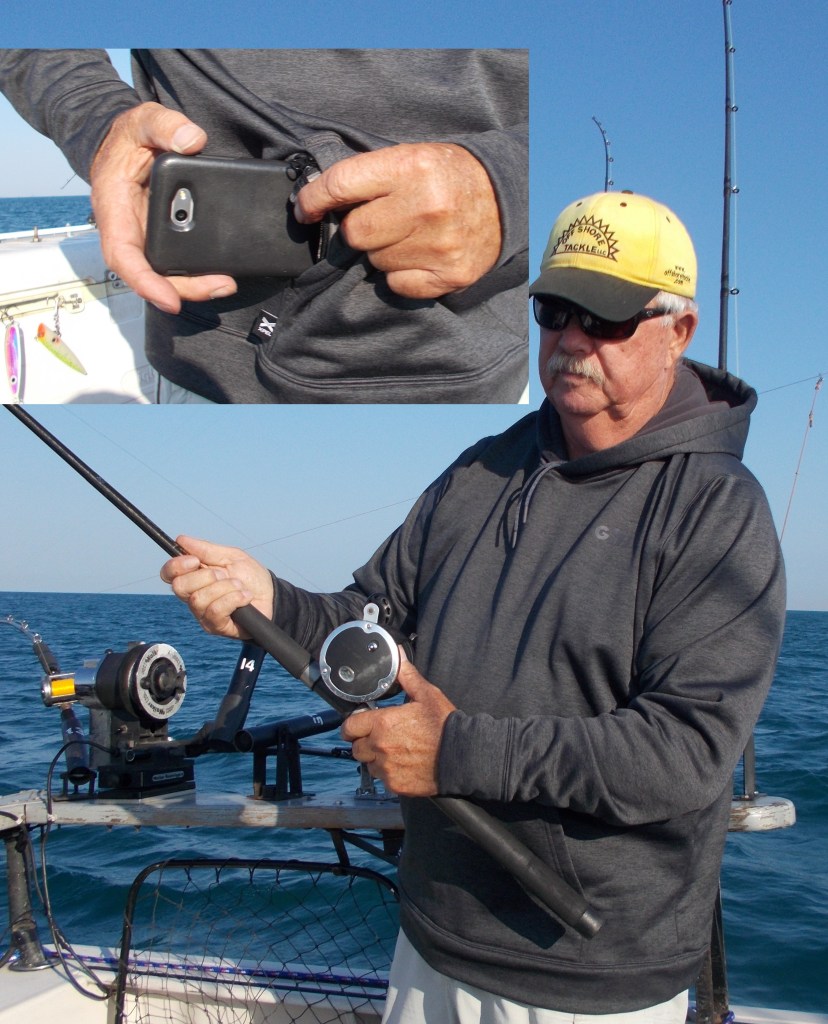
There’s no display unit to mount somewhere on the boat. Instead, the probes “report” to a receiver (a black box which can mount anywhere on the boat) and the receiver sends a Bluetooth signal to your Android SmartPhone. Here’s the kicker – the SmartPhone App will monitor up to six probes simultaneously – showing the true depth at the probe and the speed at the probe if the speed attachment is mounted.  Available from http://www.smarttroll.com.