I write the Tackle and Toys column for Great Lakes Angler magazine. Posts to this blog are about items I've personally tested on my own boat or when fishing elsewhere. These products (fishing toys) are the best of the best and I whole-heartedly endorse.
I’ve used a variety of DIY methods and home made tools to remove used line from my reels. I’ve tried a few “store-boughts” that frankly, don’t work much better than sticking a nail in a power drill. Finally, a line stripper that not-only works but it works better than any I’ve used previously. It’s called the Line Stripper Max from Berkley and it couldn’t be more simple.
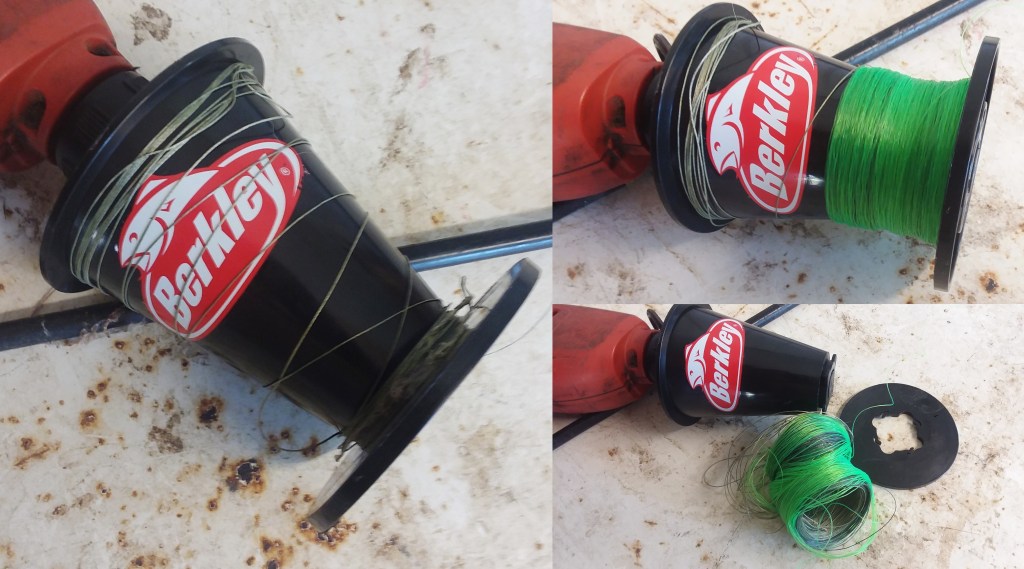
Fasten the line stripper to any powerdrill. The axle is inside the tool so it will sit on a shelf or in a drawer comfortably when not in use. There’s a flange at the top to keep the line from flipping off and winding on the chuck of the drill. That happens frequently when using a nail.
Tie the line to the cone-shaped arbor, then manually make a few wraps of line to make the line snug-up and not slip when the drill is turned on. Then trigger the drill and the used line will pile on the line stripper.
Then comes the clever part of the tool. Once the line is removed from the reel (or several reels) just twist the flange on the narrow end of the cone to remove it. Once the flange pops off the line will easily slide off. Replace the flange and “Max” is ready for next time. Dispose of the used line by taking it to a special recycling bin found at over 17-thousand marinas and tackle shops or mail it to Berkley Recyling, 1900 18th Street, Spirit Lake, Iowa, 51360.
The Line Stripper Max is available at retail outlets, online at a Amazon and other sellers or buy one straight from Berkley at: http://www.berkley-fishing.com.
If there is one thing I don’t like about inflatable life jackets it’s that they are single taskers. The rest of the garb I wear while fishing performs two or three functions. Gloves keep my hands warm, protects them from the sun, keeps them clean and wards off sticks from sharp walleye fins. Shirts, pants, hats and other wearables are multi-taskers as well.
Inflatable life jackets are single taskers. Granted, that task is important and can be a life saver, but since accidentally falling out of a boat or off a fishing pier is extremely rare, too many people don’t habitually wear them.
Evidently, the designers at Absolute Outdoors, maker of Onyx inflatable PFDs, realized this so they created the deluxe version of their popular and ultra-comfortable Auto/Manual Life Vest – “deluxe” means they’ve added pockets. It’s a simple thing, but now, instead of the life jacket being just a safety harness strapped on “just in case,” there are two zipper-close pockets (one on each side) to hold a cell phone, gloves, bait box or fishing tools. Or just stick you fingers inside the pocket to warm them up a bit on a chilly morning.
Onyx is a leader in the life jacket industry, with a variety of throwable cushions as well as inflatable and standard PFDs in sizes to fit infants to adults. All (including the A/M 24 Deluxe) are made with tough, long-lasting materials and constructed to exacting standards. The A/M in the name is for automatic or manual activation. The auto-inflate feature which causes the vest to instantly self-inflate when submerged in water can be disabled (if desired) for when the user is in a relatively non-dangerous situation – kayaking in relatively warm or shallow water, for instance. In the manual mode the vest won’t pop open if all the wearer needs to do is stand up or climb back into the boat or kayak but in an emergency a quick pull on the ripcord will inflate the vest.
Onyx life jackets are widely available from online sources as well as brick and mortar stores. Check out the M-24 A/M Deluxe Auto/Manual Inflatable Life Jacket and other products at www.onyxoutdoor.com.
Remember, life jackets only work if they are being worn and the more comfortable and more useful they are, the more likely it will be to make wearing one all the time an every time habit.
I learned the difference between relatively inexpensive or even cheap sunglasses and high quality sun-shades years ago. Number one, the comfort, stylishness, vision and protection from harmful UV radiation is better in the expensive glasses. Number two, most of the high quality brands are overpriced. Sure they come with lifetime or extremely long warranties and your girlfriend may be impressed, but really, are they worth 10X or even 20X the price of a pair of polarized lenses from Walmart? You be the judge.
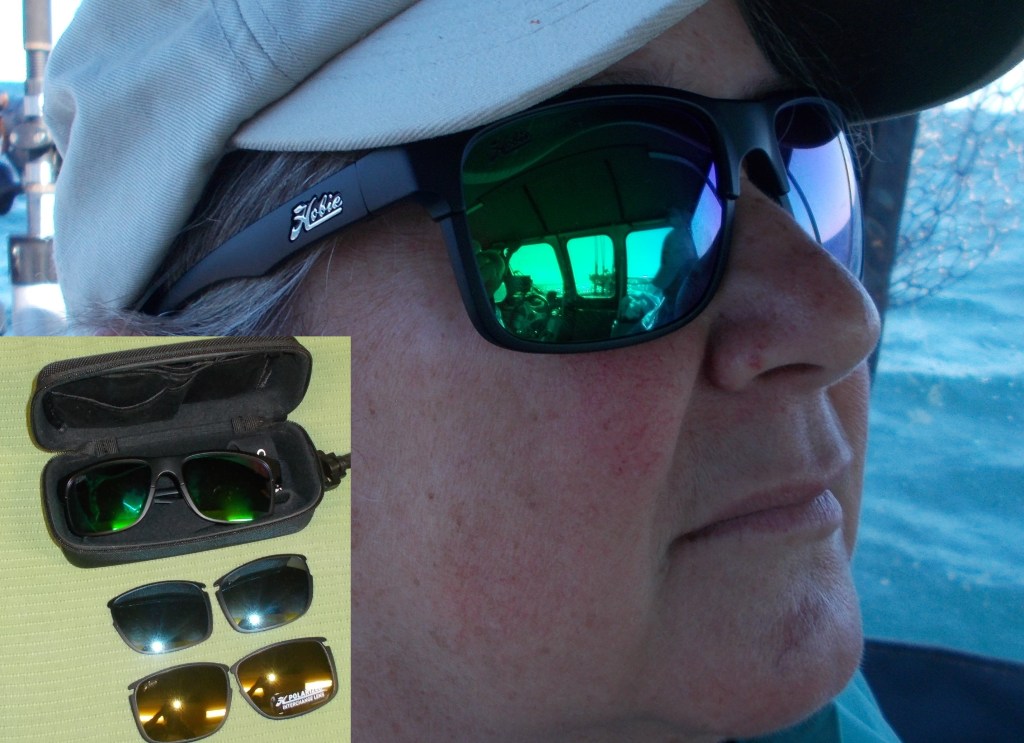
But also remember, whether your sunglasses are sub-twenty or north of two hundred for a pair, none of them are going to be good for all conditions. That’s what attracted me to the Huntington model from Hobie Eyewear. Not only do you get a stylish pair of sunglasses with a catchy logo on the temple arm, the base pair you order comes with a choice of one of the two mirror-lens colors or three of non-mirror colors (each color or mirror selection performs best for different conditions), then you can add additional lenses. Hobie Eyewear’s Huntington model features interchangeable lenses and you can purchase any or all of the colors if you wish.
Whether on the lake, at the dock or driving home different lenses help you see better. Weather conditions change. Bright sun, early morning, partly cloudy or overcast conditions can all occur – sometimes on the same fishing trip. Fishing conditions change, as well. Sight fishing for bass or looking for submerged structure requires different lenses than trolling in 150 feet of water.
I got the grey, non-mirrored lens set to use mostly for driving on the road. I added the unmirrored Sightmaster lenses, perfect for overcast, early or evening fishing as well as giving great performance allowing me to see what’s below the surface when fishing shallow. The set I use most on the open water is the Cobalt Blue Mirror lenses. These give the most protection in the brightest conditions. Mix or match – buy all the lenses for a full set and you still won’t approach the price of most “designer” shades. And you do get a lifetime warranty! They come with a case that has slots inside to hold the spare lenses when they are not on your face. Hobie Eyewear is widely available at online and retail outlets. Check out all their models including prescription and unsinkable versions at www.hobieeyewear.com
I probably wear boots more than half the time while I’m fishing on the Great Lakes. I wear boots 100 percent of the time when winter fishing. Basically, it’s only June through September that I hit the lakes with my feet unbooted.
I have lightweight “deck” boots for use in warm weather, I have heavily insulated boots I wear in March and early April to keep my toes warm and dry, but by late April, I need something in the middle. I found the perfect boot in the Dry Walker S-Track model.
I’ve also found a winter-use for these medium insulated boots, as well. There are plenty of times when my “temperature-minus” boots are perfect to wear all day. If I’m not going to be in a shelter, or I slap on the HD, but there are days when I’m going to be inside much or all of the time. Again, the S-Track model is the perfect answer.
The S-Track is molded from a tough EVA plastic material, so totally waterproof with the feel of sturdy leather. Add to this a thin, full-lenght, wool-felt insert to provide insulation. The boot slips on easily and the 12″ height provides plenty of protection when walking in slush, or when washing down a deck covered with early season fish slime.
The S-Tracks are multi-season, if you wish – and I wish. I slide out the felt liner and wear them as uninsulated muck boots. I pop them on in the uninsulated mode all season at some of the launch ramps I use where I have to get down to or past the water’s edge to hook or unhook the bow strap when loading the boat and at some of the fish-cleaning stations I use with what seem to be perpetually wet floors. With the liner removed, they are doubly easy to slip on or off.
Winter or summer, an aggressive tread on the bottom insures a solid, non-slip grip. Dry Walker boots are available at some retailers or online at http://www.drywalkerbootsusa.com.
Supply chain issues delayed the debut of Frabill’s new Vypr Tip Up enough that sales lagged during the “stock up” time of year for many ice fishing fans last year. Then, once they did hit the stores, buyers snapped them up so supplies were still short in many places. Not so, for this season.
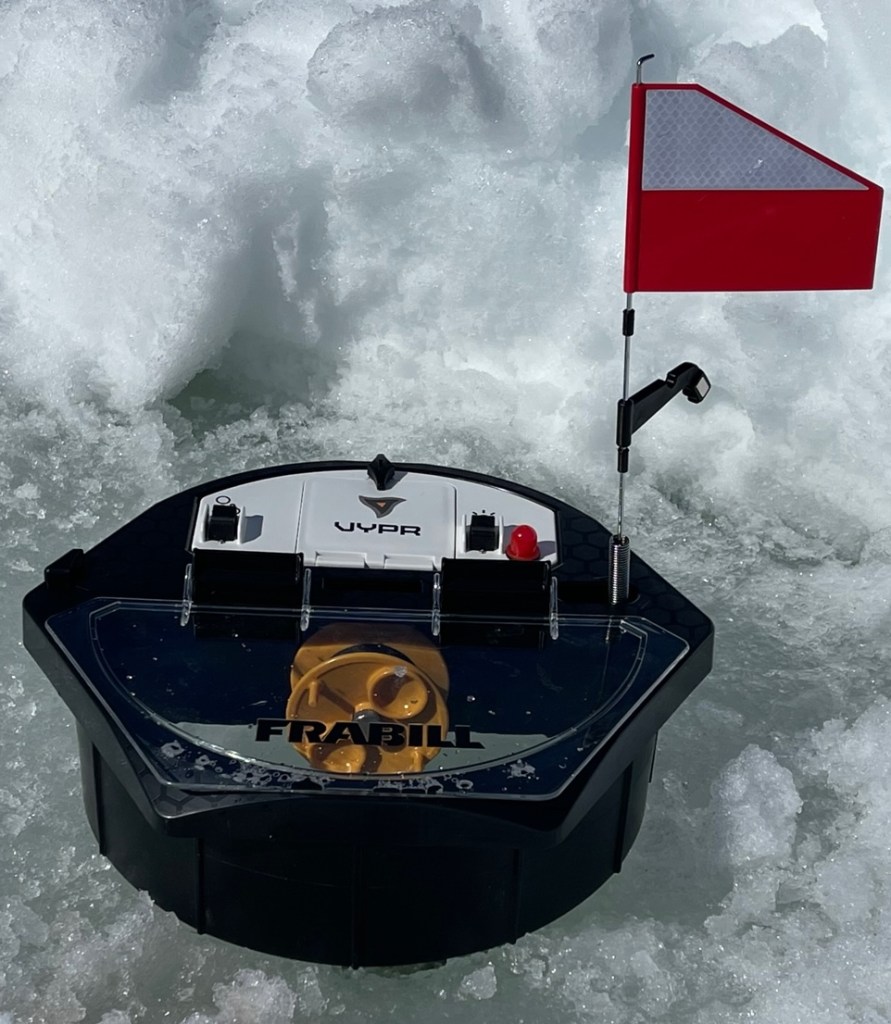
I had the chance to get one of these on the ice late in the year. The Frabill Vypr is packed with features. The one I liked the best was it did not let the hole freeze over, partially because of the lid that closes over the hole, but also because the battery operated aerator kept the hole clear of ice. I had a problem with the vinyl hose trying to coil up so I added a bubbler stone from the aquarium section to the end of the tube. The weight of the stone helped to ensure that the tube stayed in the water.
Another nice feature was having a straight-line spool with a variable tension nut. With that feature I was able to use light tension on the spool to better detect a bite from the smaller lake trout where it was tested. When using larger bait for northerns, just increase the tension on the spool so that larger, livelier baits don’t trip the strike indicator flag. It was also nice to have the clear window on the tip up so the person responding to the flag could see if the spool was still running when they first arrived.
Although I did not use them at night, the light that activates when the flag goes up would be very nice when sitting in your warm a shelter at night watching for a bite outside. Available at retailers across the ice belt, at many online sellers including Amazon or direct from www.frabill.com.
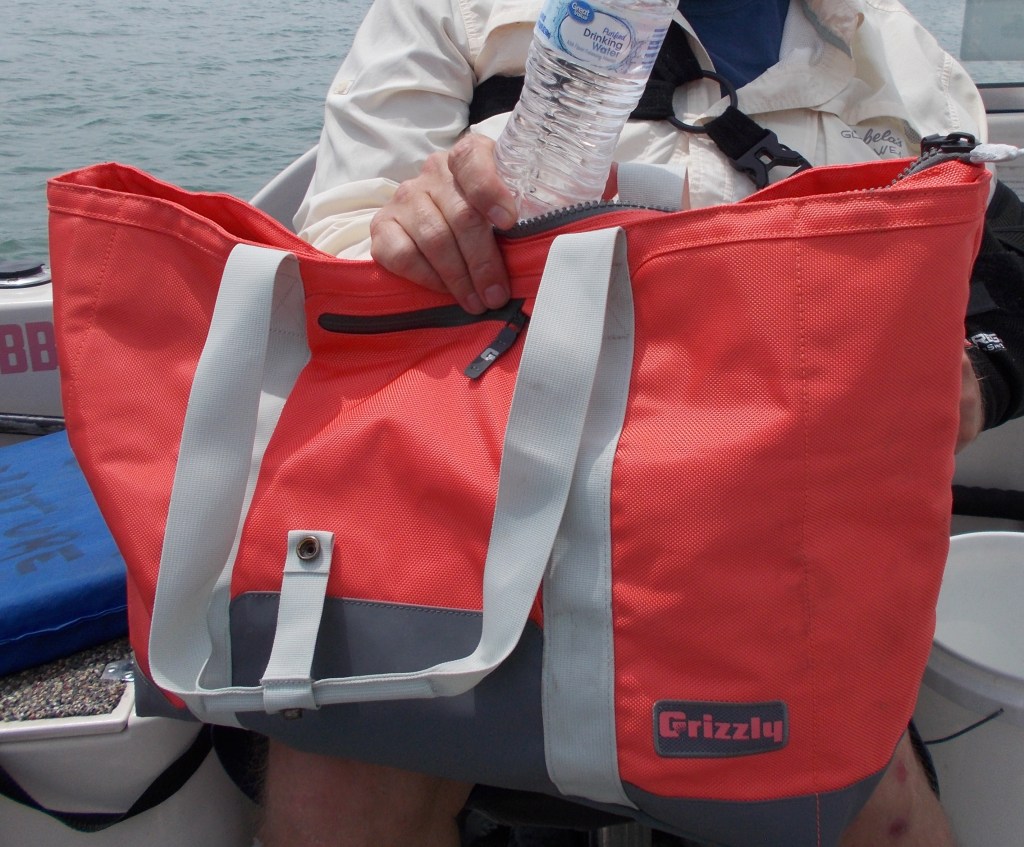
In the rotomolded cooler industry, Grizzly is one of the big dogs. Why not? Made in America, grizzly bear tough, Grizzly Coolers are the choice of many charter captains and hunting outfitters. So when Grizzly introduced their Drifter Carryall Bag, I expected big things from it. “Big” is one of the operative words, as well. With inside dimensions of 18 X 14 X 8 inches it will hold over eight gallons of stuff.
When I say stuff it’s because the bag isn’t designed just to be a soft-sided cooler – though it does that exceptionally well. As a cooler, it’s well insulated, so pack in a bunch of sandwiches, several cold drinks and add a couple of freezer packs. There’s room for lunch for the whole crew.
It has a thermoplastic, waterproof liner. That means it will keep any condensation or melting ice cubes from leaking out; and of course, it will keep water from the outside from going the other way. So use the bag for a dry bag on your boat to keep spray or rain from getting to spare clothes or other items that should be kept dry.
Traveling anglers will like it as well. I’ve used mine as a traveling cooler. I put it in my luggage where folds to the size of a hoody or pair of jeans, then use it as a cooler on day trips or to bring fish fillets home if the trip was successful. Jet-set anglers will appreciate that though it’s ample in size, it meets the carry-on luggage size requirements and will fit in overhead compartments on airplanes.
Available in pale orange, dark tan and teal blue, look for them at select retailers or online at http://www.grizzlycoolers.com
Using “wire line” to make Dipsey Divers go deeper than they would go using monofilament or braid has been a popular tactic for decades. Deeper is better when summer thermoclines pushed salmon and trout to depths reserved for downrigger fishing. Wire line also helps when deploying a pair of divers on each side of the boat, relying on the diver’s belly weight to dipsey them apart. The wire gives the divers a totally different dive curve than when using either mono or braid and that helps keep separation on the high diver and low diver.
Braid comes close to putting divers as deep down as wire, but anglers soon learned that wire often outfished braid in head-to-head competition. The only conclusion is the wire creates some sort of vibration as it cuts through the water that fish find attractive.
Thirty pound test, seven-strand wire is made by several different companies, and for years was the wire most anglers used. Many still do. It certainly works, but there were some drawbacks to it.
Primarily, it kinked easily and once kinked, no longer tested 30 pounds. And, it was abrasive to conventional rod guides so it required using rods with roller guides instead of rings. Those rods aren’t cheap.
Torpedo Fishing Products got it’s start making Torpedo Divers – a tool designed to take lures deep instead of, or as an addition to, downriggers or diving planers and it was soon learned that pairing the Torpedo Divers with wire, instead of monofilament or braid, provides the same fish catching advantage as it did with conventional divers.
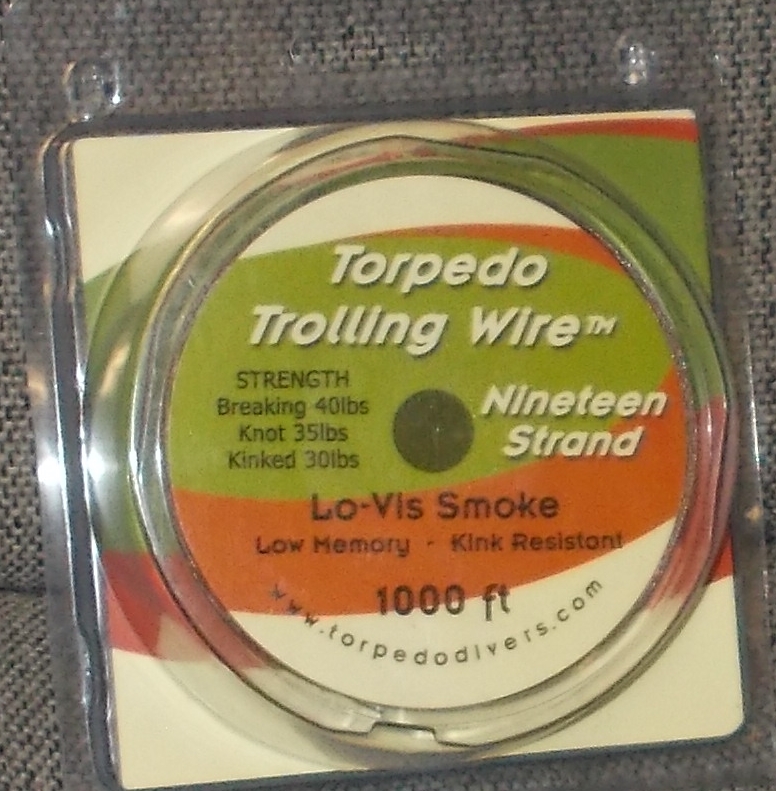
Was there an alternative, more user friendly wire line? The Torpedo Diver folks asked and answered this question by introducing a stranded wire line with a similar diameter built using 19 strands of micro-stainless steel wire instead of just seven, larger diameter wires. The result was mini-cable much smoother to the feel and more supple. That makes it easier to use and less prone to kinking. It also cuts through the water with less drag. Nineteen-strand is stronger to begin with, stated to be 40-pound test when new, 35-pound test when kinked and 30-pound test when tied in a knot.
Why tie it in a knot? Knotting it to the diver or the snap that will clip onto the diver is quicker, simpler and easier than crimping on sleeves to form a loop at the terminal end. That’s what I do – snipping off the knot and retying every few trips.
Most anglers still use their roller-guide rods when they switch to 19-strand wire. I don’t blame them, those roller guide rods are expensive. However, I know many anglers who use their 19 strand wire on moderately priced rods with Fuji SIC or other extra hard line guides. Weekend fishermen report getting several years out of a rod before they notice the line cutting grooves in these extra tough line guides. Even frequent fishers usually get a season or more, then they either buy new rods or just replace the worn guides with new ones.
If this all sounds good to you, let me mention one more selling point. I know dozens of anglers, from weekend fishermen to full time charter captains who switched from seven-strand wire to 19-strand on a trial basis. I don’t know any of these guys who ever switched back.
Nineteen-strand wire is available at many trolling oriented tackle shops, online at Amazon or order directly from Torpedo Fishing Products at http://www.torpedodivers.com
When Rapala invented the Shad Rap in 1982 it became an instant hit with walleye fishermen. Since then, millions of walleyes have started their journey from water to frying pan thanks to those lures. The surprising thing is the color selections available on those original lures was rather plain, by today’s standards. I could choose between silver-gray, chartreuse yellow, sky blue or dark gold. (I liked chartreuse the best for walleyes.)
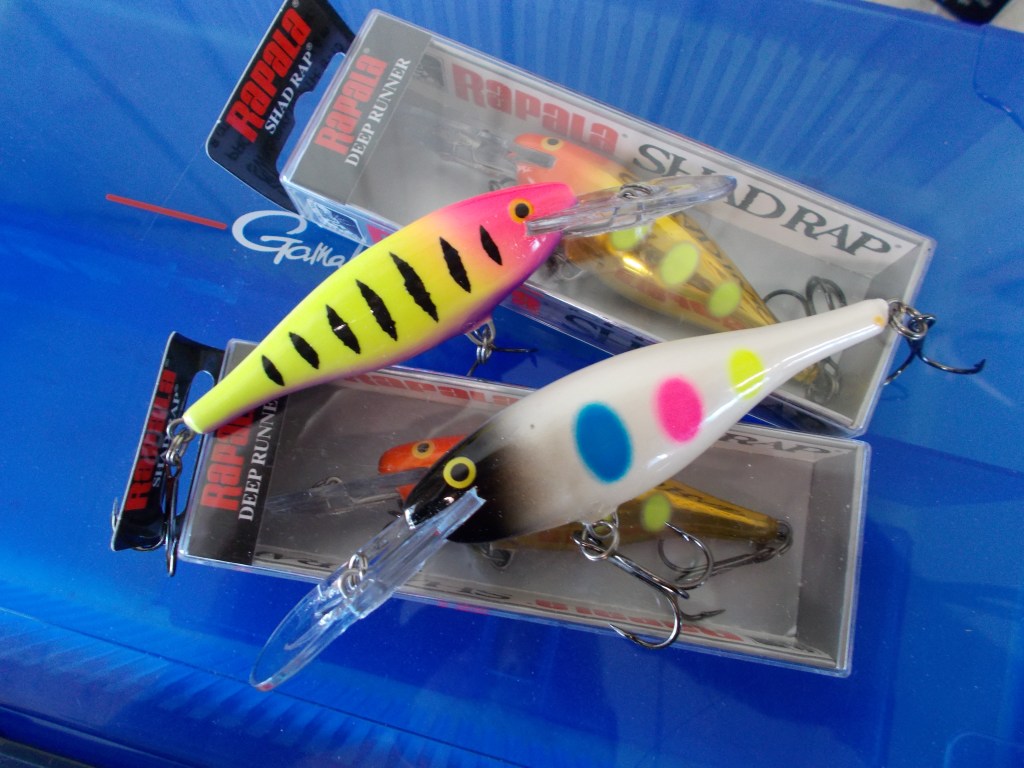
Additional colors showed up over the years – many of them designed strictly for bass or other species. Last year, the Rapala Shad Rap lure painters introduced a half-dozen new walleye-oriented patterns. All of them are winners. Especially on the Great Lakes, I expect more and more walleye guys to be reporting their Shad Raps in Jucy Lucy or Pink Squirrel did the job for them.
Other color names are Black Wonderbread, Headspin, Moldy Fruit and Voodoo Haze. I’ve used them enough (successfully) to be able to picture those color patterns just from their name. If you can’t picture Jucy Lucy, go to http://www.rapala.com to check out (or puchase) what she looks like as well as the other new Shad Rap colors that look good to you. Tip: Don’t think these are only for walleye, I’m sure plenty of bass, trout, salmon and other species will find these paint-jobs good enough to eat.
There are certainly some advantages for fishing with SpiderWire (or other braided lines) and there are certainly some advantages to having your lure or bait tied to fluorocarbon line. Each of those types of lines come with disadvantages, as well. To get the best of both, anglers across the country spool up with braid, but they tie on a fluorocarbon leader to put three or four feet of nearly invisible line between the end of the braid and the hooks they want the fish to bite down on.
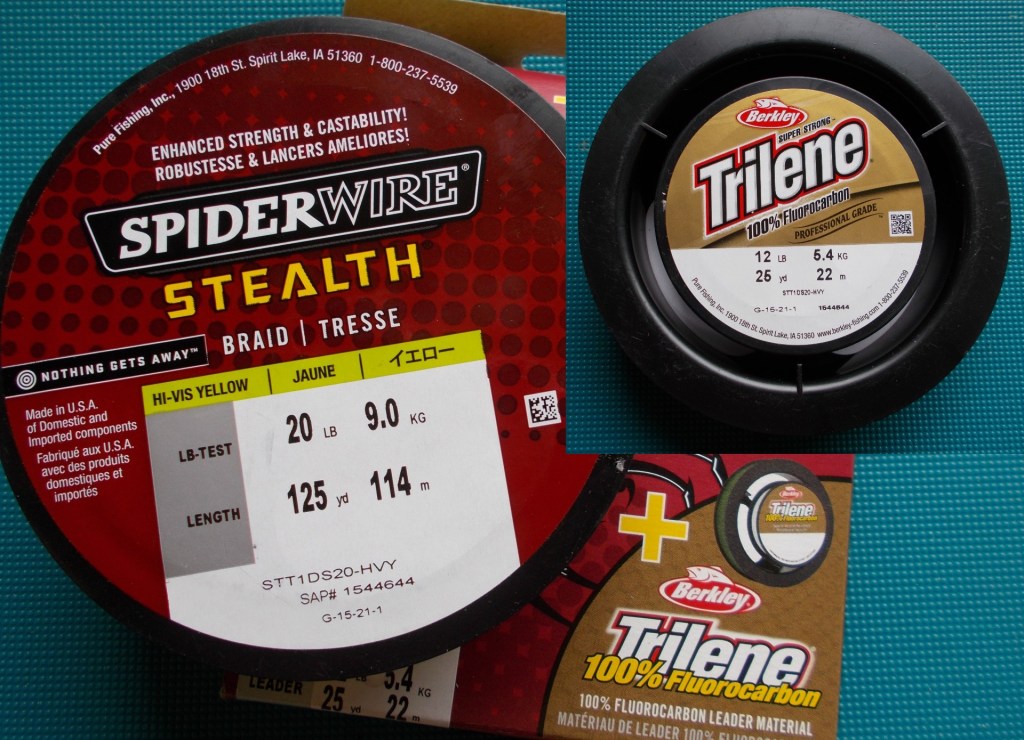
That’s what I often do and and now SpiderWire and Berkley (both owned by Pure Fishing) makes that easier than ever. To make things easier for braid/fluoro users, SpiderWire now offers a dual spool option in one package. A reel-filler spool of SpiderWire Stealth in either 8, 10, 15 or 20-pound break strength comes with an attached smaller spool of suitably strong fluorocarbon inside the back of the braided line’s spool. Choose either hi-vis yellow or moss green for the SpiderWire Stealth. Both SpiderWire Stealth and Trilene Fluorocarbon are personal favorites of mine that I have plenty of experience using.
Check out the braid/fluorocarbon options http://www.purefishing.com. All of these products are available at many retail and online outlets.
The emcee at the gathering read off the numbers on the winning raffle ticket, “801, 776,” then he scanned the room for a hand to go up. My wife, sitting next to me, raised hers.
I’d bought her a string of tickets for the fund raising raffle part of the evening. “What did I win?” she asked. “A St. Croix fishing rod,” I said. “Those are really good rods, great rods. Way to go!” She liked winning, I like the idea of adding a new fishing rod to “my” assortment. Peggy took personal liking to it and continues calling it “her” rod.
Regardless of who owns it and despite this 7′ 2″ rod (Model BAC72MHM) being specifically built and labeled as a bassin’ stick, the first fish hoisted to the surface with it, was a walleye Peggy cranked to the surface on a trip to the St. Clair River last spring. The fish didn’t know the difference and my wife didn’t care. She out fished me with the Bass X both in numbers and with the big fish of the day. Was it luck or her new rod?
After a couple of fish, I borrowed the rig from Peggy – just for a few minutes – to see how it felt. This is a rod crafted with St. Croix’s most durable carbon fiber called SCII but it doesn’t lose any of the sensitivity St. Croix’s rods are noted for having. With no-stretch braid between the rod tip and hooks, I could feel the blades on the crawler harness thumping in the current.
Often, sensitive means brittle. Not with this rod. Good thing! I don’t baby my gear – I fish with it and I’m not a finesse angler. When I secreted Peggy’s rod over to Lake Erie a few weeks later to fish for smallmouth, I stuck it to the bass with Peggy’s rod like a pro angler making a YouTube vid. The rod turned the bass I hooked when I set the hook, got them coming and kept them coming all the way to the boat. What more can you want? See all the Bass X rods at http://www.stcroixrods.com.
St. Croix rods are available at dealers listed on their website or just buy some raffle tickets. You could be a winner!




 FISHING TOYS