

Reviewed by: CAPT. MIKE SCHOONVELD
When I’m reviewing, say, a spinning reel, it’s easy to just evaluate the basic parts of the reel without comparing the reel or the features to other models and/or other brands. There are hundreds of brands and models of spinning reels.
When I’m reviewing Scotty’s entry into the speed/temperature/depth (STD) probe market that’s different. There aren’t hundreds of comparable products being used in and on the Great Lakes. There are perhaps a half dozen or so somewhat similar products and only a few of them that do what Scotty’s Seeker unit does. So, it’s tempting to compare how the Seeker unit compares with the few other brands I’ve used.
No need, it stacks up as well or better than other brands. I’ll try to mention the features that make Scotty’s Seeker different if not better than the others.
In many places, at many times of the year – especially during the warm months of the year – a tool that shows STD of the water where a lure is being trolled can be the most important electronic gizmo on the boat. In the warm months, the surface water is often too warm in the Great Lakes, but warm water floats on cooler water so having a tool that measures the subsurface temperatures allows the angler to put the lure in the perfect temperature for the fish.
Once that is found, the next thing is to ensure the lures being presented to those fish are being trolled at their optimum speed. All of the popular models and brands do this quite well. So does the SEEKER – and more.
Here’s the more. Probes that rely on the amount of downrigger cable to show the depth they are being pulled are assuming the downrigger’s line meter is accurate. Few are. No big deal, if you catch a fish when the ‘rigger indicates the weight is 85 feet deep, put the weight at 85 feet when the lure is reset.
However, what if the downrigger weight and lure is really only trolling at 65 or 70 feet deep? That’s not out of the realm of possibility since the ‘rigger could over-count the true amount of deployed cable and if trolling at medium or fast speeds, the amount of blow-back (the amount of deflection caused by the drag on the downrigger weight, the probe, the fishing line and cable) can make the true depth significantly shallower than the downrigger’s line counter shows.
The Seeker’s probe has a depth sensor in it that measures the water pressure and accurately measures the true depth it’s running. In the above scenario, I’d still reset the weight at 85 feet, but I’d know if the Seeker probe is really only 67 feet below the surface and finding the right water temperature, I can use that info to get the lures pulled deep by my Dipsey Divers or copper line at the right depth.
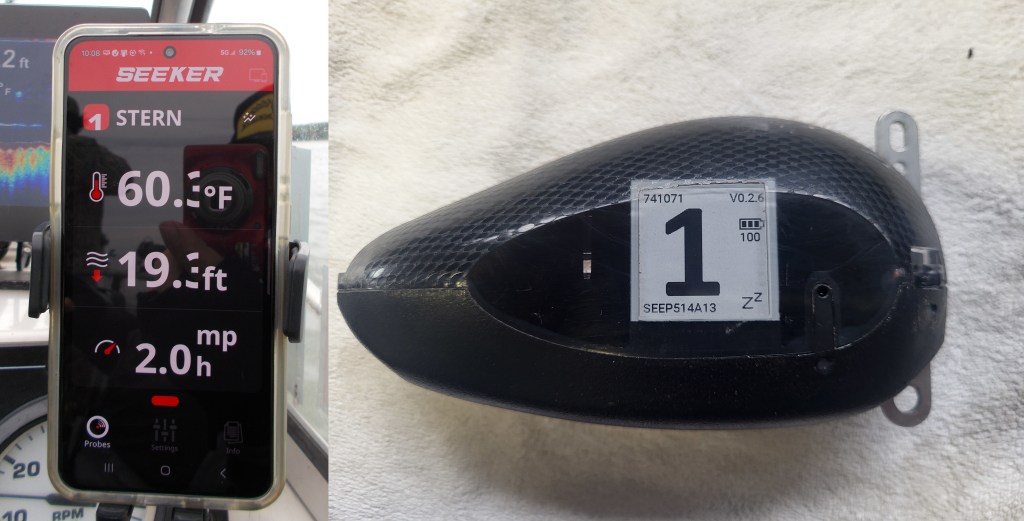
A part of the blow-back is caused by the bulk of the probe so the smaller and sleeker the probe, the better. The Seeker’s probe passes that test. It’s sleek and even the paddlewheel that measures the speed is set so the water spinning the wheel is just hitting the tips.
One of the selling points that makes the Seeker unique is that all the other STD units rely on a stand-alone display mounted somewhere on the boat to show what’s happening in the depths. The information from the Seeker displays on one of the screens you probably already own. Just plug a cable into the ethernet socket at the rear of your Garmin, Raymarine, Lowrance or other brand of multi-function display and monitor the SDT.
Or do what I did. I have an Raymarine Axiom MFD unit, but rather than connecting to it directly, I chose to just download the Seeker app on my cell phone and sync the Seeker’s onboard hub to my cell phone via BlueTooth. My cell is already mounted at the helm with a Scotty cell phone holder and most of the time it’s just sitting there. It might as well show the SDT info while it’s on standby waiting for a call or text.
Want more information at your finger tips? Add additional probes (up to four). When the currents are really cranking after a blow, putting an additional probe in the lake can let you track your lure speeds (as well as temperatures) at various depths in or out of the currents.
The Seeker’s probes contain rechargeable lithium batteries so no annoying battery failures. The recharging dock can plug in to a USB port on the boat or to a 120V receptacle l with a USB adaptor anywhere. I’ve been told the unit will work up to 40 hours on a charge. I charge mine after every few trips.
More information (especially technical data) can be found at www.scotty.com. Scotty doesn’t sell retail on their website, but they do list their dealers in the US and Canada and they sell through many online retailers including Amazon.
 FISHING TOYS