I don’t know about you but at times I get irked when I’m looking at (or trying to look at) the screens on two of my electronics when I’m wearing a pair of polarized sunglasses and all I see is a dark, blank, nothing. If I tilt my head off to the side the marks, letters or numbers on the screen become visible but isn’t there something better?
That’s what the founder of the RLVNT company tackled soon after he left the optics company he working for to start his own business. Few fishermen want to give up the advantage of using polarized lenses to be able to see into the water. “Isn’t there another way?” he thought.
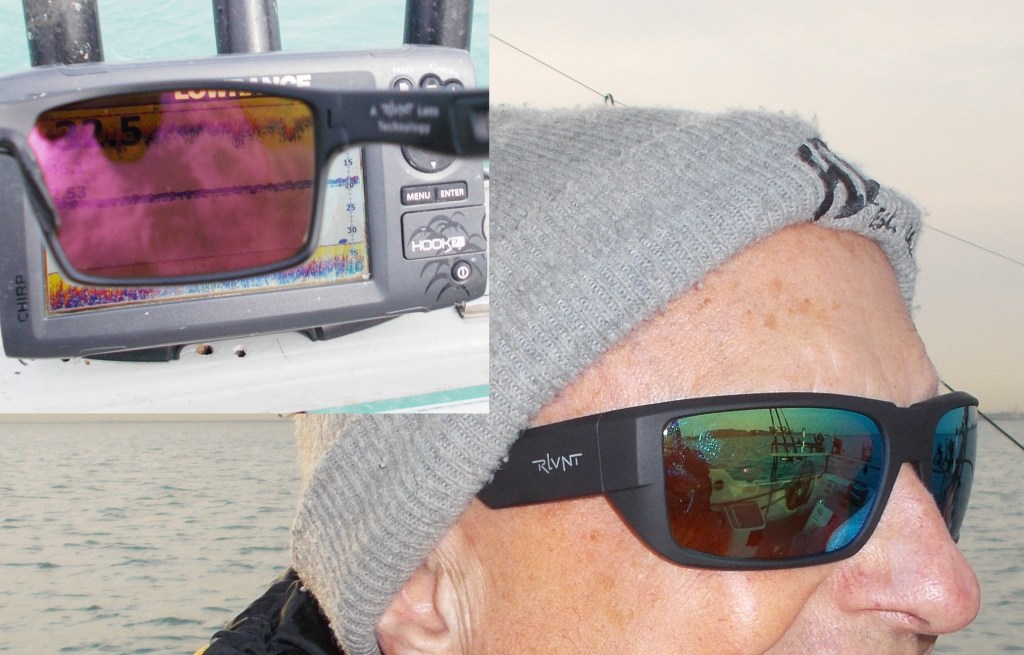
Yes was the answer. First, scrap the traditionally polarized lenses which block the whole spectrum of visible light when it reflects off the water. That’s what gives them better underwater visibility. Instead, he applies a film that turns down the reflection of most colors of the spectrum, but enhances the greens. The result is an enhanced look at weeds or other underwater objects but still reduces glare as with traditional polarization.
Most important, when you look at your sonar screen, it’s not blacked out. Sure it’s not as bright as if you weren’t wearing sunglasses, but you can see fish marks, bottom contours and other info, or when using forward facing sonar, you can see your lure and the fish.
But wait! There’s more! The Chameleon Lens option is perfect for bright sunny days, not so sunny days or on partly cloudy situations when the passing clouds change the light level frequently. You’ll get all day, all weather use since the lenses are photochromic and auto adjust to changing light levels. They filter less light when it’s cloudy, then instantly darken when the sun pops out and you need a darker lens to be comfortable.
I chose the Renegade model since I like to make sure no light gets to my eyes from the side. The wide earpiece on the Renegade shutters the side light. They still look good, feel good and they work perfectly day-in, day out.
The Renegade and all the other models are available at www.rlvnt.life as well as many other retail and online outlets including Amazon.
When I’m reviewing, say, a spinning reel, it’s easy to just evaluate the basic parts of the reel without comparing the reel or the features to other models and/or other brands. There are hundreds of brands and models of spinning reels.
When I’m reviewing Scotty’s entry into the speed/temperature/depth (STD) probe market that’s different. There aren’t hundreds of comparable products being used in and on the Great Lakes. There are perhaps a half dozen or so somewhat similar products and only a few of them that do what Scotty’s Seeker unit does. So, it’s tempting to compare how the Seeker unit compares with the few other brands I’ve used.
No need, it stacks up as well or better than other brands. I’ll try to mention the features that make Scotty’s Seeker different if not better than the others.
In many places, at many times of the year – especially during the warm months of the year – a tool that shows STD of the water where a lure is being trolled can be the most important electronic gizmo on the boat. In the warm months, the surface water is often too warm in the Great Lakes, but warm water floats on cooler water so having a tool that measures the subsurface temperatures allows the angler to put the lure in the perfect temperature for the fish.
Once that is found, the next thing is to ensure the lures being presented to those fish are being trolled at their optimum speed. All of the popular models and brands do this quite well. So does the SEEKER – and more.
Here’s the more. Probes that rely on the amount of downrigger cable to show the depth they are being pulled are assuming the downrigger’s line meter is accurate. Few are. No big deal, if you catch a fish when the ‘rigger indicates the weight is 85 feet deep, put the weight at 85 feet when the lure is reset.
However, what if the downrigger weight and lure is really only trolling at 65 or 70 feet deep? That’s not out of the realm of possibility since the ‘rigger could over-count the true amount of deployed cable and if trolling at medium or fast speeds, the amount of blow-back (the amount of deflection caused by the drag on the downrigger weight, the probe, the fishing line and cable) can make the true depth significantly shallower than the downrigger’s line counter shows.
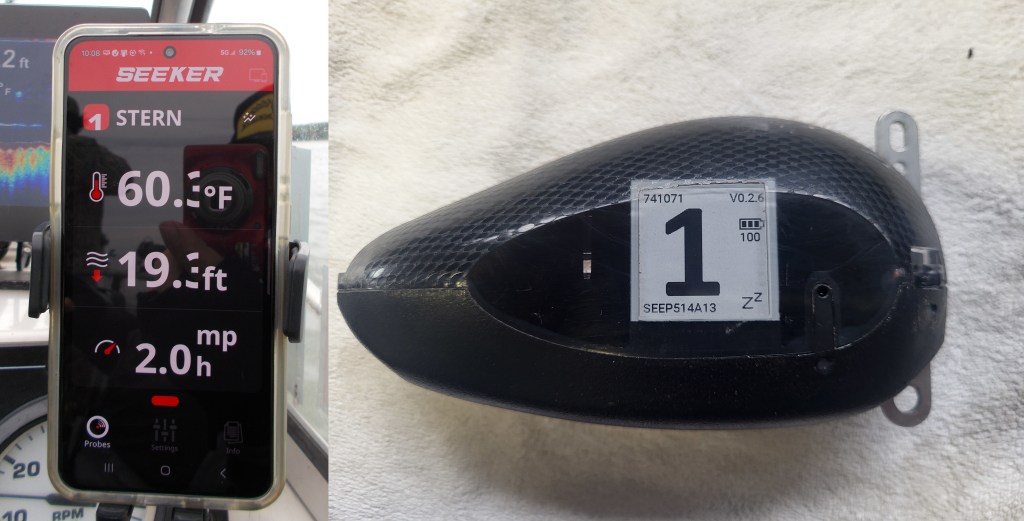
The Seeker’s probe has a depth sensor in it that measures the water pressure and accurately measures the true depth it’s running. In the above scenario, I’d still reset the weight at 85 feet, but I’d know if the Seeker probe is really only 67 feet below the surface and finding the right water temperature, I can use that info to get the lures pulled deep by my Dipsey Divers or copper line at the right depth.
A part of the blow-back is caused by the bulk of the probe so the smaller and sleeker the probe, the better. The Seeker’s probe passes that test. It’s sleek and even the paddlewheel that measures the speed is set so the water spinning the wheel is just hitting the tips.
One of the selling points that makes the Seeker unique is that all the other STD units rely on a stand-alone display mounted somewhere on the boat to show what’s happening in the depths. The information from the Seeker displays on one of the screens you probably already own. Just plug a cable into the ethernet socket at the rear of your Garmin, Raymarine, Lowrance or other brand of multi-function display and monitor the SDT.
Or do what I did. I have an Raymarine Axiom MFD unit, but rather than connecting to it directly, I chose to just download the Seeker app on my cell phone and sync the Seeker’s onboard hub to my cell phone via BlueTooth. My cell is already mounted at the helm with a Scotty cell phone holder and most of the time it’s just sitting there. It might as well show the SDT info while it’s on standby waiting for a call or text.
Want more information at your finger tips? Add additional probes (up to four). When the currents are really cranking after a blow, putting an additional probe in the lake can let you track your lure speeds (as well as temperatures) at various depths in or out of the currents.
The Seeker’s probes contain rechargeable lithium batteries so no annoying battery failures. The recharging dock can plug in to a USB port on the boat or to a 120V receptacle l with a USB adaptor anywhere. I’ve been told the unit will work up to 40 hours on a charge. I charge mine after every few trips.
More information (especially technical data) can be found at www.scotty.com. Scotty doesn’t sell retail on their website, but they do list their dealers in the US and Canada and they sell through many online retailers including Amazon.
Many marinas or boat access sites don’t have fish cleaning facilities but many anglers want to clean their catch before heading home. If that’s you or that’s the place you launch, Toadfish’s Stowaway Filet System can save the day.
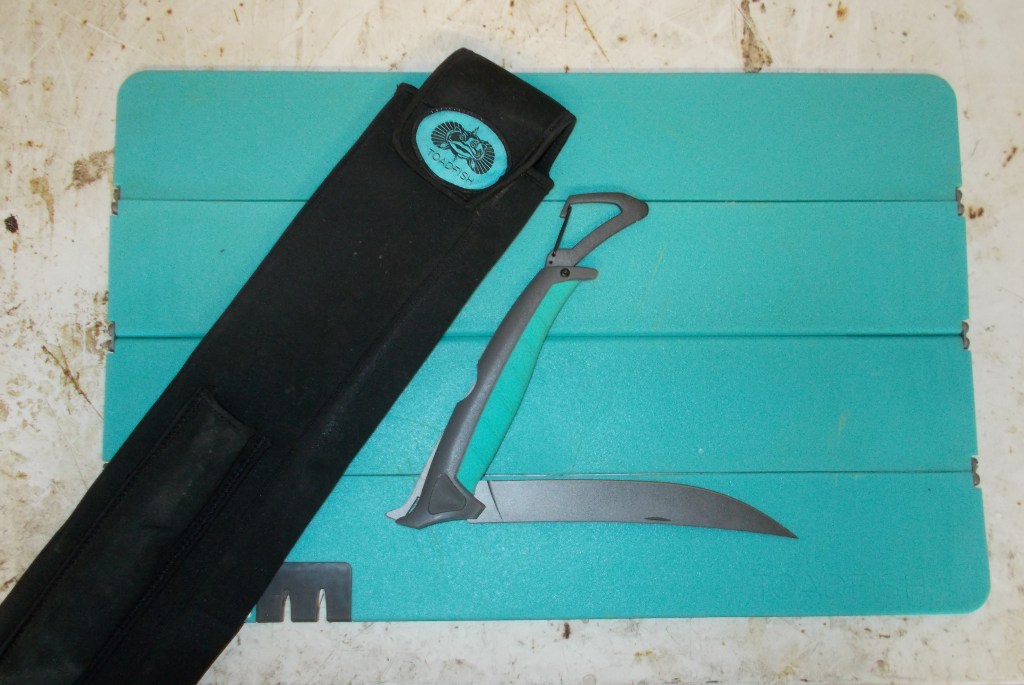
Toadfish, a company with an eclectic assortment of outdoor products, has produced a folding cutting board – the large size is 14X22 inches when it’s opened flat and it rolls up to the size of a 22-inch-long two-by-four (1.5 X 3.5 inches). Made of four hinged slats made from dishwasher safe high-density polyethylene, it has stainless steel hinges and built in magnets to hold it shut when not in use. When rolled open the bottom side has anti-skid material to keep if from sliding around when in use. One edge has a two-stage (carbide + ceramic) knife sharpener to keep your fillet knife razor sharp.
The cutting board is a great product on its own, but I’ve been wanting to get a quality folding fillet knife to add to my collection. That’s why I chose the Toadfish “system” that includes a high-quality folding fillet knife as well as tough neoprene sheath that contains the folded cutting board and features a snug pocket on the outside to hold the folded-up knife. I tested the extra-large size kit that matches the 22” board with the 8.5” knife.
Sadly, I’ve been in several fish cleaning stations that were just plain disgusting. Even in the nice ones, how well do you think the cutting boards or the surfaces designed to be used for cutting fish have been sanitized? Most get a quick squirt of a hose to remove obvious blood and gore, but what about the germs and bacteria festering there?
I’m not a germaphobe; but still, I always bring my own cutting board along that I know is clean and relatively germ free. Even in my pick-up, the compact size is welcome and ready to use.
Check out this and other Toadfish products at www.toadfish.com. Purchase them there, at some retailers and at numerous online sellers including Amazon.
There are very few heated fish cleaning stations at marinas or access sites around the Great Lakes. Many marinas and access sites don’t even have a dedicated facility to clean fish.
My fishing season starts long before the cleaning station is open and I’ve seen and used plenty of innovative ways to clean the fish I catch before heading home. Over the winter I got a new one – a tailgate sized cutting board.
I’ve used the tailgate of my pick-up as a work bench many times and as a fish cleaning station a few times. It’s the perfect height, but the downside of using it as a fish cleaning location is the clean-up. Even when laying the largest sized cutting board I owned on the tailgate, there was always some blood or other, slimy fishy-stuff that drips off the board onto the tailgate.
Sure, that can be cleaned up, but doing so without spraying or sloshing water into the truck bed or onto the gear stowed in the bed is tedious. That’s why, when I saw the tailgate sized cutting board from North Lake Outdoors, I realized this two-foot by four-foot cutting board was the perfect answer.
When my fishing partner and I were back at the dock with our limit of cohos (including a bonus brown trout) in early March we lined up our fish on the board for a hero shot and then I went to work. By positioning the board with an inch or so overhanging the open tailgate the blood and slime just dripped off onto the asphalt. When finished, I leaned the board against the open tailgate, dipped a bucket of water from the lake and cleaned the blood, slime and scales off the cutting board, gave it a final rinse with bleach-water I’d brought from home and stowed it in the back of the truck for the next trip.
North Lake makes a slightly smaller 48” X 19” model and a “miniature” 16” X 32” board – all made in America, all made from food-grade polyethylene. Check them out and order one for yourself at www.northlakeoutdoors.com.
“**it Happens,” but luckily, most of the time, for most people, with a bit of planning, “it” can happen – more or less on schedule. Most of the time, a quick stop at a restroom before heading out for a day on the lake does the trick or a more or less comfortable delay until the end of the trip makes the time actually on the water **it-free. Then there’s the other times when the fishing schedule didn’t coincide with your body’s schedule. Suddenly, it’s time.
If you are fishing on a sizeable boat that has “indoor plumbing,” problem solved. For most of us on smaller boats hopefully, there has been some advance planning about this. The answer is having some sort of portable potty on board. A stiff-sided bucket is about as simple as it gets – there are also portable toilets costing a couple hundred dollars. Both are somewhat appropriate for various situations.
For most Great Lakes anglers, there are several other options – and luckily, a solution towards the less expensive end of the available types is often suitable. One of these is a portable toilet sold by Lee Fisher Sports. Basically, it’s a toilet seat that fits on a five-gallon bucket. Buy the seat only and hope it fits nicely atop a bucket you already have; but beware, all buckets are not identical. Buy the seat and the five-gallon bucket both from Lee Fisher and you know the top will fit the bottom. If your boat doesn’t have a storage area that will fit a five-gallon bucket LFS has 3.5-gallon buckets (only 11.5 inches high) that the seat will fit and the shorter bucket may store more easily.
I got the ISMART Portable Toilet “combo” to put on my boat – their deluxe model – which features the bucket, closable lid, TP holder and sturdy pair of handles. When **it happens on my boat, the deluxe model is what I want.
You do as you wish, but my ISMART Portable Toilet is not a multi-tasker. I don’t use the bucket assembly for other purposes. I have a storage area in which it fits and I keep the TP, some heavy-duty can liners, a bottle of hand-cleaner and some paper towels stowed inside the bucket for when it’s needed.
This unit is listed as an “Amazon’s Choice” at Amazon.com but I encourage you to visit www.leefishersports.com just to check out the hundreds of other fishing and outdoor products they carry.
Long ago, every fishing line company jumped into the race to produce their own version of braided line. Some of it was very good, some was very poor and history is littered with examples of both. One of the first brands to surge to the forefront was a brand called Power Pro. It’s early version dates back to 1997 and surged to the forefront in the fishing world.
For a while Power Pro was like Kleenex, in that when you ask someone for a Kleenex, you may get a Puffs, Ultra Soft or some other brand. Anglers often just called the braided line on their reel as Power Pro, even though it may have really been spooled with SpiderWire, Sufix or some other brand.
Most of the major line companies now offer several different versions of braided line, sometimes just to offer something new, but usually it’s to provide options that are created for special fishing conditions. Power Pro is no different; now offering versions designed for various conditions and in a variety of colors.
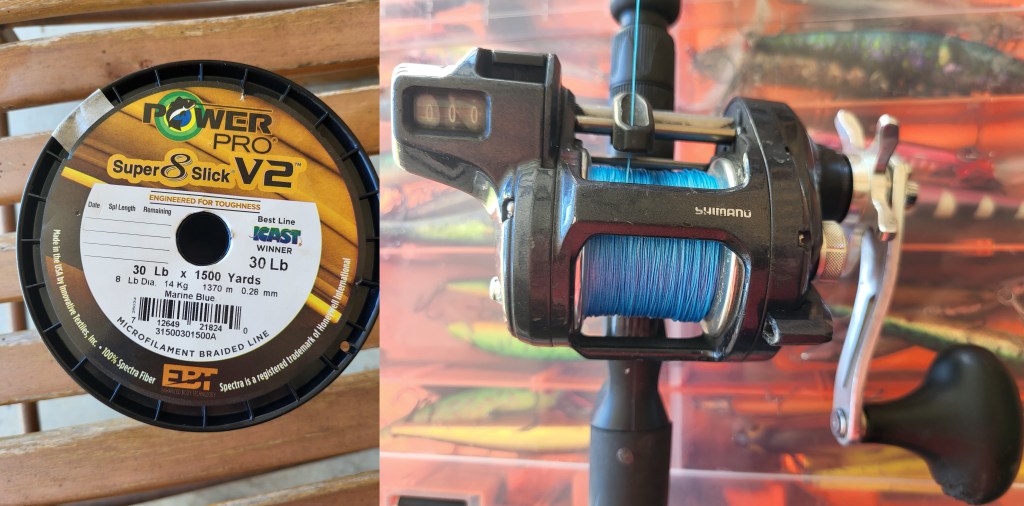
When I was respooling my reels with braided line this spring, when I got to the Shimano Tekota A that I use as my “braid” dipsey I immediately thought of the Power Pro Super Slick V2 I’d spotted at the ICAST show last summer. (Shimano has been making Power Pro since 2008 when they acquired the company that developed it originally.) This is the line that won the prestigious “Best New Product” award at the show.
I’ve been using braid on some of my diver set-ups for decades. Braided line is super thin and super strong and it has zero stretch. I can trip a diver (and so can a fish) whether there’s 20 feet of line between the rod tip and diver or 200 feet.
The Super Slick V2 is the smoothest (slick) eight-strand braided line I’ve found, so besides being thinner than most, the line passes through the water with less drag. I use 30-pound braid for diver trolling and I’m confident I’ll be getting the maximum depth with the minimum amount of line when using this Power Pro line.
Of course the color of the line makes no difference to the fish, but I like an easy-to-see line on my diver set-ups and the Marine Blue color fills that order quite nicely. Power Pro lines are available in a variety of spool sizes, colors and other options at retailers and online sources. Check them all out at www.powerpro.com
The Great Lakes is hockey country. Many people from Michigan, Wisconsin, Minnesota and the other Great Lakes states love their hockey as much as other sports fans love their “ball sports.” Many sports fans aren’t shy about displaying their favorite teams logos. I wear my Chicago Bears sweatshirts a lot – even in Wisconsin! My best fishing friend has Iowa Hawkeyes boat bumpers and seat covers for his boat. I’ve seen plenty of anglers wearing their Chicago Blackhawks coats while fishing for salmon on Lake Michigan and Detroit Redwings bling while on the Detroit River.
This isn’t review about “fan”-atics and their idiosyncrasies. It’s about landing nets, and there is a connection.
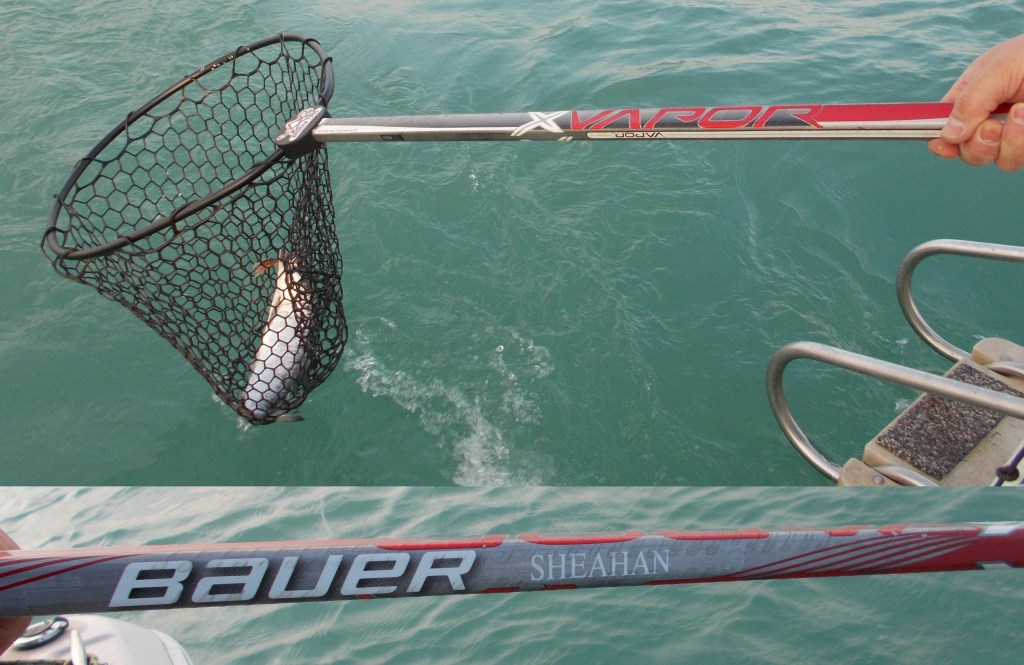
I’m always on the lookout for clever ways to repair or repurpose broken or well-used items rather than just tossing them away. Add these two things together and no wonder I was attracted to the small booth at a recent ICAST show called Broken Twig Landing Nets. They might call themselves “broken twig” but the twigs are actually broken or retired handles from hockey sticks.
One of the attributes of a good landing net is a light, strong handle. Most nets rely on aluminum, wood or fiberglass. One of the attributes of a good hockey stick handle is similar. It also has to be light and strong.
According to Chris LeMessurier, a hockey player, coach and owner/operator of Broken Twig Nets, the carbon fiber handles on modern hockey sticks are light, strong and a stick will last the average player the whole season and probably the following season. But when you move up to the collegiate level and more so to the NHL a good stick’s lifespan can be measured in days. Simply put, these hockey guys go through a lot of sticks like I go through trolling flies. I don’t know where all the tinsel on my used and abused flies end up but when defenseman breaks a stick, it heads for the trash heap and eventually to a landfill.
These days, however, some of these dead sticks head for Broken Twig Landing Nets, where Chris and family repurpose the cast offs as handles for landing nets and gaffs. How clever, especially for hockey fans who switch to fishing in the off-season.
Broken Twig nets are available at select dealers in Michigan and elsewhere or at their website: www.brokentwiglandingnets.com. Select from a variety of “twig” lengths and hoop sizes. The net I “test-scooped” was their largest size with 40-inch handle and a 21” X 18” hoop with a 20-inch deep rubber basket. Other, smaller sizes go all the way down to small bait scooper nets. Handles are available from a good number of NHL and college teams. The one I used was a recycled stick used by a former Red Wings’ player Riley Sheahan. You can pick a stick/net from your favorite team, but not a specific player.



 FISHING TOYS