MARUTO PREMIUM FISHING HOOKS

Reviewed by: CAPT. MIKE SCHOONVELD

There are okay fishing hooks, pretty good fishing hooks and really good fishing hooks. All of them will hook and hold some of the fish that bite on them, none of them will hook and hold all of the fish that bite on them. If hooking and holding the fish that bite on the hooks you are using is important, you probably want a premium hook on the end of your line.

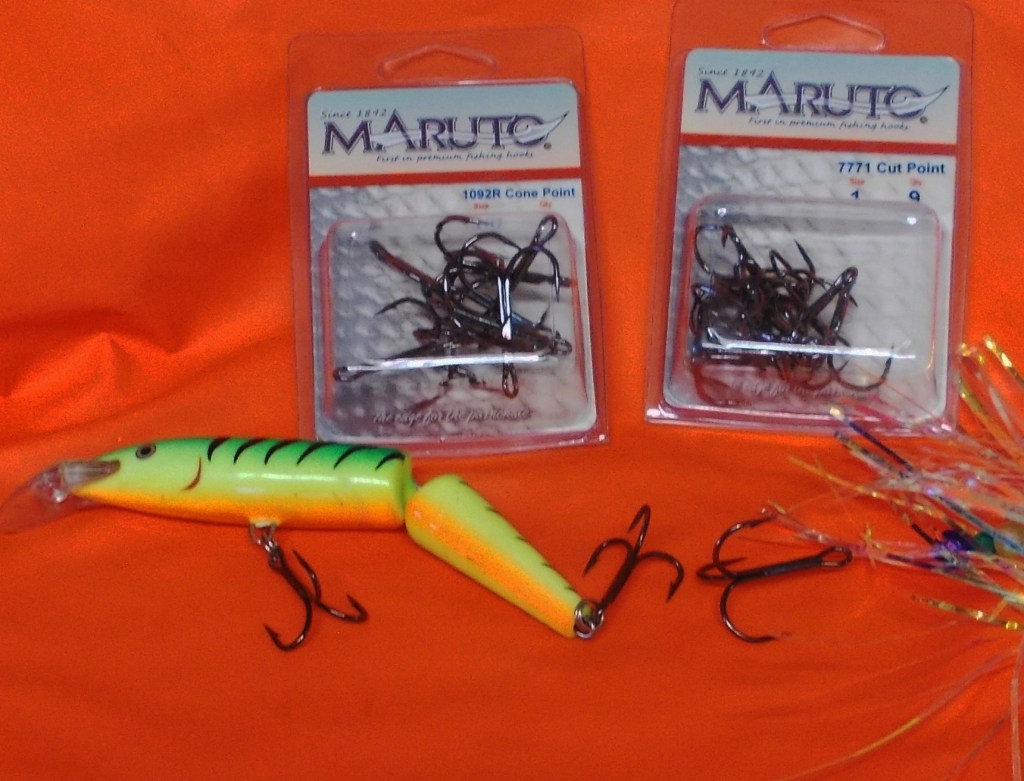
Just what does premium mean? To me, it’s strength, sharpness and consistency. I’d never heard of Maruto hooks until I stopped by their booth at the ICAST show last summer, but once there, I decided what I saw and heard deserved a closer look and subsequently I picked out a several models of these “made in Japan” hooks in several sizes to put on the end of my fishing lines.

I was planning a trip to Canada later in the summer and some of the places we heading were unique in that the lakes were filled with big fish and the regulations required the use of barbless hooks. Maruto is one of the few premium hook brands that feature barbless options – especially in the “full-sized” versions and in treble hooks. (Many brands only offer barbless options in the tiny, stream-trout sizes.) I’d rather replace the hook than try to smash the barbs down to make them barbless.

At the same time, I picked up a few packs of Maruto 7771 barbed trebles to use on my walleye and salmon lures. If you are like me, just bending a hook back to the right shape after a fish or a flopping fish bends it in their mouth or in the landing net isn’t good enough. I want hooks that are strong enough to resist bending without being just made using heavier gauge wire.

I outfitted some of my late summer, “fall kings” lures and several of my walleye lures I use to troll for late season trips to Lake Erie with Maruto 7771 trebles. I also selected some of their saltwater hooks to use on my annual winter pilgrimage to the Gulf of Mexico to fish for red snappers and other salty fish. Every hook Maruto hook performed exactly as I expected and those same hooks will be in my line-up this summer and next winter. Learn more about them and see all the types, sizes and colors and purchase at: http://www.anglerinnovations.com. Many styles are available at Amazon.com.
SILVER HORDE GLOW PLUGS

Reviewed by: CAPT. MIKE SCHOONVELD

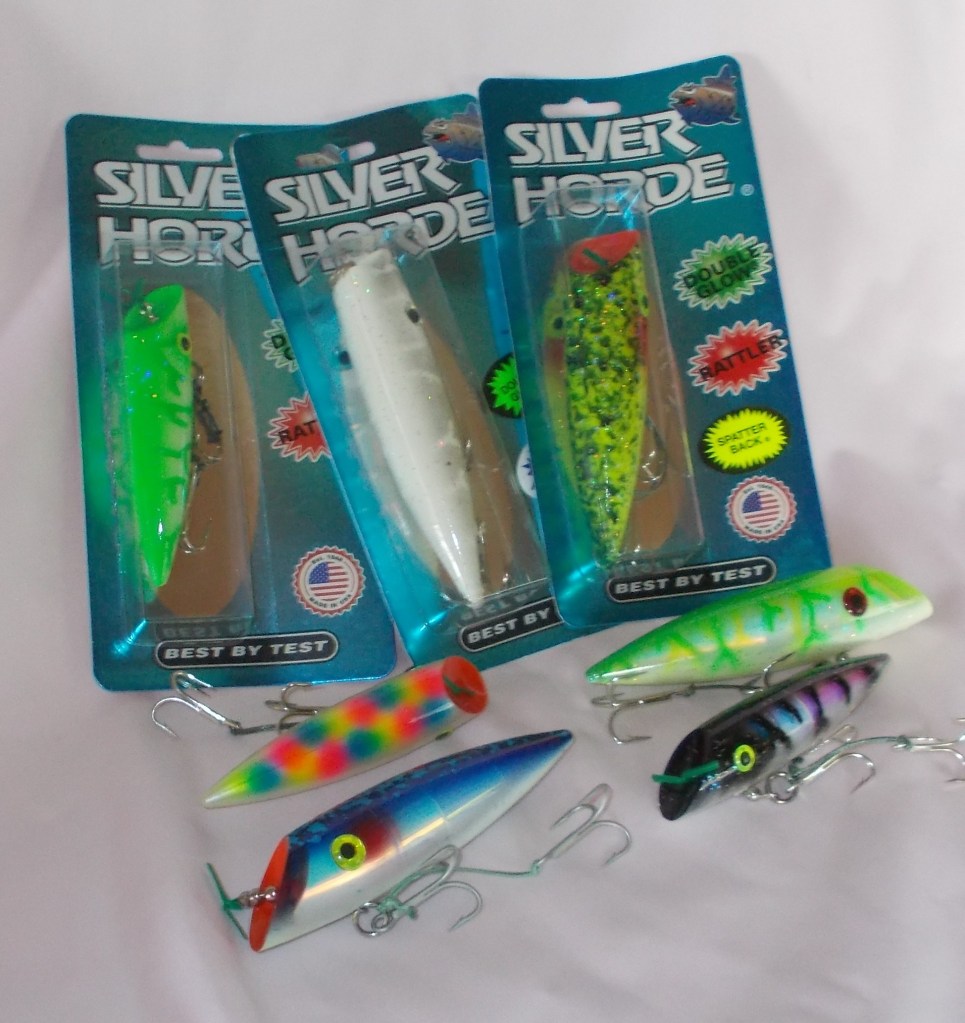
Silver Hoard was one of the originators of the “cut-plug” design of artificial lures made of plastic. The original plugs Silver Horde plugs were modelled after hand-carved, hand painted salmon lures. In the 1950, the founder of Silver Horde lures was the first company to make lures of this shape from plastic. Hand painting the lures at home made the company into a family business.

Still a family run business, the Silver Horde Company still offers their original Ace Hi plug and the slightly fatter Silver Horde plug along with spoons, dodgers, flashers, trolling flies and other tackle. One of their most popular colors in both their spoons, plugs and dodgers was one of their original colors – green spatter. 

The Green Splatter pattern is still available, still a favorite on the Great Lakes and out west, but it’s now painted with what they call Double Glow pigment. This color as well as a large number of other permutations of Double Glow have proven to be absolute king killers in August and September on the Great Lakes when some of the best action occurs in the dark or at the “dawn’s early light. (They are no slouch in the daylight, either.) 

Some of these new colors are also made with clear plastic with the painted colors and UV activated mylar inserted or painted inside to give the plugs a unique 3-D looking finish. Silver Hordes are offered in both rattling and non-rattling versions. If you want to add some storied, productive plugs to your line-up this fall, give a second or third look to the Silver Hordes in both the traditional and new color schemes. Check out all the Silver Horde products at www.silverhorde.com which also lists places to purchase them in your area. 

Hint:  In late summer and fall, I use the 4 ¾-inch versions. In the spring to mid-summer, I use the 4-inchers to catch kings, cohos, steelhead, browns and lakers. 

BERKLEY DEEP HIT STICKS

Reviewed by: CAPT. MIKE SCHOONVELD

On my first trip to Lake Erie last spring the walleyes were acting more like the fish I normally encounter in early to mid-autumn trips. They were deep. Whether it was the water temperature, the waves or where they were finding the baitfish I don’t know, but my usual deep divers that worked with 60 to 80 feet of line out behind the planers weren’t getting into the zone.

We compensated by letting out more line – much more line to get our lures 20 feet or deeper to get to the level the fish were showing on the sonar and where we were getting the bites. How much more line? With some of the lures, twice as much line was needed to get them in the zone.

If we had been fishing areas where we could troll a few miles without needing to turn, the extra line wouldn’t have been a big deal, but on the calm days we found the most active fish near the Bass Islands where islands were creating currents where the active fish were holding. On the windy days, we used the islands as a lee area where we could fish away from the whitecaps.

Long lines behind planer boards aren’t conducive to whipping around in tight turns without tangling one lure with their neighbors. It started to feel normal to reel in a fish hooked fish on one lure along with the lure that had been running in an adjacent position. It also caused more lost fish since the longer it takes to reel in a lightly hooked walleye, the better the chance for it to pop loose before getting it to the net.

Waddayagonnadoo? A part of fishing is coping with the weather conditions and the moods of the fish.

One of the ways to cope is to examine the “tools” at your disposal. Mostly we’d been using Bandit Walleye Deep Divers and #11 Flicker Minnows let out 140 feet and 120 feet respectively, to get them over 20 feet deep according to the Precision Trolling Data app. One of my friends opened his tackle box and showed a few Berkley #12 Deep Hit Sticks he’d picked up on sale at FishUSA (www.fishusa.com). “Want to try some of these?” he asked.

The colors looked good. “Check the Precision Trolling Data chart to see how much line we’ll need,” I said.

I was shocked to learn we could hit our minimum trolling depth with only 88 feet of line. I wasn’t surprised when the next fish was hooked with the Clown pattern Hit Stick he’d just put out. We added another Hit Stick (Blue Chrome) and in the next couple of days, these two Deep Hit Sticks became our go-to baits. Early in the day the FireTiger pattern was particularly hot, as well.

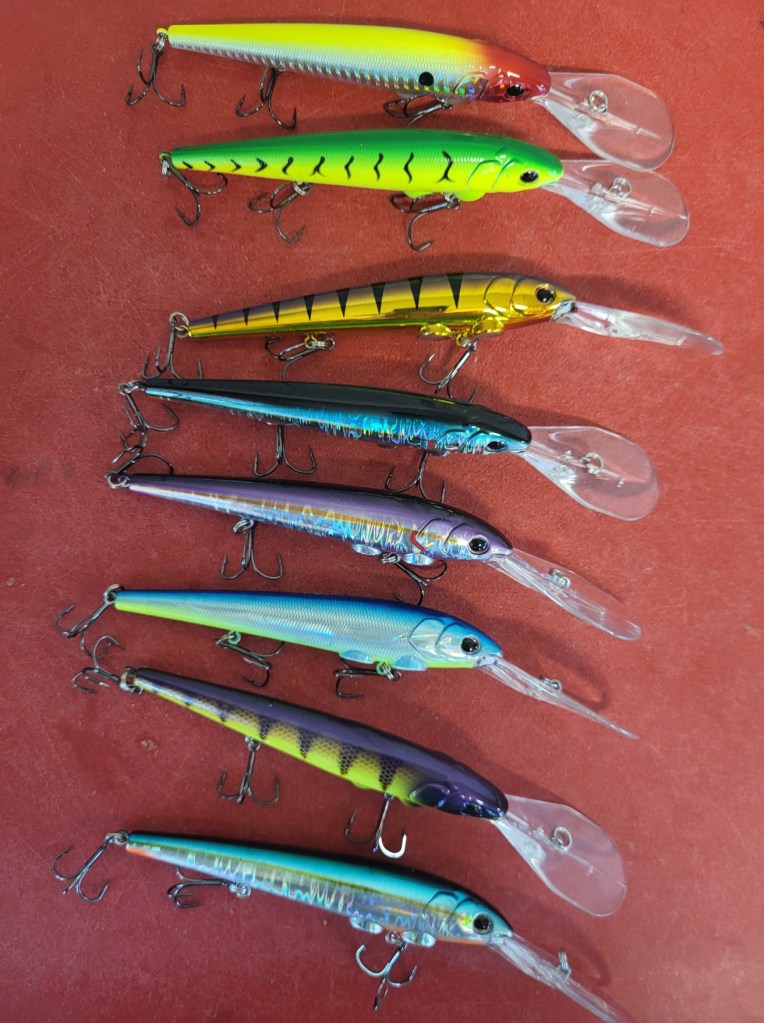
Hit Sticks come in 20 color patterns (check them out at www.berkley-fishing.com) but color is only one these lures’ enticements. They have a great tail-wagging action and there was nothing subtle about the internal rattles. The walleyes loved them. Though we started using them primarily because they had a much steeper dive curve, we appreciated that they were also fisherman-friendly.  Each of the half-dozen “sticks” my friend purchased ran perfectly, straight out of the box.

FISH HAWK LITHIUM PROBES

Reviewed by: CAPT. MIKE SCHOONVELD

Me along with countless other anglers have always had a love/hate relationship with their Fish Hawk Electronics X4 models or the X2 model speed and temp measuring systems. We love them because of the many times the information shown on the display is what puts us on fish or keeps us on fish. I’ve had days when it’s meant the difference between a fish in the cooler and limits of fish in the cooler.

 For me (at least) I hate them because of the battery operated probe that goes down to the depths and measures the speed of the lures at that depth and the water temperature. When it’s working properly, when the batteries are fresh enough, when I can get the cap off the probe without tools or when the O-ring on the cap isn’t leaking water inside – it’s an okay tool. I’ve never thought of any of these examples to be a certainty. Not every time, but often enough, it’s not working, the batteries are unexplainedly exhausted, there is water or at least dampness inside the probe.

 Though the battery-operated probe is smaller than similar electronics I’ve used in the past, it’s still quite large. It’s large enough to create blowback on the downrigger cable used to take it into the depths.  Blowback is cumulative. At 20 feet it’s negligible. At 50 feet (on your downrigger’s counter) the actual depth is probably off by 10 percent or so, depending on trolling speed. At 100 feet, it’s almost a wild-azz guess about the actual depth (not to mention the angle it’s being pulled through the water which affects the speed at depth reading.

 Still, the Fish Hawk unit is one of the best available and widely used in every Great Lake. That doesn’t mean it can’t be improved and Fish Hawk Electronics has made it better with the introduction of their Lithium Probes. One model is the Ultra Probe, compatible with their X4D Bluetooth System, their Pro Probe, compatible with X4 and X2 Systems.

 Lithium battery technology is changing almost every kind of electronic tools, eliminating the need for traditional AA, AAA or other types of batteries, they are longer lasting, they recharge more quickly and, important for the Fish Hawk probes, allowing battery powered devices to be made more compact. Fish Hawk says the Lithium Probes are 40% smaller than the battery operated probes. It looks smaller than that – and because the case is more hydrodynamic, it doesn’t create the drag when trolled through the water it acts smaller. That increases underwater accuracy. 

 I recharge the one I’ve been using all season after every few trips. FHE says it will recharge in two to four hours and the unit will operate 50 hours or more. A quick, 20 minute charge will give you about 8 hours of use.  I charge mine indoors since the probe has to sit on end on a charging pad. On a docked or stable boat, the charging pad will plug into anything with a USB port.

 I now have a mostly “love it,” hardly ever “detest it” relationship with my Fish Hawk X4 unit. I can say the same thing about most every electronic device I use on my boat.  The probes are available at www.fishhawkelectronics.com, as some retailers and plenty of online sellers including Amazon.com. 

SMITH’S BAIT AND FISH KILL BAG

Reviewed by: CAPT. MIKE SCHOONVELD

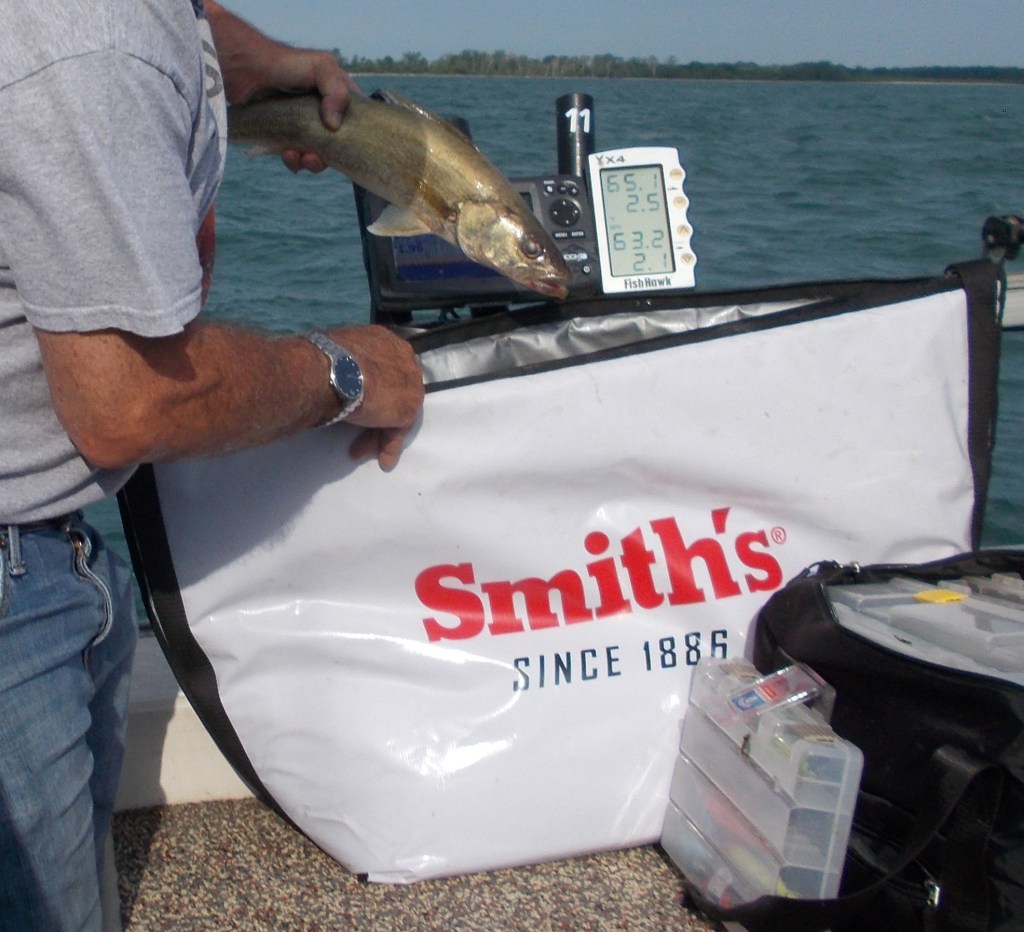
There was something missing on my boat last spring, a fish cooler. Often called a box or the fish box. If you don’t have a fish cooler on your boat, chances are you rely on stuffing the fish you catch and keep into a livewell or into a built-in fish storage compartment. My boat’s livewell must have been designed for perch fishing. It won’t hold a four-person limit of spring cohos and is certainly too small to hold a decent four-person bag of Lake Erie walleye.

 So I “bagged” the fish.  Actually, the fish went into Smith’s Products Insulated 36” Bait and Fish Kill Bag. Why not use my old IGLOO cooler? It takes up a lot of space.

Formerly, when my cooler was my only choice, I “made” space for it. It was a piece of necessary gear, so I economized on other gear to make everything fit with room left over for the fish box and the fishermen. Not now.

At the beginning of the day, the Kill Bag takes up almost no room. It doesn’t fold perfectly flat, it is insulated – front, back and bottom with closed cell foam, but a cooler is the same size whether it’s full or empty. Before the first fish is caught I add one or two small (7-pound) bags of ice – depending on air temperature. At that point the bag is about 1/3rd the size of my old fish cooler. On a good day, by the time it’s got 18 or 24 walleyes in the bag (or 15 or 20 cohos), it takes up about half the space of my fish cooler – and there’s space left over to hold a king, a big brown trout or several plus-size walleyes if the fishing was extra-good.

I had four concerns when switching from a hard-sided plastic cooler to a soft-sided kill bag. Would it be tough enough? Would it be hard to clean? Would it keep the fish cool and fresh? Would it be large enough?

The Smith’s bag is constructed (inside and out) with a heavy-duty, marine grade tarp-like fabric. I wasn’t overly concerned the sharp fins on the walleyes I put in the bag would perforate the interior lining, but that thought was in the back of my mind. So, after several walleye trips, I took a flashlight, put on my reader glasses and examined the interior closely so see if there were any visible holes. None were found, nor did I ever detect any leakage around the bottom seams from melting ice had dripping through the inner skin and leaking out the bottom. Additionally, the seams are reinforced with strong nylon strapping material made from the same material as the detachable carrying strap. Plenty tough.

Both the interior and exterior is slick-finish allowing fresh blood to just rinse off and even dried-on blood to wash clean with a minimum amount of scrubbing with a soft brush. Once it’s rinsed clean, I just invert it with the zipper open and to let it quickly dry. Cleans up easily.

Cooling ability? One sure indicator of how well it’s insulated is how much ice is left at the end of the trip. If all you have left in your fish cooler is melt water, it’s not doing the job. On my early spring trips when the air temperature and the water temperature (thus the fish temperatures) are in the 40s, that small bag of ice was still more ice than meltwater after a long half-day of fishing. Once the weather and water warmed, the second bag of ice still did the job. 

The 36” Bait and Fish Kill Bag is Smith’s middle size offering. It’s perfect for how I used it. Later in the season when king salmon and lake trout figure heavily into the catch where I fish, it wouldn’t be large enough. However, Smith makes a 48” kill bag that is advertised to be larger than my Igloo and there’s a smaller, 30-incher (called Mr. Crappie) that will hold several limits of perch or crappies.

Though the 30 and 36-inch versions are called “bait and fish kill bags,” I don’t think they’d be a good replacement for a bait bucket. Perhaps in a special situation, they’d be ideal – not on my boat. They do come with drain plugs at the bottom, however, to allow melt water from the ice or minnow water if used for bait to flow out the bottom. Available at www.smithsproducts.com at retailers and several online outlets including Amazon.