STUBBY DODGERS

Reviewed by: CAPT. MIKE SCHOONVELD

I don’t know how long ago metal trolling dodgers were invented, but it was long before salmon were introduced to the Great Lakes. With minor variations these relatively flat slabs of thin brass or steel all looked similar and were built with nearly identical proportions. A six-inch dodger was about two inches wide; an eight-inch long dodger was a bit less than three-inches wide.

That’s why I noticed several of the bright orange dodgers dangling on the rods being readied for action on the boat being preparing to launch just ahead of me. I don’t know if the word, “stubby” is what I thought, but I did notice the dodgers were out of proportion compared to every other dodger I’d ever seen. They were proportionately wider than any dodger I’d ever seen – roughly only twice as long as they were wide.

A few hours later I returned to the marina to find the angler with the “stubby” dodgers just finishing his chores at the fish cleaning station and the pile of fillets being packaged showed he’d had a successful trip. When I got home that day, the mailman had delivered my latest issue of Great Lakes Angler magazine and it was in this issue I noticed the advertisement posted by Gold Star for Stubby Dodgers.

 Due to the time-zone difference between the Great Lakes and Washington state, I was able to call Kelly Morrison, owner of Silver Hoard Fishing Supplies (who makes Gold Star dodgers), to ask about them. Long story short, Morrison said their Stubbies had earned a solid following by West Coast salmon trollers and they were betting their advertising dollars they’d be a hit in the Great Lakes.

 By the end of the week, I had some Stubby Dodgers on my boat and about three minutes after I’d slowed to trolling speed I had a coho thrashing on a trolling fly trailing 18-inches behind one of the Stubbies. About three minutes after coolering that coho, there was another coho on the same dodger and fly pulled under by a Dipsy Diver. If that wasn’t convincing enough, though it took about 10 minutes, the same set-up caught the third fish of the day – and that set-up continued being the “stud-rod” for the rest of the morning.

There’s no better lure for early season cohos in Southern Lake Michigan than a six-inch flame-red metal dodger trailing a half-sized tinsel fly. Most of these cohos are caught within a few feet of the surface, but the dodger fly set-up will continue to work as the surface warms and the fish seek deeper water. Often, once the fish start foraging 30 or more feet deep, many anglers move to eight-inch dodgers to provide more “flash” attractant.

This was the condition when I started fishing Stubby Dodgers. I think the Stubbies boosted the flash to attract the fish but still imparted the same snappy action to the fly as the six-inch regular dodgers. I’m sold! I haven’t had the chance to use them in the early spring when the fish are shallow, but I think these might be a solid choice on those gray-spring days when a bit of extra flash could be helpful.

If you only want to try a couple of them, stick to the 077 Flame color, but they are available in over a dozen traditional colors including one which is quite novel. For me, my second-favorite “coho” dodger color is chartreuse with fire dots. The Stubby does come in that pattern, but there’s also one that’s painted Flame on one side, chartreuse/fire-dot on the other.

Find Stubby Dodgers at some retailers, at on-line sellers or order them direct at http://www.silverhorde.com.  

MERCER SPORT KNIVES and TRUE 7″ SYK FILLET KNIFE

Reviewed by: CAPT. MIKE SCHOONVELD

COLORFUL CUTTERS

There’s no reason a bland looking knife can’t be the best knife you’ve ever used. Whether the handle is black, white, or any color of the rainbow is about 99 times less important than how it fits the hand gripping it. Fillet knife blades are usually stainless steel and have either a bright, polished finish or perhaps a duller, brushed finish. Older fish cleaning knives I’ve used were high-carbon steel and sometimes had a blued look; but again, the color or finish of the blade takes a distant backseat to other factors like sharpness, shape, flex and length.

 But recently, I have been using some “colorful cutters” when I show up at the fish cleaning table. They are all great knives. If they only looked cool but under-performed, they wouldn’t have “made the cut” and ended up on these pages. These knives do look great and more importantly, they do the job.

MERCER SPORT KNIVES


The first couple of knives I used late last summer sported a bright orange, textured non-slip handle with a comfortable feel when holding them. I used the 9” “regular” blade for large trout and salmon and found it to be perfect for this purpose. The blade was razor sharp and stayed that way fish after fish. I haven’t had to sharpen it yet, but I steel my fillet knives regularly when I’m using them – like after every couple three fish. Most of my knives only get sharpened on a whetstone or other abrasive sharpener once a season, or until I loan it out to someone who uses it until it gets dull.

The other Mercer knife I used was the Utility Slicer with the same exact handle and blade length. The difference is this blade is serrated which makes it a specialty knife for fish cleaning.

Several years ago I switched to electric knives when cleaning lake trout and walleyes because I’m a “cut through the rib bones” fillet maker. Once the fish is slabbed, step two is to remove the ribs by cutting just under them and lifting at the same time. I find that technique much easier, quicker and I get more of the “rib meat” doing it that way than to cut around the ribs when separating the meat from the bones. 

            Walleyes and lake trout have ribs that seem to be made from steel wires when trying to cut through them with a smooth bladed fillet knife. The electric knife snips them off effortlessly. So does the utility slicer. I make the first cut behind gills down to the backbone with a fillet knife, then switch to the Utility Slicer. The serrated blade acts like a saw and easily cuts through the wiry ribs, then I switch back to the fillet knife to finish the chore, removing the fillet down to the tail, removing the ribs and skinning the fillets.

 I also use the Utility Slicer to make both lake trout and salmon steaks from larger fish. My wife and I think these bone-in, skin-on steaks have a better flavor than skinless, boneless fillets when grilled or in other recipes. In this case, I use the Utility Slicer to “saw” through the backbone with just a couple of strokes. Check them out at www.mercersport.com.

TRUE 7” SYK FILLET KNIFE

The handle of this seven-inch fillet knife is a pleasing, if not gaudy bright blue handle. It too has an easy-to-grip textured, well contoured handle. What makes this knife colorful is the avocado green blade – True says it was inspired by one of the colors on a yellowfin tuna. Other than in ceramic knives, I’ve never seen blades of this color. The color is actually a special corrosion preventing, micro-coating often used in firearms called Ceracote. Under the coating is hard, high-carbon stainless steel that will sharpen to a razor like edge. The hardness makes it a long lasting edge, as well.

Available in a 9” version, I found the seven-incher a good all-around size and I cleaned perch, coho, cisco and walleyes with it handily. It has a medium flex which I like better than a more flexible blade since I try to leave as much of the red-meat lateral line on the skin as possible when skinning trout and salmon. It also has a bit more sweep to the cutting edge which makes it easier to cut out the ribs whether cutting through them or cutting around them. Check them out at www.true.acgbrands.com/en-US

KASTKING KALIBRATE

Reviewed by: CAPT. MIKE SCHOONVELD

Most anglers know they need to change their line on a regular basis and most fishermen know quality fishing line is expensive. The two things that can help cut those costs is to purchase line in bulk spools instead of reel-filler amounts and don’t remove all the line on each reel every time it’s time to swap it out. 

 Few anglers use all the line spooled on a reel. If that happens you probably need a bigger reel. That line at the bottom of the spool may not be as good as new, but since it is never subjected to the subtle degradation by UV light and it’s never brutalized by being stretched, cast and other normal wear and tear of just being used, why change it?

 If you buy a bulk spool, how do you know when you have removed enough line? If you buy a 300 yard spool and you want to split it between two or three reels, how do you split it equally? The only way to do it with precision is to measure the line. There are tools to do this.

 One of the tools is not a line-counter reel. LC reels only measure the number of revolutions the reel’s spool makes and the changing numbers on counter are approximations – at best! A revolution of a half empty spool will only hold a small amount of line compared to a nearly full spool.

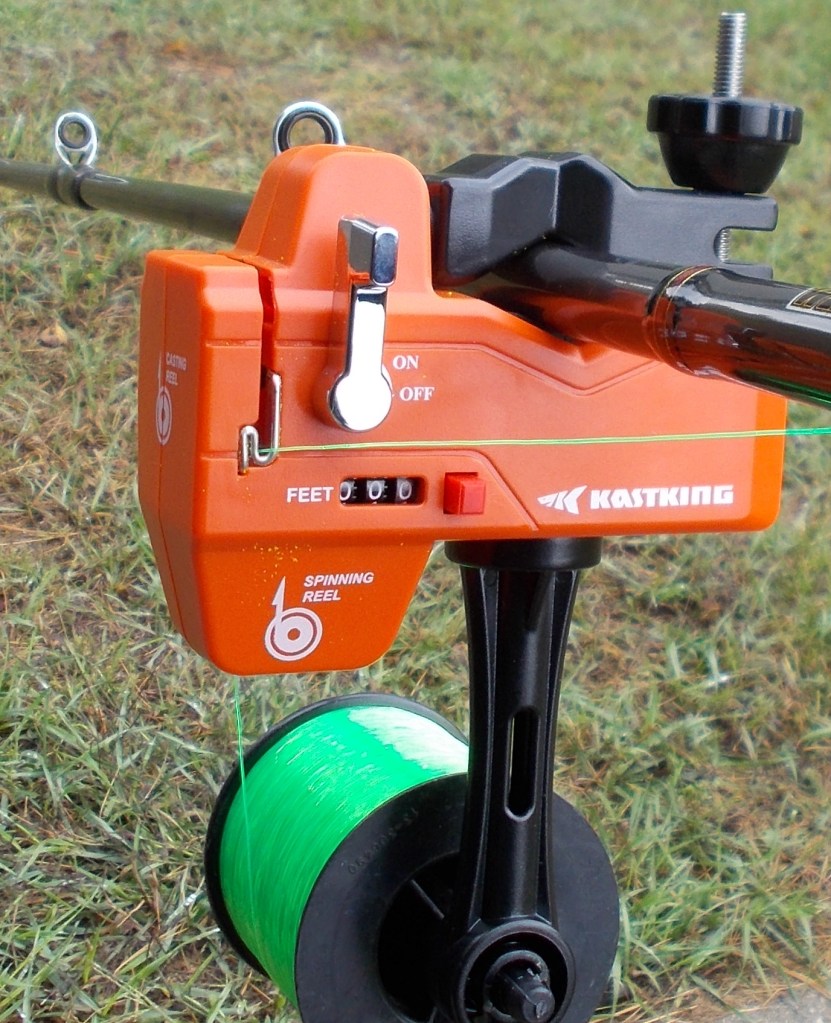
 One of the tools that will accurately measure the line spooling on or peeling off a reel is KastKing’s Kalibrate Line Spooler. (It’s designed to measure line being spooled on, but can easily be reversed to measure outgoing line.)  There are a lot of moving parts on this tool allowing it to be used for spooling with both spinning reels as well as revolving spool reels and on rods from heavy trolling to light carbon-fiber models – but it’s not complicated.

There are lots of line spooling tools available. Before I got the Kalibrate, I normally used a screwdriver punched through the arbor of a spool of line and clamped between my knees. There are a few line-counter tools that clamp onto a rod as well but the ones I’ve tried ranged from horrible to barely okay at best, for both ease of use and accuracy. The Kalibrate is the only model I’ve found that does both things and does both of them well.

The KastKing Kalibrate Tool is available at www.amazon.com or visit http://www.KastKing.com to see this tool and other KastKing products.  

WORLD CLASS RODS BY FENWICK

Fenwick Lifestyle Shoot for Pure Fishing

Reviewed by: CAPTAIN MIKE SCHOONVELD

Fenwick rods have been around almost as long as I’ve been fishing. The rod company was founded in the 1950s and sold to a new owner about the time I graduated from high school. Fenwick quickly became one of the leading innovators that changed fishing rods basically from fiberglass sticks to high tech fishing tools demanded by the increasing numbers of competitive anglers.

They were the first company to produce an all-graphite rod and for a time Fenwick captured almost half the fishing rod market in the US and Canada. During that time, they branched into fly fishing rods, rods specialized for a variety of fish and even paired their rods with a line of reels that paired perfectly with some of their rods.

Pure Fishing added Fenwick to their stable of rod and reel brands like Abu Garcia, Shakespeare, Berkley and others some time ago and there are plenty of anglers who still look to Fenwick when they are shopping for a new rod. If it’s not broken, don’t fix it, seemed to be their marketing plan.

However, over time, rod technologies changed with rod makers producing new models using lighter, tougher, more specialized materials that better met the specialized needs of modern anglers. The rod engineers at Pure Fishing turned their attention to the Fenwick line and the result was a new line of rods at last summer’s ICAST show. I’ve had the chance to fish with both the casting rod and spinning rod models. Both performed flawlessly for me. I own a World Class spinning rod which I used for a variety of species and techniques, from dock fishing for sunfish with my grand daughter to deep jigging for ciscoes in Grand Traverse Bay. Walleye, bass and lake trout have also “volunteered” to help me evaluate this new rod.

It’s extremely light, but according to Fenwick their proprietary Powerlux 500 resin (whatever that is) makes them 30 percent stronger compared to similar rods produced by other companies. The cork handle on all of the rods I’ve used were flawless, there are quality guides and I’ve not had any issue with the reel seats not gripping the reel firmly.

Whether or not you are a long-time Fenwick fan, if you are a looking for a high-end, long-lasting rod which will match up or exceed the performance of any brand on the market, give these a look at a tackle shop near you. To see the entire line-up of Fenwick World Class Rods check them out at www.purefishing.com/fenwick