PENN MARINER III (DIVER) ROD

Reviewed by: CAPT. MIKE SCHOONVELD

When I’m at the ICAST show or in tackle emporiums when I’m on away-trips to “salty” destinations, I’m often looking at a variety of saltwater gear. That’s not because I fish saltwater often enough to warrant owning a full set of ocean-fishing gear. It’s because there is a lot of stuff designed to be used in the salt that plays quite nicely in the Great Lakes. That’s what I was doing at the salty-section of the Penn booth at last year’s ICAST.

What I found was a line of rods called the “Mariner III Boat Conventional.” The display started with short little brutes-pretty much what I consider to be saltwater “boat” rods – but at the end of the display was a 9-footer, rated medium (by saltwater standards) that caught my eye. Most of the saltwater boat captains I’ve been with would have viewed a 9-footer as a pole vault stick. As a Great Lakes captain, I viewed it as a diver rod. I hefted it, wobbled it, gauged the bend and pronounced it diver-worthy.

Let’s look at a few of the details in this rod. First off, the rod is made of graphite and fiberglass. An all fiberglass rod would be heavy with a slow action, but it would be as tough as a pole vault stick. But by engineering it with both glass and graphite, the rod’s weight is reduced, it’s action is faster and it’s still plenty tough. That’s important for a diver rod since when the diver is being trolled, there’s a constant heavy strain on the rod and when a fish strikes the rod has to go from heavy strain to extreme.           

 Penn has fitted this rod with their own one-piece stainless steel Dura-Guides. Dura-Guides eliminate the need to fuse a ceramic or other type of insert to protect the frame of each guide. The extra-hard stainless is plenty durable for years of use with mono, fluoro or braided lines.

 The EVA Torque grips (another Penn exclusive) are substantial, plenty long to fit comfortably in any rod holder. The feature I’ve come to embrace is how the foregrip is triangular in cross section. That gives it a comfortable feel in hand and helps eliminate the rod from twisting when being gripped and the reel’s handle is being cranked.

 Penn Mariner IIIs are mostly available at retailers who handle saltwater tackle but you’ll find them at Amazon.com or at www.purefishing.com as well as at other online outlets at surprisingly affordable prices.
PENN FATHOM II 30LW LINECOUNTER REEL

Reviewed by: CAPT. MIKE SCHOONVELD

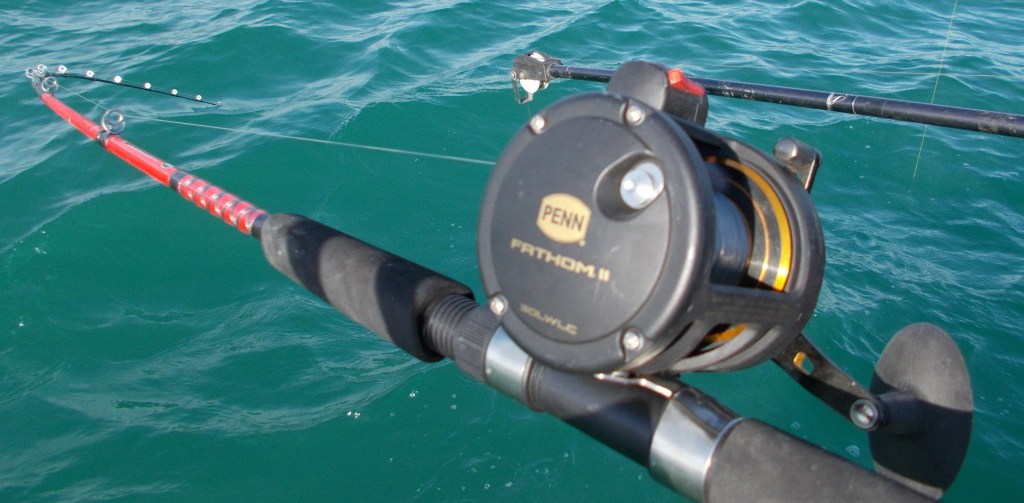
For Great Lakes salmon, steelhead and trout, using affordable rods is certainly possible, but skimping on the reel you clamp onto that rod can be a heart braker – and that’s even more important for diver reels than those used for ‘riggers or planers. Most “affordable” (spelled C-H-E-A-P) reels can’t hold up to the constant strain of pulling a full-size or magnum diver into the depths and then be able to smoothly become a fish fighting machine when a big king or an energized steelhead is at the end of the string.

 I could cut this review short by saying the Fathom II is up to both tasks. There’s more to it than that. I’ve never had a reel with a drag so sensitive. On too many reels, you can dial a drag to go from near zero to full strength in less than a half rotation of the star-wheel on the handle. That means if you need to loosen or tighten it just a bit, the star needs to only rotate a few degrees and especially, when in the middle of fighting a “big one” it’s easy to over-correct. Not so on the Fathom II. Backing off the reel from the setting I was using to near zero required 1 ½ revolutions of the star wheel.

 I like to adjust my diver reels so the drag is just holding firm as we are trolling, then give it a tiny bit more so when the fish strikes, the diver will trip and the fish can make it’s initial run on a smooth, medium drag setting. Tighten it up halfway through the battle and a bit more as most of the line is regained and the fish is pulled close to the boat.

 The handle is oversized, compared to most other reels and exceedingly comfortable to grip. With a full spool, one turn of the handle will crank on more than 30 inches of line. The clicker mechanism is solid, but not overly loud. The reel’s frame and housing is metal, not composite, so it looks, feels and is rock solid.

 I spooled-up with mono for early season fishing, then switched to braid as the fish went deeper. In early summer, when the fish headed to the depths, I respooled with 19-strand wire and switched to magnum divers to put them down to or below the thermocline. With a solid season of using this reel on every trip and catching countless fish, it’s still delivering “out of the box” performance and I have no doubt I’ll be able to say that again next year (and the next, and the next….). Check out the Fathom II at www.pennfishing.com. They are available at many retail outlets and through many online outlets including Amazon. 

RAPALA 50 LB. ANGLER MODEL SCALE

Reviewed by: CAPT. MIKE SCHOONVELD

Elsewhere in this magazine is an article about fishing scales, how they work, available models and how accurate they weigh fish. I gathered several scales to use, evaluate and test for this article and while none of them are perfect for every angler, for every fish or fishing condition, one thing did come out of my tests. I replaced the spring type, mechanical scale which had been on my boat for the past several years with the Rapala Angler Model acquired specifically for the feature story.

 I’d owned digital scales in the past and they worked well when the batteries were good. Too often, I’d pull the scale out to weigh a notable catch and found the Energizer Bunny had died. That’s why I switched to a good, mechanical model, but my tests for the feature showed my spring scale was “off” for the better part of a pound and the graduations that showed the weight were so close together that weighing to anything less than to the nearest pound was pure guesswork.

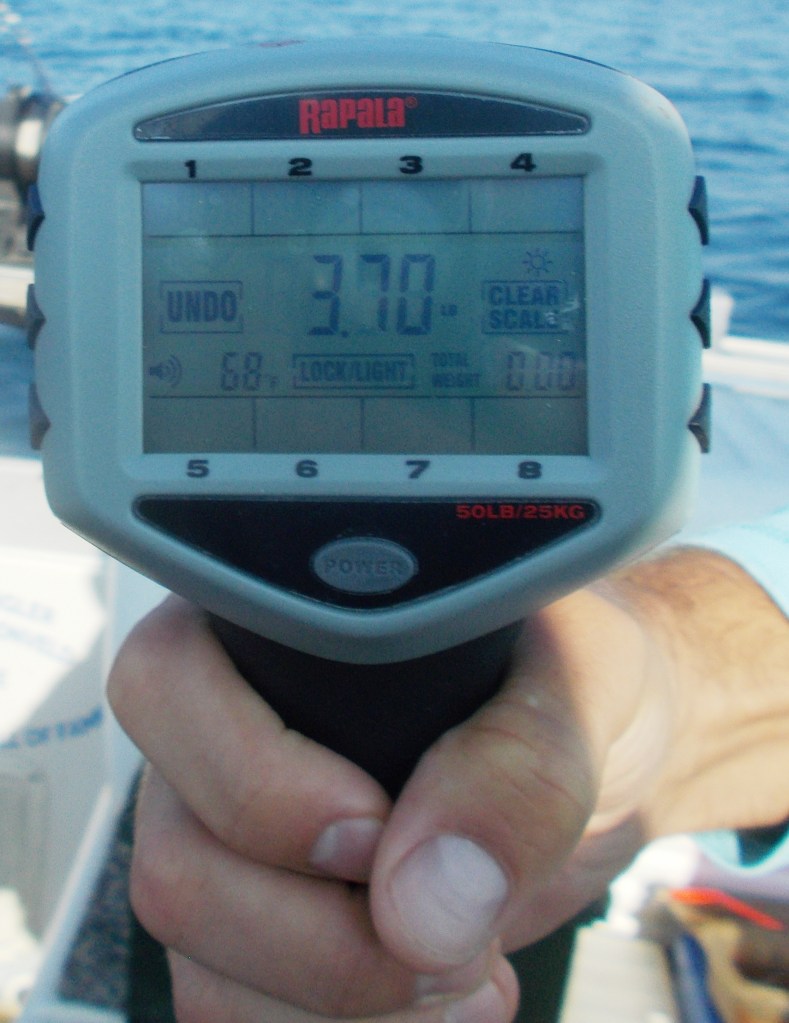
 The Rapala digital was spot-on for accuracy and was easy to read. I could have chosen one of the other digitals I tested, but several features guided my selection – most notably the scale operates on AA batteries – available anywhere. Try to find one of those square, 9Vs when you need it.

 Rapala says the two AAs will run the scale for 400 hours so expect a season’s use out of each pair. The circuitry automatically turns off the scale after a few minutes eliminating the possibility of accidentally leaving the scale in the on position from one trip to the next. Should the batteries run down, there is a back-up memory to store any weights you’ve entered and want to save.

 It will store up to eight different previously weighed fish – one for each person perhaps, or save the weights for different species as the season progresses. It will also total all the stored weights for an instant cumulative weight for tournament or other purposes.

 I don’t much use those features, but maybe I will. The kicker for me, however was instead of a simple hook to hold the fish being weighed, the scale comes with a rugged “vise-grip” style lip gripper which holds the fish securely and is less injurious to the fish being weighed.

 Rapala Touch Screen Angler Model scales are widely available at retail or online merchandizers or order them straight from Rapala at: www.rapala.com

SRD20 SOAP, WAX AND PROTECTANT

Reviewed by: CAPT. MIKE SCHOONVELD

When I’m getting my boat out of winter storage and lake ready in late winter or early spring, the last thing I want to do is take a look at it and tell myself it needs a wash and wax. If it was dull and dirty when winterized, it will be that way when the spring melt opens up the lakes and harbors. If it was clean and shiny when laid up in the fall, even if it was just fitted with a cover, it won’t look disturbingly bad when pulled out of storage. Spend the time getting the interior stocked up with rods, lures and all the rest to make that first of the season outing a success.

 It will be easier than ever to button down my boat all clean and shiny this year since I’ve started using SRD20 products during the summer and fall fishing season. SRD20 makes three products that make it easy called: Pink Soap, Waterless Wash and Wax and Graphene Spray Protectant. I call them simply wash, wax and wipe.

 The marina where I often launch in the fall opens into a river that is often almost stagnant and filled with algae and stained water by the time the salmon are spawning upstream. Two or three late season trips puts a scum ring around the bottom of the hull that looks like the boat has been soaking in the marina all summer. I’ve used some highly acidic products that does a good job of knocking it off, but it won’t work on aluminum boats and it takes longer to rinse the boat and trailer than to do the actual cleaning. I doubt that stuff is good for the driveway or wherever rinsewater it runs off.

 The SRD20 pink soap is pH balanced and environmentally safe. Use it in the marina if you wish. A couple of ounces in a five gallon bucket is enough to clean most boats. Spray in the water and stir it well to produce a high-suds and then swab the boat. It’s easy on existing wax, but you can see the white suds turn gray as it drips down the boat’s side and picks up dirt. A bit of scrubbing and a quick rinse and the hull is clean.

 Next step is Waterless Wash and Wax. Spray on about six to ten square feet, rub it in with a microfiber cloth or an old towel, then buff it dry. The result is a ceramic-like shiny coating of wax that protects the paint, chrome or gelcoat. No power-buffers needed.

 I use it inside and out, as needed. It doesn’t need much, thanks to the Graphene protectant. I use it as a touch up and regularly apply it to areas like the dashboard and where people climb in and out of the boat. Graphene is diamond-shiny and diamond hard, microscopically thin coating. Just spray it on and wipe it off to make the surface gleam brighter than new and to protect it better than wax.

 The motto on each bottle of SRD20 products is, “It shouldn’t be hard work.” That nails it. The soap does much of the work to clean your boat. I could see the suds go from white to gray as it ran down the hull. The Waterless Wash and Wax gets any residual dirt and tar-spots from trailering on the highway. Wipe on the Graphene Spray Protectant whenever a place, inside or outside needs a touch up.  Wash, wax and wipe as needed through the season and your boat will be ready for lay-up in the off season and ready to go all season, next year.

 Check out the products more thoroughly at ww.SRD20.com. These American made products are available at Amazon.com.

GILL FITZROY JACKET 

Reviewed by: CAPT. MIKE SCHOONVELD

I love the fall and early winter weather in the Great Lakes. That includes the brisk, frosty mornings that often gives way to tee-shirt warmth in the afternoon. Obviously, seasoned anglers know the key to this is layering but it doesn’t have to be a complicated system as is needed in “real” winter on the ice, in deer stands or other cold weather outings. The Fitzroy Jacket from Gill can be your go-to top layer on those Indian summer mornings (and just as useful on middle-spring days.) 

My go-to outer layer for the past couple of seasons has been my Gill Winter Jacket and Bibs, which are both heavily insulated and fully waterproof, but the winter-wear is overkill on those days when the frosty morning fades quickly to comfortable temps as soon as the sun brightens the morning sky.   

The Fitzroy jacket is very lightweight and packable for when it needs to be stowed, but easily fluffs to a warm, well insulated, good looking coat and hood. For me (so far) the hood is more for style since I’ve never needed it. 

Fishing can be a wet sport even on a sunny day, either from errant spray when the boat is under power or when dealing with wet tackle or flopping fish. The Fitzroy will handle spray and wet fish, but it’s a poor choice for a rainy day. It has the same Durable Water Repellant finish on the outer layer that’s the first line of water resistance on all of the best totally waterproof rainwear, but that makes it water resistant, not waterproof. A bit of spray will just bead up and run off or evaporate, a soaking rain will, eventually soak in.  

I love the three zip-close pockets – two on the sides for hands, for stowing car keys or other items and one on the upper chest where I often insert my cell phone or camera. The sturdy zips open and close easily and keeps things secure and available.  

One observation I’ve noted on this and other Gill products is their sizing. Gill products are designed and engineered in the United Kingdom and sold worldwide where many people are smaller than many of us in the Great Lakes. I choose garments one size larger than I’d normally buy from American producers.  

If environmental responsibility is important to you, both the Fitzroy’s shell and insulation is made from recycled materials.  

Want to try Gill yourself? The Fitzroy Jacket (and other Gill products) are widely available or order them online straight from the Gill website with a discount:

At checkout, use the discount code- CAPTMIKE10 – for 10% off your order at gillfishing.com

H20X CRANKBAITS

Reviewed by: CAPT. MIKE SCHOONVELD               

No doubt you’ve seen the price of crankbaits (and other lures) skyrocketing faster than the price of eggs and bacon during the pandemic. Crankbaits used to seem expensive when priced at five or six bucks. Now, they are often two or three times more, these days. Maybe that’s okay with your budget, but it’s not with mine and that’s what attracted me to the H20X cranks at the Academy Sports store that opened near me in Lafayette, IN last spring – the price.

Often shopping by price alone is a poor choice when it comes to fishing equipment. Cheapskates are setting themselves up for failure. I also have observed that “store-brand” knock-offs of big brand lures isn’t the same as buying a generic equivalent for other products. Far from it.

Often, just looking at the store-brand crankbaits tells the story. The molded bodies are rough, the paint or finish is notably inferior and the hooks and hardware on the lures are noticeably cheap. You know they won’t hold up, you know they won’t have the proper action and you know after a few trips you’ll be wishing you’d never bought them at any price.

I didn’t notice any of the above with the H20X (Academy Sports’ store brand) hanging on the racks. I did notice the retro price tags marked on the boxes.

Academy Sports is a chain of big-box sporting goods stores (think Bass Pro or Dick’s Sporting Goods), born in Texas and now found in states across the southeastern U.S.A.  The Lafayette store was the first one opened in a Great Lakes state. Now, they are in Indiana and Illinois. (Academy does offer online shopping, however, so even if you fish Lake Superior, H20X products are just a few clicks and a truck ride from your door.)

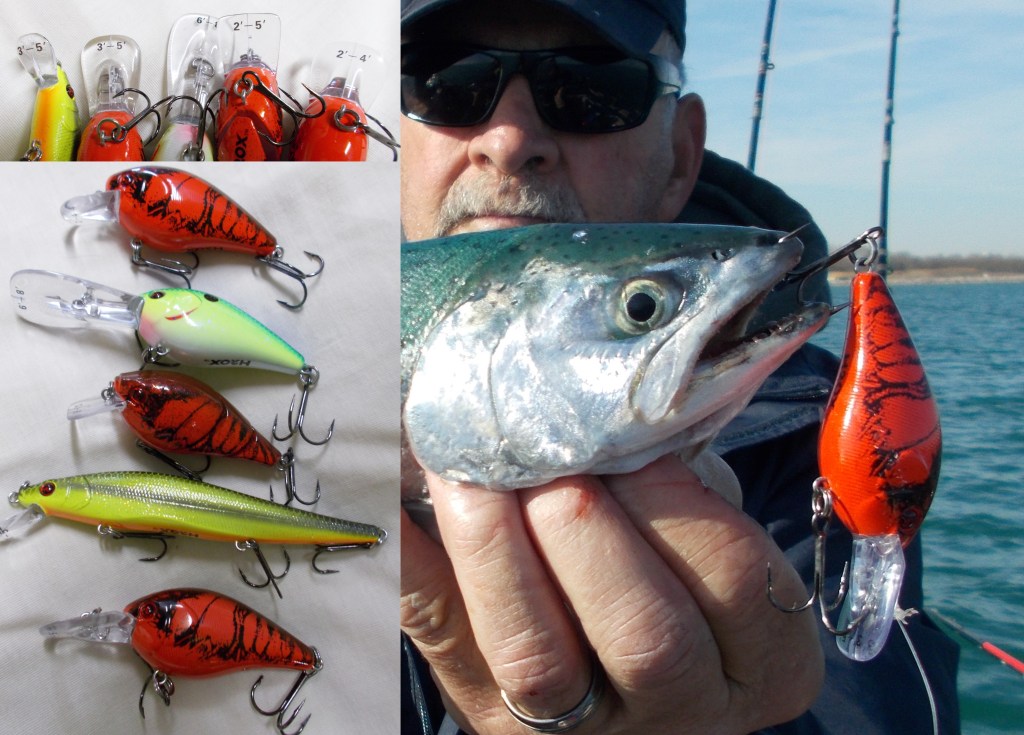
Naturally, the H20X cranks were designed with bass fishing in mind and the colors available reflect that. However, many crankbaits used by salmon, steelhead and walleye anglers weren’t designed specifically for those species. They were probably designed for bass guys and us Great Lakes guys learned they were equally effective on salmon or trout.

For the first two or three months of the open water season in southern Lake Michigan, crankbaits are the top producers and some Great Lakes walleye guys use cranks all season long.  So I selected an assortment of H20X cranks and tied them on last spring. Plenty of cohos and browns considered them edible and Lake Erie walleyes gave them a “fins-up” as well.