SCENTED FLICKER SHADS

Reviewed by: CAPT. MIKE SCHOONVELD

If you are a walleye angler, a coho angler, if you fish for brown trout in the spring, if you cast crankbaits for bass; goodness, if you have any crankbaits in your tackle box, chances are you have one or more Berkley Flicker Shads. Why not? They are among the most affordable of “brand name” cranks, they come in a million colors, they perfectly mimic two of the most important baitfish in the Great Lakes – alewives and shad. What more could one want? 

 “Easy answer,” said the lure designers at Berkley, “Scent.”

Many anglers are skeptical of scent products. I know I am. Then when I switch from trolling the lakes to casting for bass or other fish using plastics, I’ll grab a bag of Berkley Gulp twister tails, worms, minnow or other Gulp-scented soft body.

I remember an off the record comment made by a professional bass tournament angler when Gulp first came out. “It ought to be prohibited in tournaments. It’s like allowing live bait.”

 So when the “Gulp-chef” at Berkley Fishing came up with a Gulp Gel, I took notice. And when I saw some of the prototype Flicker Shads at the Berkley booth at last summer’s ICAST, I took double notice.

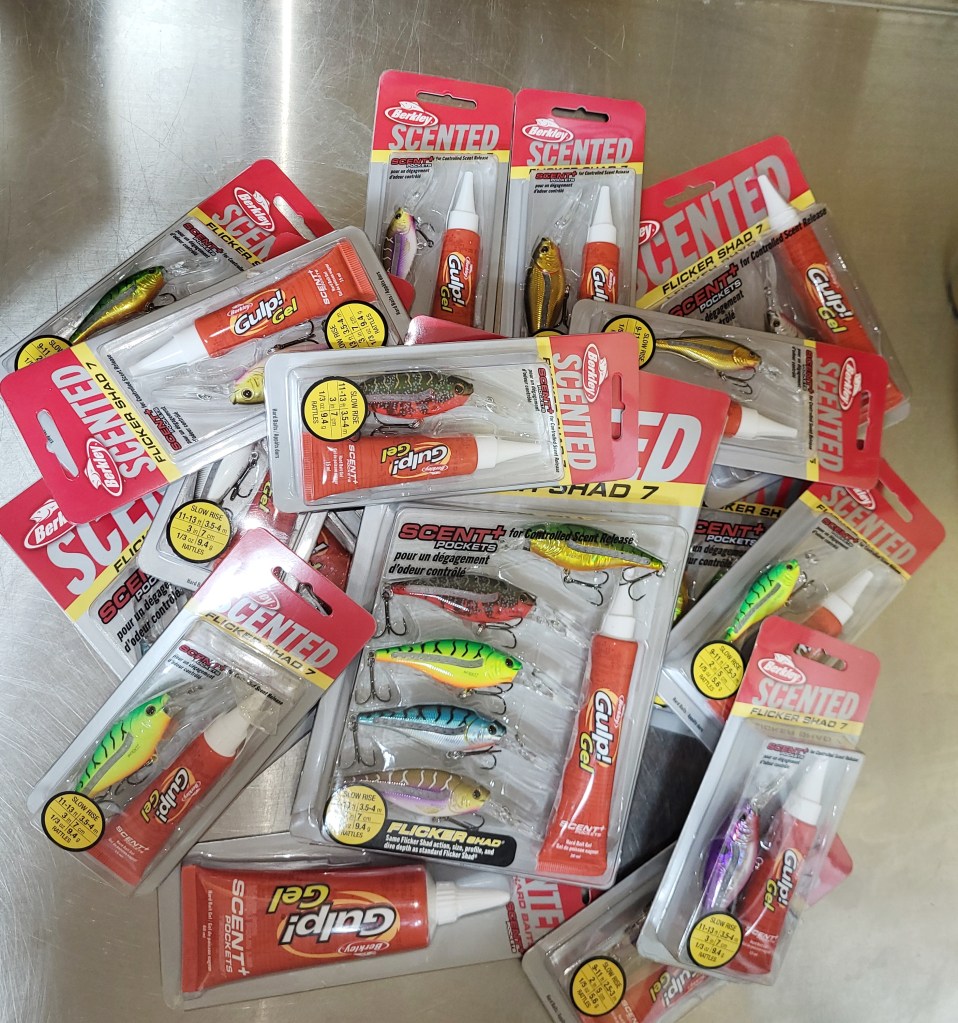
 The “Flicker Shad designers” made their most popular 2-inch and 2 ¾-inch Flicker Shads with a special strip of scent pockets on each side and another on the lure’s bottom to hold and disperse the Gulp Gel as the lure goes through the water. Put a dab of the gel on your finger, then smear it down the side or along the bottom enough to fill the tiny cavities in the scent-strips and then just fish the lure as you would any regular Flicker Shad. The scent strips and the gel doesn’t impede the action or alter the diving depth at all.

I’ve not heard any professionals claiming “it oughta be outlawed,” and it’s not the nearly miraculous difference Gulp made in soft plastics. That’s probably because the difference in how most soft plastics are fished compared to crankbaits. Especially on the troll, a lot of the strikes are “impulse-bites,” where the fish spots the lure and strikes immediately before it can get away.

That’s most days. Especially with walleyes in early spring or in post-frontal conditions that are in a neutral or negative mood, a bit of the scent can turn a snub into a nibble. When a nibble occurs, the Fusion 19 hooks latch on and it’s “fish on.”  It can be the difference between no bites and some bites or even some bites to a fast bite.

At this writing, I’ve used the Scented Flickers more for salmon than for walleye and cohos are probably more impulsive than walleyes. The best test I ran was to put a Fire Tiger regular Flicker on one side of the boat and a Fire Tiger Scented Flicker on the other. Fire Tiger is an okay color, some days, for cohos. Other days, almost any hot red/orange colored crankbait will beat it.  End of the test – regular Flicker Shad zero – Scented Flicker Shad three. This was on a day when hot red/orange cranks were cookin’!

 I’m not saying the Scented Flicker Shads will be a game changer, but I’m confident on some days they’ll at least put you in the game.  They don’t come in a million colors, but (barring hot red/orange) they come in 10 fish-catching patterns and are available in single packs, three and five packs. Each lure or packet comes with a tube of Gulp Gel. Check them all or order them at www.berkley-fishing.com. Look for them at your favorite tackle emporium.

BERKLEY GULP GEL

Reviewed by: CAPT. MIKE SCHOONVELD

Each Scented Flicker Shad or pack comes with a tube of Gulp Gel so is the gel only effective when used with the special Flicker Shads? Of course not. The scent strips helps hold the scent, but I slathered Gulp Gel some on slick-sided crankbaits and fished some of them as much as an hour. When I reeled them in, I could still feel the gel on the sides of the bait. I put Gulp Gel on a gauze pad and stuffed it inside a Yakima SpinFish and absolutely crushed Lake Superior lake trout with the lure.

 I’ve used other scent products that were like smearing axle grease on the lures. After an hour of trolling, the Gulp Gel was still present, but far less than when I smeared it on. I can only assume it still smelled okay to the fish, perhaps a bit subdued. It’s not water soluble, but it’s not axle grease, either.

 Did it work? As with most scent products, it’s hard to quantify the results, but it gave me more confidence and I’m convinced the scent helped a little or a lot each day I tried it. I put a small spritzer bottle of dish detergent and water on the boat to clean the lures before or after using. John Procnow, “the Gulp guy at Berkley Fishing” says the product won’t degrade over time, but I’m of the “fresh is best” philosophy. 

In cold weather, keep the tube of Gulp Gel in an inside pocket. When the temps are in the 30s or low 40s, it gets hard to squeeze out of the tube.  Again, available at www.berkley-fishing.com or at a variety of tackle retailers. 

ANGLER AID FOR BODIES AND BOATS

Reviewed by: CAPT. MIKE SCHOONVELD

First Aid kits aren’t required equipment on boats. Neither are tool kits. But common sense dictates having one of each. Some first aid kits are overkill. I’m not planning to do open heart surgery. I want to be able to do a quick patch job on minor dings and scratches.

Likewise, though I do about 97% of the mechanical work on my boat, about 97% of that work is done at home where I have more gear than Tim the Tool Man. That other three percent are minor problems that can be handled with just a few tools.

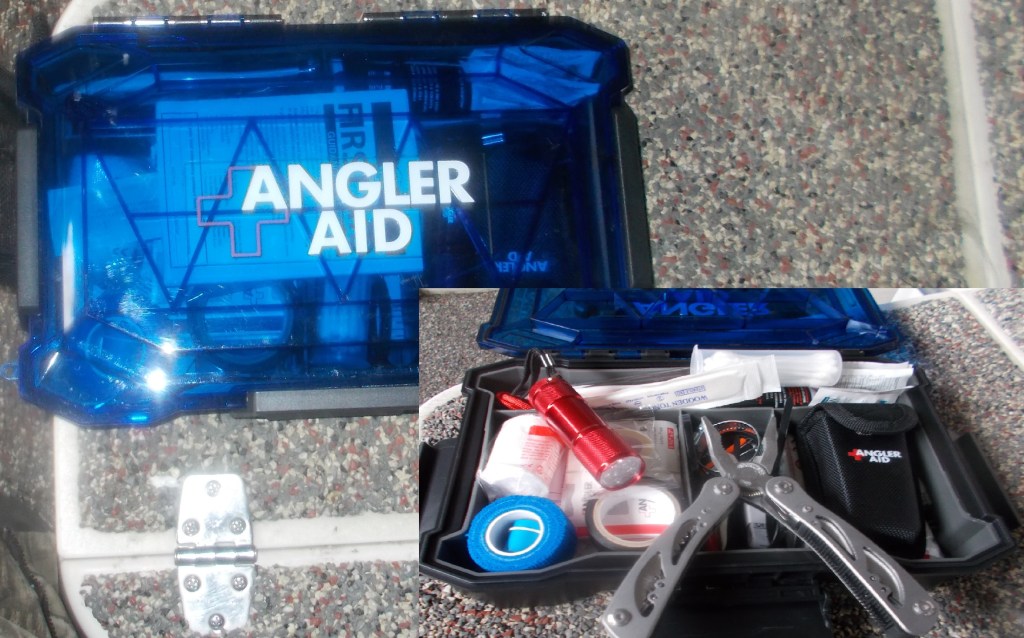
That must be the same mindset the people who came up with Angler Aid kits. These waterproof containers have tools and supplies to perform first aid on both yourself or your passengers as well as tools and supplies to make minor repairs to keep your mechanized gear going. 

They have three sizes – a compact version, a medium size and their large has enough stuff to overhaul an engine or perform an appendectomy. For my use, the medium size, called the Angler Aid Safety Kit made the most sense – both from the size of the kit to fit the storage area on my boat as well as the 88 items contained inside the tough, waterproof box. 

Not only does it have the usual bandaids, gauze, antiseptic, cotton swabs and both adhesive and sports tape, it has electrical tape, a multi-tool, assorted fuses, hose clamps, a bright LED flashlight and much, much more.  Most “body or boat” problems that can be treated or fixed while underway can be handled with an Angler Aid Safety Kit. If you (or your boat) needs to upgrade so the emergency supplies common sense dictates having in your boat or car, check out all three sizes at http://www.angleraid.com or in retail outlets.     

EYE FISH SPINNER HARNESSES

Reviewed by: Capt. Mike Schoonveld

I was fishing on Eastern Lake Erie with Capt. T.J. Yetzer out of Irving, New York (Reel Time Charters) last August and in general conversation he mentioned he buys 10,000 Gamakatsu hooks each year. “Whoa, back-up!” I said. I buy a lot of hooks each year, but I may not have bought 10,000 of them in my whole life. (Though I might be close.)

“I work for Eye-Fish Premium Fishing Tackle as a side line to my charter fishing business. I tie up the Eye-Fish Spinner Harnesses and we use only high-quality Gamakatsu hooks on each harness. Eye-Fish Harnesses are all I use on my boat – and not just because I work for them. They are the best!”

Personally, I don’ t often use worm harnesses when I’m walleye fishing on my own boat, but I do know there’s a quality difference with different brands. That quality pays off whether it’s in the hooks, the line, the beads or the blades. T.J. opened a compartment and handed me an assortment of still-in-the-package Eye-Fish harnesses.

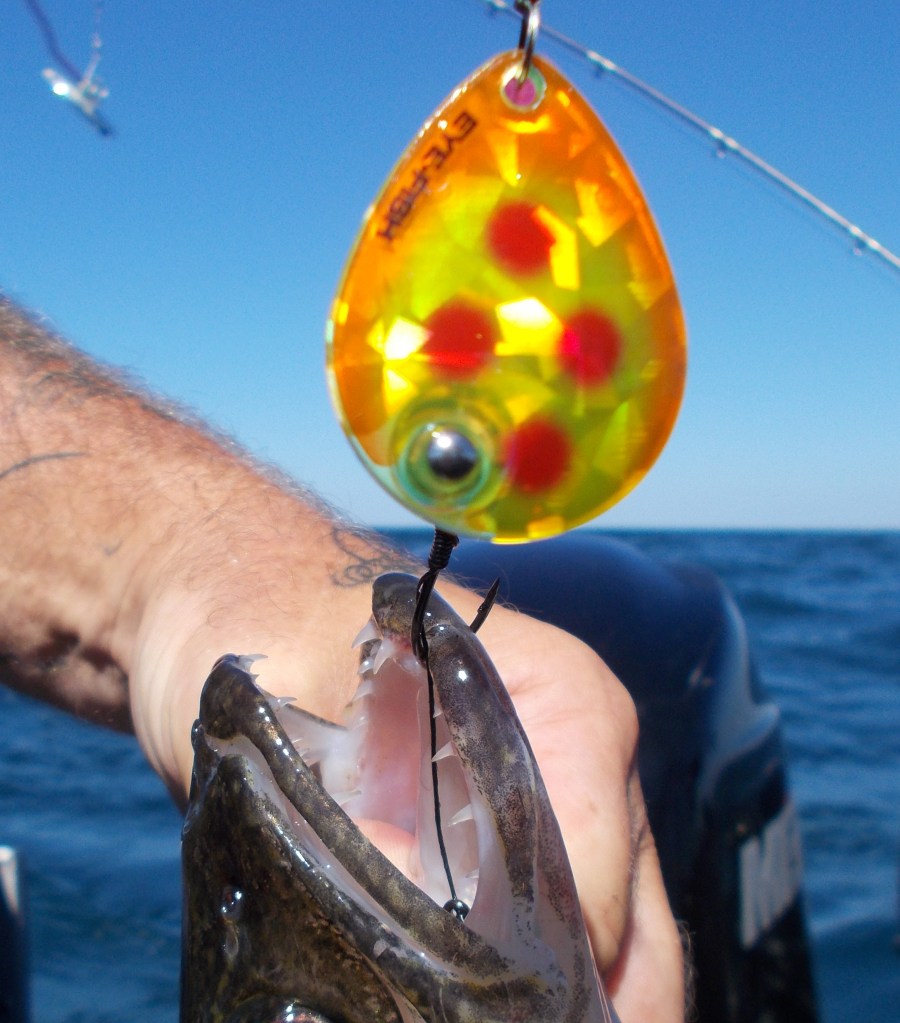
The one thing that popped out at first glance is the realistic fish eye located on each spinner blade. Obviously, these spinners weren’t just bought in bulk from one of the few wholesalers most spinner and spinner harness lure companies use on their products. I asked about them.

“Eye-Fish makes all their own blades, each with their ‘signature’ eye. Of course we paint and coat each of the blades as well.  You may think the eye on each blade is just there to make them look more appealing to the fish or to the fishermen shopping for new harnesses.”  “I’m convinced,” said Capt. Yetzer “The eyes on the blades do attract more fish than if the blades didn’t have them, but they aren’t just there for show. Actually, when we developed these eyes, we attached them at various places on the blades. Placement on the willow leaf blades we made for higher speed trolling wasn’t so critical, but we noticed on the Colorado blades, the location on the eye, made big difference. At normal, slow speeds 1.2 to 1.7 mph, the Colorado blade harnesses work great, but hit the throttle and they’ll keep spinning attractively and keep catching fish up to a mile per hour faster! I don’t know of any other Colorado blade harness that will perform well at those speeds.”  We needed that on the day I fished with him since steep waves on our downwind troll jumped our trolling speed from 1.2 to nearly 3 mph as we rocked, rolled and caught fish on them.

Eye-Fish Spinner Harnesses are available in many Eastern Basin tackle shops, perhaps not in all colors and styles. Check out all the options and purchase them online at www.eye-fish.com

They come in dozens of colors, with seven different bottom or back colors – blue, copper, gold, gold crush, raspberry, shattered glass or silver on various models. All are available as either single or double rigs with either Colorado or willow leaf blades.

BAFFIN ENDURO MEN’S BOOT

Reviewed by: CAPT. MIKE SCHOONVELD

There was a tip from a reader several years ago for the Basics and Beyond column in Great Lakes Angler magazine about hopping into a pair of muck boots when he loaded his boat at the ramp after each fishing trip. The alternative, he said was either wet feet or tip-toeing on the bumper of his truck and onto the tongue of his trailer.

 Great idea and like the tipster, I took it to heart since I walked the bumper and hitch tightrope each time I loaded my boat. I bought an inexpensive pair at a farm store and they worked well for their intended use – for a couple of years. One day last fall I was loading my boat and I got a wet foot. The cheapo boots had a weather check from very limited exposure to the sun. I only wore them about 10 minutes each time I loaded my boat. More likely the rubber broke down just from baking in a hot vehicle while I was out on the lake.

 Did I mention I only used them for a few minutes each day I went fishing?  That’s because the fit and feel of the boots didn’t suggest I wanted to use them for more “normal” uses, like hunting, gardening, shoveling snow or just mucking around in muddy places and conditions.

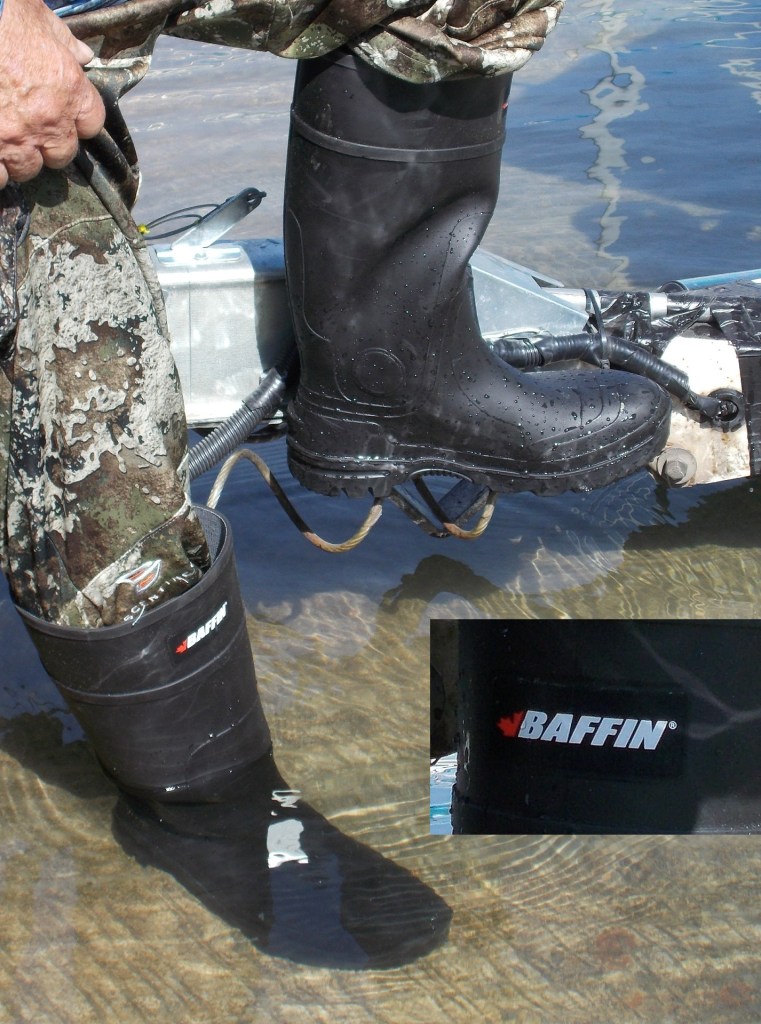
 I replaced them with a Canadian made pair from Baffin Boots, a company that prides itself for putting quality first. When I slid my feet into the Enduros it was like slipping into a familiar pair of comfortable work boots. It has an interior that almost feels sculpted and Baffin’s unique GelFlex anti-fatigue material on the insole for foot comfort. I could see wearing these boots all day when necessary.

 They are 16 inches tall – plenty of depth on every ramp where I’ve used them with several inches to spare. The bottom of the outsole has a rugged pattern giving a firm footing whether it was slick winter conditions or algae-slick boat ramps in the summer.

 If you are looking for a muck boot, for work, boat launching or just all around use in “mucky” conditions, consider the Enduros from Baffin.  Check them out at www.baffin.com. They are available at some retailers and many online sellers including Amazon.com (Women’s versions are available, as well.)